
Business Signs in Toowoomba: A Practical Guide to Shop Fronts, Pylons and Vehicle Signage
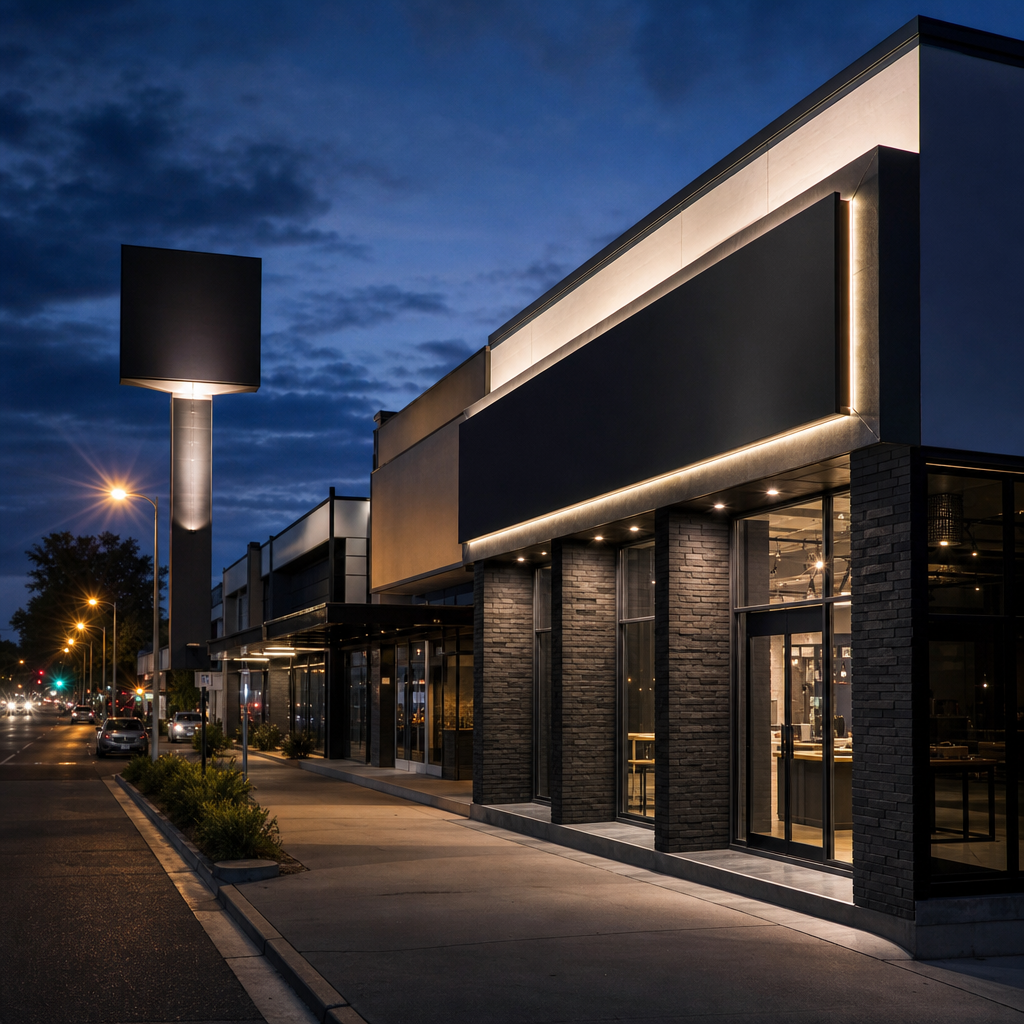
Business signs in Toowoomba need to handle harsh sun exposure, strong wind on the range, and a mix of heritage CBD frontages and wide-set highway sites. The right sign depends on location: fascia panels and 3D letters suit Ruthven and Margaret Street shop fronts, pylon signs suit set-back sites, and heavy-duty vehicle wraps suit mobile advertising across the wider Darling Downs.
Toowoomba is Queensland's largest inland city and a genuine regional hub for agriculture, health, education and freight. That mix shows up in the signage too. A specialist medical clinic on James Street has completely different needs to a servo on the Warrego Highway or a boutique fitting out inside Grand Central. Getting the sign right means matching the fabrication method, the material and the lighting to the site, not just picking something off a template.
This guide walks through the main sign types Toowoomba businesses ask for, what suits which kind of site, and what the approvals and install process actually looks like from first measure to final fix. It's written from the fabricator's side of the bench, not a reseller's.
Key Takeaways
- Toowoomba's climate and terrain, strong wind on the range, intense UV, and cold snaps, mean signage needs to be specified differently to coastal Queensland jobs.
- CBD frontages on Ruthven Street, Margaret Street and around Grand Central often involve heritage building constraints that affect what can be fixed to a facade.
- Pylon and monument signs suit set-back sites, drive-throughs and multi-tenancy complexes common in Wilsonton, Torrington and Charlton, and along the Warrego and New England Highways.
- Illuminated and projecting signs can require development approval through Toowoomba Regional Council, and that process should be factored into your timeline from day one.
- Vehicle wraps turn a work fleet into a rolling billboard across the Darling Downs, which matters in a freight and agriculture-heavy region where vehicles cover serious distance.
- In-house capability, design, laser cutting, CNC routing, printing and installation, means fewer handoffs, tighter quality control and one point of accountability.
Ready to make your business impossible to miss?
Design, manufacture and installation, all under one roof in Warana.
Get a Free QuoteSummary Table: Sign Types for Toowoomba Businesses
| Sign Type | Best Suited To | Typical Toowoomba Locations | Investment Level | Key Consideration |
|---|---|---|---|---|
| Fascia and shop front signs | Retail, hospitality, professional services | Ruthven Street, Margaret Street, Grand Central | Entry to mid | Heritage facade rules may restrict fixing method |
| Pylon and monument signs | Set-back sites, drive-throughs, multi-tenancy | Wilsonton, Torrington, Charlton, Warrego and New England Highways | Mid to premium | Wind loading and council approval for illumination |
| Neon and LED feature signs | Hospitality, gyms, retail interiors | CBD dining strips, fitness precincts | Entry to mid | Best as interior features, not exterior UV exposure |
| Vehicle wraps and fleet graphics | Trades, freight, agriculture, mobile services | Darling Downs-wide | Entry to mid per vehicle | Design needs to read at speed on the highway |
| Laser cut and CNC signage | Reception walls, directories, architectural detail | Corporate offices, health and education precincts | Mid to premium | Material choice affects finish and longevity |
Why Toowoomba Signage Has Its Own Considerations
Toowoomba signage has to deal with three things at once: heritage constraints in the CBD, exposed highway-facing sites, and a climate that's genuinely harsher than coastal Queensland. A sign specified for Brisbane or the Gold Coast doesn't automatically hold up on the range, where wind and UV punish a poorly built sign far faster.
Toowoomba sits high on the Great Dividing Range, which gives it cooler averages and stronger, more consistent wind than most of coastal Queensland. That matters structurally. A pylon sign on a set-back site along the Warrego Highway carries real wind load, and the footing, frame and panel fixings all need to be engineered for it, not just for looks.
The CBD brings a different set of problems. Ruthven Street, Margaret Street and the Grand Central precinct include heritage-listed and character buildings where facade treatments, fixing points and even colour can be constrained by the local planning scheme. A fascia sign that would be a simple job elsewhere might need a lighter fixing method or a different mounting approach to protect the building fabric.
Toowoomba's role as a regional hub adds another layer. It services agriculture, health, education and freight for the whole Darling Downs, which means a huge range of sign briefs: agribusiness depots at Charlton, allied health clinics near the hospital precinct, freight operators using the Warrego and New England Highways, and retail chains opening in Grand Central. Each of those briefs needs a different sign strategy, not a one-size template.
Shop Front Signs: Fascia, 3D Letters and Illumination
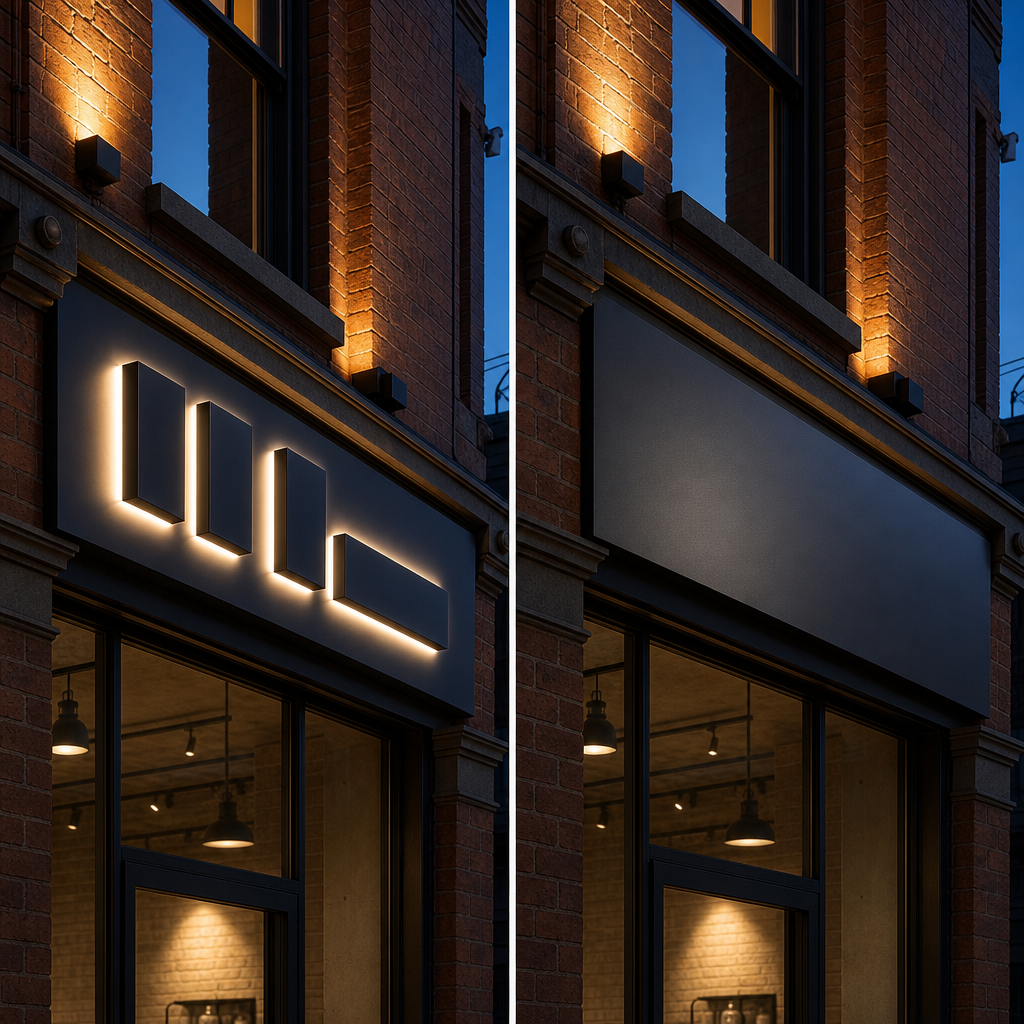
A shop front sign in Toowoomba's CBD generally means a fascia panel, acrylic or metal 3D letters, or a combination of both, chosen to suit the building and whether it needs to read at night. The right option depends on the frontage type, council rules for the precinct, and whether the site gets direct sun exposure that will fade cheaper materials.
Fascia panels are the workhorse of Ruthven Street and Margaret Street retail strips. A well-made panel, properly substrated and printed or vinyl-applied, gives strong brand presence without heavy engineering. For a heritage frontage, a lighter fixing method that doesn't damage original brickwork or render is usually the better call.
3D letters, cut from acrylic or metal, lift a shop front from flat to dimensional. Acrylic letters work well for daytime presence and can be face- or halo-lit for evening trade. Metal letters, laser cut or CNC routed from aluminium or stainless steel, suit a more premium brand look and hold up better under sustained UV exposure than lower-grade acrylics.
Illuminated versus non-illuminated comes down to trading hours and council rules. A cafe trading into the evening around Grand Central benefits from illumination. A professional services tenancy with daytime-only hours may not need it, and skipping illumination also sidesteps a development approval trigger in some cases.
Pylon and Monument Signs for Set-Back and Multi-Tenancy Sites
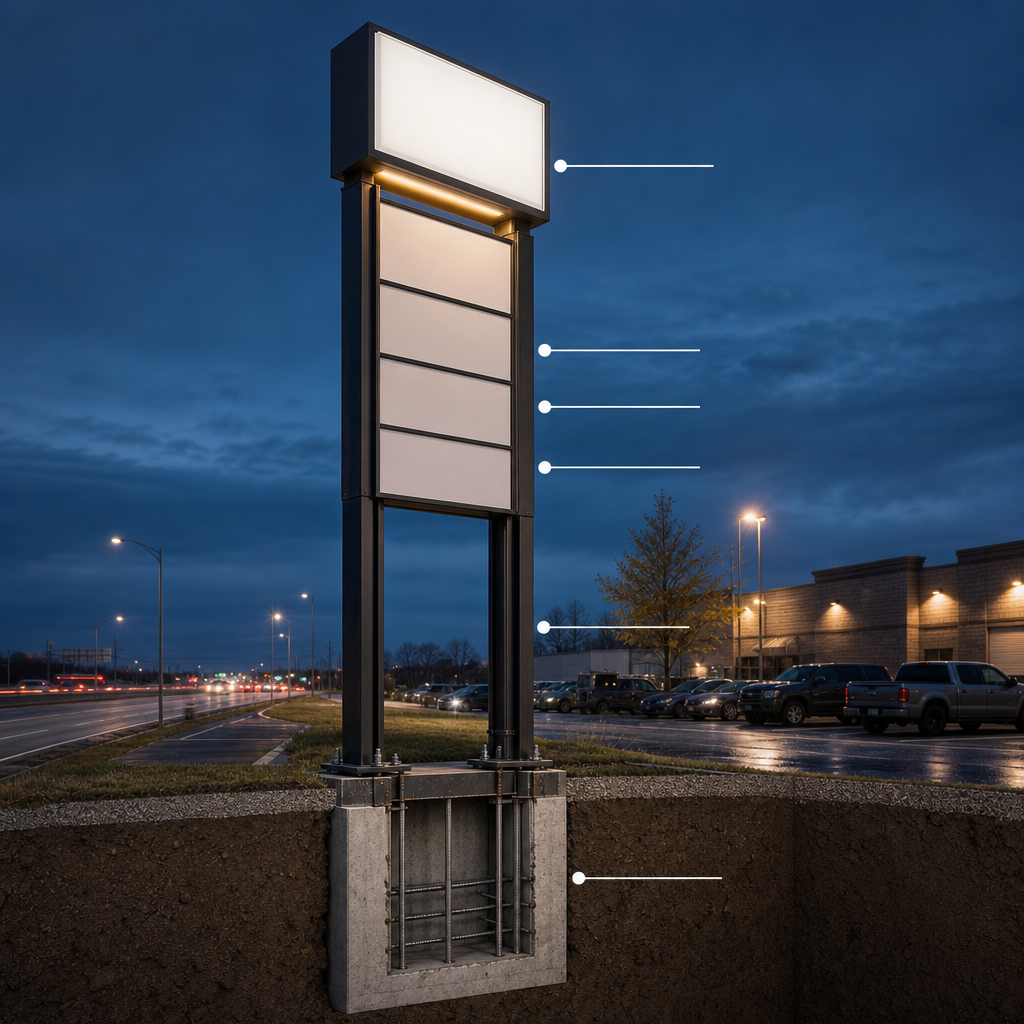
Pylon and monument signs solve the problem of a business sitting back from the road, which is common at Wilsonton, Torrington and Charlton industrial estates and along the Warrego and New England Highways. A pylon sign puts identity at eye level for passing traffic when the building itself is too far from the kerb to do the job.
Drive-through venues, service stations and multi-tenancy complexes rely on pylons and monuments because a single building-mounted sign can't represent every tenant or catch highway speed traffic. A tenancy directory on a pylon lets a shopping centre or business park list multiple businesses on one structure, which is common around the light industrial estates on Toowoomba's western and northern fringes.
Wind loading is the engineering issue that separates a pylon sign built to last from one that fails in a storm. Structures need to be designed to relevant Australian wind loading standards for the specific site, and footings sized for the local soil and exposure. This is not a place to cut corners on a highway-facing structure where a failure is both a safety issue and a liability issue.
Monument signs, lower profile and often masonry or metal clad, suit sites where council or a body corporate wants a more grounded, less visually dominant structure. They're common at health, education and corporate precincts where a tall pylon would look out of place.
Neon and LED Feature Signs for Hospitality, Gyms and Retail
Neon and LED feature signs work best as interior statements for hospitality venues, gyms and retail fitouts, where they build atmosphere and give customers a photo moment, rather than as exterior signage exposed to Toowoomba's UV and temperature swings. The tech has moved from glass neon to flexible LED neon, which is more durable and easier to maintain.
A bar or cafe in the CBD dining strip might use a custom LED neon script on a feature wall to reinforce brand personality inside the venue. Gyms use bold LED lettering and icon signs to energise a training floor. Boutique retail uses them as a backdrop for social content, which matters when a lot of local discovery now happens through Instagram and TikTok before a customer ever walks in.
Exterior use is possible but needs a different specification. Toowoomba's cold snaps and strong wind mean any exterior neon or LED needs weatherproof housing and secure fixing, and it's worth checking whether the sign is a projecting or illuminated element that triggers a council approval requirement before committing to a design.
Vehicle Wraps and Fleet Graphics: Mobile Advertising Across the Downs
Vehicle wraps and fleet graphics turn a work vehicle into a moving billboard, which matters in a region built around agriculture, freight and trades where vehicles clock up serious kilometres across the Darling Downs. A wrapped ute or truck advertises a business at every servo, job site and highway stretch it travels, at no ongoing media cost after the initial wrap.
Full wraps suit businesses wanting maximum brand presence, particularly freight and agribusiness operators running along the Warrego and New England Highways where a vehicle might be seen by the same commuters and truckies repeatedly. Partial wraps and simple decal packages suit trades and service businesses on tighter budgets who still want clear signage on the doors and tailgate.
Design for a vehicle wrap needs to read at speed, which is a different brief to a shop front. Bold logo placement, high contrast and minimal small text matter more on a vehicle than on a static sign a customer can stand in front of and read slowly.
Laser Cut and CNC Signage for Reception Walls and Wayfinding
Laser cut and CNC signage suit reception walls, directories and architectural detail where a business wants a premium, dimensional finish rather than a flat printed panel. Laser cutting gives fine detail and clean edges in acrylic, timber and thin metal, while CNC routing handles heavier material and larger scale letterforms and panels.
Corporate offices, health precincts and education campuses around Toowoomba often want a reception feature that reflects brand identity in a tactile, three-dimensional way, built to last well beyond a standard vinyl application. A CNC-routed logo panel or a laser cut directory board gives that permanence.
Having laser cutting and CNC routing in-house, rather than outsourced, is what lets a fabricator control tolerances and turnaround on this kind of detail work. It also means design files go straight from the design proof to the cutting bed without a third party in between.
Approvals, Site Survey, Fabrication and Install: What the Process Looks Like
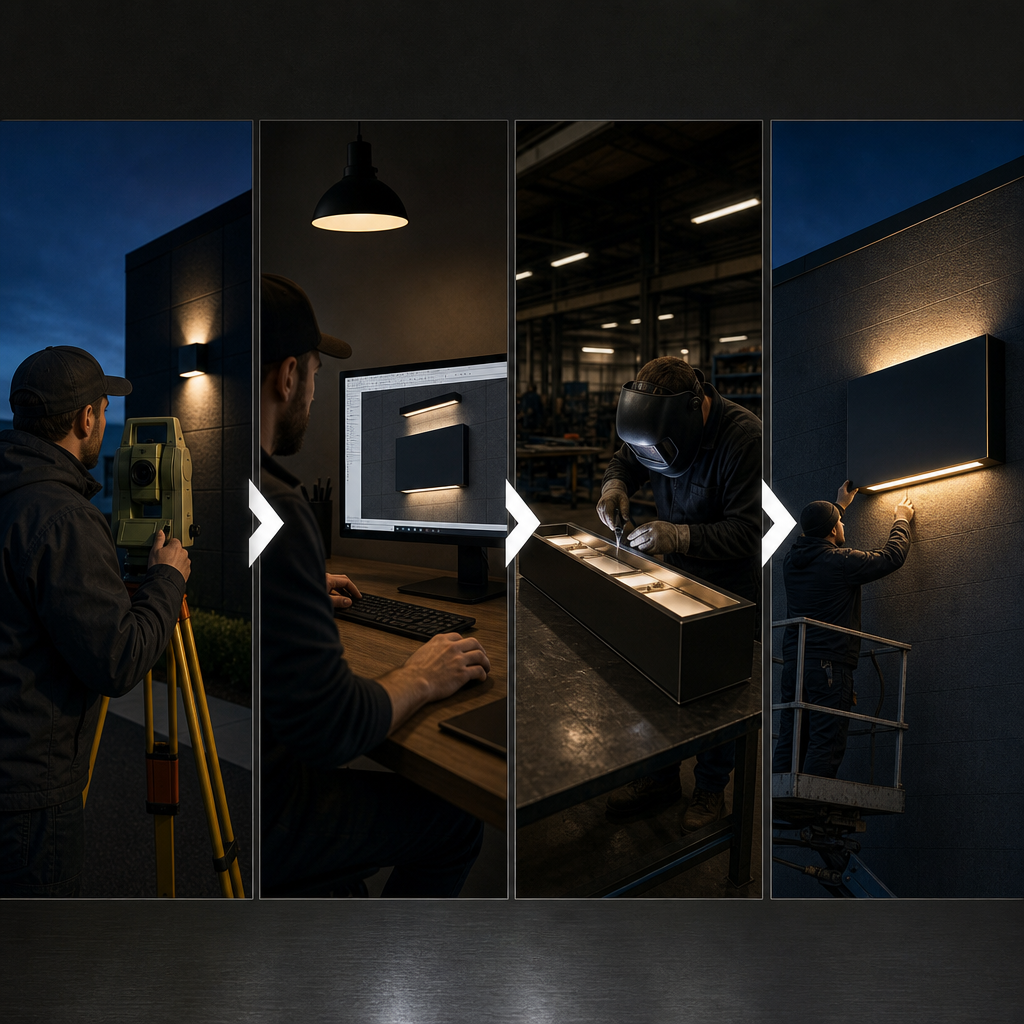
Getting a business sign made in Toowoomba generally follows four stages: site survey and measure, design proof and sign-off, fabrication, and install. Illuminated or projecting signs may also need development approval through Toowoomba Regional Council before fabrication starts, and that step should be built into the project timeline early rather than discovered late.
The site survey is where a lot of avoidable problems get caught before they cost money. Measuring the actual frontage, checking structural fixing points, confirming power availability for illuminated signs, and photographing the site all feed into a design that will actually fit and mount correctly. Skipping this step is how businesses end up with a beautiful design that doesn't fit the wall.
Council approval applies more often than business owners expect. Illuminated signs, projecting signs over a footpath, and larger pylon structures can all fall under Toowoomba Regional Council's planning scheme requirements. Managing that application, submitting plans, responding to any requests for information, is a task best handled by the fabricator rather than left to the business owner to navigate solo.
Consider a hypothetical example: a cafe taking over a tenancy on Margaret Street. The sequence would typically run: site survey and measure to confirm the fascia dimensions and existing power points; a design proof showing fascia panel artwork and an illuminated 3D letter option for evening trade; a council check to confirm whether the illumination triggers an approval requirement given the building's heritage overlay; fabrication of the panel and letters once the design is signed off; and a scheduled install timed around the cafe's fitout and opening date. Each stage depends on the one before it, which is why an accurate survey at the start saves rework later.
What Most Toowoomba Businesses Get Wrong About Signage
The most common mistake is treating signage as a purely aesthetic decision and only thinking about engineering and climate after something fails. A fascia sign or pylon structure that looks identical to one on the coast can perform very differently once it's exposed to Toowoomba's wind and temperature swings for a few years.
Acrylic that isn't UV-stabilised will yellow and go brittle faster on an exposed western-facing frontage in Toowoomba than it would in a shaded coastal arcade. A pylon footing sized for a sheltered suburban street won't necessarily hold up on an open highway frontage where wind loading is genuinely higher. These aren't dramatic failures most business owners notice until year two or three, by which point the sign looks tired and the cost of fixing it is higher than specifying it correctly the first time.
The contrarian view here is that cheaper signage is often the more expensive option in Toowoomba specifically, because the climate accelerates the gap between a correctly specified sign and a corner-cut one. Spending a bit more on UV-rated material, correctly engineered footings and proper illumination housing up front tends to be the cheaper path over a five to ten year sign life, not the more expensive one. A fabricator who designs, cuts and installs in-house is better placed to make that call at the quoting stage than a reseller passing a spec sheet along to a third party.
References
- Toowoomba Regional Council, Toowoomba Region Planning Scheme (advertising devices and development approval provisions), toowoombaRC.qld.gov.au
- Australian Bureau of Statistics, Regional Population data for Toowoomba and the Darling Downs, abs.gov.au
- Bureau of Meteorology, Climate statistics for Toowoomba, bom.gov.au
- Standards Australia, AS/NZS 1170.2 Structural Design Actions: Wind Actions
Talk to a signage expert
Tell us about your project and we'll come back with options and honest advice.
Get in TouchFrequently Asked Questions
Do I need council approval for a business sign in Toowoomba?
It depends on the sign type. Illuminated signs, projecting signs over a footpath, and larger pylon or monument structures can trigger development approval requirements under Toowoomba Regional Council's planning scheme. Simple non-illuminated fascia signs within standard dimensions often don't. Checking early avoids delays once fabrication has started.
How much does a shop front sign cost in Toowoomba?
Cost depends on size, material, illumination and fixing complexity rather than a flat rate. A non-illuminated fascia panel sits at the lower end, while illuminated 3D letters or a fully engineered pylon sign cost more due to materials, power connection and structural requirements. A site survey and quote gives an accurate figure for a specific job.
What sign material handles Toowoomba's climate best?
UV-stabilised acrylic, powder-coated aluminium and stainless steel generally hold up well against Toowoomba's strong sun exposure and wind. Cheaper, non-UV-rated acrylics and thin substrates tend to fade, warp or crack faster on exposed frontages and highway-facing sites than in more sheltered coastal locations.
How long does custom signage take from design to installation?
Timeframes vary with sign complexity, material availability and whether council approval is required. A simple fascia sign moves through survey, design and fabrication faster than an illuminated pylon sign requiring council sign-off, engineering and a power connection. Building council approval time into the schedule early avoids surprises.
Can Sunquest Signs handle vehicle wraps for a whole fleet?
Yes. Fleet graphics are designed once as a template, then applied consistently across every vehicle in the fleet, whether that's two utes or a larger freight or trade fleet operating across the Darling Downs. Scheduling multiple vehicles together keeps the fleet look consistent and minimises vehicle downtime.
What's the difference between a pylon sign and a monument sign?
A pylon sign is a tall, pole-mounted structure designed to catch attention from a distance, common on highway-facing sites. A monument sign is lower profile, often masonry or metal clad, and sits closer to ground level. Monument signs suit precincts where councils or body corporates want a less visually dominant structure.
Related Articles
Signage in Caboolture: Sign Options for CBD, Morayfield and Industrial Businesses, Council Rules and Costs
Sunshine Coast Signage Project Gallery: Real Local Sign Installs by Suburb and Sign Type
Signage in Nambour: Sign Options for CBD, Heritage and Industrial Businesses, Council Rules and Costs
Signs that set you apart
Over 40 years on the Sunshine Coast. Design, compliance, manufacture and installation handled end to end.
Get a Free Quote