
Construction and site signs
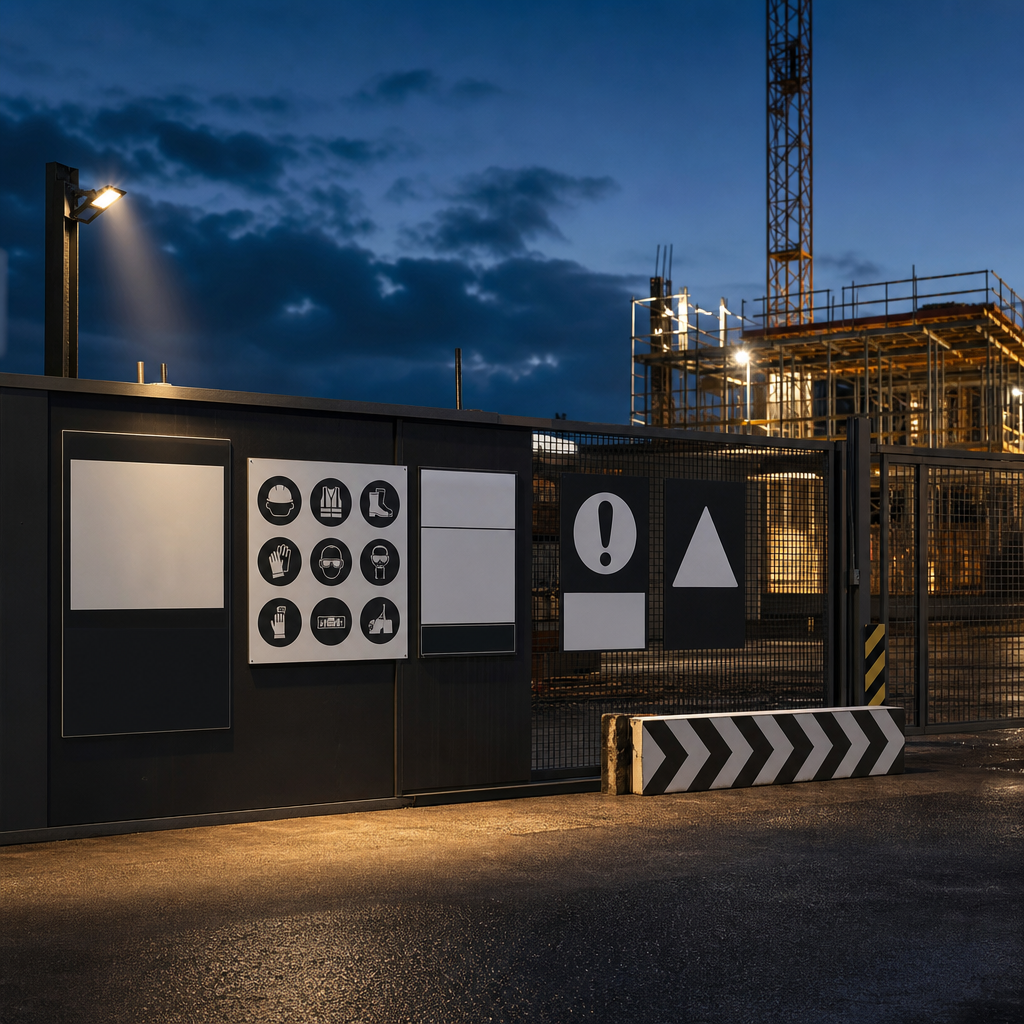
Construction and site signs communicate hazards, access rules, emergency information, traffic directions and project contacts across a worksite. The right system combines signs suited to each risk, durable materials, compliant symbols and wording, clear placement, and regular inspection. Site-specific risk controls and applicable WHS duties should determine the final sign schedule.
Introduction
Construction signage is not a box-ticking exercise. A sign only works when the right person sees it, understands it and can act before entering danger. That requires more than ordering a generic pack and attaching signs wherever space remains on the fence.
This guide explains how to select, specify, position and maintain construction and site signs for Australian projects. It covers common sign types, WHS considerations, materials, customisation and a practical framework for finding gaps before work begins.
Ready to make your business impossible to miss?
Design, manufacture and installation, all under one roof in Warana.
Get a Free QuoteKey takeaways
Effective site signage begins with risks, audiences and decisions rather than a catalogue of standard products. Signs should support physical controls and documented procedures, not replace them. Materials, placement and wording must suit the actual environment, while inspections should continue as access routes, work stages and hazards change.
- Start with the site risk assessment, traffic plan and access plan.
- Separate public, worker, visitor, delivery and emergency communication needs.
- Use recognised safety sign formats where a standard message applies.
- Keep critical information visible, concise and free from branding clutter.
- Match the substrate and finish to weather, impact, mounting and viewing conditions.
- Review signs whenever site conditions or work areas change.
Summary table
A useful sign schedule groups signs by their purpose, intended audience and required response. This approach reduces duplicated messages and highlights missing controls. The table below provides a practical starting point, but the final schedule must reflect the project's risk assessment, WHS duties and local approval conditions.
| Sign category | Typical purpose | Common locations | Specification priority |
|---|---|---|---|
| Site identification | Identify the principal contractor, project and site office | Main gate, pedestrian entry, site office | Legibility from outside the site |
| Entry and induction | Control access and explain entry requirements | Gates, turnstiles, reception points | Clear action for workers and visitors |
| Mandatory safety | State required PPE or behaviour | Before the relevant work area | Recognised symbols and direct wording |
| Prohibition | Prevent unauthorised or unsafe actions | Restricted areas, gates, storage zones | Immediate recognition and visibility |
| Hazard warning | Alert people to a hazard ahead | Plant zones, excavations, electrical areas | Placement before exposure occurs |
| Emergency information | Direct people to emergency facilities or exits | Work areas, amenities, access routes | Visibility during likely emergency conditions |
| Traffic and delivery | Separate vehicles, plant and pedestrians | Gates, haul roads, loading areas | Alignment with the traffic management plan |
| Environmental and amenity | Control dust, waste, noise and site behaviour | Waste stations, washout areas, boundaries | Site-specific instructions |
| Public information | Explain access changes and provide contact details | External fencing and public approaches | Plain language and weather resistance |
How should construction and site signs be selected?
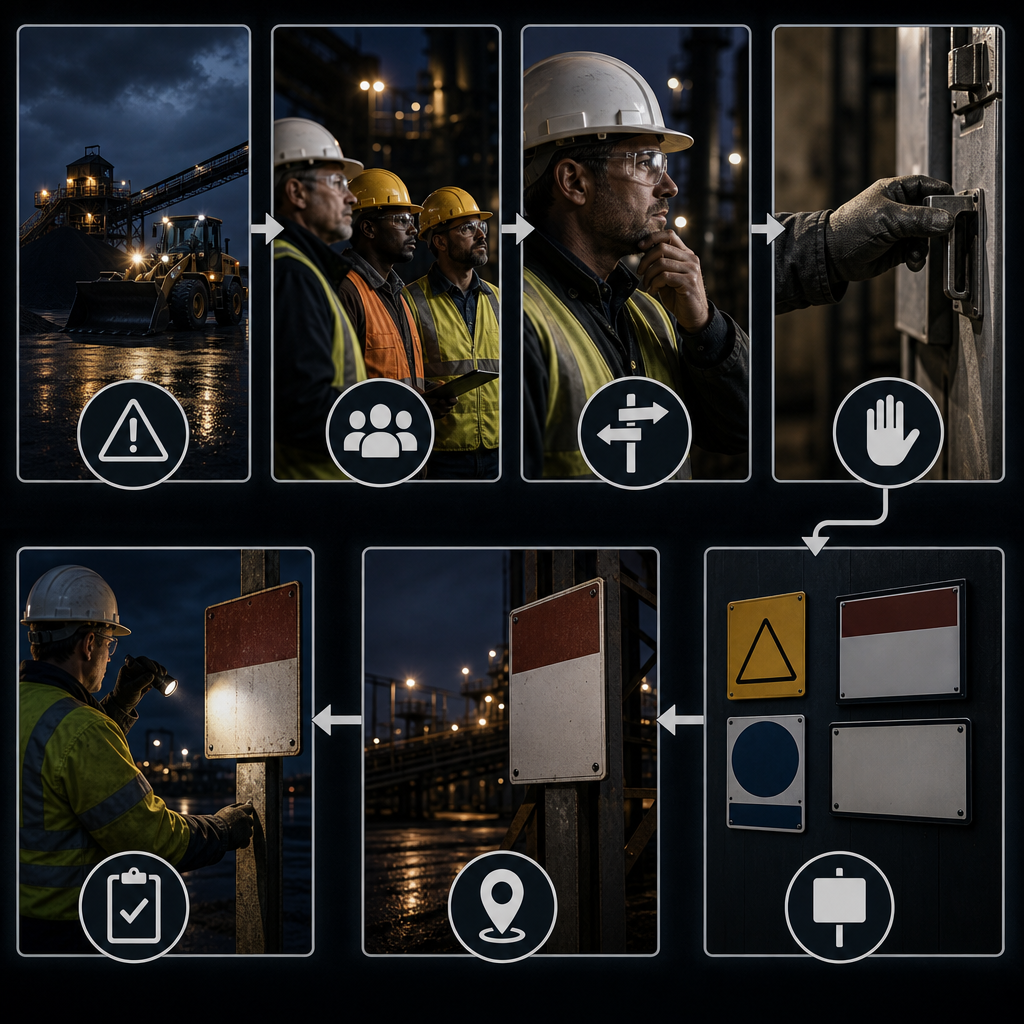
Select construction signs by working from the hazard and required action, not from a supplier's product list. Identify who could encounter the issue, where they make a decision, what they must do and whether a sign is an appropriate supporting control. Then specify format, size, substrate, mounting and maintenance requirements.
Begin with the documents already controlling the project. These may include the site risk assessment, safe work method statements, emergency plan, traffic management plan, induction material and council conditions. Each document can create a signage requirement, but repeated instructions should be consolidated where possible.
A practical selection process asks:
- Who needs the message: workers, subcontractors, visitors, delivery drivers or the public?
- What must they notice before proceeding?
- Is the required response obvious?
- Could poor literacy, limited English or unfamiliarity with the site affect understanding?
- Will the sign remain visible during changing work stages?
- Does a recognised safety sign format apply?
Signs sit low in the hierarchy of controls because they depend on human behaviour. A warning sign beside an unguarded excavation does not make the excavation safe. The sign may support barriers, exclusion zones and supervision, but it cannot replace them.
Avoid buying every sign that appears relevant. Too many messages create visual competition. When a gate displays a dense wall of instructions, people scan rather than read. Prioritise conditions that affect entry, immediate safety and the next required action.
Which signs does a construction site commonly need?
Most construction sites need a combination of entry, mandatory, prohibition, warning, emergency, traffic and project information signs. The exact mix changes with the work, site layout and public interface. A residential build, occupied commercial refurbishment and civil project should not receive identical sign packs simply because each involves construction.
Entry and site identification signs
The main entry should tell people whose site it is, where to report and how access is controlled. Where principal contractor signage duties apply, the required details must be visible from outside the workplace. The model WHS Regulations include requirements concerning the principal contractor's name, contact telephone numbers and site office location.
Entry signage can also cover visitor reporting, induction requirements, authorised access, operating hours and site-specific PPE. Keep the hierarchy clear. The reporting instruction should not disappear beneath logos, project renders and promotional copy.
Mandatory and prohibition signs
Mandatory signs state actions people must take, such as wearing specified PPE. Prohibition signs identify actions that are not permitted, such as unauthorised entry, smoking or using a mobile in a controlled area.
Use these signs at the point where the rule begins. A PPE sign inside the hazardous area arrives too late. Likewise, a prohibition sign should make the boundary of the restriction obvious.
Hazard and danger signs
Warning signs alert people to hazards that may cause injury. Danger signs are reserved for hazards with an immediate threat to life. Australian Standard AS 1319-1994, Safety signs for the occupational environment, establishes recognised categories and design conventions for workplace safety signs.
The distinction matters. If every minor issue receives the strongest signal word, the visual system loses meaning. Match the sign category to the risk assessment rather than choosing the most dramatic option.
Emergency signs
Emergency information signs help people locate exits, first aid, emergency equipment, assembly areas and other safety facilities. Their placement should reflect actual evacuation routes and site conditions. Temporary walls, scaffold, stored materials and parked plant can all obstruct a previously visible sign.
Emergency diagrams and contact information also require updating when site arrangements change. An obsolete evacuation map can direct people towards a closed route.
Traffic, plant and delivery signs
Vehicle and pedestrian interactions require more than a generic speed or warning sign. Site traffic signs should align with the traffic management plan and show drivers where to enter, stop, turn, unload and exit. Pedestrians need clear routes and crossing points.
Work affecting public roads may be subject to road authority requirements and AS 1742.3-2019, Manual of uniform traffic control devices, Part 3: Traffic control for works on roads. Standard building-site signs should not be substituted for an approved traffic control arrangement.
What Australian compliance requirements apply?
Australian construction signage requirements come from overlapping sources, including WHS legislation, regulations, codes of practice, Australian Standards, road authority rules and development conditions. There is no universal sign pack that guarantees compliance. The responsible duty holder must identify the requirements applying to the project, jurisdiction, hazards and surrounding public area.
Safe Work Australia's model WHS laws provide the basis for harmonised WHS legislation adopted across much of Australia, although each jurisdiction administers its own laws. The model WHS Regulations address signage for principal contractors on construction projects. They also sit within a broader duty to manage risks rather than treating signs as the primary control.
AS 1319-1994 covers safety signs intended for the occupational environment. It provides recognised approaches for regulatory, hazard, emergency information and fire signs. Using familiar formats improves recognition and reduces the risk that custom design choices obscure the safety message.
Compliance requires more than the correct colour or symbol. Consider whether the sign is:
- Relevant to an identified risk or legal requirement
- Located where the intended audience can see it before exposure
- Legible at the expected viewing point
- Maintained in a readable condition
- Consistent with induction and site procedures
- Removed or replaced when no longer accurate
Development approvals and council permits may also require project identification, builder details, pedestrian detours, hours of work or public notices. Hoarding graphics and advertising can face separate planning controls. Confirm these requirements with the relevant authority rather than assuming a standard safety sign covers them.
Which materials are suitable for site signage?
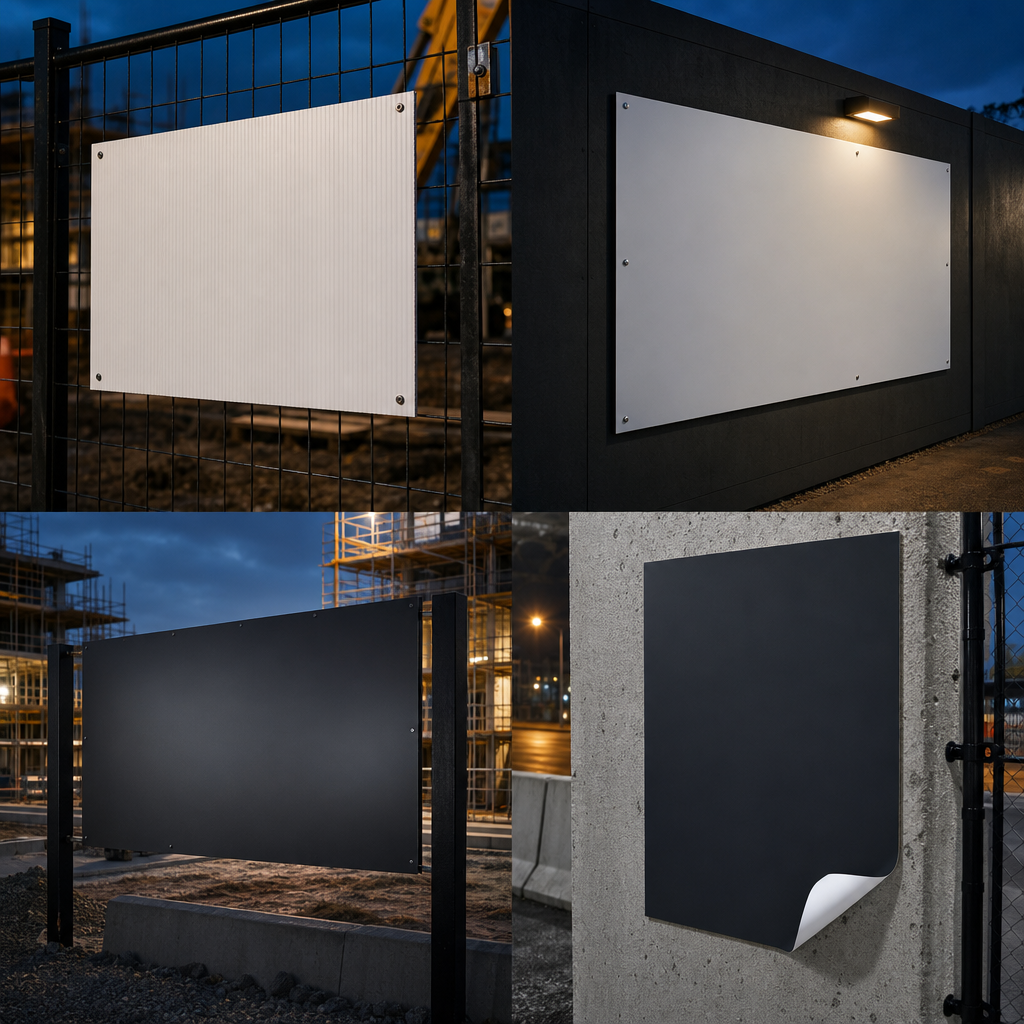
The right material depends on exposure, expected handling, mounting surface and how often the message will change. Corflute suits many temporary applications, while rigid composite or metal panels offer greater stability for exposed locations. Self-adhesive graphics work on suitable smooth surfaces, and reflective materials support visibility where illumination is limited.
Corflute
Corflute is lightweight, economical and easy to cable-tie or screw to temporary fencing. It suits changing work areas and shorter-term messages. It is less suitable where signs face repeated impact, unsupported edges or strong exposure without secure fixing.
Aluminium composite panel
Aluminium composite panel provides a flat, rigid face for gate signs, project boards, directional signs and longer-term displays. It presents printed text and branding cleanly and resists bending better than lightweight fluted sheet. Edges and mounting points still need appropriate specification.
Aluminium and other metal signs
Metal signs suit demanding outdoor locations, permanent facilities and repeated cleaning. Material choice, coatings and fixings should account for corrosion risks, nearby electrical equipment and the mounting structure.
Self-adhesive and reflective graphics
Self-adhesive signs work best on clean, smooth and compatible surfaces. They can be useful for doors, equipment, windows and internal site facilities. Rough, dirty or low-surface-energy materials can undermine adhesion.
Reflective sheeting may be appropriate for traffic directions and signs viewed in vehicle headlights. It does not make a poorly positioned or obstructed sign effective. Road-related applications should follow the relevant traffic control specification.
The cheapest substrate is not always the lowest-cost choice. Reprinting damaged or unreadable signs creates delays and administrative work. Specify for the likely exposure rather than using the same material throughout the site.
Where should construction signs be installed?
Install signs at decision points, before people enter the controlled area or encounter the hazard. They should face the expected approach, remain within a clear line of sight and avoid competing visual clutter. Placement must account for pedestrians, vehicle drivers, changing work zones, lighting, fencing and temporary obstructions.
Think in routes rather than walls. Walk the path taken by a new worker, visitor, delivery driver and member of the public. Each person sees the site differently.
At the external boundary, people need enough information to choose the correct entrance and understand restrictions. At the gate, they need reporting and entry instructions. Inside the site, signs should reinforce route choices, exclusion zones and local controls.
Consider these placement failures:
- A delivery sign is visible only after a truck passes the turning point.
- A pedestrian detour sign faces workers but not the approaching public.
- A mandatory PPE sign is hidden when the gate opens.
- A warning sign is attached to movable fencing and later relocated.
- An evacuation sign points towards a route blocked by the next work stage.
Mounting also matters. Cable ties, screws, posts, frames and adhesive systems should suit the substrate and wind exposure. Sharp edges, projecting fixings and unstable freestanding frames can introduce new hazards.
Signs intended for drivers need concise wording and an uncluttered layout. Drivers have less time to read than pedestrians. Put detailed delivery instructions in pre-arrival communication, then use signs to confirm the critical route and stopping point.
When should site signs be customised?
Custom signs are appropriate when the message depends on the project, company, access arrangement or local hazard. Customisation should improve clarity, not redesign recognised safety conventions. Keep standard symbols, signal words and layouts intact where they apply, then place branding and project information where it cannot compete with the required action.
Common custom applications include:
- Principal contractor and site office details
- Combined entry and PPE boards
- Project-specific delivery routes
- Named exclusion zones or work areas
- Environmental controls and washout instructions
- Public access changes and contact information
- Multilingual instructions supported by recognised symbols
- Directional signs using the site's actual terminology
A combined signboard can reduce clutter at the main gate, but it needs a clear visual hierarchy. Group related information. Entry actions should appear together, emergency details should be distinct, and promotional content should remain secondary.
QR codes can support inductions, delivery booking or detailed project updates. Do not make a QR code the only way to access urgent safety information. Phones may be prohibited, connectivity may fail, and visitors may not have the required application.
Proof custom signs against source documents before production. Check names, telephone details, arrows, PPE requirements and site terminology. An accurate print of outdated information is still an ineffective sign.
How should site signs be inspected and maintained?
Inspect signs as part of normal site checks and whenever weather, access, fencing, traffic routes or work stages change. Replace signs that are damaged, faded, obscured, inaccurate or no longer securely mounted. Maintenance should also remove obsolete signs, because conflicting instructions can be more dangerous than a missing message.
A useful inspection checks four things: content, condition, position and relevance. The wording must remain correct. The sign must be readable. Its position must match the current approach route. The message must still apply to the work underway.
Photographs can help document significant gate, traffic and emergency sign arrangements. However, a photograph should not replace an on-site view from the audience's approach. Camera angles often make a sign look clearer than it appears to a driver or pedestrian.
Assign ownership for updates. If nobody is responsible for changing signs when the work stage moves, obsolete information tends to remain. Site supervision, traffic control and project administration should understand who approves, orders and installs replacements.
Clean signs where dust, concrete slurry or mud affects readability. Check that vegetation, stored materials, bins, parked vehicles and opened gates do not block them. Remove temporary signs promptly when the restriction ends.
Build a signage control map, not a shopping list
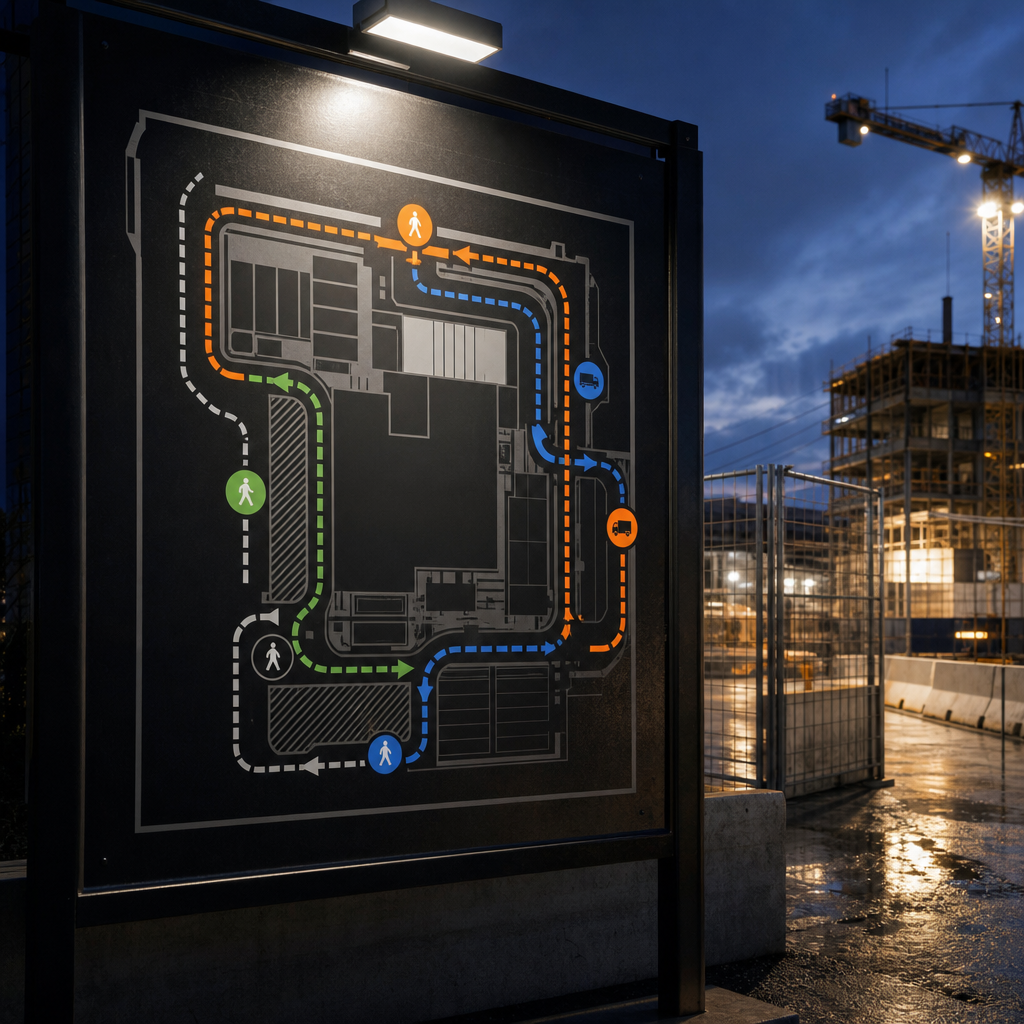
Most sign catalogues organise products by message, but projects should organise signage by decisions. Map each audience's route, identify the decisions they make and specify the message required before each decision. This exposes gaps that a generic sign pack misses, particularly around deliveries, public interfaces and changing internal access.
The key question is not, "Which signs do we need?" It is, "Where could someone make the wrong decision because information was missing, late or unclear?"
Consider a hypothetical occupied refurbishment. Workers enter through a controlled gate, building occupants use another entrance, and deliveries arrive through a loading area. A generic construction pack may cover PPE and unauthorised entry. It may not explain temporary pedestrian diversions, delivery holding instructions or the boundary between occupied and construction areas.
A signage control map records:
- The audience approaching each point
- The decision they must make
- The consequence of misunderstanding
- The physical control already in place
- The supporting sign or marking required
- The event that triggers review or removal
This method also prevents sign inflation. If a barrier, locked gate or supervised access point already controls the issue, the sign can focus on the next action instead of repeating a broad warning. The result is a smaller, clearer and more defensible sign system.
My direct view is that signage procurement happens too late on many project plans. Sign requirements should be developed alongside access, logistics and traffic arrangements. Waiting until fencing is installed encourages improvised placement and rushed wording.
Ordering construction and site signs from Sunquest Signs
Prepare a clear brief before requesting construction signs from Sunquest Signs. Include the required wording, sign category, intended audience, viewing location, approximate mounting surface and environmental exposure. Supply approved logos and project details separately, and identify any message that must follow a specified standard or authority requirement.
For custom work, provide a marked site plan or photographs where practical. This helps explain approach direction, available mounting space and nearby visual competition. It also reduces ambiguity around arrows and directional wording.
Before approving artwork, verify:
- Site and company names
- Contact and emergency details
- Required PPE and access rules
- Directional arrows
- Sign dimensions and orientation
- Substrate and finishing requirements
- Fixing or mounting method
- Whether information is temporary or likely to change
Sunquest Signs can then produce a coordinated set rather than isolated signs with inconsistent terminology or branding. For help planning a site signage package, visit /contact and provide the project location, sign list and expected installation conditions.
References
The sources below establish the main legal and technical context for Australian construction signage. Standards and model laws should be read alongside the legislation adopted in the project's jurisdiction, regulator guidance, approved traffic arrangements and site-specific risk documents. Access to the complete Australian Standards may require purchase or subscription.
- Safe Work Australia, Model WHS laws
- Safe Work Australia, Construction
- Standards Australia, AS 1319-1994 Safety signs for the occupational environment
- Standards Australia, AS 1742.3-2019 Manual of uniform traffic control devices, Part 3: Traffic control for works on roads
Talk to a signage expert
Tell us about your project and we'll come back with options and honest advice.
Get in TouchFrequently Asked Questions
What signs are required on a construction site in Australia?
Requirements depend on the jurisdiction, project and identified risks. Common needs include principal contractor details, visitor reporting, PPE, restricted access, hazard warnings, emergency information and traffic directions. Review applicable WHS laws, project risk controls, traffic plans, council conditions and relevant Australian Standards.
Can safety signs replace barriers or other risk controls?
No. Signs depend on people noticing, understanding and following them. They support higher-level controls such as isolation, guarding, barriers, traffic separation and supervised access.
What is the best material for outdoor construction signs?
There is no single best material. Corflute suits many temporary signs, rigid composite panels suit exposed gate and project boards, and metal signs suit demanding or longer-term applications. Choose according to weather, impact, mounting, cleaning and the expected frequency of change.
Can a construction sign include a company logo?
Yes, where branding does not obscure or compete with safety information. Keep required symbols, signal words, instructions and contact details prominent. Branding should be secondary on safety signs.
How often should construction signs be checked?
Check signs during routine site inspections and after events that could affect them, including severe weather, fence relocation, access changes, new work stages, altered traffic routes and emergency plan updates.
Do custom site signs need to follow Australian Standards?
Where a recognised safety sign category applies, custom artwork should retain the relevant conventions in AS 1319-1994. Other requirements may apply to roadworks, fire safety, accessibility or local approvals.
Related Articles
Sunshine Coast Signage Project Gallery: Real Local Sign Installs by Suburb and Sign Type
Signage in Caboolture: Sign Options for CBD, Morayfield and Industrial Businesses, Council Rules and Costs
Signage in Nambour: Sign Options for CBD, Heritage and Industrial Businesses, Council Rules and Costs
Signs that set you apart
Over 40 years on the Sunshine Coast. Design, compliance, manufacture and installation handled end to end.
Get a Free Quote