Custom Laser-Cut Signage Components: Letters, Faces, Panels and Fixings Explained
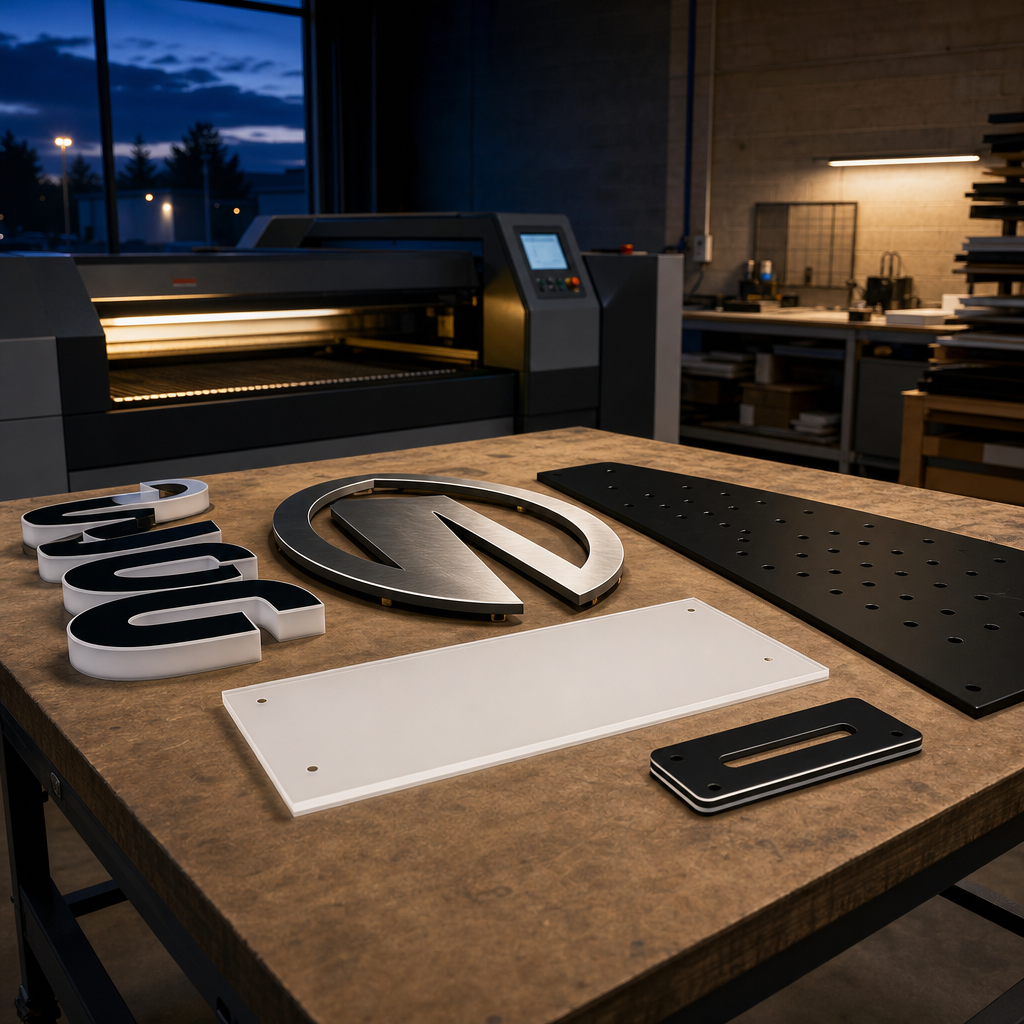
Custom laser-cut signage components are the individual parts cut from sheet material that make up a finished sign: letters, logos, acrylic faces, backing panels, tenant inserts, wayfinding plates and compliance blanks. Cutting them precisely, in the right material for the environment, determines how well the sign fits, finishes and lasts.
Most people specify a sign by what it looks like from the street. The parts behind that look are what you actually pay for, and they decide whether the sign still looks sharp after a few Queensland summers. A letter cut in the wrong material, or a panel that does not suit its frame, shows up as a problem long after installation.
This guide goes component by component. For each part, you will see what it does in the sign, which materials suit it and how it combines with the other parts. It is written for business owners, shopfitters, builders and designers who want to understand what they are specifying before they approve a quote.
Key Takeaways
- A laser-cut part is not a finished sign. Durability and finish depend on how the parts are cut, finished, fixed and assembled together.
- Material choice should follow the environment. Coastal UV and salt air punish the wrong acrylic, adhesive, fixing or coating.
- Illuminated faces are a system. The face, the diffuser and the light source need to be specified together.
- Replaceable inserts let you update a pylon or plinth sign without rebuilding the structure.
- Clean vector artwork with clear cut lines is the single biggest thing you can do to speed up a quote and avoid rework.
Ready to make your business impossible to miss?
Design, manufacture and installation, all under one roof in Warana.
Get a Free QuoteSummary Table
| Component | What it does | Common materials | Works with |
|---|---|---|---|
| Flat-cut letters and logos | Carry the brand name and mark | Acrylic, aluminium, aluminium composite | Stand-offs, studs, backing panels |
| Push-through letters | Stand proud of a face and glow when lit | Opal or coloured acrylic | Face panel, LED modules, diffuser |
| Routed or cut face panels | Form the visible front of a lightbox | Opal acrylic, aluminium, composite | Frame, LEDs, vinyl or paint |
| Backing panels | Give letters a mounting surface and contrast | Aluminium composite, aluminium, acrylic | Letters, fixings, building wall |
| Pylon and plinth inserts | Let tenant names change without a rebuild | Aluminium composite, acrylic, aluminium | Existing frame or track |
| Wayfinding plates and blades | Direct people and name rooms | Acrylic, aluminium, laminates | Wall, door or ceiling fixings |
| Compliance sign blanks | Provide the base for required safety signs | Acrylic, aluminium, composite | Printed or applied compliance content |
What Counts as a Signage Component?
A signage component is a single cut part, such as a letter, face or panel. A finished sign is those parts cut, finished, fixed and assembled into one working product. The difference matters because most failures happen at the joins, fixings and finishes between parts, not in the cut itself.
A laser cutter turns a vector file into a precise shape. That is the start of the job, not the end. After cutting, parts may need edge finishing, painting, vinyl application, drilling, bonding or fitting with LEDs. Each step affects how long the sign lasts.
That is why in-house capability matters. At Sunquest Signs, the same team cuts the parts, finishes them and assembles them into complete signs. If a letter does not sit flush on a panel, or a stud pattern does not match the template, the person who cut it is the person who finds out and fixes it. When cutting is outsourced and assembly happens elsewhere, those problems tend to become arguments about whose fault it was.
Two other posts cover the technical detail behind this. Our acrylic laser cutting guide explains cast versus extruded acrylic and edge finishes. Our CNC cutting tolerances post explains how accurate cut parts need to be. This article focuses on the parts themselves and how they fit together.
Why Environment Drives Material Choice
Signage in Queensland works hard. ARPANSA publishes UV index data for Australian cities, and summer readings in Queensland regularly sit in the extreme band. Add salt-laden air on the coast and you have conditions that fade cheap coatings, cloud poor-quality plastics and corrode the wrong fixings.
A sign in an air-conditioned office foyer can use materials that would not survive a year on a beachfront pylon. Specify for where the sign will live, not where it was photographed.
Flat-Cut and Dimensional Letters and Logos
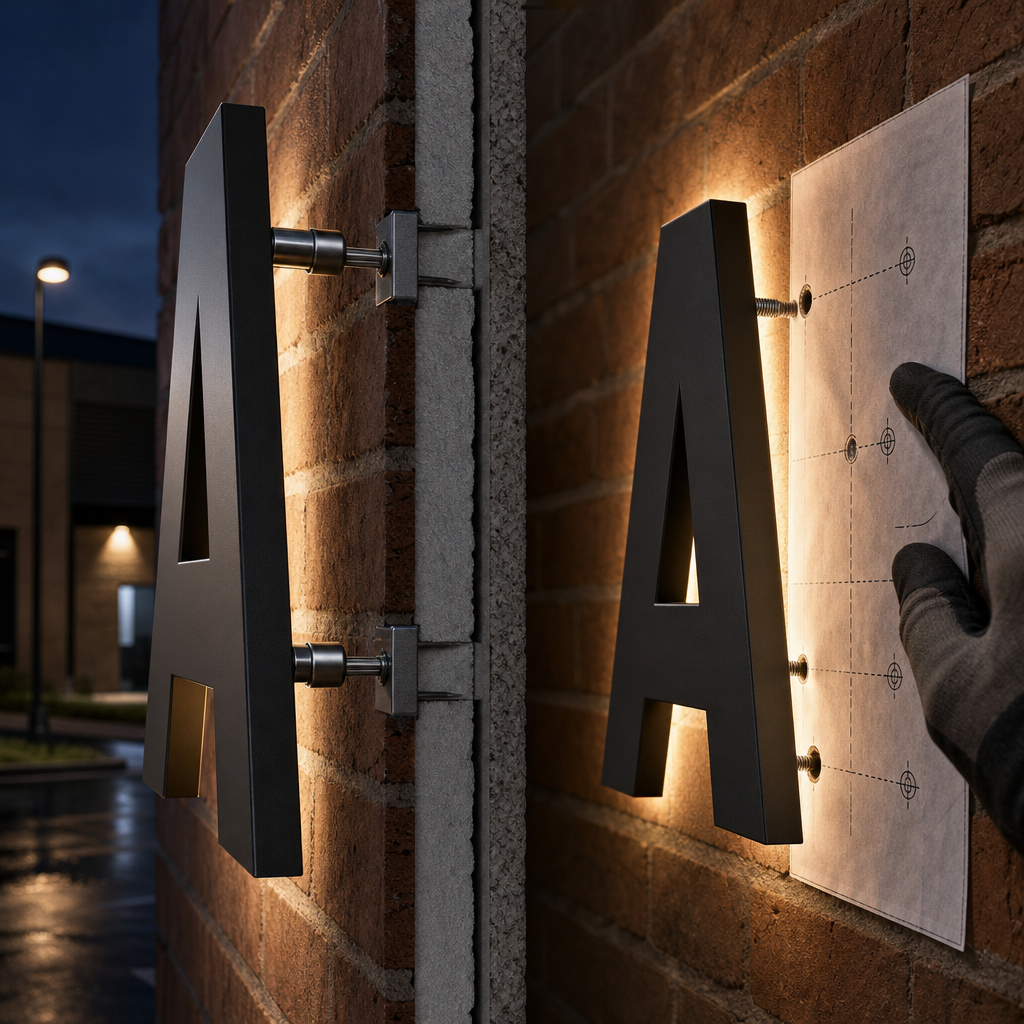 Flat-cut letters are individual characters or logo shapes cut from sheet and fixed to a wall or panel. Acrylic suits colour and a polished edge, aluminium suits durability and a premium look, and aluminium composite suits larger, lighter lettering. The right choice depends on size, exposure and how the sign is mounted.
Choosing the Material
Acrylic is the most common choice for laser cut sign letters. A laser leaves a clean, polished edge on acrylic, and the material comes in a wide range of colours, mirror finishes and opacities. It can be layered, so a logo can have a coloured face sitting on a thicker white or black base to create depth. For outdoor use, material quality matters. Good cast sheet holds colour better under UV than cheap alternatives.
Aluminium is the durable option. Solid aluminium letters can be painted, anodised or left brushed, and they cope well with weather. They suit applications where you want a precise, architectural look, such as a professional services firm or a medical centre. Aluminium is heavier, so fixing method and substrate need more thought.
Aluminium composite has two thin aluminium skins around a lightweight core. It is flat, stable and takes paint or vinyl well, which makes it a good fit for large logos and panels. It is usually cut with CNC routing rather than a laser, because the core and skins respond differently to heat. If your design needs both, we cut the acrylic by laser and route the composite, then assemble them together.
Other stock includes foam PVC for light interior work, timber and timber-look laminates for hospitality fitouts, and brushed or mirror metal finishes. Foam PVC is fine indoors but not a good choice for sun-exposed exteriors.
Stand-Off and Stud Mounting
Stand-off mounting holds letters a short distance off the wall using small metal spacers. It creates a shadow gap that makes the lettering look more dimensional, and it lets water drain behind the letters. Stud mounting uses pins fixed into the back of each letter, which slot into drilled holes in the wall or panel. Studs give a flush, clean look.
Both methods depend on a drilling template. We supply a template cut to match the letter layout, so installers can mark the wall once and drill accurately. Without a template, spacing errors creep in and letters end up misaligned.
Fixing material matters as much as the letter. On the coast, stainless steel fixings are the sensible default. Mixing metals, such as steel pins in aluminium letters, can cause galvanic corrosion over time. Specify fixings that suit both the letter material and the wall behind it, whether that is brick, concrete, render or a cladding panel.
Lightbox and Illuminated Faces
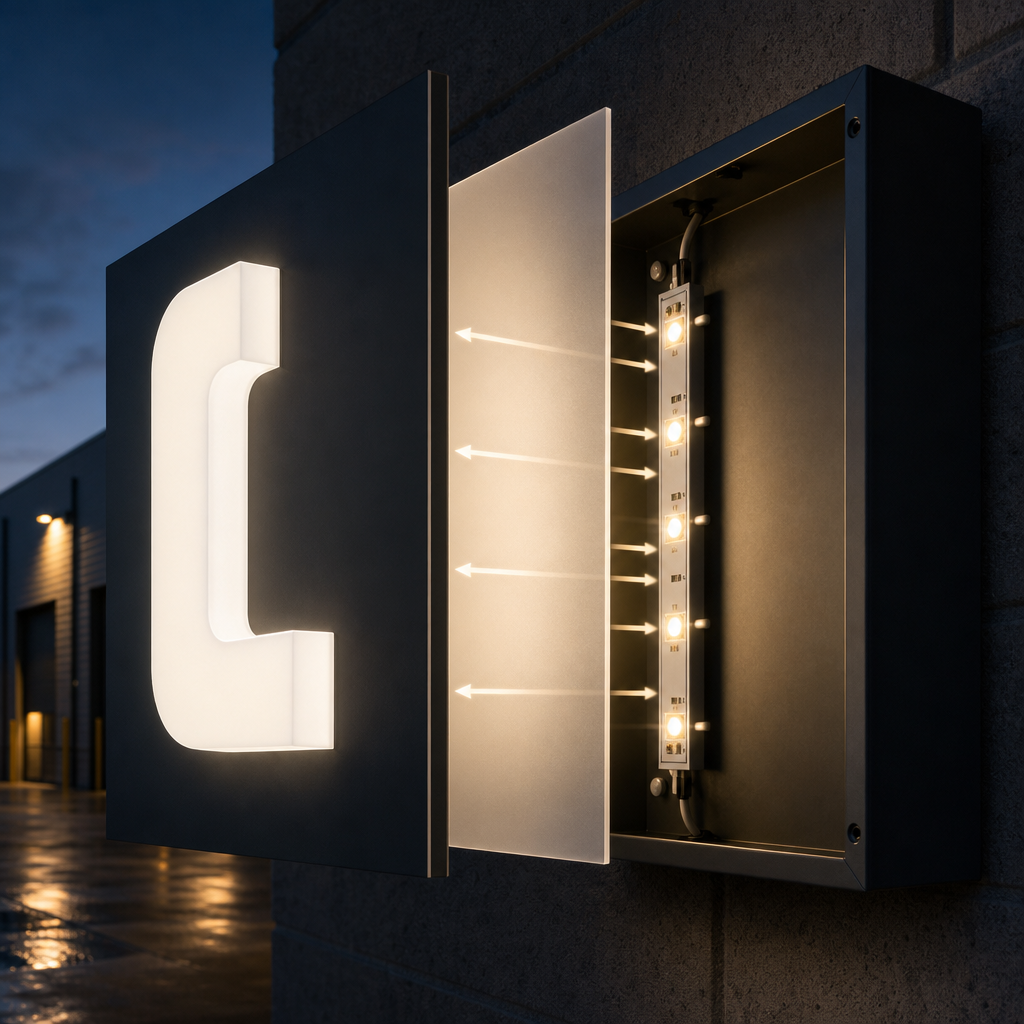 Illuminated faces are the visible front of a lit sign. Push-through acrylic letters stand proud of a solid face and glow from behind, while routed or cut face panels let light shine through shapes. The face, the diffuser and the LEDs must be chosen together to get even, flicker-free light.
Push-Through Acrylic Letters
Push-through acrylic letters are cut from translucent acrylic and fitted through matching openings in an opaque face panel. The letters sit proud of the face, catch the light and glow when the LEDs behind them are on. Done well, they give a crisp, three-dimensional look in the day and a bright, even glow at night.
The fit is critical. The openings in the face and the letters must match closely, or you get light leaks around the edges or letters that will not seat properly. This is where laser cutting earns its place: both the face openings and the letters can be cut from the same file, so they match by design.
The face panel is usually aluminium or aluminium composite, painted or wrapped in a dark colour for contrast. The letters are usually opal (white translucent) acrylic, sometimes with coloured vinyl on the face for brand colours.
Routed and Cut Face Panels
A routed face panel is a flat panel with shapes cut out, backed by translucent material. It suits signs where the whole front is a single plane rather than letters standing proud. Opal acrylic faces with applied vinyl are common for traditional lightboxes. Aluminium faces with cut-outs and an acrylic backing give a sharper, more modern look.
The choice affects maintenance. Faces that can be removed easily make LED servicing quick. Faces that are sealed or bonded make servicing harder and more expensive. Think about access when you specify, not when the first LED fails.
Diffuser Choices
A diffuser spreads LED light so it looks even rather than showing bright dots. Opal acrylic is the standard diffuser. Denser opal hides the LEDs better but passes less light, so you trade evenness against brightness. The depth of the box and the spacing of the LEDs also decide whether you see hotspots.
If you are comparing illuminated options, our LED channel letter signs post covers a related approach where each letter is its own illuminated unit. It also covers what ongoing upkeep looks like, so you can weigh up the long-term costs of each style before you commit.
Backing Panels, Plinth and Pylon Inserts
Backing panels give letters a mounting surface and contrast against the building. Pylon and plinth inserts are replaceable panels that slot into a fixed structure. Both make signage easier to maintain, because you can refresh the visible part without rebuilding or replacing the frame behind it.
Laser Cut Backing Panels
A backing panel sits behind letters or a logo. It does three jobs. It gives the lettering a flat, consistent surface when the wall is rough or uneven. It adds contrast so the brand reads clearly. And it keeps drilling and fixing off the building itself, which matters for tenants who must reinstate the wall when they leave.
Aluminium composite and aluminium are the usual materials, painted to suit. Acrylic backing panels work for interiors and reception areas. The panel shape can follow the brand, with cut corners, curves or a profile that matches the logo, rather than a plain rectangle.
Tenant Panels and Replaceable Inserts
A tenant panel is a flat insert, usually aluminium composite or acrylic, that slots into a pylon or plinth frame. When a tenant leaves or rebrands, you replace the insert and keep the structure. That is far cheaper and faster than rebuilding the whole sign.
The key is accurate cutting to suit the existing frame. Inserts need enough clearance to slide in and out, but not so much that they rattle or let water in. We usually measure the frame on site, or work from a supplied drawing, and cut to suit.
Consider a pylon sign at a Sunshine Coast shopping centre, with six tenant panels. Three have faded badly after years of sun and salt, and one tenant has changed brand. Rather than rebuilding the pylon, the centre manager has four new inserts cut and printed, and the faded and outdated panels are swapped in a single visit. The structure, lighting and footings stay untouched. This is a hypothetical example, but it is exactly the type of job inserts are designed for.
For more on this category, see our Pylon and Plinth signage hub, which covers the structures these inserts fit into.
Material Choice for Inserts
Inserts are exposed to the full weather, so material and finish matter. Aluminium composite with a quality UV-stable print or paint is the common choice. Cheaper vinyl on lower-grade substrates will fade, curl or delaminate faster, especially on north and west-facing pylons. If your pylon is near the coast, ask specifically about coastal-grade finishes and edge sealing.
Interior and Wayfinding Parts
Interior and wayfinding parts are the smaller plates, blades and blanks that name rooms, direct people and carry required safety information. Acrylic and aluminium are the main materials. Consistency matters more than any single part, because a building's signs should read as one system.
Room Plates and Directional Blades
Room plates mount beside or on doors. Directional blades project from walls or hang from ceilings so people can see them from a distance. Both are typically cut from acrylic or aluminium, with layered or printed graphics.
Laser cutting suits these jobs because it handles repeat parts well. A building with fifty room plates needs fifty identical shapes, with consistent hole positions and edge finish. A single cutting file gives you that consistency, and replacement plates months later will match the originals.
Plan for change. Offices reorganise and tenancies turn over, so consider a plate design with a replaceable insert strip rather than a fixed face. That lets you update names without replacing the whole plate. Our Interior and Wayfinding hub covers whole-building systems in more depth.
Compliance Sign Blanks
A compliance sign blank is a cut panel that forms the base for a required sign, such as a safety, exit or accessibility sign. The blank is cut to size with correct corner radii and mounting holes, then printed or fitted with the required content.
The content itself is governed by standards. AS 1319 covers safety signs in occupational environments. Exit signs and tactile signage fall under the National Construction Code and related Australian Standards, including AS 1428.1 for access and mobility. Requirements depend on the building class and use, so confirm what applies with your building certifier or designer before ordering. We cut and finish the blanks, and you supply or confirm the compliance content.
Supplying Artwork and Ordering Components
The best artwork for laser cutting is a vector file with outlined text and clearly separated cut lines. Tell us the quantity, material, finish and mounting method, and we can quote accurately. Clear information up front prevents delays and rework later.
Vector Files and Cut Lines
Laser cutters follow paths, not pixels. A photo or a low-resolution logo has to be redrawn as a vector before it can be cut, and that adds time. Send files in a format such as AI, EPS, SVG, DXF or a vector PDF where possible.
A good file has these features:
- Text converted to outlines, so fonts do not substitute.
- Cut lines on a separate layer or in a distinct colour from print artwork.
- No overlapping or duplicate paths, which can cause a part to be cut twice.
- Small details checked against the material. Very fine features in thick material can be fragile or may not cut cleanly.
If you only have a JPEG or a photo, send it anyway. We will tell you what can be redrawn and what needs adjusting.
Quantities, Repeats and Replacement Parts
Tell us how many of each part you need, and whether you expect to reorder. Repeat runs are straightforward when the file is saved and the material is still stocked. If you expect to replace parts in future, such as tenant inserts, ask us to keep the cutting file on record. Matching an existing part is far easier from the original file than from a measurement of a weathered sample.
Also tell us where the parts are going. Suburb, distance from the coast and sun exposure all shape our material and fixing recommendations. We cut and supply from our workshop and can quote installation as well. If you are searching for laser cutting near you, we also have local pages covering Maroochydore, Caloundra and Hervey Bay.
Why the Cheapest Upgrade Is Usually the One Nobody Specifies
The part most specifications skip is the fixing. Clients spend time choosing the face colour and the font, then leave fixings to the installer on the day. In my view, that is backwards for Queensland coastal work.
A letter cut in good acrylic or aluminium looks the same on day one whether it is held by the right fixing or the wrong one. Two years later, the wrong fixing shows rust streaks down the wall, loose letters or a panel that will not come off without damage. The face did not fail. The cheapest, least-considered part did.
So my advice is to write the parts list before you approve the design. List each component, its material, its finish and its fixing. Ask for stainless fixings on exposed or coastal sites, and ask how each part will be replaced when it eventually wears out. A sign is not a single object. It is a set of parts with different lifespans, and the sensible approach is to design it so the short-lived parts are easy to swap.
That is also why we prefer to cut, finish and assemble in one place. Someone who sees the whole sign from file to installation will question a bad fixing choice. Someone who only cuts the panel will not.
References
- ARPANSA, Ultraviolet Radiation and UV Index information: https://www.arpansa.gov.au
- Australian Building Codes Board, National Construction Code: https://ncc.abcb.gov.au
- Standards Australia, AS 1319 Safety signs for the occupational environment: https://www.standards.org.au
- Standards Australia, AS 1428.1 Design for access and mobility, General requirements for access, New building work: https://www.standards.org.au
Send Us Your Artwork or a Photo
If you are planning a new sign or need parts for an existing one, send us your artwork or a photo of the sign that needs work. Sunquest Signs will recommend the right materials, then quote the cutting, finishing and installation as one job.
Talk to a signage expert
Tell us about your project and we'll come back with options and honest advice.
Get in TouchFrequently Asked Questions
What are custom laser-cut signage components?
They are individual parts cut from sheet material by laser to suit a specific sign. Examples include letters, logos, face panels, backing panels, tenant inserts, wayfinding plates and compliance blanks. They can be supplied as parts or assembled into a complete sign.
What is the difference between laser cutting and CNC routing for signs?
Lasers suit acrylic and thin metals, and leave fine detail with a clean edge on acrylic. CNC routers suit thicker or composite materials, such as aluminium composite panels. Many signs use both.
What file format should I send for laser cutting?
Send a vector file, such as AI, EPS, SVG, DXF or a vector PDF, with text converted to outlines and cut lines on their own layer. If you only have a JPEG or a photo, send that and we will advise what can be redrawn.
Can laser-cut acrylic letters be used outdoors in Queensland?
Yes, with the right material. Quality cast acrylic holds up better under strong UV than cheap alternatives, and fixings should be stainless on coastal sites. Aluminium letters are another durable option.
Can I replace one tenant panel without rebuilding the whole pylon?
Usually, yes. If the pylon was built with slot-in or removable inserts, a single panel can be cut to the same size and swapped. If the original panels are fixed in permanently, the structure can be reviewed to make future changes easier.
Related Articles
Education Signage Case Studies: How Australian Schools, Campuses and Training Centres Sign Their Sites
Sunshine Coast Signage Project Gallery: Real Local Sign Installs by Suburb and Sign Type
Signage in Caboolture: Sign Options for CBD, Morayfield and Industrial Businesses, Council Rules and Costs
Signs that set you apart
Over 40 years on the Sunshine Coast. Design, compliance, manufacture and installation handled end to end.
Get a Free Quote