
Education Signage Case Studies: How Australian Schools, Campuses and Training Centres Sign Their Sites
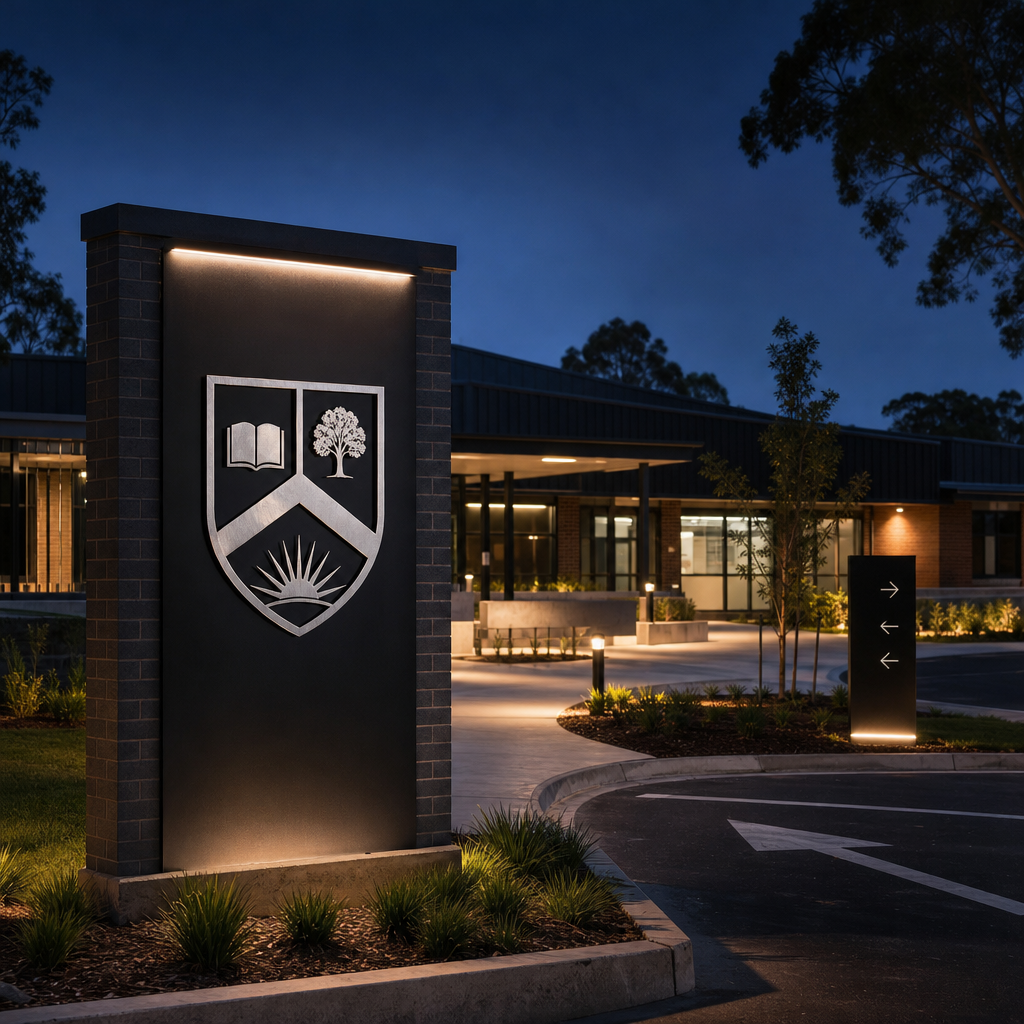
Education signage case studies show that Australian schools, universities, TAFEs and childcare centres succeed by staging projects around term breaks, splitting scope into pylon or monument signs, building identification, wayfinding and vehicle graphics, and securing council approval early. Sunquest Signs manufactures and installs each component, from CNC-cut lettering to illuminated shop fronts, without disrupting term-time operations.
A school, campus or childcare centre is not like a retail shop that can close for a weekend refit. Students are on site most days of the year, parking and pickup traffic is constant, and every gate, building and vehicle carries the institution's name. Getting signage wrong means confused visitors, missed deliveries, or a council stop-work notice on a pylon sign that was never approved.
This article walks through how a primary school entry statement, a university campus, a childcare centre and a private training college each approach signage differently, and what that means for materials, approvals and timing. Every example reflects the way Sunquest Signs actually scopes and stages these projects: pylon and monument signs, CNC and laser-cut lettering, illuminated and neon feature signage, business signage suites, and vehicle wraps for buses, utes and campus fleets.
Key Takeaways
- Education sites need staged signage rollouts across multiple buildings, gates and budget cycles, not a single one-off order.
- Pylon and monument signs usually require local council development approval, and heritage-listed campuses often need an additional heritage check.
- Term breaks (typically April, July, the September or October break, and the long December-January break) are the only realistic windows for on-site installation.
- Consistent CNC-cut or laser-cut lettering, in one font and colour standard, is what actually makes multi-building campus wayfinding work.
- Illuminated and neon feature signage lifts childcare centre street presence without a full shop front rebuild.
- Vehicle wraps on buses, maintenance utes and fleet cars extend brand recognition well past the front gate.
Ready to make your business impossible to miss?
Design, manufacture and installation, all under one roof in Warana.
Get a Free QuoteSignage at a Glance: Education Site Types Compared
| Site Type | Core Signage Scope | Approval Considerations | Best Install Window | Typical Sunquest Products |
|---|---|---|---|---|
| Primary or secondary school | Entry statement, building identification, internal wayfinding | Council development approval for pylon/monument signs; heritage overlay check on older buildings | A term break (April, July, or the longer end-of-year break) | Pylon and monument signs, CNC-cut aluminium lettering, business signage suite |
| University or TAFE campus | Faculty signage, multi-building identification, campus-wide wayfinding | Staged approvals across the precinct, often against an internal campus design standard | Between semesters, over the summer break | Laser-cut faculty signage, building identification panels, entry pylon signage |
| Childcare and early learning centre | Shop front signage, fascia and window graphics, illuminated feature element | Standard commercial signage approval; some strip shopping centres set their own street presence rules | Any time, scheduled around drop-off and pickup, no term dependency | Illuminated and neon feature signage, shop front signage, window graphics |
| Private training college or RTO | Shop front sign, reception feature wall lettering, vehicle wrap | Landlord or body corporate sign-off in leased premises, plus standard council rules | Flexible, not tied to a school term | Shop front signage, laser-cut lettering, vehicle wraps |
Why Education Sites Are Their Own Signage Category
Education sites need multi-stage signage plans because they combine several buildings, budgets tied to school terms, and layered approval processes. A single project might need pylon signage, building identification, internal wayfinding and vehicle graphics, each approved and installed at a different time so students, staff and pickup traffic are never disrupted.
A suburban school is not one site, it is several. There is the main road entry, the staff car park, the bus zone, the delivery gate and often a separate early learning or out-of-school-hours care entrance. Each needs its own signage decision, and each decision usually sits with a different budget line, whether that is a capital works allocation, a P&C fundraising target, or a facilities maintenance fund.
Council approval adds another layer. Most local government planning schemes across Australia treat pylon and monument signs as a form of development, which means a development application before anything goes in the ground. Schools built before the 1970s are often heritage-listed or sit inside a heritage conservation area, which can mean an additional heritage referral before a pylon sign, illuminated feature or even new building identification is approved. This is one reason a school signage Australia project takes longer to plan than a comparable retail fitout, even when the physical scope is smaller.
Then there is timing. A cafe can close for a weekend regrout of its shop front sign. A school cannot fence off its main driveway on a Tuesday afternoon while parents are doing pickup. Every physical install has to land in a window when the grounds are genuinely empty, which in practice means a term break.
Case Study: A Primary School Entry Statement
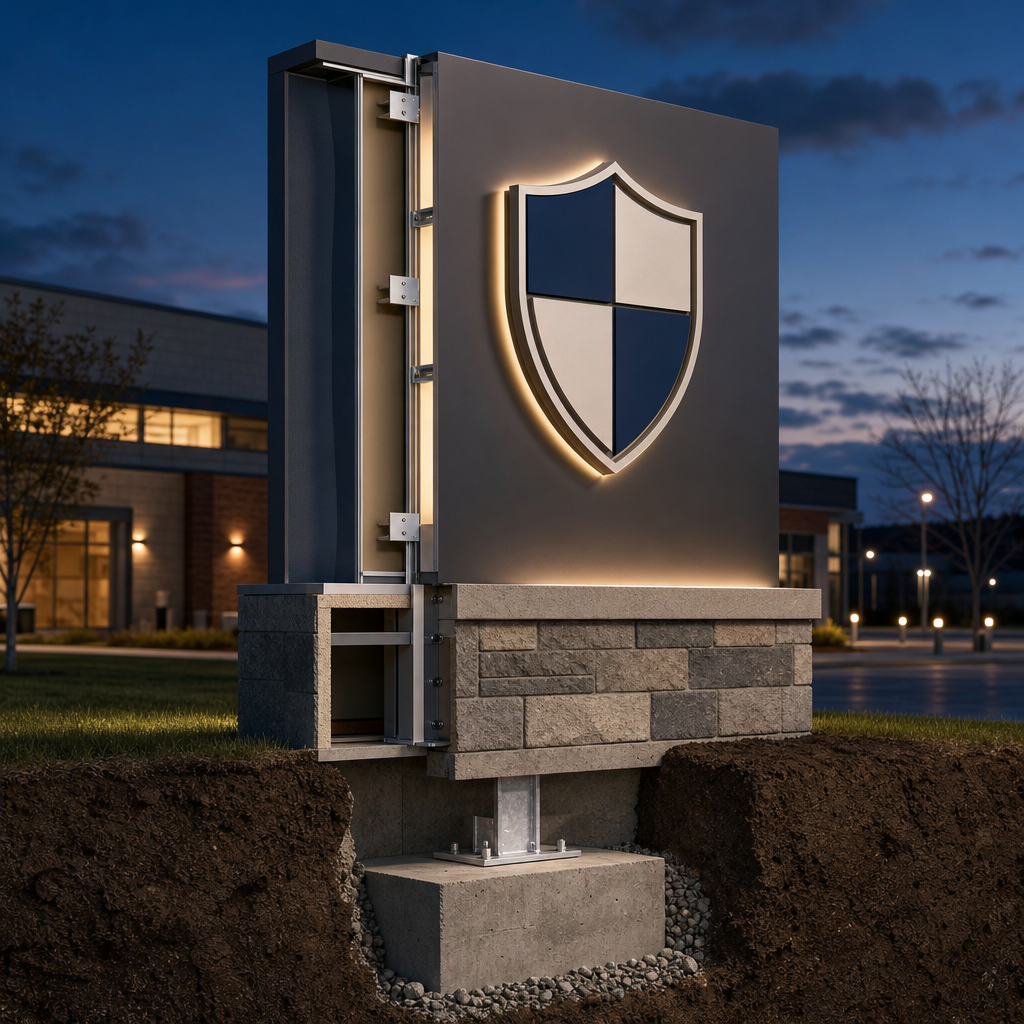 A typical primary school entry statement combines a pylon or monument sign with CNC-cut aluminium crest lettering and building identification at the main gate. Consider a staged rollout: a monument sign carrying the school crest and name in the first year, followed by matching building identification and directional signage once the next budget cycle opens.
For the monument itself, the base is usually rendered masonry or a clad aluminium composite panel structure, set on a concrete footing dug and poured well ahead of the install date. The school crest and name are CNC-routed from aluminium or acrylic, then powder-coated in the school's colours so they will not fade under direct sun. Some sites choose face-illuminated or halo-lit lettering if the entry sits close to a busy road and needs to read clearly at dusk during after-school pickup or evening events.
The survey has to happen while the school is operating normally, so a site visit is usually scheduled for a quiet afternoon with the business manager or grounds staff on hand. Design and artwork sign-off follows during term, along with the council development application, since most councils will not fast-track a pylon or monument sign approval. Manufacture then runs in the background while the term continues, with installation locked in for the next school holiday period so trades are never working near an open driveway during drop-off or pickup.
Once the entry statement is in, many schools follow with a matching business signage suite for the administration building, reception and staff room doors, so the crest, font and colour used at the gate carries through the whole site rather than stopping at the fence line.
Case Study: A University or TAFE Campus Wayfinding Rollout
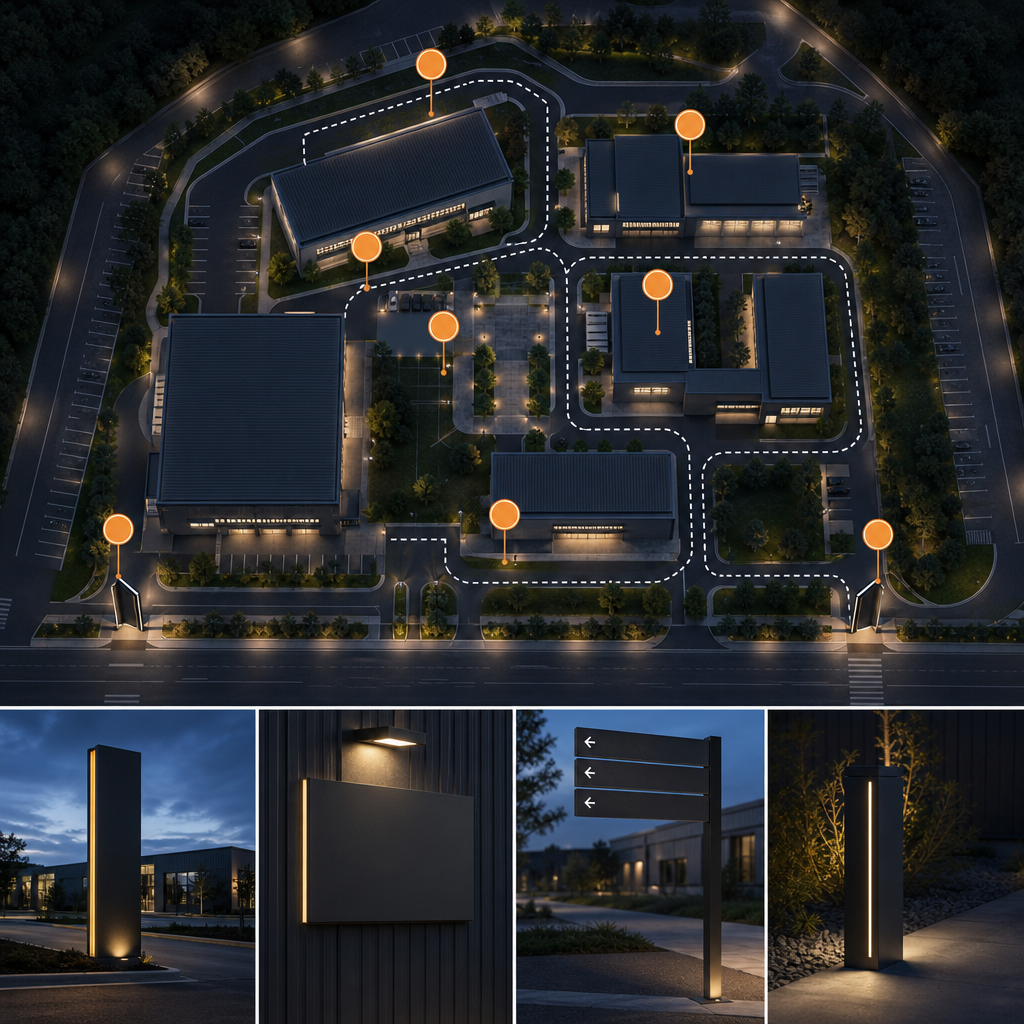 University and TAFE campuses need laser-cut faculty signage and building identification panels that stay consistent across dozens of buildings built in different decades. Consider a multi-building rollout built around one master signage specification for font, colour and material, then staged fabrication and installation building by building across successive semester breaks.
The biggest problem on most established campuses is not missing signage, it is mismatched signage. A campus built out over 40 or 50 years often has three or four different sign styles layered on top of each other, from hand-painted building numbers to 1990s vinyl-cut fascia lettering. University campus signage projects usually start by fixing the standard: one font, one colour palette, one lettering depth and mounting method, documented so every future building follows the same rule.
Faculty and department signage is typically laser-cut from acrylic or aluminium, since laser cutting holds tight tolerances on small serif or sans-serif letterforms that CNC routing can struggle with at a smaller scale. Building identification panels, by contrast, are usually larger CNC-cut aluminium composite panels mounted on stand-off fixings, which keep the panel proud of the wall face for a cleaner shadow line on brick or precast concrete facades. Wayfinding signs for schools within the wider campus, meaning internal directional signs pointing to specific faculties, libraries or student services, follow the same font and colour rules so a student walking from one end of campus to the other reads one consistent system, not three competing ones.
Because a campus cannot close, this work is staged. High-traffic buildings, such as the library, student services and main lecture theatres, are usually prioritised first, with installation timed for the summer break between academic years, then again over the shorter mid-year break for peripheral faculty buildings. An entry pylon sign at each vehicle and pedestrian entrance rounds out the project, giving the whole precinct one identifiable brand from the street.
Case Study: A Childcare and Early Learning Centre Shop Front
Childcare centre signage needs to be bright, approachable and visible from the street, since most centres compete for attention with cafes, salons and other shopfronts on the same strip. Consider a fitout combining an illuminated fascia sign or a neon feature element with coloured window graphics and directional signage, installed in a single visit since centres run year-round rather than on a school calendar.
Most childcare operators sit in a leased strip shop or a purpose-built standalone centre, and the fascia sign is the first thing a parent driving past will notice. An illuminated acrylic letter set, or a neon-style feature spelling out the centre's name or a friendly icon, gives the shop front presence after dark and on grey days, which matters for a business that relies on drive-past visibility to fill enrolments. Window graphics do double duty here, carrying the branding while also meeting the privacy and safety expectations that apply to spaces with young children, using frosted or translucent vinyl at eye level on street-facing glass.
Unlike a school, a childcare centre is not bound to term dates, so installation can happen on almost any weekday, usually scheduled around nap times or before opening to avoid disrupting routine. Approval requirements are generally lighter than a pylon sign, since a fascia or window sign sits within the existing shop front rather than being a new freestanding structure, though some shopping strips and business parks set their own signage criteria that need checking before artwork is finalised.
Case Study: A Private Training College or RTO Fitout
Private training colleges and registered training organisations typically need a shop front sign, a reception feature wall and a vehicle wrap for the fleet ute as part of one fitout. Consider a college relocating to a new tenancy: shop front signage confirms the address to prospective students, laser-cut lettering on the reception wall reinforces the brand indoors, and a vehicle wrap turns a trainer's ute into a mobile advertisement.
Shop front signage for an RTO usually has to satisfy a landlord's or body corporate's signage criteria as well as council rules, particularly in shared business parks or shopping centres where every tenant's sign needs to match agreed dimensions and mounting points. Inside, a reception feature wall carrying the college name in laser-cut acrylic or metal lettering, mounted on a painted MDF or acoustic panel backing, gives prospective students and auditors a clear, professional first impression the moment they walk in.
Because RTOs often send trainers and assessors out to workplaces and trade sites, a vehicle wrap on the fleet ute or van extends the brand well past the front door. A well-designed wrap turns every site visit into a piece of local advertising, which matters for colleges competing on word of mouth and local visibility rather than a national marketing budget. Since private colleges are not tied to a school calendar, this work can be scheduled on ordinary business days with minimal disruption.
Working Around the School Calendar
Every education signage project runs on the same rhythm: survey and design while students are on site, manufacture during the term, then install in the holidays when the grounds are empty. This keeps trades away from pickup and drop-off traffic and avoids fencing off active playgrounds during class time.
The process starts with a site survey, usually scheduled outside peak arrival and dismissal times, to measure entry points, check for underground services before any footings are dug, and confirm sightlines for council approval. Design and artwork sign-off with the principal, business manager or marketing coordinator typically happens across the following weeks, alongside the council development application if a pylon or monument sign is involved. Manufacture, whether that is CNC routing, laser cutting, illumination assembly or vehicle wrap printing, runs in the background while the term continues as normal.
Installation is then locked in for one of the four term breaks: the April break, the July break, the September or October break, or the longer December-January break, with exact dates varying slightly between states. Smaller jobs, such as internal wayfinding or a single directional sign, can sometimes be scheduled on a pupil-free day rather than waiting for a full holiday period. Any install that affects a driveway, car park or bus zone during term needs its own traffic management plan, and install crews working on active school grounds should expect standard contractor induction and Working With Children requirements before they set foot on site.
Budget and Staging Guide by Site Type
Education sites get the best value from signage by staging spend across budget cycles rather than committing to one large rebrand in a single year. Consider staging by priority: entry statement and building identification first for visibility and safety, wayfinding and directional signage second, then feature illumination, neon or vehicle wraps once the core brand presence is already in place.
Primary and secondary schools generally fund signage through capital works allocations, P&C fundraising, or a combination of both, which naturally pushes projects into stages matched to the school's financial year. Universities and TAFEs tend to run signage against a multi-year facilities or estates masterplan, which is why campus wayfinding rollouts are staged building by building rather than delivered all at once. Childcare centres and small chains usually fund signage as part of a shop fitout capital expense, often tied to a lease renewal or a new site opening. Private colleges and RTOs typically bundle signage into the setup cost of a new campus or tenancy.
Across every site type, the same logic applies. Safety and functional signage, meaning the entry statement, building identification and any tactile or wayfinding signage required for accessible entry, should come first. Directional wayfinding that reduces reception enquiries and helps new families or students find their way comes second. Feature elements such as illuminated lettering, neon accents and vehicle wraps are the layer that lifts brand presence once the essentials are already working.
Why We Push Schools to Budget for Wayfinding Before the Feature Sign
Most schools come to us wanting the pylon sign first. It is the most visible thing on the site, the crest catches the sun, and it is the photo that goes in the newsletter. Our view is that this is usually the wrong first purchase, and we say so at the first meeting.
The pattern we see across school signage briefs is consistent: the pylon sign solves a problem the school doesn't actually have, which is that people can't tell it's a school. The problems a school does have are usually inside the fence. Parents doing pickup for the first time can't find the office. Visitors walking in for a meeting don't know which building is administration. Delivery drivers drop parcels at the wrong entrance because there's no signage at all past the front gate. None of that gets fixed by a bigger, brighter sign at the road.
Our position is to sequence the budget the other way. Building identification and basic wayfinding go in first, even if that means a modest CNC-cut nameplate at the entry rather than an illuminated monument. The feature sign, the illuminated crest or the neon-lit welcome element, comes once the functional layer is sorted. It is a less exciting first invoice, but it is the one that actually reduces the daily friction a school deals with, and it means the eventual entry statement is built on top of a site that already reads clearly, rather than standing alone as the only signage that works.
This is part of a broader case study series covering how different sectors approach signage, including our work on healthcare signage, hospitality signage and retail signage. Education sites share some of the same staging challenges as healthcare facilities, particularly around working on a live site with the public present, but the term-based calendar is unique to schools, universities and childcare.
References
- Australian Bureau of Statistics, Schools, Australia (https://www.abs.gov.au/statistics/people/education/schools/latest-release)
- Australian Building Codes Board, National Construction Code (https://ncc.abcb.gov.au/)
- Standards Australia, AS 1428.1 Design for Access and Mobility (https://www.standards.org.au/)
- Heritage NSW, Heritage Act Approvals (https://www.heritage.nsw.gov.au/)
If your school, campus or centre is planning a signage refresh, new build or expansion, Sunquest Signs can run a free site survey and put together an education signage quote staged around your term breaks, so the grounds stay clear and classes are never disrupted.
Talk to a signage expert
Tell us about your project and we'll come back with options and honest advice.
Get in TouchFrequently Asked Questions
Do Australian schools need council approval for pylon signs?
Most local councils treat a freestanding pylon or monument sign as a form of development, requiring a development application before installation. Heritage-listed schools or sites within a heritage conservation area often need an additional heritage referral, which can extend the approval timeline, so it pays to lodge well ahead of the intended install date.
How does signage installation work while students are still on site?
Larger installs, particularly anything involving footings, driveway access or scaffolding, are scheduled for term breaks when the grounds are empty. Smaller internal signage can sometimes be fitted on a pupil-free day, provided the area is fenced off and a traffic management plan is in place if vehicles or pedestrians are affected.
What's the difference between a pylon sign and a monument sign for schools?
A pylon sign is typically an elevated, pole-mounted structure, while a monument sign sits closer to the ground on a solid base, often rendered masonry or clad panels. Schools often prefer monument signs at pedestrian-facing entries and reserve taller pylon signs for sites with a longer road setback.
Can childcare centres install illuminated or neon signage in a shopping strip?
Generally yes, subject to standard commercial signage approval and any additional criteria set by the shopping centre landlord or body corporate. Because a fascia or window sign fits within the existing shop front, approval requirements are usually lighter than for a pylon sign.
How far in advance should a school start planning a signage refresh?
Start the survey, design and council approval process during the term before the holiday break you want to install in. This gives enough runway for artwork sign-off, council processing and manufacture to be complete before the grounds are empty.
What signage does a university campus need beyond the main entrance sign?
Beyond the entry pylon, a campus typically needs building identification panels, faculty and department signage, internal wayfinding to student services and libraries, and directional signage for car parks and pedestrian routes, all in a consistent font and colour.
Related Articles
Custom Laser-Cut Signage Components: Letters, Faces, Panels and Fixings Explained
Sunshine Coast Signage Project Gallery: Real Local Sign Installs by Suburb and Sign Type
Signage in Caboolture: Sign Options for CBD, Morayfield and Industrial Businesses, Council Rules and Costs
Signs that set you apart
Over 40 years on the Sunshine Coast. Design, compliance, manufacture and installation handled end to end.
Get a Free Quote