
Floor graphics
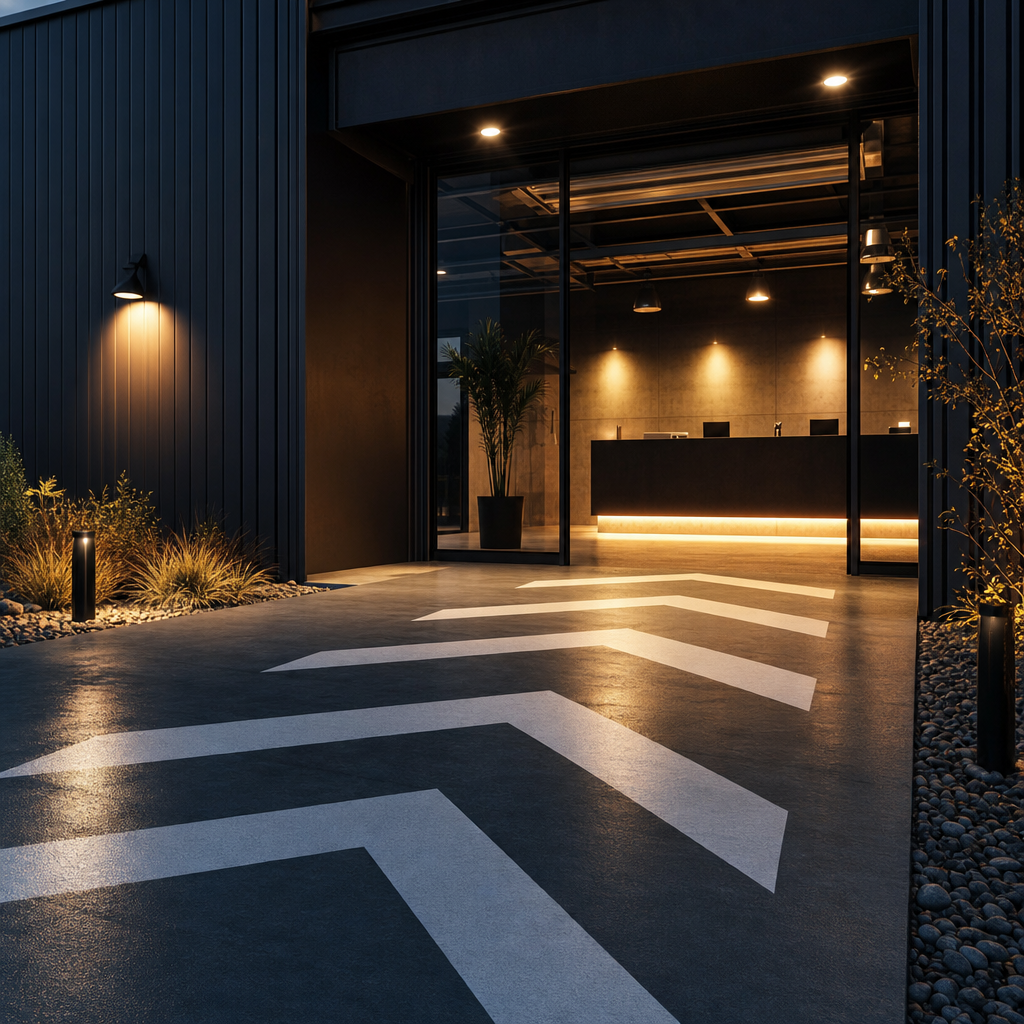
Floor graphics are printed, adhesive signs designed for application to suitable floors. They can guide visitors, promote products, mark operational zones or communicate safety instructions. Effective floor graphics require the right material, slip-resistant finish, legible design, compatible surface and controlled installation. Choosing solely on print price increases the risk of lifting, damage or premature replacement.
Floor space is valuable because people naturally look down while walking, queuing and navigating unfamiliar environments. That makes a floor graphic useful, but it does not make every floor an appropriate sign surface.
This guide explains how floor graphics work, where they perform well and what Australian organisations should check before ordering. It also covers design, slip resistance, installation, maintenance, removal and environmental claims.
Key takeaways
- Match the adhesive and laminate to the actual floor, traffic and cleaning regime.
- Treat slip resistance as a specification issue, not an optional coating upgrade.
- Keep messages short because pedestrians see floor graphics while moving.
- Test uncertain, sealed, textured or sensitive surfaces before a full rollout.
- Plan edges, joins and placement carefully to reduce lifting and trip hazards.
- Judge value by usable service and safe removal, not print price alone.
Summary table
| Decision | Suitable approach | Common mistake | What to confirm |
|---|---|---|---|
| Purpose | Give each graphic one clear job | Combining promotion, directions and disclaimers | The action viewers should take |
| Surface | Specify the exact floor finish and condition | Ordering for a generic "indoor floor" | Adhesion compatibility and removal risk |
| Location | Use areas with clear sightlines and controlled wear | Placing artwork across thresholds or damaged joints | Traffic, moisture and cleaning exposure |
| Construction | Match print film, adhesive and protective finish | Treating every self-adhesive print as floor media | Supplier guidance for the intended use |
| Safety | Assess slip resistance and edge condition | Assuming lamination automatically makes a sign safe | Evidence relevant to the installed application |
| Installation | Prepare the floor and apply with controlled pressure | Installing over dust, polish, grease or moisture | Surface preparation requirements |
| Maintenance | Inspect edges and clean with compatible products | Leaving damaged graphics in service | Inspection and replacement responsibility |
| Removal | Follow the media supplier's removal method | Pulling quickly or using unapproved chemicals | Substrate sensitivity and adhesive residue risk |
What are floor graphics?
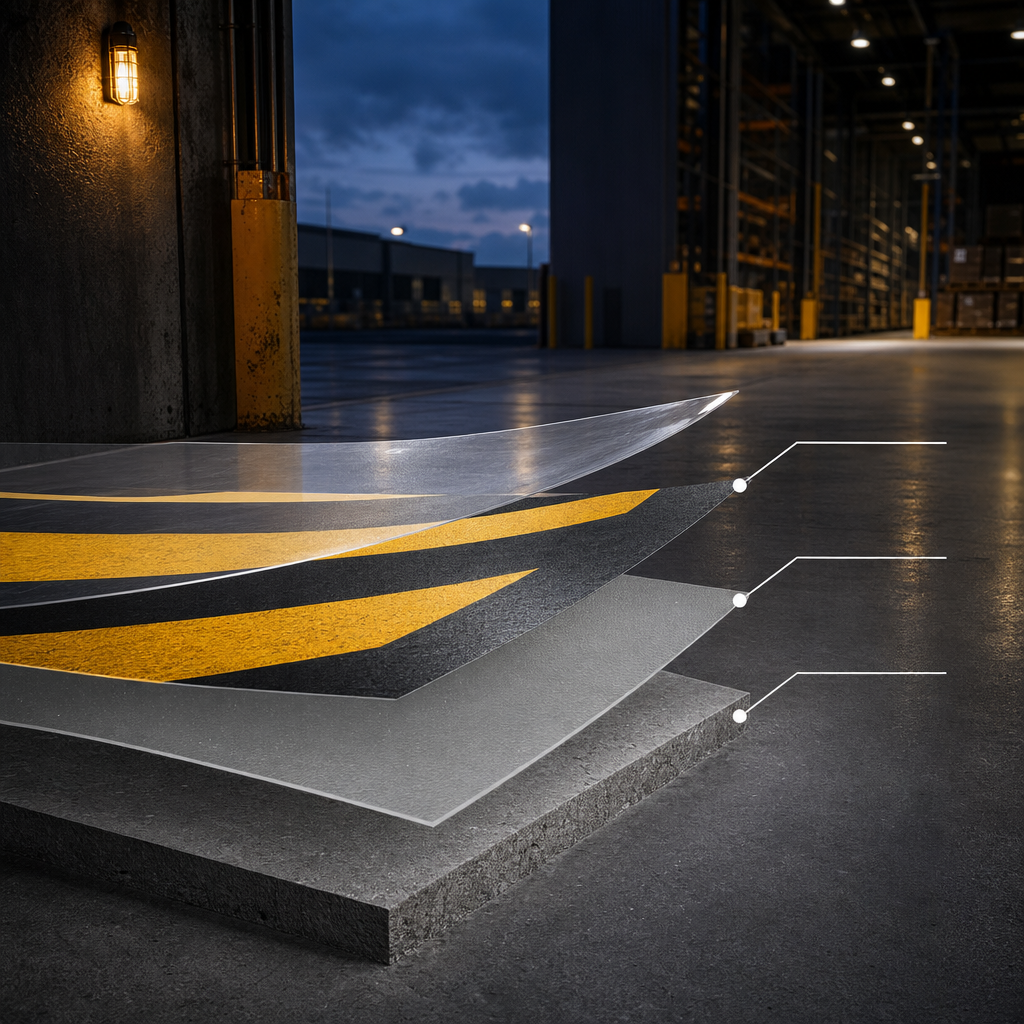
Floor graphics are purpose-built printed signs applied directly to compatible flooring. Unlike ordinary stickers, a suitable floor graphic system considers foot traffic, cleaning, edge stability, surface texture and slip risk. The complete system usually combines printed film, adhesive and a protective walking surface selected for the intended indoor or outdoor conditions.
Common names include floor stickers, floor decals, floor signage and floor vinyl. These terms are often used interchangeably, but the product specifications can differ significantly. A promotional decal for a short indoor programme does not face the same conditions as a directional marker near an entrance.
A complete specification should cover:
- the existing floor material and finish
- whether the location is indoors, outdoors or exposed to an entrance zone
- pedestrian, trolley and equipment traffic
- moisture, grit, heat and cleaning chemicals
- the intended message and viewing direction
- expected removal conditions
- applicable safety and facility requirements
Floor graphics can support branding, but their practical value comes from using otherwise empty visual space. They can direct visitors towards a service desk, identify a queue, reinforce aisle navigation or mark where an activity should occur.
They should not be treated as a substitute for every other sign. A critical emergency instruction, for example, may require permanent signs at a predictable viewing height. Floor graphics are often strongest as part of a wider wayfinding or safety system.
Ready to make your business impossible to miss?
Design, manufacture and installation, all under one roof in Warana.
Get a Free QuoteWhere do floor graphics work best?
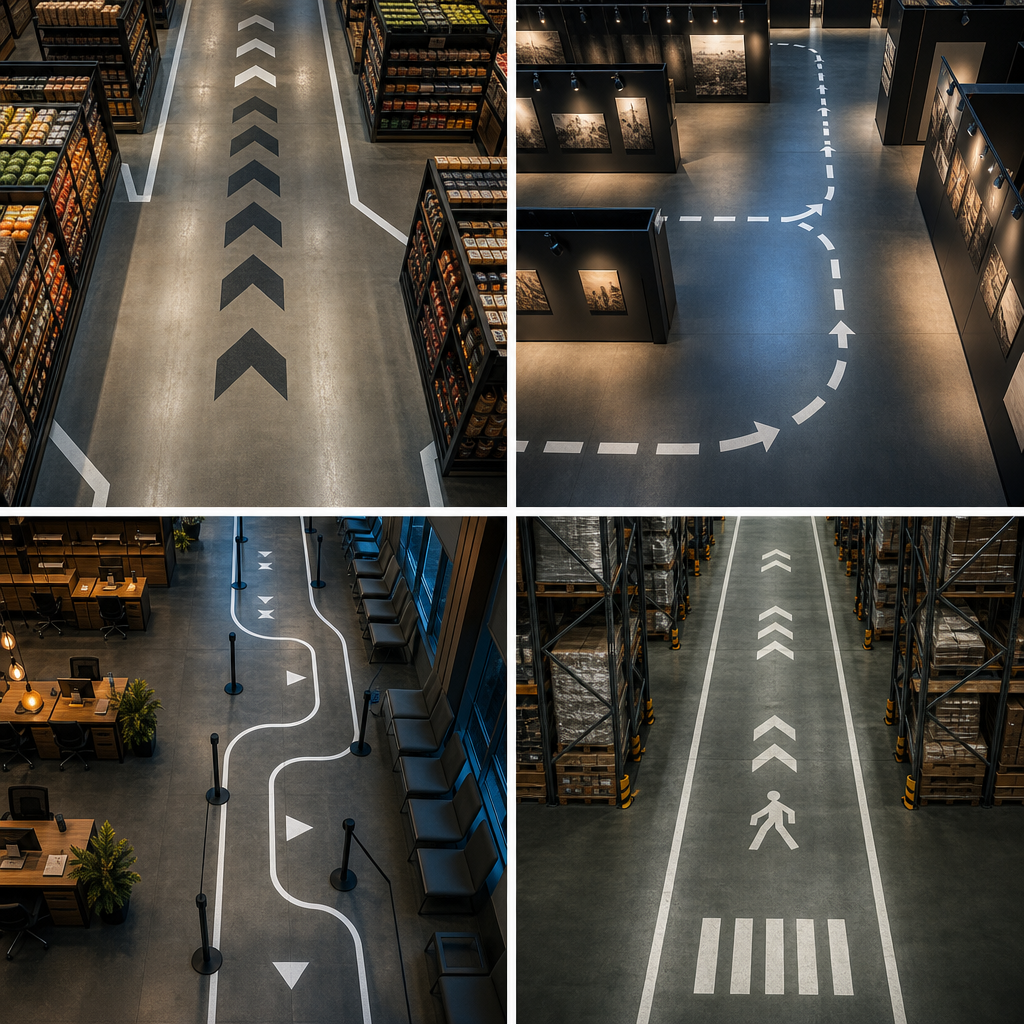
Floor graphics work best where people move through a defined path, have enough time to notice the message and encounter a clean, stable surface. Retail aisles, reception areas, exhibitions, queues and controlled workplace zones are common applications. Poor candidates include damaged floors, constantly wet areas and locations where equipment repeatedly turns across the graphic.
Retail and shopping environments
Retail floor graphics can draw attention near a product category, communicate an offer or lead customers towards a display. Their placement should complement shopper movement rather than interrupt it.
A graphic positioned too close to shelving may sit under a customer's feet before it can be read. One placed in the centre of a turning point may experience twisting loads from shoes, trolleys and cleaning equipment. The message, position and expected wear need to be considered together.
Events and exhibitions
Exhibition floors offer clear routes between entrances, stands and activity areas. Floor graphics can reinforce booth directions, sponsor branding or programme zones without taking up wall space.
The floor still requires inspection. Carpet, polished concrete, temporary floor panels and sealed timber need different media. Venue approval may also be required, especially where removal or residue could affect a bond or cleaning charge.
Offices, education and public facilities
Floor signage can help organise queues, indicate room directions and support temporary changes to movement. It is useful when layouts change more often than permanent architectural signs.
Accessibility remains important. Directional information should not depend only on a floor graphic. Glare, visual contrast, crowding and a viewer's ability to look down can affect whether the information is noticed.
Warehouses and operational areas
Floor markers can identify pedestrian routes, storage zones or equipment boundaries. However, an adhesive sign is not automatically suitable for industrial traffic. Forklift turning, tyre heat, dust, oils and damaged concrete can shorten usable service and create lifting edges.
Operational markings should be assessed within the workplace's broader risk controls. Safe Work Australia's guidance treats slips, trips and falls as hazards requiring identification and control, rather than problems solved by signage alone (Safe Work Australia).
Outdoor areas
Outdoor floor graphics face water, ultraviolet exposure, temperature changes, dirt and uneven substrates. A material described simply as waterproof may still be unsuitable for pedestrian use or a rough exterior surface.
Outdoor proposals need product-specific confirmation. In some locations, a stencil, pavement sign or other sign format may provide more predictable performance.
How should floor graphic materials be selected?
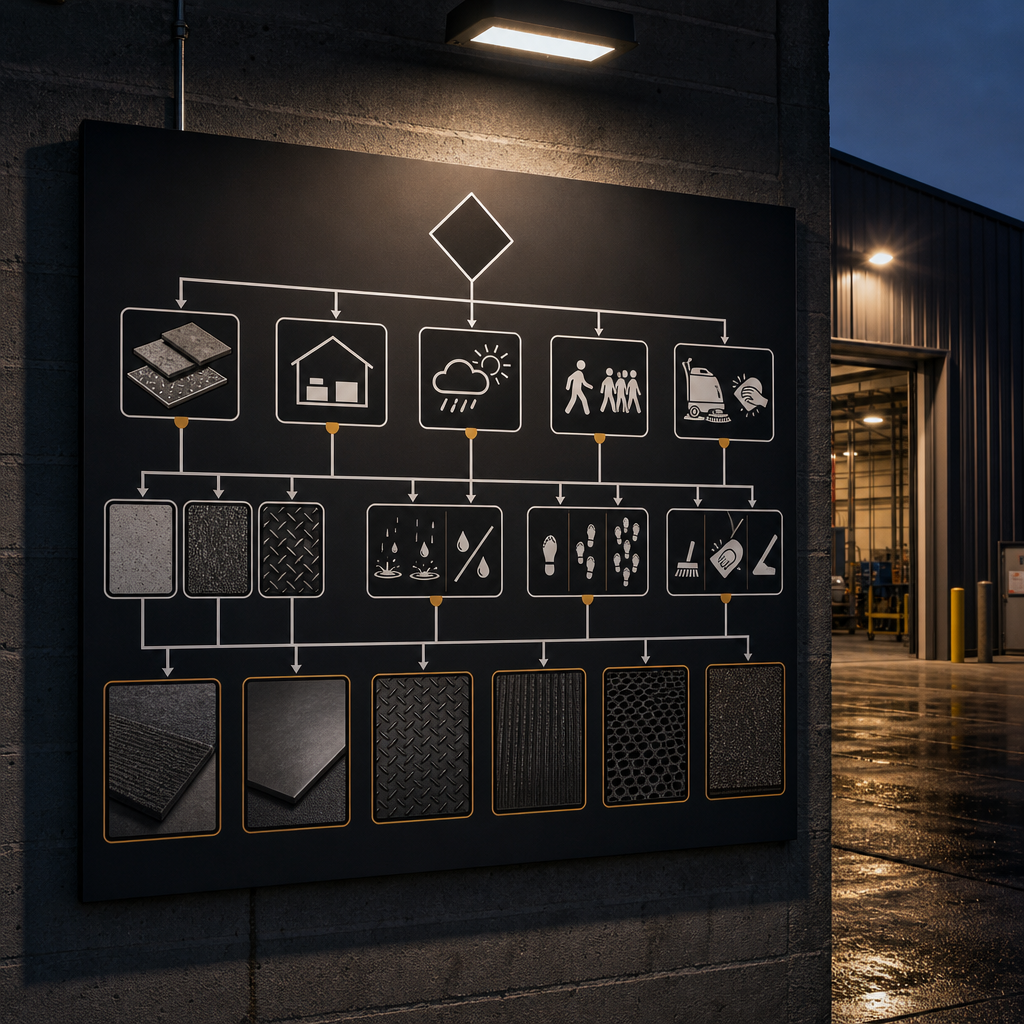
Choose floor graphic materials by working backwards from the surface, exposure and removal requirement. The correct question is not "Which vinyl is best?" It is "Which tested print, adhesive and protective surface suits this floor and use?" Material selection must account for both adhesion and the condition of the floor after removal.
Print film and adhesive
The print film carries the artwork, while the adhesive determines how it bonds to the substrate. Adhesives vary in initial tack, conformability, removability and suitability for particular surfaces.
A strong adhesive is not always a better choice. It may create removal problems on painted, coated or sensitive floors. A removable adhesive is also not a guarantee of residue-free removal under every condition. Heat, age, cleaners and substrate condition can affect the result.
The supplier should know the exact floor type. Useful descriptions include sealed concrete, ceramic tile, commercial vinyl, epoxy coating, painted concrete or low-pile carpet. "Standard floor" is not an adequate specification.
Protective walking surface
Many floor graphic systems use a textured overlaminate or purpose-designed printable surface. This protects the print and contributes to slip performance. It must remain properly bonded around the full perimeter.
A film intended for a wall, window or vehicle should not be moved to the floor merely because it sticks. Pedestrian contact introduces abrasion, contamination and edge-loading conditions that other signage does not face.
Indoor and outdoor media
Indoor suitability does not establish outdoor suitability. Exterior use introduces rain, surface water, thermal movement and higher contamination. Conversely, an aggressive outdoor adhesive may be inappropriate for a sensitive indoor finish.
Claims such as "long-lasting" or "heavy duty" are too broad for procurement. Ask for the manufacturer's intended applications, installation instructions, limitations and relevant slip information.
Test patches
A test patch is sensible when the floor coating is unknown, recently applied, porous, damaged or sensitive. It can reveal immediate adhesion issues and provide an early indication of removal behaviour.
Testing has limits. A small patch cannot reproduce every effect of traffic, cleaning and prolonged exposure. It is a risk check, not a warranty beyond the product manufacturer's stated conditions.
Are floor graphics safe and slip-resistant?
Floor graphics can be safe when the complete installed system is appropriate, correctly applied and maintained. Safety cannot be inferred from texture alone. The relevant questions include the product's slip classification, whether its test conditions match the application, the condition of surrounding flooring and how contamination, wear or lifting edges will be managed.
In Australia, AS 4586:2013 addresses slip resistance classification for new pedestrian surface materials. Standards Australia publishes the standard through its catalogue (Standards Australia). A supplier should be able to explain what has been tested, using which configuration and for what intended conditions.
A test result for one laminate does not necessarily cover every printed construction, substrate or installation method. Nor does a laboratory classification remove the need for site risk assessment.
Slip resistance is only part of safety
A floor graphic can also create risk if:
- an edge lifts into a walking path
- the graphic bridges a grout line or floor defect
- cleaning residue changes the walking surface
- water collects at an entrance
- the design resembles a step, hole or level change
- visual clutter hides an actual hazard
- the graphic is installed on a ramp, stair or critical transition without proper review
The National Construction Code contains access and movement provisions relevant to building work and pedestrian surfaces. Requirements depend on the building, location and work involved, so project teams should check the applicable NCC edition and any referenced standards (Australian Building Codes Board).
Safety graphics do not replace controls
A graphic saying "watch your step" does not repair a broken surface. A pedestrian symbol does not physically separate people from mobile equipment. Workplace signs support controls, but should not become the only response to a known hazard.
Assign someone to inspect installed graphics. If an edge lifts, the surface becomes damaged or the sign no longer communicates accurately, it should be removed or replaced promptly.
How do you design effective floor graphics?
Effective floor graphics communicate one action quickly, from the direction in which people approach. Use short wording, strong contrast, simple shapes and artwork sized for the available viewing distance. Design around movement rather than a desktop preview. If a pedestrian must stop and study the message, the graphic is probably carrying too much information.
Start with the intended action
Decide what the viewer should do. Examples include turn, wait, follow, enter, avoid or look towards a product. Once the action is clear, remove design elements that compete with it.
Promotional artwork may support more creativity than operational signage. Even then, the product, offer or direction should remain obvious. A logo without a message may build recognition but provide little guidance.
Design for the approach direction
Orientation matters. Text that faces the wrong direction may only become readable after a person has crossed it. For traffic approaching from several directions, repeated graphics or a symbol-led design may work better than one block of text.
Place directional arrows where the decision occurs, not well after it. Consider what shelving, crowds, displays or queues will obscure from each approach.
Use contrast deliberately
Contrast should exist within the artwork and against the surrounding floor. A grey graphic on grey concrete can disappear, even if the design looks balanced on screen.
Patterns can also interfere with comprehension. Detailed photography, small disclaimers and decorative backgrounds tend to become harder to process while walking. Keep essential information visually dominant.
Avoid misleading depth effects
Floor graphics can use perspective creatively, but simulated holes, steps or obstacles may surprise pedestrians. That may be the campaign idea, yet it also raises a practical safety question. Consider the audience, setting and likely response before using visual illusions in a walking path.
Prepare artwork for production
Print-ready files should contain suitable image resolution, correct dimensions, outlined or supplied fonts, and any required cut path. Important text and logos should sit clear of trimmed edges.
Colour appearance also depends on the printer, ink, media and ambient lighting. Brand-critical work may require an approved proof or colour reference. A mobile screen is not a reliable print standard.
How are floor graphics installed?
Floor graphics should be installed on a sound, clean and dry surface using the media manufacturer's method. Preparation usually determines whether the edges remain stable. Dust, polish, grease, silicone, moisture and loose coatings can prevent reliable adhesion, even when the graphic appears secure immediately after application.
Inspect the site first
Check the floor for cracks, flaking coatings, raised joints, deep texture, moisture and existing contamination. Also review pedestrian access, cleaning schedules and the ability to isolate the work area during installation.
If the substrate itself is failing, the graphic will bond to the failing layer rather than a stable floor. Installing over it may hide the defect temporarily without solving it.
Confirm the layout
Position the graphic before removing the release liner. Check orientation from the pedestrian's actual approach and confirm that doors, fixtures or queues will not cover the message.
For a series of graphics, establish consistent alignment. Small positioning errors become obvious when arrows or repeated markers form a route.
Prepare the surface
Use cleaning products that are compatible with both the substrate and adhesive system. The surface must be allowed to dry properly. Household cleaners can leave residues that interfere with adhesion, while harsh solvents can damage floor finishes.
Follow product guidance rather than assuming one preparation method suits every floor.
Apply controlled pressure
The film should be laid without trapping contamination or creating wrinkles. Firm, even pressure helps establish adhesive contact. Edges require particular attention because they receive repeated contact from footwear, trolleys and cleaning equipment.
Complex layouts, large panels and joins benefit from professional installation. The cost of correcting a misaligned or contaminated application can exceed the saving from an improvised installation.
Record the installation
For commercial sites, keep the product details, installation date, location and maintenance instructions. This makes later inspection and removal more controlled. It also helps facility teams avoid using incompatible cleaning products.
How should floor graphics be cleaned, maintained and removed?
Maintain floor graphics through routine inspection, compatible cleaning and prompt action when edges or surfaces deteriorate. Removal should follow product guidance and account for the underlying floor finish. Do not wait for a damaged graphic to become a trip point, and do not assume an aggressive solvent is safe for the substrate.
Cleaning
The correct cleaning method depends on the selected film and floor. Avoid abrasive tools or chemicals unless the manufacturer confirms compatibility. Cleaning equipment that turns sharply over an edge can increase mechanical stress.
Advise the site's cleaning contractor that floor graphics are present. Otherwise, a technically suitable installation may be damaged by a process selected for the surrounding floor.
Inspection
Look for lifting edges, bubbles, tears, worn texture, loss of legibility and contamination. Entrance zones and turning points deserve closer attention because they often receive concentrated wear.
Inspection frequency should reflect site conditions rather than an arbitrary calendar. A controlled office corridor and a busy public entrance present different risks.
Removal
Removal technique can affect both adhesive residue and substrate damage. Pull angle, temperature and pace may matter, depending on the product. Obtain the supplier's instructions before work starts.
Test any adhesive remover in an inconspicuous area. The chemical may remove residue but dull, soften or discolour the floor coating. Sensitive substrates may require specialist advice.
There is no credible universal service life for all floor graphics. Performance depends on the specified system, floor, traffic, cleaning, installation and environment. Suppliers should discuss these variables instead of offering a blanket promise detached from site conditions.
What should you ask a floor graphics supplier?
Ask a supplier to specify the complete system, not merely quote printed vinyl by area. A sound proposal should identify the intended media, protective surface, substrate assumptions, installation method, slip information and removal considerations. The supplier should also be willing to reject unsuitable applications rather than forcing one product onto every floor.
Useful questions include:
- What exact floor type and finish is the quotation based on?
- Is the media intended for this indoor or outdoor application?
- What slip-resistance evidence applies to the complete product?
- Which contaminants or cleaners can affect adhesion?
- Is a test patch recommended?
- Who is responsible for site preparation and installation access?
- How should the graphic be cleaned and inspected?
- What removal process is recommended?
- Could the adhesive affect this coating or finish?
- How will artwork orientation and cut lines be checked?
Price comparisons only make sense when quotations cover comparable materials and responsibilities. A cheaper quote may exclude lamination, installation, site preparation, testing or removal. That is not necessarily poor value, but the scope must be clear.
Environmental claims also deserve scrutiny. "Eco-friendly" is too vague without an explanation of material composition, ink, production, transport, expected waste and available disposal pathways. The ACCC advises businesses to make clear, accurate and substantiated environmental claims (ACCC).
Ask what happens to offcuts and removed graphics locally. A material described as recyclable may not be accepted by the facility available to your organisation.
The best floor graphic is sometimes no floor graphic
Our view is simple: floor space should not be used merely because it is available. If the substrate is unstable, the route stays wet or the message is safety-critical, another sign format may be the better recommendation. Good signage advice includes knowing when an adhesive floor product adds more risk than value.
This position differs from catalogue-led selling, where every enquiry is pushed towards a standard decal. The sign should start with the site problem.
Consider a hypothetical retail entrance exposed to wet shoes, grit and frequent machine cleaning. A bold floor promotion may look ideal in the artwork. In practice, that location combines contamination, concentrated traffic and demanding maintenance. Moving the graphic deeper inside, after the entrance matting, may improve visibility and reduce wear.
Now consider a warehouse route across cracked concrete where mobile equipment turns. Installing adhesive arrows over the cracks does not repair the substrate or control vehicle movement. Surface repairs, durable line marking, barriers or overhead signs may be more appropriate.
The useful question is not whether floor graphics work. They do. The useful question is whether a specific graphic, on a specific surface, under actual site conditions, will remain legible, secure and appropriate.
That site-first approach also improves creative decisions. Once approach direction, cleaning, traffic and floor colour are known, designers can work within real constraints. The result is usually simpler and more useful than artwork created before anyone inspects the location.
For advice on a floor graphics project, visit Sunquest Signs' contact page at /contact with photos of the floor, approximate artwork area, site location and intended use. Clear site information supports a more accurate recommendation.
References
These sources provide the Australian safety, construction, consumer and testing context relevant to floor graphics. A product supplier's technical data should still be reviewed because standards and general guidance do not establish compatibility with every floor, adhesive or location.
- Safe Work Australia, Slips, trips and falls
- Standards Australia, AS 4586:2013 Slip resistance classification of new pedestrian surface materials
- Australian Building Codes Board, National Construction Code
- Australian Competition and Consumer Commission, Making environmental claims: A guide for business
Talk to a signage expert
Tell us about your project and we'll come back with options and honest advice.
Get in TouchFrequently Asked Questions
What surfaces can floor graphics be applied to?
Floor graphics can be applied to compatible, sound surfaces approved for the selected adhesive system. These may include some sealed concrete, commercial vinyl, tiles, coated floors and carpets. Suitability varies with texture, coatings and condition, so testing may be required.
Can floor graphics be used outdoors?
Floor graphics can be used outdoors when the complete product is intended for outdoor pedestrian use and the substrate is suitable. Rain, ultraviolet exposure, temperature changes, texture and contamination must be considered.
Will floor stickers damage the floor?
Floor stickers can affect weak paint, uncured coatings, sensitive finishes or deteriorating floors. Correct material selection, surface testing and removal methods reduce risk, but they cannot make an unstable substrate suitable.
How long do floor graphics last?
There is no universal lifespan for floor graphics. Performance depends on traffic, surface preparation, installation, cleaning, moisture, exposure and product construction. Replace a graphic when it becomes damaged, insecure or difficult to read.
Are floor graphics slip-resistant?
Purpose-designed floor graphic systems may carry slip-resistance test information. Buyers should confirm which product construction was tested, the test method and whether the result applies to the proposed installation.
Can I install floor graphics myself?
Small, simple floor graphics may be suitable for self-installation when the supplier provides instructions and the surface is straightforward. Large graphics, joins, complex layouts and uncertain substrates benefit from professional installation.
Related Articles
Sunshine Coast Signage Project Gallery: Real Local Sign Installs by Suburb and Sign Type
Signage in Caboolture: Sign Options for CBD, Morayfield and Industrial Businesses, Council Rules and Costs
Signage in Nambour: Sign Options for CBD, Heritage and Industrial Businesses, Council Rules and Costs
Signs that set you apart
Over 40 years on the Sunshine Coast. Design, compliance, manufacture and installation handled end to end.
Get a Free Quote