LED Channel Letter Signs: How Fabricated Lit Letters Are Built, Mounted and Maintained
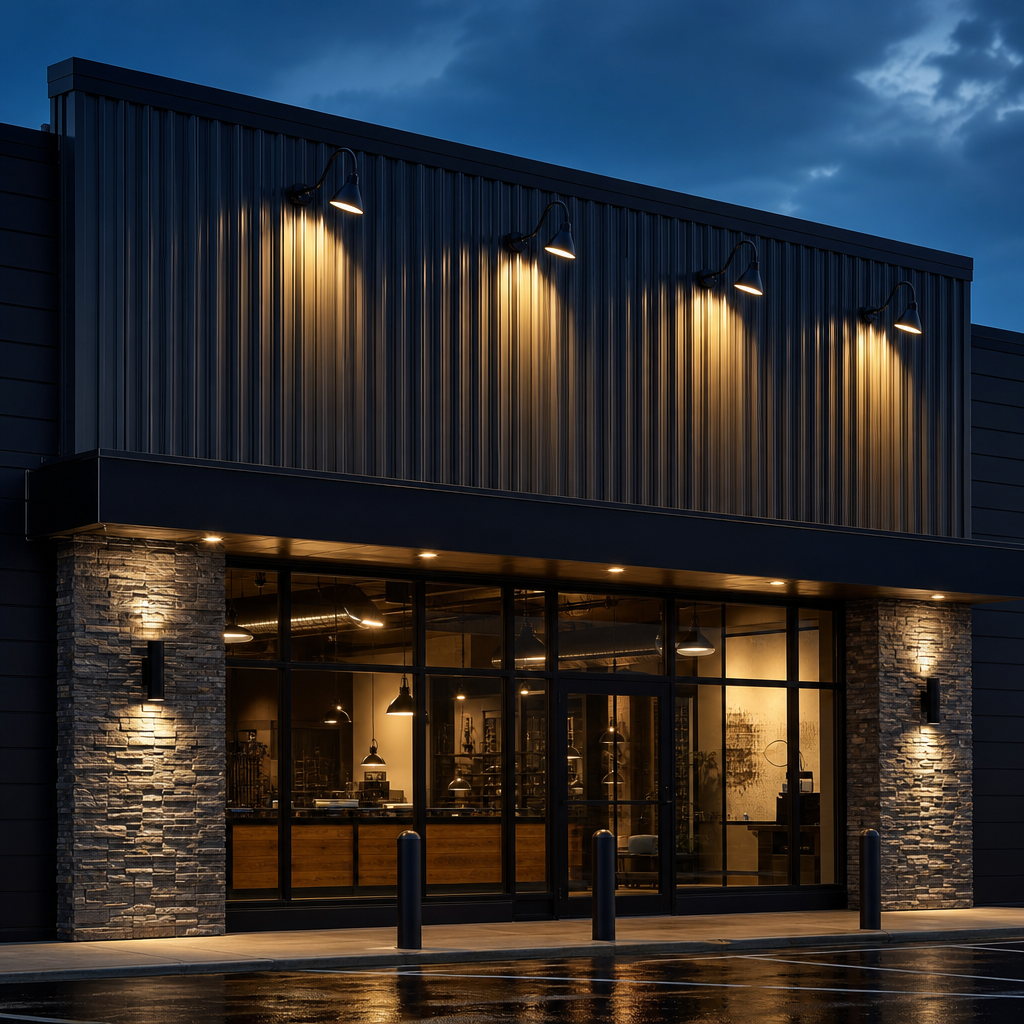
LED channel letter signs are three-dimensional shop front letters fabricated from acrylic and aluminium, each fitted with an internal LED module and wired to a low-voltage transformer. They sit above flat panel and vinyl signage as the premium option, built letter by letter rather than printed on a single sheet, and designed to read clearly by day and glow by night.
Anyone who has driven past a well-lit channel letter sign at night knows the difference between a business that looks established and one that looks like it is renting a shopfront for six months. The letters sit proud of the wall, the light comes from inside the letterform itself, and the whole thing reads as permanent. That presence is not an accident. It comes from how the letters are fabricated, what they are lit with, and how they are fixed to the building.
This guide walks through what a channel letter actually is, how it gets built using laser cutting and CNC routing, the lighting styles available, and the mounting and durability questions that matter most for Queensland shop fronts exposed to sun, salt air and council sign codes. By the end you will know enough to brief a fabricator properly and spot a poorly built sign before it goes on your wall.
Key Takeaways
- Channel letters are individually fabricated 3D letters, not printed vinyl or a single flat panel.
- There are four main lighting styles: face-lit, halo-lit, front-and-back lit, and non-illuminated flat-cut.
- Acrylic faces and aluminium returns are shaped with in-house laser cutting and CNC routing for crisp letterforms.
- The mounting method (flush-mount, raceway or stud-mount) decides how many holes go into your fascia.
- Coastal Queensland conditions demand IP-rated LED modules, sealed returns and corrosion-resistant fixings.
- Legibility, landlord sign-off and council approval need to be locked in before artwork goes to fabrication.
Ready to make your business impossible to miss?
Design, manufacture and installation, all under one roof in Warana.
Get a Free QuoteSummary Table: Lighting Styles Compared
| Lighting Style | How It Works | Best For | Daytime Look | Night Look |
|---|---|---|---|---|
| Face-lit | LEDs shine forward through the acrylic face | Maximum brand visibility on high street frontages | Bold, coloured letterform | Bright, even glow through the face |
| Halo-lit (reverse-lit) | LEDs shine backward, spilling light around the letter edge onto the wall | Boutique retail, clinics, professional services wanting an understated look | Solid, dimensional metal letter | Soft glowing outline on the fascia |
| Front-and-back lit | Combines face-lit and halo-lit in one letter | Corner sites and high-impact frontages | Bold coloured letterform | Glow plus outline, maximum night presence |
| Non-illuminated flat-cut | Shaped acrylic or aluminium composite letters, no LEDs | Daytime-only trade, heritage facades, budget-conscious sites | Dimensional letterform with shadow line | Not visible after dark |
What Is a Channel Letter Sign?
A channel letter sign is a run of individually fabricated 3D letters, each with a metal or acrylic return forming the side wall, a translucent acrylic face, and an internal LED module. Every letter is its own sealed light source, unlike printed vinyl lettering or a single flat lightbox panel that lights an entire sign as one unit.
The "channel" is the fabricated return: a strip of aluminium, or occasionally acrylic, bent or routed to the exact shape of each letter to form the wall the face sits on. The acrylic face sits over the top, usually somewhere between 3mm and 10mm thick, often colour-matched or finished with a translucent vinyl overlay so the letter reads the correct brand colour in daylight and lights the same colour at night. LED modules run down the inside of the return, spaced to avoid hot spots and dark patches across the letterform.
This is what separates channel letters from cheaper alternatives. Printed vinyl lettering is a flat graphic applied to glass or a substrate. A lightbox is a single sealed box with a printed or painted face, lit uniformly behind the whole sign as one panel. Channel letters give each letter its own depth, drop shadow and light source, which is why the category is often called fabricated letter signage or 3D signage letters rather than a printed graphic. Businesses moving from a banner or a vinyl-on-perspex sign to lit channel letters are usually doing it because they have taken a permanent site and want the shop front to say so.
Face-Lit vs Halo-Lit vs Front-and-Back Lit: Choosing a Lighting Style
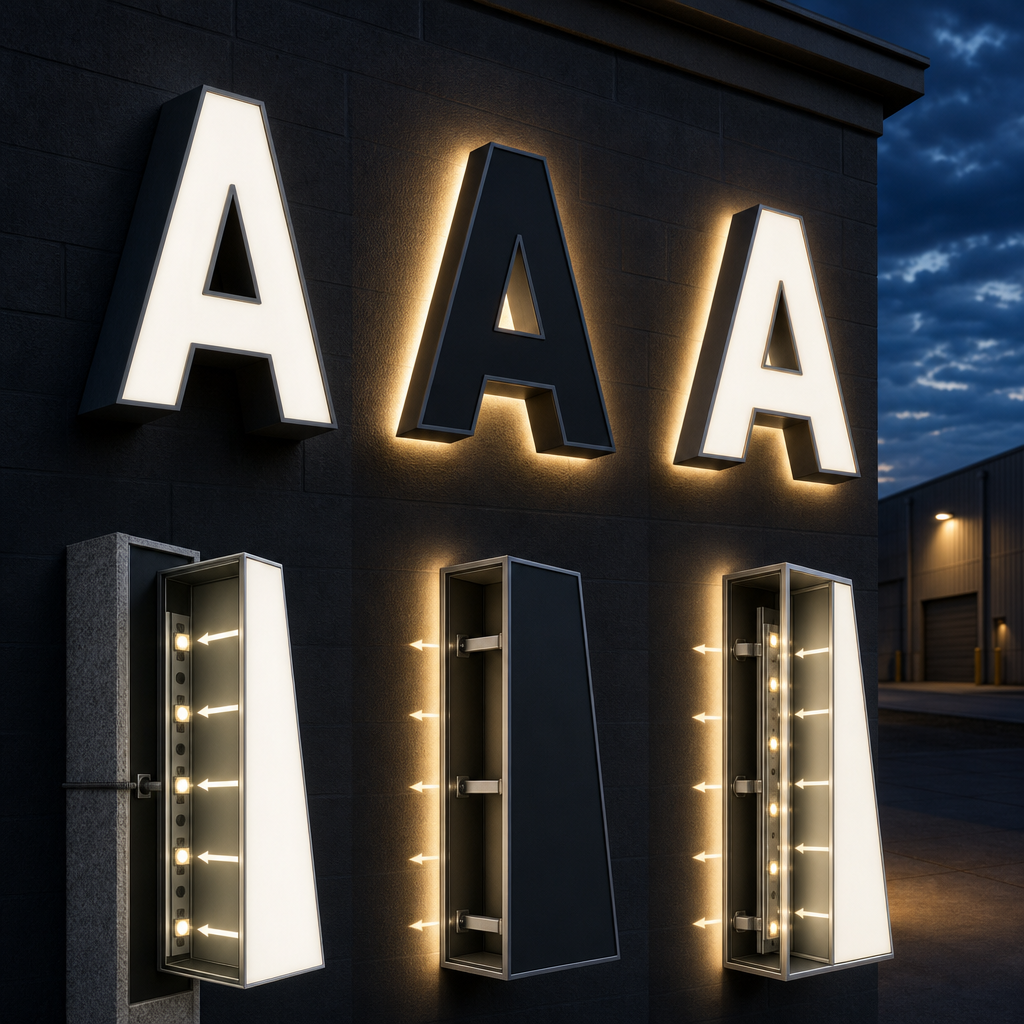
Face-lit letters shine light forward through the acrylic face for a bold, high-visibility glow. Halo-lit letters shine light backward so it spills around the letter edge onto the fascia, giving a softer, premium outline. Front-and-back lit combines both, and non-illuminated flat-cut letters skip LEDs entirely for daytime-only sites.
Face-lit letters have LED modules pointing forward inside the return, with light passing through the acrylic face so the whole letterform glows in the brand colour. This is the style for a high street frontage that needs to be read at speed from a car, and it works for gyms, fast food outlets and retail strips wanting maximum daytime and night visibility.
Halo-lit, or reverse-lit, letters usually have an opaque or solid metal face, with LEDs pointing backward into a standoff cavity so light spills onto the wall behind rather than through the letter itself. This creates a glowing outline around a dark letter shape rather than a bright colour block. It suits clinics, boutique retail and professional services chasing a quiet, premium look at night. It only works, though, on a wall that can actually show the halo: a light-coloured render or masonry, not heavily textured or dark brick.
Front-and-back lit letters combine both, with a translucent front face and a halo spill from the rear. This is the most expensive and most visually dominant option, suited to corner sites, highway-facing frontages, or sites where council caps the illuminated area and the business wants maximum impact within that limit.
Non-illuminated flat-cut letters use the same dimensional acrylic or aluminium composite letterforms without LEDs, wiring or a transformer. These suit arcades, verandas and heritage facades where a council will not approve illumination, or businesses that close before dark. They cost less to buy and run and still deliver a dimensional, illuminated-look shop front during the day thanks to the raised letterform and shadow line. For a completely different lit texture, some businesses also weigh neon signage as an alternative to channel letters, since neon delivers a script or retro glow that channel letters are not built to replicate.
Materials and Fabrication: Acrylic Faces, Aluminium Returns and In-House Cutting

Channel letters are built from an acrylic or aluminium composite face, an aluminium return that forms the side wall, and internal LED wiring, all shaped with laser cutting and CNC routing for crisp, consistent letterforms. Faces and returns are then powder-coated or vinyl-wrapped for an exact brand colour match.
Faces are cut from acrylic for translucent, lit letters, or aluminium composite panel for solid halo faces and non-illuminated letters. These are laser-cut to the exact outline supplied from the client's font or logo file. Returns are cut from aluminium coil, either CNC-routed or laser-cut and then folded to a set depth, commonly in the order of 75mm to 100mm depending on letter size, deeper for larger letters that need room for the LED module and driver wiring to sit cleanly. A trim cap, usually plastic or aluminium, finishes the join between face and return and is colour-matched or run in a contrasting tone for a branded edge detail.
In-house laser cutting and CNC cutting matter because letterform accuracy depends on it. A hand-cut return, or a laser job outsourced to a third supplier, that is off by a couple of millimetres shows up immediately in a serif or a tight internal counter, the enclosed hole in a letter like "e" or "o". Cutting faces and returns on the same in-house laser and CNC equipment used across other fabricated letter and Business Signs work means one fabricator controls tolerance from artwork file through to finished letter, rather than the job passing between three different suppliers. Finishing then locks in durability: powder-coated returns and trim caps hold colour on the metal, while vinyl wrap or paint sets the daytime colour on the acrylic face without blocking the LED glow at night.
Mounting Options: Flush-Mount, Raceway and Stud-Mount Standoffs
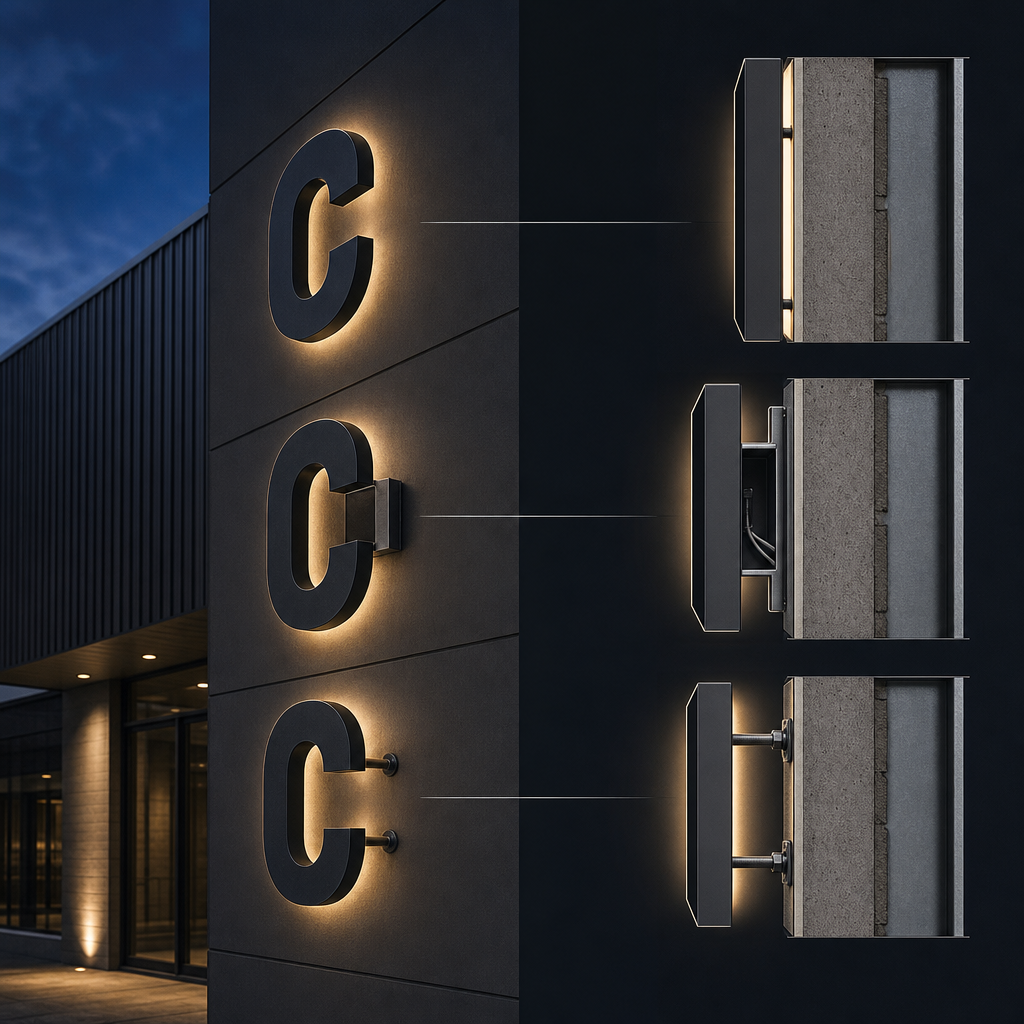
Channel letters are fixed to a building using flush-mount direct to the fascia, a raceway (a backing box holding wiring and power supplies), or stud-mount standoffs that hold halo-lit letters off the wall. Each method changes how many wall penetrations are needed and whether the facade needs patching or rendering afterward.
Flush-mount fixes letters directly to an existing solid fascia, whether that is fibre cement, metal cladding or timber. Wiring runs through a small number of penetrations behind each letter or through a single feed point. It gives the cleanest look but needs a fascia in good enough condition to carry the fixings and hide the cable run.
A raceway is a single aluminium box mounted to the wall first, with letters then fixed to the raceway rather than directly to the wall. Wiring and transformers sit inside the raceway itself. This suits situations where the wall cannot take multiple penetrations, such as a rendered heritage facade, or a leased tenancy where the landlord wants minimal building work. It also future-proofs a change of wording later: the raceway stays in place and only the letters change.
Stud-mount standoffs hold letters off the wall on threaded studs, creating the air gap halo-lit letters need for light to spill onto the fascia behind. They are also used on non-illuminated letters where the client wants a floating shadow gap rather than a flush fit. For fit-out managers working under a lease, raceway and stud-mount options both reduce the number of holes drilled into a rendered or heritage facade, which is worth raising with a landlord before artwork is finalised, not after.
Built for the Coast: UV Fade, Salt Air Corrosion and IP-Rated Components
Queensland's UV exposure fades unprotected acrylic faces over time, and salt air corrodes unsealed fixings and cheap electrical components faster than at inland sites. Durable channel letters use UV-stable acrylic, stainless or powder-coated fixings, and IP-rated LED modules and transformers with proper sealing and drainage to handle both.
Acrylic faces sitting in direct sun for years, especially closer to the coast where UV load and salt-laden air are higher, will chalk and yellow if the acrylic or the vinyl overlay is a lower grade. UV-stable cast acrylic and quality vinyl films slow this considerably, but a face is still a wear item over the sign's life, not something built to last forever untouched. Planning for an eventual face refresh is realistic maintenance, not a sign of a defect.
Salt air corrosion is the other coastal factor. Standard steel fixings, cheap zinc-plated screws and unsealed aluminium joins can corrode within a couple of seasons on a beachfront or estuary site. Stainless steel fixings, powder-coated aluminium returns and sealed silicone joints hold up far better. It is a fair question to ask any fabricator directly: what fixing grade are you using on a coastal job, and is it any different from an inland job?
LED modules and transformers used outdoors should carry an appropriate ingress protection rating for moisture and dust, in line with the international IP Code standard, IEC 60529. A transformer rated for indoor use only, tucked inside a raceway that is not fully sealed, is a common cause of early sign failure on coastal sites. Every channel letter also needs a weep hole or drainage point so condensation and driven rain do not pool inside the return against the LED wiring. A sealed letter without drainage traps moisture just as surely as an unsealed letter lets salt air straight in, they simply fail on different timelines.
On module life itself, LED manufacturers commonly rate quality modules well beyond 50,000 hours of operating life. At typical shop-front night-time running hours, that works out to well over a decade before any noticeable drop in output, provided the driver and transformer are correctly matched and not overloaded. In practice, it is usually corrosion in the housing or wiring, not the LED chip itself, that ends a channel letter's working life on a coastal site.
From Artwork to Approval: The Buying Process, Lead Times and Maintenance
Ordering channel letters starts with a font and artwork check, then a decision on minimum letter height for legibility, then landlord and council sign approval before fabrication begins. Lead time covers artwork approval, fabrication and installation, and ongoing maintenance is mostly cleaning acrylic faces and occasional LED module or transformer replacement.
Not every logo font suits a channel letter. Fine serifs, thin script strokes and tightly kerned letters are hard to fabricate cleanly and hold light unevenly. A stroke that is too thin simply cannot hold an LED module or a return deep enough to diffuse light evenly, which is why a fabricator will often widen a stroke slightly, or recommend a bolder weight of the same typeface, for the lit version of a logo.
On minimum letter height, the sign industry's long-running rule of thumb, published by the International Sign Association, is roughly one inch of letter height for every 10 feet, about three metres, of viewing distance. A shop front facing a 40 km/h suburban road with a viewing distance of around 30 metres needs letters in the order of 300mm or taller to be read comfortably by a driver, not a pedestrian standing directly underneath. That is the number to check before falling in love with a compact logo mark that looks fine on a screen and disappears from the road.
Most shopping centre and strip retail leases require landlord sign-off on any illuminated signage before installation, and most Queensland local councils treat an illuminated shop front sign as development requiring exempt, self-assessable or code-assessable approval depending on size, illumination and any heritage overlay. Confirm both before committing to artwork. A fabricator worth using will ask for the lease signage clause and flag likely council requirements as part of the quote, not after the letters are already built.
Realistic lead time runs from artwork and engineering sign-off, through fabrication, to a scheduled install, typically several weeks in total once approvals are confirmed, longer again if council assessment is required. Ordering ahead of a shop fit-out completion date, rather than after it, avoids opening with a bare fascia. Once installed, maintenance is light: acrylic faces benefit from an occasional wash to keep light output even, and drivers or transformers are the components most likely to need replacement over the sign's working life. A fabricator that built the sign in-house can usually match parts and colour on a return visit rather than starting again from scratch. It is worth co-ordinating this with the rest of the shop front, from a pylon sign at the street entrance to a repainted fascia panel, so the whole frontage ages consistently.
If you have a shop front photo or an existing logo file, send it through and we will tell you honestly whether it is channel-letter ready, what lighting style suits the site, and what fabrication and approval will realistically involve.
Why We Talk Clients Out of Halo-Lit Letters More Often Than We Sell Them
Halo-lit letters photograph beautifully. They are the style most clients arrive wanting, because they have screenshotted it from another shop front or seen it after dark on a boutique storefront somewhere. In our experience fabricating both styles, halo-lit letters underperform face-lit letters on daytime legibility on most Queensland high streets, because the glow that looks striking at 8pm is invisible at 2pm, and a lot of shop fronts do the bulk of their walk-in trade in daylight hours.
The other issue is the wall itself. If a fascia is dark brick, heavily textured render or a busy cladding pattern, the halo effect barely shows at all, because there is no clean, light-coloured surface for the glow to land on. We would rather walk a client through that trade-off before the letters are fabricated than have them discover, after installation, that their new sign glows nicely once the sun goes down and effectively disappears at lunchtime.
Face-lit or front-and-back lit letters sidestep this problem because the coloured face itself carries the brand at any hour, with a halo added as a secondary layer if the client still wants it, rather than as the only light source. None of this is a blanket rule against halo-lit signage. A clinic or professional services suite doing most of its business by appointment, with an understated look genuinely called for, is a legitimate use case. It just needs to be chosen for the right reason, against the right wall, not because it looked good in someone else's photo.
References
- International Sign Association (ISA), sign design and viewing distance guidelines: https://www.signs.org/
- International Electrotechnical Commission, IEC 60529 (IP Code, degrees of protection provided by enclosures): https://webstore.iec.ch/publication/2452
- Standards Australia, AS/NZS 60598 series for luminaires: https://www.standards.org.au/
- Business Queensland (Queensland Government), guidance on business signage and planning approvals: https://www.business.qld.gov.au/
Talk to a signage expert
Tell us about your project and we'll come back with options and honest advice.
Get in TouchFrequently Asked Questions
How tall should LED channel letters be for my shop front?
As a rule of thumb published by the International Sign Association, allow roughly one inch of letter height per 10 feet, about three metres, of viewing distance. A road-facing shop front viewed from 30 metres typically needs letters around 300mm tall or more to be legible to a passing driver.
What is the difference between face-lit and halo-lit channel letters?
Face-lit letters shine light forward through a translucent acrylic face, giving a bold, coloured glow that reads well in daylight and at night. Halo-lit letters shine light backward, spilling a soft glow around the letter edge onto the wall, which suits a premium, understated look but relies on a light-coloured wall to show up properly.
How long do LED channel letters last?
Quality LED modules are commonly rated well beyond 50,000 hours of operating life, which is well over a decade at typical shop-front night-time running hours. In coastal Queensland conditions, corrosion in fixings or the housing, rather than the LED chip itself, is usually the more likely cause of an earlier repair.
Do I need council approval for illuminated channel letters in Queensland?
Most Queensland councils treat illuminated shop front signage as development requiring some level of approval, from exempt through to code-assessable, depending on size, illumination and any heritage overlay on the site. Landlord sign-off under the lease is also usually required before installation.
Can channel letters be made without LED lighting?
Yes. Non-illuminated flat-cut letters use the same dimensional acrylic or aluminium composite letterforms without LEDs, wiring or a transformer. They cost less to buy and run and suit daytime-only trade, verandas, or heritage facades where a council will not approve illumination.
How much do LED channel letters cost compared to a lightbox sign?
Channel letters generally cost more than a single flat lightbox panel, because every letter is its own fabricated, wired light source rather than one printed face lit as a single unit. In exchange, they read as a more premium, established presence and typically hold up better against direct sun and weather than a printed lightbox face.
Related Articles
Sunshine Coast Signage Project Gallery: Real Local Sign Installs by Suburb and Sign Type
Signage in Caboolture: Sign Options for CBD, Morayfield and Industrial Businesses, Council Rules and Costs
Signage in Nambour: Sign Options for CBD, Heritage and Industrial Businesses, Council Rules and Costs
Signs that set you apart
Over 40 years on the Sunshine Coast. Design, compliance, manufacture and installation handled end to end.
Get a Free Quote