
A-frame signs
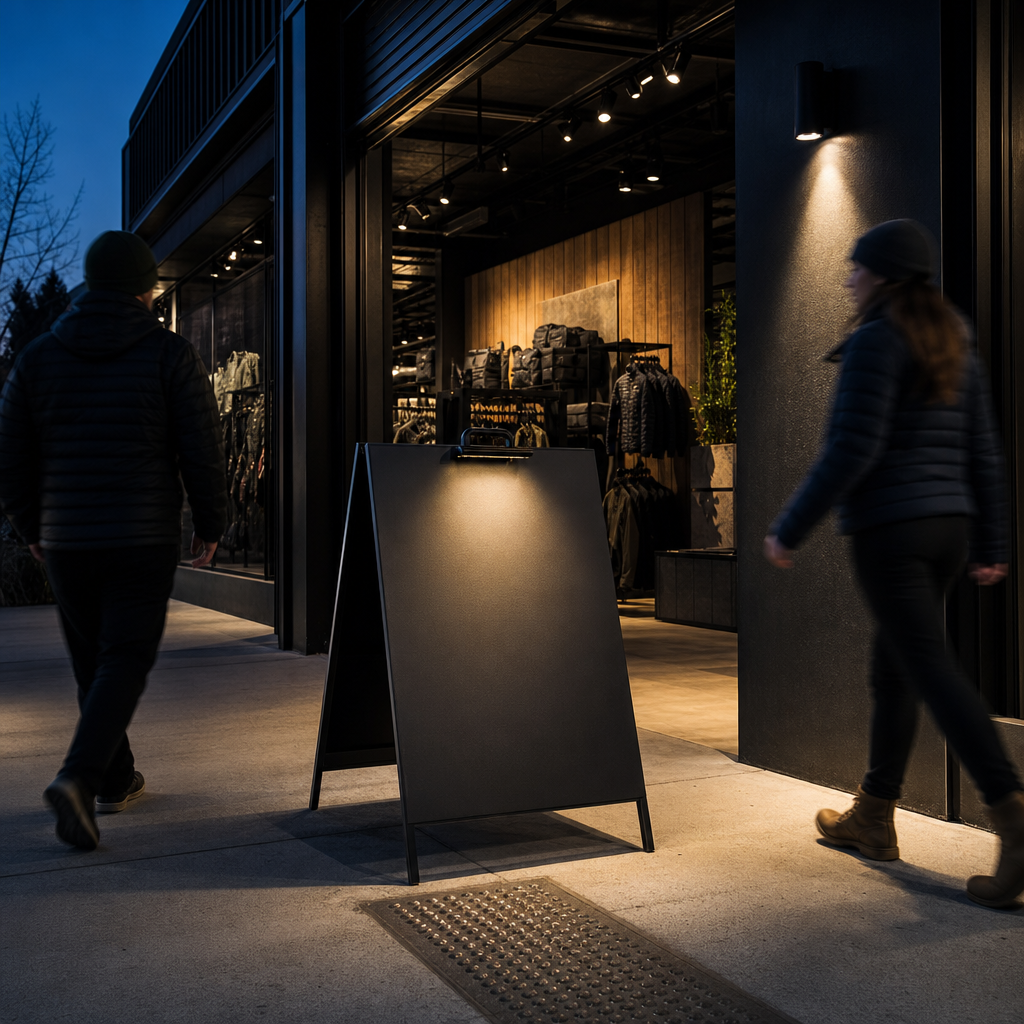
A-frame signs are portable, freestanding signs used to attract passing pedestrians and motorists near a business, event or worksite. The right model depends on placement, weather exposure, message frequency and local council requirements. Effective A-frames combine a stable structure, readable design, suitable materials and clear positioning without obstructing access.
A-frame signs look simple, but small decisions determine whether they generate attention or become expensive pavement clutter. Frame construction, sign material, message hierarchy and placement all affect practical performance.
This guide explains the main A-frame options available in Australia, how to select the right format, what makes the artwork readable and which compliance issues to check before placing a sign outside.
Key takeaways
- Choose the frame around the operating environment, not appearance alone.
- Fixed panels suit stable messages, while replaceable inserts suit regular promotions.
- Readability depends more on message hierarchy than the total amount of information displayed.
- Outdoor stability requires appropriate construction, placement and weather management.
- Council rules vary, particularly when a sign occupies a public footpath or road reserve.
- An A-frame should support a specific decision, such as entering, turning or asking about an offer.
Ready to make your business impossible to miss?
Design, manufacture and installation, all under one roof in Warana.
Get a Free QuoteSummary table
| A-frame option | Best suited to | Main advantage | Main limitation |
|---|---|---|---|
| Fixed-face metal frame | Permanent branding and stable offers | Durable, integrated presentation | Updating the message usually requires a new panel or overlay |
| Replaceable insert frame | Changing promotions, events and property listings | Artwork can be changed without replacing the frame | Inserts must be secured and protected from weather |
| Chalkboard A-frame | Cafes, bars and daily messages | Fast manual updates | Handwritten content can lose clarity from a distance |
| Snap-frame pavement sign | Printed posters and polished retail campaigns | Quick access to replaceable posters | Moving parts require suitable maintenance and handling |
| Weighted-base pavement sign | Exposed outdoor locations | Additional resistance to movement | Heavier to relocate and store |
| Corflute panel A-frame | Temporary campaigns and directional signs | Lightweight and adaptable | Less suited to long-term exposure or premium presentation |
What types of A-frame signs are available?
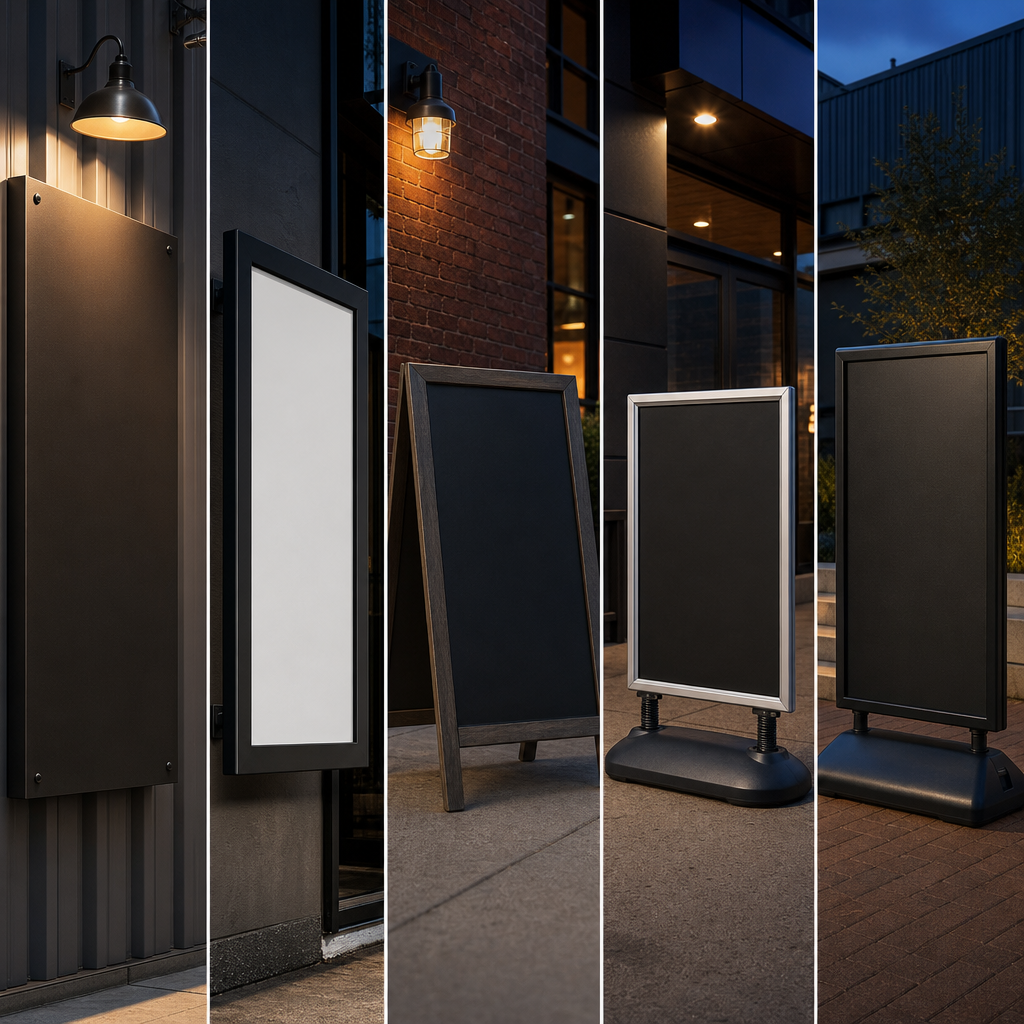
A-frame signs are available as fixed metal boards, replaceable-panel frames, chalkboards, snap frames and weighted pavement signs. The meaningful differences are how the message is installed, how often it can change, how the structure responds outdoors and how easily staff can carry, store and maintain it.
Fixed-face metal A-frames
A fixed-face frame combines the supporting structure and advertising surface into one unit. The face may be printed directly, covered with self-adhesive graphics or fitted with a separate rigid panel.
This format suits a business with a stable message. Examples include a permanent entrance marker, business name, recurring service offer or simple directional instruction.
Its main strength is simplicity. Staff can open the frame, position it and bring it inside later. There are no loose inserts to locate or protective covers to clean.
The trade-off is message flexibility. A complete artwork change may require replacement graphics or a new panel. That is reasonable for long-term branding, but inefficient for offers that change frequently.
Replaceable-panel A-frames
Replaceable-panel frames hold printed inserts made from materials such as corflute, composite panel or another rigid sign substrate. They are useful when one frame must support different campaigns.
Consider a hypothetical real estate agency promoting different inspections throughout the week. A reusable frame with replaceable inserts would avoid dedicating a complete sign to every property. The frame becomes an asset, while each panel becomes campaign material.
Check how inserts are retained. A panel that slides in easily must also resist lifting, rattling or falling out in exposed conditions. The correct mechanism depends on the frame design and intended environment.
Chalkboard signs
Chalkboard A-frames work well where messages change daily. Cafes commonly use them for specials, while venues use them for session information, event names or directional prompts.
Their flexibility is also their weakness. Handwriting, decorative illustrations and crowded menus can become difficult to read. The board still needs a disciplined hierarchy. A short headline and one clear action will usually communicate faster than a full menu written in small text.
Weather resistance also depends on the board surface and marker system. Traditional chalk, liquid chalk and paint markers behave differently. Confirm the manufacturer's cleaning and exposure recommendations before selecting a writing method.
Snap-frame pavement signs
Snap frames place a printed poster behind a protective cover. The surrounding edges open so staff can replace the artwork without disassembling the complete structure.
They suit retail environments where poster artwork changes regularly but still needs a finished appearance. The cover can protect the print from handling and light moisture, although the complete product must be rated for its actual location.
Check hinges, corners, cover sheets and drainage details. A convenient poster mechanism has little value if dirt or moisture becomes trapped across the artwork.
Weighted-base signs
Some pavement signs use a broad or fillable base rather than a folding A-frame structure. They serve a similar advertising purpose and are often considered alongside A-frames.
The extra base mass can assist in exposed settings, but no portable sign should be treated as immune to wind. Site conditions, gusts, passing traffic and uneven surfaces all matter. Follow the product instructions and remove the sign when conditions exceed its intended use.
How should you choose an A-frame sign?
Choose an A-frame by working through location, message frequency, viewing conditions, storage and handling. Start with where the sign will stand and who must notice it. Then select the structure and artwork system. Buying a frame first and forcing the campaign into it usually produces a weaker result.
Start with the viewing environment
An indoor shopping arcade and an exposed roadside verge create different requirements. Ask:
- Will the sign be indoors, under cover or fully exposed?
- Is the surface level and firm?
- Are viewers walking, driving or waiting nearby?
- Does the sign need to face more than one direction?
- Will staff move it throughout the day?
- Is secure overnight storage available?
A pedestrian moving slowly can absorb more detail than a driver passing the site. A sign near a building entrance can also use smaller supporting information than one intended to prompt a turn from the road.
Do not assume a double-sided sign will be seen equally from both approaches. Parked vehicles, street furniture, trees and pedestrian movement can block one face. Assess the real sightlines before approving the artwork.
Match the sign to update frequency
A permanent logo and entrance message can justify a fixed panel. Weekly promotions are better suited to replaceable graphics. Daily specials may suit a chalkboard or wipe-clean format.
Update frequency affects more than printing cost. It changes staff workload. If replacing artwork requires tools, careful alignment or off-site production, staff may keep displaying an expired promotion. The best format is one the organisation can maintain consistently.
Consider carrying and storage
Portable does not automatically mean convenient. Staff may need to move the sign through a narrow doorway, lift it over a threshold or carry it into a storeroom.
Before ordering, confirm:
- folded dimensions and shape
- safe lifting and carrying method
- whether the frame can pinch fingers during opening
- where wet or dirty signs will be stored
- whether loose panels need separate storage
- who is responsible for putting the sign out and bringing it in
These operational details often matter more than minor differences in purchase price.
Compare whole-of-life value
The cheapest unit is not necessarily the lowest-cost option. Compare frame durability, replacement artwork, hardware availability, cleaning requirements and expected handling.
A reusable frame with replaceable panels may cost more initially than a temporary board, but it can be the more sensible choice for recurring campaigns. Conversely, a robust premium frame may be unnecessary for a short event held inside a controlled venue.
The correct comparison is not product against product. It is the complete signage system against the job it must perform.
How do you design an effective A-frame sign?
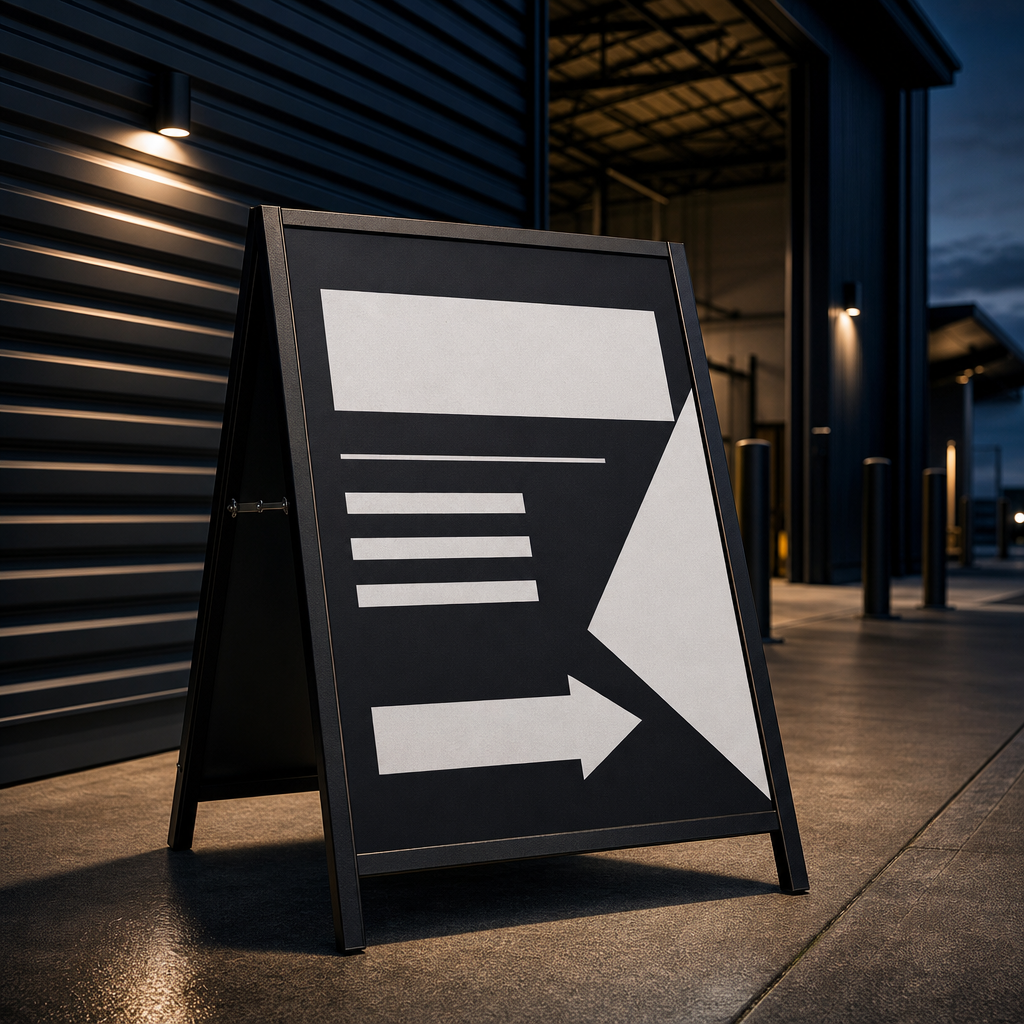
An effective A-frame communicates one primary message within the viewer's available attention window. Use a strong headline, a clear visual hierarchy and a specific next step. Remove supporting content that competes with the main action. The design should remain understandable at the actual viewing distance, not only on a computer screen.
Give the sign one job
Every A-frame should answer a practical question. Common jobs include:
- identifying an entrance
- prompting a turn
- advertising a current offer
- confirming that a business is open
- directing attendees to registration
- warning people about temporary works
Combining several jobs weakens each one. A sign that includes a logo, complete service catalogue, contact details, social handles, opening hours and several promotions makes the viewer decide what matters. That decision should happen during design, not on the footpath.
Imagine a cafe wants to attract passing pedestrians. "Lunch special inside" is a clearer primary message than a dense list covering breakfast, catering, functions, coffee, takeaway and trading hours. Supporting details can be delivered after the person stops or enters.
Build a clear hierarchy
A useful hierarchy normally includes:
Primary message: The reason to look or act.
Supporting detail: The information needed to understand the offer.
Action or direction: What the viewer should do next.
The business name may sit within this structure, but the logo should not automatically dominate. Existing customers may recognise it, while new customers need to understand the offer first.
Directional messages require particular discipline. Use an unambiguous arrow and place it beside the instruction it belongs to. Avoid placing decorative elements where they could be mistaken for directional symbols.
Design at final size
Artwork viewed on a desktop monitor can create false confidence. Fine text may look clear when zoomed in but fail once printed and positioned among street clutter.
Review the artwork at its intended physical scale. Then simulate the expected viewing distance and angle. Check whether the primary message remains clear in a quick glance.
Also inspect both faces independently. If the directional meaning changes with the viewing direction, the second face may require different artwork rather than a duplicate print.
Use contrast deliberately
Text must separate clearly from its background. Busy photographs, low-contrast colour combinations and thin lettering reduce readability. A simple layout often performs better because each element has room to work.
Contrast should also be assessed under real conditions. Reflections, protective covers, shade and direct sunlight can change how the sign appears. Matte and gloss finishes behave differently, so the intended location should guide material and finish selection.
Treat QR codes as secondary
A QR code can help a stationary pedestrian open a menu, booking page or event form. It should not carry the complete campaign.
The sign still needs to explain what the code does and why someone should scan it. Place the code where a person can approach safely without standing in a vehicle path or blocking pedestrian movement. Always test the final printed code on multiple mobile devices before deployment.
Where can an A-frame sign be placed legally in Australia?
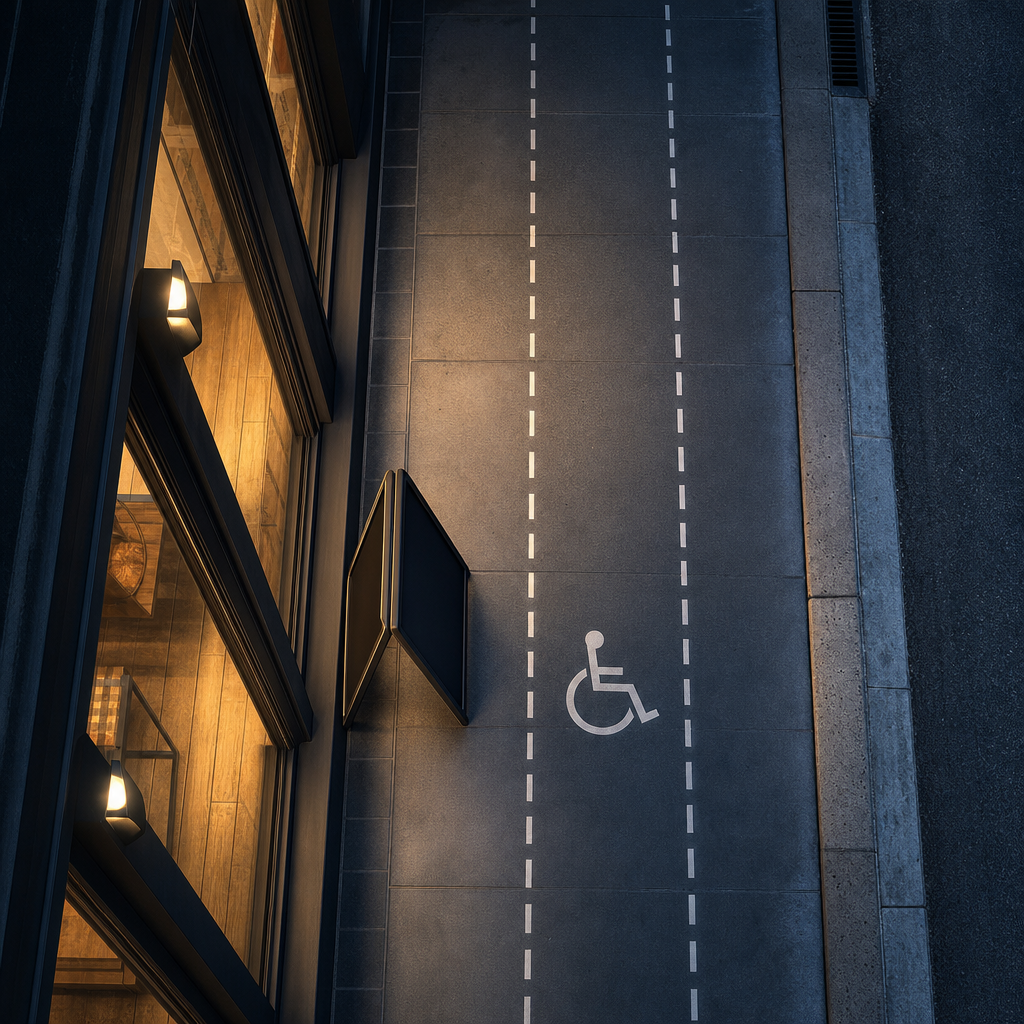
An A-frame can generally be placed on private property with the relevant owner's approval, subject to planning, lease and safety requirements. Placement on a public footpath, nature strip or road reserve may require council permission or may be restricted. Always check the rules applying to the exact site before installation.
Council requirements are local
There is no single approval rule covering every Australian footpath sign. Councils regulate advertising devices through planning schemes, local laws, footpath trading policies and permit systems.
Requirements may address placement, operating hours, sign construction, public liability insurance, pedestrian clearance and the number of advertising items outside a premises. A format accepted in one council area may not be accepted in another.
Do not rely on the fact that nearby businesses use A-frames. Their signs may have permits, operate under older approvals or simply be non-compliant. Check with the relevant council and retain written approval where required.
Keep accessible paths clear
A pavement sign should not create an avoidable obstacle for pedestrians, wheelchair users, people using mobility aids or people with low vision. The Disability Discrimination Act 1992 establishes broad protections against disability discrimination. AS 1428.1:2021 also provides recognised access and mobility design requirements for buildings, although its direct application depends on the site and project.
Good placement means more than leaving a narrow gap around the frame. Consider the complete path, nearby kerb ramps, door swings, tactile indicators, queues and street furniture. The route must remain predictable and usable.
Positioning a sign against an existing building line or approved street furniture zone may be safer than leaving it isolated within a walking path. The council's rules remain the deciding factor for public land.
Do not create a traffic hazard
A sign intended for drivers must not imitate regulatory signage, hide an official traffic sign or distract people at a complex road location. It should not obstruct sightlines at driveways, intersections or pedestrian crossings.
Directional language must also be accurate. If the sign cannot be positioned where a driver can respond safely, choose another location or another signage format. Visibility without a safe response opportunity is poor communication.
Keep advertising claims accurate
The Australian Consumer Law applies to advertising claims made through signs, not just websites and online campaigns. The Australian Competition and Consumer Commission explains that businesses must not make false or misleading claims in advertising and promotions.
Offers should state material conditions clearly. Avoid displaying expired promotions, unavailable prices or ambiguous discount claims. Replaceable inserts can help businesses update offers promptly, but responsibility still sits with the advertiser.
How should A-frame signs be installed and maintained?
Install an A-frame on a stable surface, open or assemble it according to the manufacturer's instructions and confirm that panels, hinges and retaining components are secure. Inspect the sign regularly for movement, sharp edges, loose hardware, damaged graphics and dirt. Remove portable signs during unsuitable weather or when the premises closes.
Use a placement check before opening
Staff should assess the site each time the sign is deployed. Conditions can change because of construction works, outdoor dining, parked vehicles, deliveries or events.
A practical check includes:
- confirming the approved placement area
- inspecting the surface for instability or trip hazards
- checking pedestrian and doorway clearance
- securing inserts and moving components
- viewing the sign from each intended approach
- confirming that the displayed offer is current
This process can be added to the business opening procedure. Clear ownership prevents the sign from being placed inconsistently by different staff members.
Clean the frame and graphics correctly
Dust, road residue and fingerprints reduce presentation. Use cleaning products compatible with the printed surface, protective cover and frame material. Abrasive tools and harsh chemicals can scratch panels, lift graphic edges or cloud transparent covers.
Clean chalkboard surfaces according to the marker manufacturer's instructions. Mixing marker types can leave ghosting or residue that makes later messages difficult to read.
Allow wet signs to dry before placing them into enclosed storage. Trapped moisture can affect artwork, hardware and surrounding items.
Inspect wear before it becomes a hazard
Look for loose hinges, damaged feet, bent frames, cracked covers, lifting vinyl and exposed panel edges. Retire or repair a sign if it no longer opens securely or stands as intended.
Printed inserts should also be reviewed for fading, outdated details and physical damage. A sound frame can still present the business poorly when the visible graphic is dirty or obsolete.
Plan for weather instead of reacting to it
"Outdoor" does not mean suitable for every weather condition. Product ratings, base design and site exposure vary. Wind can also change quickly around building corners and open streets.
Establish a removal rule based on manufacturer guidance and site conditions. Staff should not wait for a sign to move before bringing it inside. A portable advertisement is not worth risking injury or property damage.
The strongest A-frame is often the one with less content
Our view is that most A-frame problems are communication problems before they are product problems. Businesses often ask for a larger board when the message is overcrowded. Removing competing information can improve clarity without increasing the sign footprint, production complexity or obstruction risk.
This is the gap in many buying guides. They compare frames, materials and prices but treat the graphic as a panel that must be filled. In practice, empty space is functional. It separates information and helps the viewer identify what matters first.
A useful test is to write the desired customer response before writing the sign copy. For example:
- "Turn into this driveway."
- "Enter to ask about the current offer."
- "Walk to the registration desk."
- "Scan to view the menu."
If the artwork contains information that does not support that response, question whether it belongs on the A-frame.
This approach also improves format selection. A short directional message may only need a simple fixed panel. A regularly changing promotional message may justify replaceable inserts. A detailed product comparison probably belongs on a landing page, brochure or in-store display rather than a pavement sign.
The objective is not to put the most information outside. It is to move the right person towards the next step.
Ordering an A-frame sign
A clear production brief should identify the sign location, intended audience, message life, artwork update frequency and storage conditions. Provide final copy, brand assets and required directions before artwork approval. If these details are unresolved, ask the supplier to recommend a format rather than selecting solely from a product photograph.
Useful information to provide includes:
- whether the sign will be used indoors or outdoors
- whether the location is sheltered or exposed
- the intended viewing direction
- whether each face needs different artwork
- how often the message will change
- who will carry and store the sign
- whether council approval has been confirmed
- the required completion date
Review proofs carefully. Check spelling, prices, dates, arrows, contact details and QR destinations. Directional artwork deserves a face-by-face review because a duplicated arrow may point incorrectly from the opposite approach.
Sunquest Signs can help assess frame formats, printed panels and artwork requirements for the intended site. Contact Sunquest Signs with the location, message and expected use so the recommendation can be based on the actual job.
References
The following sources support the access, compliance and advertising principles discussed above. They do not replace legal advice, manufacturer instructions or the local rules applying to a particular site. Council requirements should be checked directly because permits and placement conditions differ across Australian local government areas.
- Federal Register of Legislation, Disability Discrimination Act 1992
- Standards Australia, AS 1428.1:2021 Design for access and mobility
- Australian Competition and Consumer Commission, Advertising and promotions
Talk to a signage expert
Tell us about your project and we'll come back with options and honest advice.
Get in TouchFrequently Asked Questions
Are A-frame signs suitable for outdoor use?
Some A-frame signs are designed for outdoor use, but suitability depends on their construction, panel material, hardware and manufacturer guidance. Outdoor use does not mean all-weather use. Assess the location and remove portable signage when conditions make placement unsafe.
Do I need council approval for an A-frame sign?
You may need council approval if the sign occupies a public footpath, nature strip or road reserve. Rules vary between councils. Signs on private property can also be subject to planning controls, lease terms and owner approval.
Can the graphics on an A-frame be replaced?
Yes, if the frame accepts replaceable inserts, posters or removable graphics. Fixed-face models can sometimes be updated with new vinyl or replacement panels. Select the update system based on how often the message will change.
What material is best for an A-frame sign panel?
The best panel material depends on exposure, required lifespan, weight, finish and frame compatibility. Corflute can suit temporary inserts, while rigid composite or metal panels may suit longer-term presentation.
What should an A-frame sign say?
Use one primary message, essential supporting detail and a clear action or direction. Avoid filling the sign with a complete service list, several promotions or information better delivered after the person stops or enters.
How do I stop an A-frame sign from blowing over?
Use a product intended for the location, follow its assembly instructions and place it on a stable surface. Weighted designs may add resistance, but portable signs should be removed when conditions exceed the manufacturer's recommendations.
Signs that set you apart
Over 40 years on the Sunshine Coast. Design, compliance, manufacture and installation handled end to end.
Get a Free Quote