
Business Signs in Noosa: A Practical Guide for Local Businesses

Effective business signs in Noosa must identify your business quickly, remain readable in strong coastal light and present a consistent brand across the site. The right solution depends on traffic movement, viewing distance, property constraints and exposure. Planning around these conditions produces better commercial signage than simply choosing a sign product from a catalogue.
Noosa businesses operate across busy visitor precincts, local shopping centres, industrial areas and professional office locations. A sign that works beside moving traffic may fail in a pedestrian-focused retail strip. The design and installation need to suit the actual site.
This guide explains how to plan Noosa signage for visibility, coastal exposure, brand consistency, approvals and accurate quoting. It is intended for retailers, hospitality operators, professional practices, property managers and businesses preparing for a new premises, rebrand or signage upgrade.
Key takeaways
Successful Noosa signage starts with the viewing conditions and business objective, not a predetermined product. The strongest projects coordinate identification, information and directional signs while accounting for glare, weather exposure, property controls and installation access. Clear site information also leads to a more useful and accurate quotation.
- Prioritise fast recognition and legibility over decorative complexity.
- Match each sign type to a specific customer or operational need.
- Design for sunlight, glare, rain, salt exposure and colour fading.
- Keep branding consistent across the shopfront, windows, interior and vehicles.
- Check current property and council requirements before fabrication.
- Supply photographs, dimensions, artwork and access details when requesting a quote.
Ready to make your business impossible to miss?
Design, manufacture and installation, all under one roof in Warana.
Get a Free QuoteSummary table
A coordinated signage system assigns each sign a clear job. Some signs identify the premises, while others provide detail, guide movement or extend brand visibility beyond the property. The table below compares common applications without suggesting that every Noosa business needs every format.
| Signage application | Primary business need | Key planning question |
|---|---|---|
| Shopfront sign | Identify the premises | Can customers recognise it from their normal approach direction? |
| Illuminated or lightbox sign | Maintain visibility in low light | Is illumination appropriate for the site and surrounding properties? |
| Pylon or freestanding sign | Identify a setback or multi-tenant property | Can drivers read the information without slowing unexpectedly? |
| Window graphics | Add branding, privacy or trading information | Will the coverage support visibility rather than clutter the glass? |
| Reception sign | Confirm arrival and reinforce the brand | Does it suit the wall, lighting and customer viewing position? |
| Wayfinding signage | Direct visitors around the property | Are instructions consistent and placed before decision points? |
| Vehicle graphics | Extend brand recognition beyond the premises | Is the message readable while the vehicle is moving? |
What effective business signage needs to achieve in Noosa
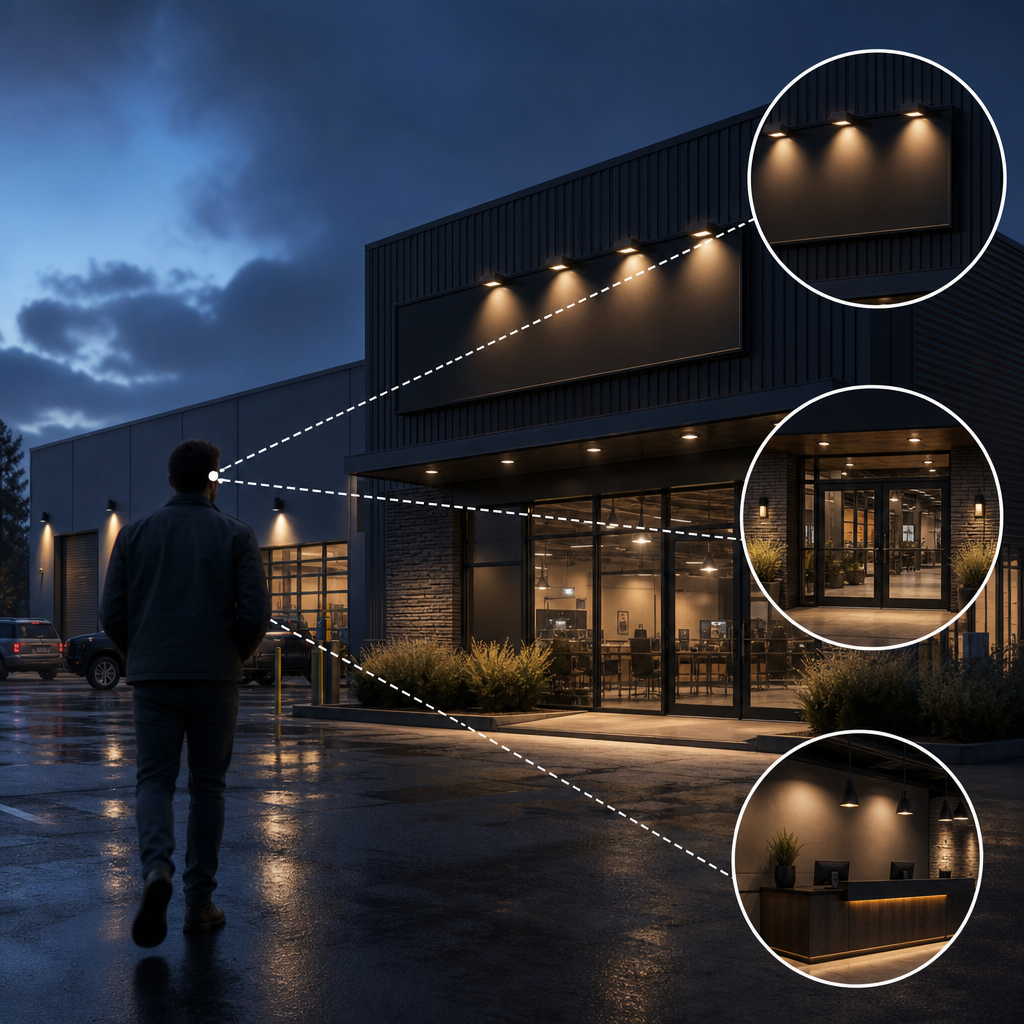
Effective business signage in Noosa must help the right person notice, recognise and locate a business with minimal effort. That requires sufficient contrast, clear wording, appropriate scale and placement based on actual viewing conditions. It also requires consistency between the first external sign and every later customer touchpoint.
Visibility must be assessed from the customer's position
Visibility is not simply about making a sign larger. The approach angle, surrounding buildings, vegetation, parked vehicles and competing signs all affect whether it can be seen.
A shopfront sign in a pedestrian precinct may be viewed from close range and from an angle. A commercial sign beside a road may have only a brief window to communicate. A professional practice inside a shared complex may depend more heavily on a pylon sign and internal wayfinding.
A site inspection should consider:
- where customers first gain a clear view of the premises
- whether they approach on foot, by vehicle or from a car park
- objects that may block the sign
- background colours and visual competition
- visibility during normal trading hours
- whether customers need identification, directions or both
Noosa had a Census population of 56,298 in 2021, according to the Australian Bureau of Statistics (ABS QuickStats). That resident market sits alongside visitor activity, but individual precincts still behave differently. Local visibility decisions should therefore be based on the site rather than broad assumptions about Noosa traffic.
Recognition needs to happen before detailed reading
Customers usually recognise colour, shape and a familiar business name before they read secondary information. A crowded sign can slow that process.
The main identification sign should generally emphasise the trading name or core brand mark. Phone numbers, service lists, web addresses and promotional messages should only be added when they have a clear purpose and remain readable from the intended position.
This does not mean every sign must be minimal. It means information needs a hierarchy. Identification comes first. Supporting detail belongs on windows, directory panels or signs viewed at close range.
Consistency should continue through the customer journey
The external sign creates an expectation. Window graphics, entry details, reception signage and directional signs should confirm that the customer has reached the correct business.
Consistency does not require every surface to display an identical logo. It requires controlled use of typefaces, colours, symbols, wording and layout. A customer should not encounter one visual identity on the building, another on the door and a third at reception.
Signage options for different Noosa premises
The right signage mix depends on how the premises is found, approached and used. Shopfront signs suit direct street identification, while pylons help businesses set back from the road. Window graphics, reception signs, wayfinding and vehicle wraps solve different communication problems and should be selected only where those problems exist.
Shopfront signs
Shopfront signs are usually the main identification point for retailers, cafes, restaurants and street-facing services. Common approaches include fabricated lettering, fascia panels, projecting signs and wall-mounted branding.
For shopfront signs in Noosa, the important decision is not just the construction type. It is where the sign sits relative to awnings, architectural lines, adjacent tenants and pedestrian sightlines. A well-positioned sign can outperform a larger sign placed outside the natural field of view.
Illuminated and lightbox signs
Illuminated lettering and lightbox signs can support businesses operating before sunrise, after sunset or in shaded locations. They may also improve contrast where the building background does not provide enough separation.
Illumination needs to be considered during design rather than added later. Brightness, light direction, electrical access, maintenance access and nearby properties all matter. Approval requirements may also differ when illumination is involved.
Pylon and freestanding signs
Pylon signs and other freestanding signs are useful where buildings are set back, screened by landscaping or shared by several tenants. They can identify an entry before a driver reaches the turning point.
Information discipline is critical. A multi-tenant pylon overloaded with small logos may technically contain every business name but still fail from the road. The layout must reflect available viewing time and the priority of the information.
Window graphics
Window graphics can display branding, opening information, services or privacy treatments. They are particularly useful when the glass area is prominent but the building offers limited sign mounting space.
Coverage should be planned around the purpose of the window. A hospitality venue may want customers to see the interior. A clinic may need greater privacy. A retail business may need room for changing displays. The graphic treatment should support that function rather than cover glass by default.
Reception and wayfinding signage
Reception signage confirms arrival and gives the interior a finished, deliberate appearance. Wayfinding signs reduce hesitation by directing customers to entries, service counters, amenities or separate tenancies.
Directional signs should appear before a decision point, not after it. Wording and arrows must also remain consistent throughout the property. Mixing terms such as "reception", "front desk" and "office" can create unnecessary uncertainty.
Vehicle wraps and fleet graphics
Vehicle graphics extend visibility beyond the premises and can connect field staff, delivery vehicles or service teams with the physical location. The strongest designs focus on recognition rather than a long list of services.
A vehicle is often viewed while moving or partially obstructed. The business name, core service and contact method need a clear hierarchy. Each vehicle should also follow the same brand rules, even when body shapes differ.
Designing commercial signage for Noosa conditions
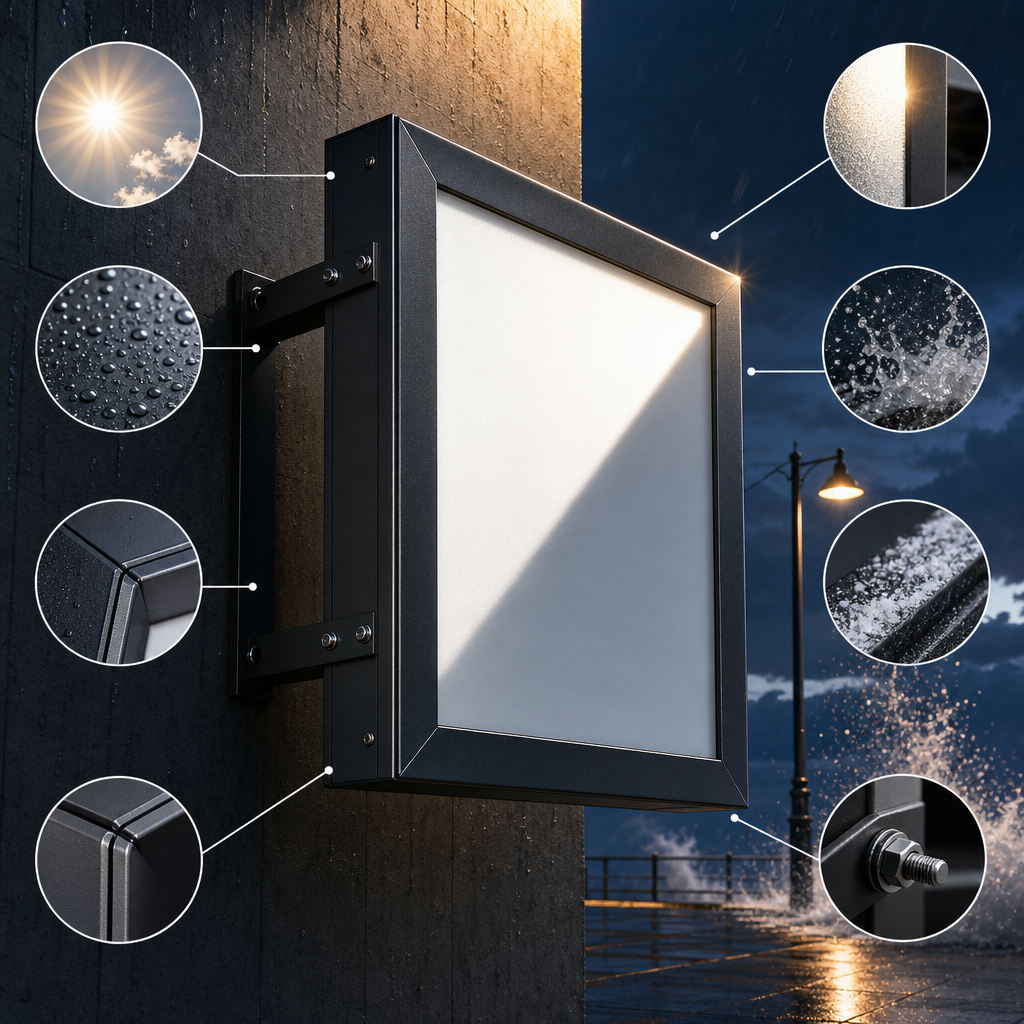
Commercial signage in Noosa should be specified for high sunlight, glare, heavy rain and varying levels of salt exposure. Effective design combines strong contrast and readable type with materials, fixings, coatings and fabrication methods selected for the exact location. No responsible supplier should promise one fixed lifespan across every coastal site.
Control contrast and glare
Bright sunlight can reduce apparent contrast, particularly when reflective surfaces or glass sit behind the lettering. A colour combination that looks clear on a computer display may become difficult to read outdoors.
Contrast should be assessed between the sign content and its installed background. Dark lettering on a pale fascia may work well, but the same lettering can disappear against tinted glass or a shadowed wall. Borders, backing panels or dimensional letters can create separation where the existing surface is visually inconsistent.
Gloss levels also matter. Highly reflective finishes can produce glare from particular angles. Material samples should be considered in relation to the site's orientation and likely viewing position.
Use type that survives real viewing conditions
Readable signage type is usually simple, well-spaced and free from unnecessary distortion. Thin strokes and tightly packed letters are vulnerable when viewed at distance or against a busy background.
Brand typefaces can often be retained for prominent names, but supporting text may need a more practical typeface. Capitalisation, spacing and line length should be tested at the intended size. A proof viewed on a laptop is not a substitute for assessing the design at physical scale.
Specify materials for the installation environment
Salt exposure can vary significantly between a protected inland site and an exposed coastal location. Rainwater paths, wind exposure, wall construction and nearby landscaping can also affect material performance.
The specification may need to address:
- corrosion resistance of frames, brackets and fixings
- sealed edges and joins
- drainage and water entry points
- compatible metals and surface coatings
- ultraviolet exposure and colour stability
- wind loading and mounting conditions
- access for cleaning and future servicing
Material choice should follow the site inspection. A generic claim that a sign is "weatherproof" provides little useful detail because exposure and construction methods vary.
Plan for maintenance without making lifespan promises
All external signage is exposed to dirt, weathering and physical wear. How quickly this becomes visible depends on materials, orientation, maintenance and local exposure.
Businesses should ask what can be cleaned, replaced or serviced without rebuilding the entire sign. Illuminated signs also need access to electrical components. Vehicle graphics need suitable cleaning practices, while damaged panels or fixings should be assessed before minor faults become broader repairs.
Planning a coordinated Noosa signage system
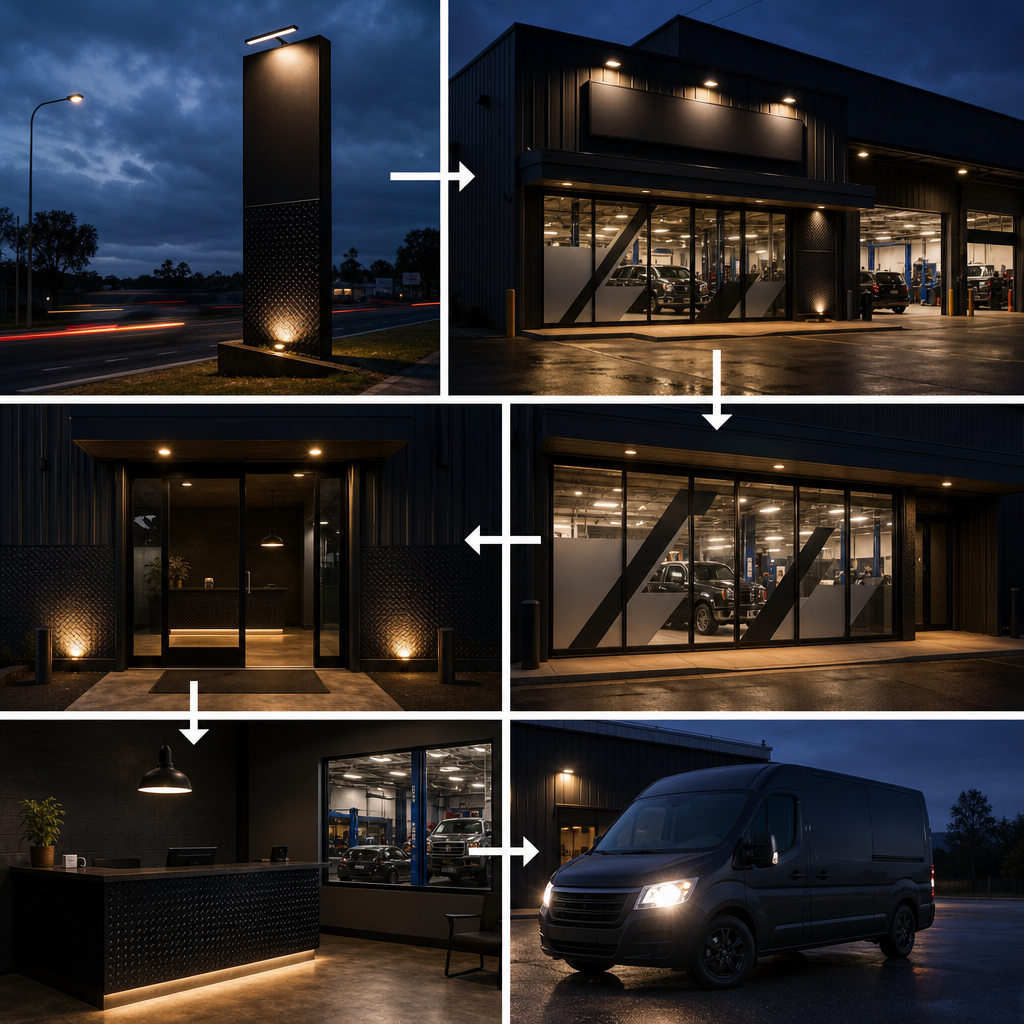
A coordinated signage system gives each customer touchpoint a defined role while preserving one recognisable visual identity. External signs attract and identify, windows provide close-range detail, internal signs confirm arrival, wayfinding directs movement and vehicle graphics extend recognition. Coordination prevents duplicated messages and inconsistent branding across the business.
Start by mapping the customer journey from the first likely approach to the final service point. Mark where a person needs to notice the business, choose an entrance, confirm the destination or find a particular area.
Then assign one primary message to each location. The external sign may carry the business name. The entry door may provide trading information. Reception may display the logo without repeating contact details. Directional signs may use shortened wording and consistent arrows.
Illustrative example: a local service business
Consider a hypothetical home services business moving into a street-facing Noosa premises.
Its shopfront sign could prioritise the company name and core service. Window graphics could add privacy to the office while presenting selected service categories at pedestrian viewing distance. A branded work vehicle could repeat the company name, service category and contact method in a simplified layout.
The three applications would not need identical compositions. They would use the same logo files, colour specifications, type rules and message hierarchy. This creates recognition without forcing a shopfront layout onto a vehicle or window.
The example also shows why product-by-product ordering can cause problems. If each item is designed separately, colours, proportions and wording can drift. Planning the system first creates a consistent result and can identify artwork requirements before production begins.
Approvals and site checks before ordering signage
Sign approval requirements in Noosa can depend on the property's location, planning controls, tenancy conditions, sign dimensions, illumination and installation method. Businesses should confirm current requirements before production and should not rely on advice prepared for another property. A site check is also necessary to verify mounting surfaces, access and services.
Noosa Council maintains the Noosa Plan and supporting planning information on its website (Noosa Plan 2020). Property owners and tenants should consult current council material or obtain qualified advice for their site. This article does not provide legal or planning advice.
Businesses can also review Sunquest Signs' signage permit and approval management article for an overview of the approval process. No link has been included because no approved internal URL was supplied for this article.
A practical pre-production check should cover:
- property ownership and landlord consent
- relevant planning or building controls
- proposed sign location and overall dimensions
- whether the sign is illuminated
- electrical supply and isolation requirements
- wall, fascia or ground conditions
- underground or concealed services where relevant
- installation vehicle and equipment access
- pedestrian and vehicle management during installation
- removal or repair of existing signs
Approval and fabrication should not be treated as unrelated tasks. If the approved size, position or lighting differs from the initial concept, artwork and engineering may also need adjustment.
What to provide when requesting a signage quote
A useful signage quote requires enough information to define the site, scope and installation conditions. Provide clear photographs, approximate dimensions, branding files, visibility goals, access details, preferred timing and the condition of existing signs. The supplier can then identify missing information and arrange a site inspection where needed.
Site photographs and measurements
Take wide photographs showing the whole building frontage, neighbouring signs, access points and customer approach. Add closer images of the proposed mounting surface and any existing sign.
Approximate measurements are useful for initial discussion, but fabrication should rely on verified dimensions. Mention whether measurements were estimated or professionally checked.
Branding and content files
Supply vector logo files where available, along with brand guidelines, colour specifications and preferred typefaces. A small image copied from a website may not be suitable for enlargement.
Also provide the exact wording required. Confirm business names, phone details, web addresses and trading information before artwork approval. Sign errors are more expensive to correct after production.
Visibility and operational goals
Explain what the sign needs to achieve. Is the problem poor visibility from the road, confusion at the entry, outdated branding, insufficient privacy or inconsistent fleet presentation?
A clear objective helps the signage company recommend an appropriate format. Asking only for "a bigger sign" may overlook a placement, contrast or wayfinding problem.
Installation and timing information
Mention restricted access, awnings, traffic, nearby power lines, trading hours and any requirement to coordinate with builders or property managers. If a new premises has a planned opening, provide the preferred installation timing early while recognising that approvals and site readiness can affect scheduling.
Existing signage should also be documented. State whether it needs removal, repair, refacing or disposal. Reusing a structure may be possible in some cases, but its condition and suitability must be inspected.
The site should choose the sign, not the other way around
My view is that businesses should avoid starting with a favourite sign product. Start with the visibility failure, customer decision point or branding inconsistency that needs fixing. This produces a tighter brief, reduces unnecessary signage and makes it easier to judge whether the finished work will deliver a practical commercial result.
This position matters in Noosa because sites differ sharply. A sign package suited to a visitor-focused retail frontage may be wasteful for an appointment-based office. A large roadside panel may solve an identification problem but do nothing for visitors who cannot find the correct entry.
Before discussing products, answer these questions:
- Who needs to notice the business?
- Where will that person be standing or moving?
- What must they understand immediately?
- What action should follow?
- Which existing visual obstacle prevents that action?
These questions create a performance brief. Products come later.
The same reasoning can reduce clutter. If the pylon identifies the complex and the fascia identifies the tenancy, the window does not need to repeat every message. It can handle privacy, promotions or close-range information instead.
This approach also improves future consistency. Once every sign has a defined role, repairs, replacements and additional vehicles can follow an established system rather than restarting the design process.
Discuss your Noosa signage requirements
Sunquest Signs can assess your Noosa site, signage requirements and available branding before preparing a quote. Whether you are opening new premises, updating a shopfront, coordinating several sign types or replacing weathered signage, begin with photographs and a clear description of the visibility or customer navigation problem you need to solve.
Contact Sunquest Signs through its official website at sunquest.com.au to discuss the location, proposed signage, installation access and preferred timing. Approval requirements and final measurements can then be identified before fabrication proceeds.
References
These references provide official demographic, planning and legislative context. They do not replace site-specific planning, building, engineering or legal advice. Council pages and legislation can change, so businesses should confirm the current version and applicable property controls when planning business signs in Noosa during 2026.
- Australian Bureau of Statistics, 2021 Census QuickStats: Noosa
- Noosa Council, Noosa Plan 2020
- Queensland Government, Planning Act 2016
- Australian Building Codes Board, National Construction Code
Talk to a signage expert
Tell us about your project and we'll come back with options and honest advice.
Get in TouchFrequently Asked Questions
What type of business sign works best in Noosa?
There is no single best type. The right option depends on the customer's approach, viewing distance and required action. Shopfront signs, pylons, window graphics, reception signs and vehicle wraps each solve different business needs.
Do I need Noosa Council approval for a business sign?
Approval requirements can depend on location, dimensions, illumination, planning controls and installation method. Check current Noosa Council information and obtain site-specific advice before fabrication. Landlord or body corporate consent may also be relevant.
How should signage be designed for coastal conditions?
Use strong contrast, readable type and materials selected for the site's exposure. Consider sunlight, glare, rain, salt, wind, fixings, coatings and water entry. Coastal exposure varies, so a site inspection is important.
What files are needed for sign artwork?
Supply vector logo files, brand guidelines, colour references, typeface information and confirmed wording where available. If suitable files do not exist, include artwork preparation in the project scope.
Can an existing sign be repaired instead of replaced?
Sometimes. The structure, face, fixings, coatings, illumination and mounting surface must be assessed. Repair may be practical when the underlying structure remains suitable, while extensive damage may require replacement.
How can I get a more accurate signage quote?
Provide site photographs, approximate measurements, logo files, wording, visibility goals, access details, preferred timing and information about existing signs. Final pricing may require verified measurements, a site inspection and approval checks.
Related Articles
Shop Front Signs in Noosa: Precinct Styles, Coastal Materials, Council Rules and Costs
Illuminated Signs in Noosa: LED Lightboxes, Lit Letters and Pylon Signage for Coastal Trading
CNC Cutting in Noosa: Custom Routed Signs, Letters and Panels for Local Businesses
Signs that set you apart
Over 40 years on the Sunshine Coast. Design, compliance, manufacture and installation handled end to end.
Get a Free Quote