Shop Front Signs in Noosa: Precinct Styles, Coastal Materials, Council Rules and Costs
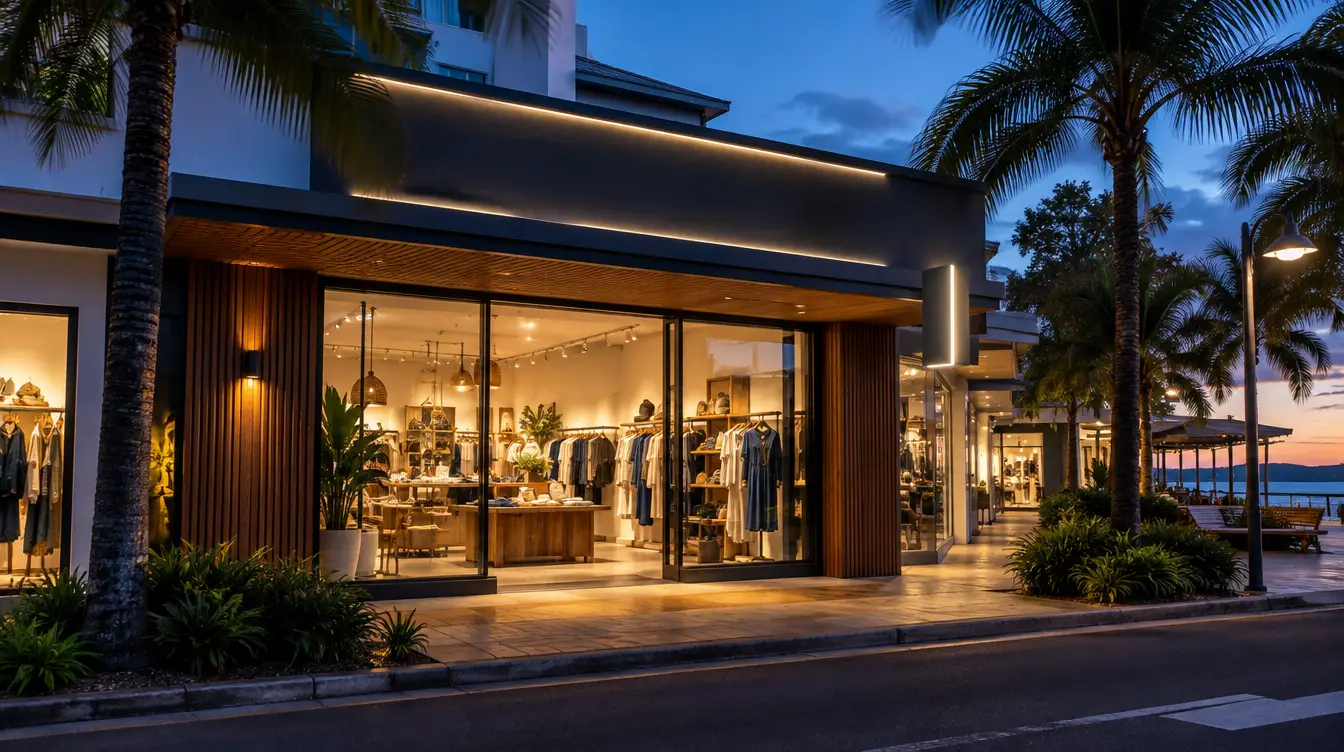
The best shop front sign in Noosa is a restrained, well-made one: halo-lit channel letters, flush lettering or a blade sign in marine-grade aluminium with 316 stainless fixings and UV-stable finishes, designed to suit the precinct and checked against Noosa Plan 2020 before fabrication. Approval depends on your site, so confirm with Noosa Council and your landlord first.
Noosa is not a typical Australian shopping strip. The streetscapes are natural-toned and design-conscious, the holiday foot traffic is heavy, and the evening dining trade means your sign works hardest after dark. Add salt air and strong UV, and a sign that looks fine in an industrial estate can look wrong, or fail, within a couple of seasons.
This guide is for owners and fit-out managers opening, rebranding or replacing a weathered sign in Hastings Street, Noosa Junction, Gympie Terrace, Tewantin and Peregian Beach. It covers style by precinct, coastal materials, the council approval path, what drives cost, and how to maintain a sign near the coast. It does not repeat the generic rundown of sign types. For that, see our Sunshine Coast shop front guide.
Key Takeaways
- Noosa rewards restraint. Understated, well-finished signs in natural or muted palettes suit the streetscape better than loud, oversized ones.
- Each precinct has its own expectations. Hastings Street, Noosa Junction, Gympie Terrace, Tewantin and Peregian Beach are not interchangeable.
- Salt air and UV decide material choices: marine-grade aluminium, 316 stainless fixings, quality powder coating, UV-stable vinyl and inks, and sealed LED modules.
- Check the Noosa Plan 2020 advertising devices provisions, and get landlord or body corporate consent, before you lock in a design.
- Price is driven by size, illumination, materials, site access and permits. Be wary of any quote that ignores approvals.
- Coastal signs need a simple maintenance routine: regular washing and a periodic fixings inspection.
Ready to make your business impossible to miss?
Design, manufacture and installation, all under one roof in Warana.
Get a Free QuoteSummary Table
| Decision | What suits Noosa | Main watch-out |
|---|---|---|
| Style | Understated, precinct-appropriate signs | Oversized or high-glare designs can attract council attention |
| Illumination | Halo-lit or softly lit letters, sealed LED | Light spill, glare and council limits on illumination |
| Materials | Marine-grade aluminium, marine-grade stainless steel fixings, UV-stable finishes | Cheaper fixings that stain and corrode |
| Approvals | Check the current Noosa planning scheme and landlord consent first | Fabricating before approval is confirmed |
| Pedestrian streets | Blade signs and window graphics | Projections over public land usually need separate permission |
| Maintenance | Regular wash and fixings check | Salt build-up left to sit |
Why Noosa Shop Fronts Are Different
Noosa shop fronts differ because the streetscape is deliberately low-key and natural-toned, visitors make up a large share of foot traffic, and many businesses trade into the evening. A sign has to feel local by day, read clearly at night, and resist a harsher environment than inland retail strips.
Three things shape every decision.
Character. Noosa's brand is relaxed and design-literate. Boutiques, galleries, cafes and restaurants tend to present quietly, with timber, stone, greenery and muted tones. A sign that shouts competes with that character and often loses. Visitors read a restrained sign as quality.
Foot traffic. Holiday visitors are walking, not driving, so the sign is read at close range and at a slow pace. That favours detail: crisp lettering, good material finishes and blade signs at pedestrian height. Tourism Noosa publishes visitor data if you want to size the opportunity for your own business, but your design brief should come from how people actually approach your door.
The dining trade. Cafes become restaurants after sunset. Your sign needs to work in daylight glare and in dim evening light, which is where illumination style matters more than brightness.
Then there is the environment. Noosa's coastal position exposes outdoor signage to salt-laden air and strong UV. Standards Australia's AS 4312 classifies atmospheric corrosivity zones across the country, and coastal sites are the reason that standard matters to anyone specifying metal, fixings or coatings.
Sign Styles That Suit Each Noosa Precinct
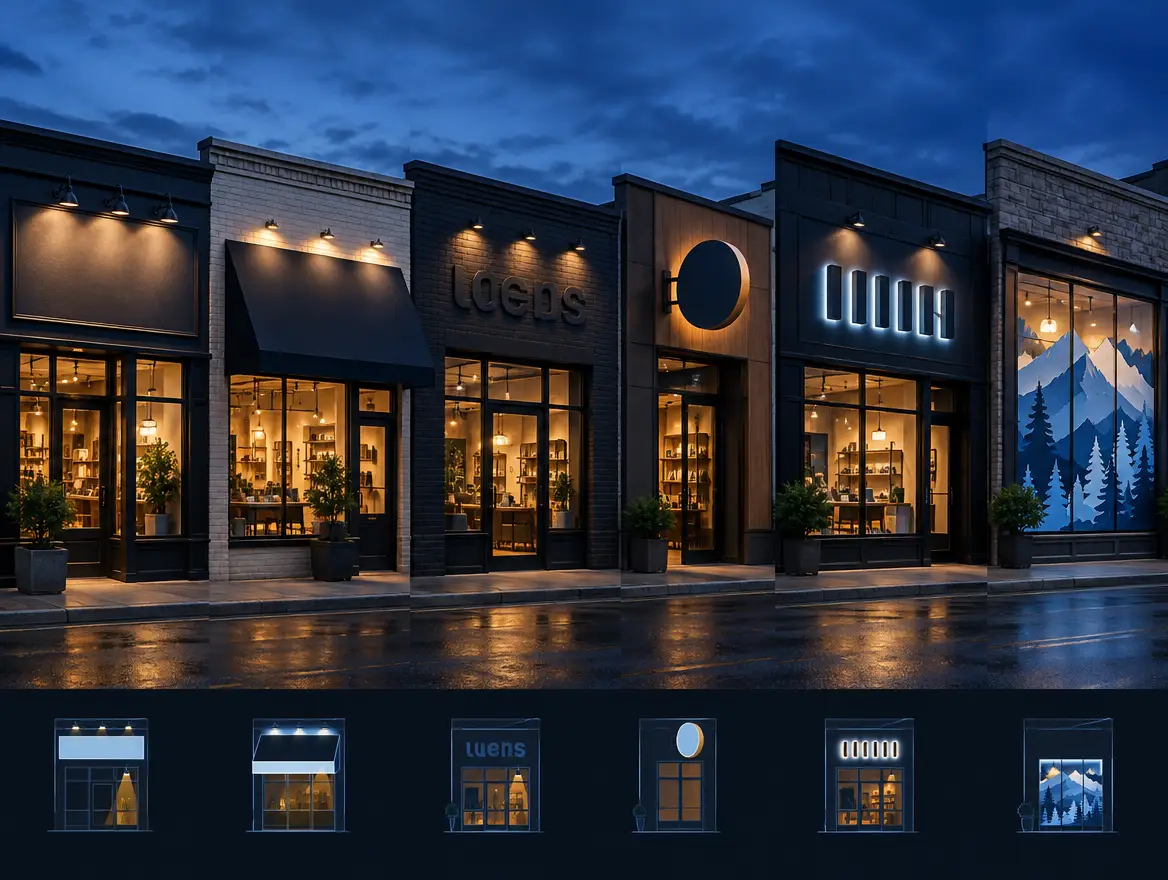 The right style depends on the precinct. Hastings Street favours refined, low-glare signage. Noosa Junction suits clear, practical fascia signs. Gympie Terrace supports bolder dining visibility. Tewantin and Peregian Beach reward village-scale, hand-finished looks. Match your sign to the street, not to your brand guide alone.
Hastings Street (Noosa Heads)
This is Noosa's premium strip: fashion boutiques, fine dining, tourism operators and real estate offices in a largely pedestrian setting. Flush-mounted lettering, halo-lit channel letters and slim blade signs suit it. Keep palettes muted, fonts considered and light sources hidden. If your tenancy is on the main strip, assume any illuminated sign will get a close look at approval stage.
Noosa Junction
Noosa Junction serves locals as well as visitors, so legibility and everyday function matter. Fascia signs with clean, high-contrast lettering work well. Awning signs help for service businesses such as salons and professional offices. You have more room for practical information, but the same principle holds: avoid glare and clutter.
Gympie Terrace (Noosaville)
The riverfront dining and tourism strip is where evening visibility pays. Halo-lit channel letters give a premium glow after dark without hard glare. Blade signs help diners spot you while walking the footpath. This is also a high-exposure position for moisture and salt, so material quality counts here as much as design.
Tewantin and Peregian Beach
Tewantin and Peregian Beach have a more village feel. Hand-finished letterforms, timber-look aluminium and compact fascia signs suit the scale. Window graphics are a cost-effective way to carry hours, services and branding without adding a large structure.
Style by sign type
- Fascia and awning signs: the workhorse option. Flat, low-profile panels or applied lettering keep the look clean.
- Flush lettering: individual letters fixed directly to a wall. It reads as architectural and suits boutiques and galleries.
- Blade signs: projecting signs that catch pedestrians approaching along the street. They are especially useful in walkable precincts, but anything projecting over public land usually needs separate consideration.
- Halo-lit channel letters: letters that glow around their edge against the wall. They suit evening trade, and you can explore the format on our illuminated and channel letter pages.
- LED neon: best kept to interiors and window displays in Noosa. Our guides on custom LED neon signs, business logo neon signs and indoor versus outdoor neon signage explain where each works.
- Window graphics: low-cost, flexible, and quick to update when hours or offers change.
Materials for Salt Air and UV
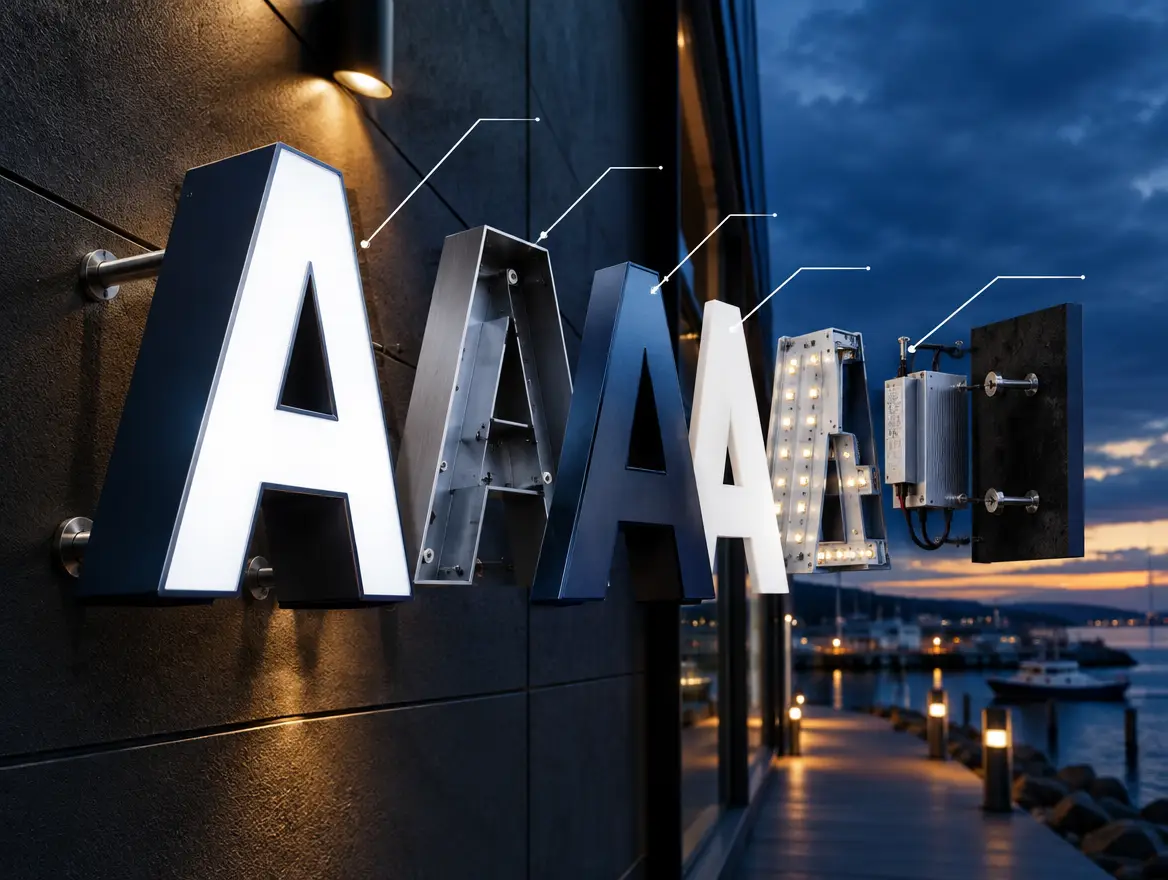 For Noosa's coastal conditions, specify marine-grade aluminium, 316 stainless steel fixings, a quality powder-coat or equivalent finish, UV-stable vinyl and inks, and sealed LED modules. Corrosion usually starts at the fixings and edges, not the sign face, so cheap hardware is the most common point of failure.
Marine-grade aluminium. Aluminium does not rust like mild steel, and marine-grade alloys are designed for harsher environments. It is the sensible base for fascia panels, channel letter returns and blade sign housings.
316 stainless fixings. Grade 316 contains molybdenum, which improves resistance to chloride corrosion compared with grade 304. Use 316 for bolts, brackets, standoffs and anchors. Rust streaks running down a wall from cheap fixings are the most visible sign of a poor install, and they are especially noticeable on pale rendered walls.
Powder coating. A properly pretreated and applied powder coat protects the metal and holds colour. The quality of surface preparation matters as much as the coating itself. Ask what pretreatment and coating system your fabricator uses, and whether it is suited to coastal exposure.
UV-stable vinyl and inks. Strong UV fades cheap vinyl and digital prints. For windows and flat panels, specify outdoor-rated vinyl with UV-stable inks and, where relevant, a protective laminate. Dark reds and certain blues are typically the first colours to show fade, so it is worth checking material data before committing to a colour palette.
Sealed LED modules. Water and salt-laden moisture are the enemies of illumination. Choose LED modules and power supplies with appropriate ingress protection ratings, and make sure cable entries are sealed. Our guide to illuminated pylon signs covers lighting and running costs in more detail, and the same principles apply to shopfront lighting.
| Component | Coastal-ready choice | Common failure with cheaper options |
|---|---|---|
| Sign body | Marine-grade aluminium | Corrosion at cut edges and joins |
| Fixings | Stainless steel of the higher, salt-resistant marine grade | Rust staining on the wall below |
| Finish | Pretreated powder coat | Peeling and chalking |
| Graphics | UV-stable outdoor vinyl and inks | Fading and lifting at edges |
| Lighting | Sealed LED modules and power supplies | Moisture ingress and flicker |
For corrosivity guidance, refer to AS 4312 and the AS 2312 series on protecting structural steel from atmospheric corrosion, or ask your supplier to show the manufacturer's coastal specifications for each material.
Noosa Shire Council Requirements for Shop Signs
Signs in Noosa are regulated through the advertising devices provisions of Noosa Plan 2020, the shire's planning scheme. Whether you need approval depends on the sign type, size, illumination, location and the zone or character area. Always confirm with Noosa Council before fabrication, because the rules and thresholds can be amended.
I am not going to quote size limits or illumination thresholds here. Those details sit in the current version of the planning scheme, and they can change. What I can tell you is the structure of the approval question and the order in which to answer it.
Step 1: Identify your zone and character area
Noosa Plan 2020 applies different expectations in different parts of the shire. A tenancy on Hastings Street sits in a different planning context from one at Noosa Junction or Tewantin. Ask Council's planning team, or use the planning scheme mapping on the Noosa Council website, to confirm which provisions apply to your address.
Step 2: Check whether the sign needs approval
Some advertising devices may be exempt or accepted without a development application, and others need a formal approval. The answer depends on the type of sign, its dimensions, whether it is illuminated, whether it projects over a footpath, and whether the building has any heritage or character overlay. Get the answer in writing from Council or a qualified town planner rather than relying on a general assumption.
Step 3: Think about illumination early
Illuminated signs are where approvals most often get tight, because glare, flashing and light spill affect neighbours and the streetscape. Halo-lit and softly lit options are generally easier to justify in a character-focused precinct than bright, high-contrast faces. Confirm the current illumination provisions rather than assuming.
Step 4: Get landlord or body corporate consent
Even if Council has no objection, your lease or body corporate by-laws may restrict what you can attach to the building. Many centres have their own signage guidelines or approved sign zones. Get written consent from the landlord, centre manager or body corporate before you commission artwork.
Step 5: Allow for projecting signs and public land
A blade sign that extends over a footpath is a different proposition from a flat fascia sign. Projections over public land typically involve additional consideration, and may need separate permission. Raise this at the start if a blade sign is part of your plan.
Our practical advice: design to the rules before the proof is signed off, not after. That is also why we recommend getting a site assessment and a conversation about approvals at the start of any Noosa quote.
Costs and Timelines for Noosa Shop Front Signs
The main cost drivers for a Noosa shop front sign are size, illumination, materials, site access and permit requirements. Timelines run from design proof through approvals, fabrication and installation. Exact prices depend on your site, so a written quote after a site assessment is the only reliable figure.
I will not publish price ranges here, because a number without a site inspection would be a guess. What I can do is explain what moves the price.
- Size and complexity. Larger signs use more material and take more labour. Complex letterforms and multi-layer builds cost more than flat panels.
- Illumination. Halo-lit or face-lit channel letters involve LEDs, power supplies and wiring. That adds fabrication cost and electrical work compared with non-illuminated signs.
- Materials. Marine-grade aluminium, 316 stainless fixings and quality finishes cost more upfront and cost less over the life of the sign.
- Site access. Second-storey fascias, awkward frontages and pedestrian-only streets can need lifting equipment, traffic or pedestrian management and after-hours work.
- Permits and approvals. Council fees, planning advice and any engineering or certification requirements add cost and time.
From design proof to installation
- Site assessment and brief. Measure the frontage, check access, confirm your lease position and discuss the look you want.
- Design proof. A scaled visual of the sign on your shop front, showing materials, colours and illumination.
- Approvals. Landlord or body corporate consent, plus Council confirmation or application as required.
- Fabrication. Manufacture to the approved design, with coastal-grade materials and fixings specified.
- Installation. Mounting, electrical connection for illuminated signs, and a final check.
The approvals step is where timelines blow out, so start it early. If you are opening a new business with a fixed launch date, begin the signage conversation as soon as your lease is confirmed.
Coastal Maintenance: Keeping a Noosa Sign Looking New
Coastal signs need regular washing to remove salt build-up and a periodic inspection of fixings, seals and lighting. A simple routine extends sign life and protects warranties. The aim is to catch small problems, such as a weeping fixing or a failed LED module, before they become costly repairs.
A practical routine
- Regular wash. Rinse the sign face, letters and surrounding wall with fresh water and a soft cloth or brush. Salt crystals left on the surface hold moisture and speed up corrosion. Avoid abrasive pads and harsh solvents, which can damage powder coat and vinyl.
- Fixings check. Look for rust staining, loose brackets, movement in letters and gaps where sealant has failed. Do this regularly, and always after severe weather.
- Lighting check. Switch on at dusk and look for dark modules, flicker or uneven glow. Check that seals around cable entries are intact.
- Face and finish check. Look for fading, lifting vinyl edges and chalky or peeling coatings.
How often you wash depends on how close you are to the water. A Gympie Terrace frontage facing the river will usually need more attention than a sheltered position set back from the coast.
How long LEDs last
LED lifespan is a manufacturer-rated figure, usually quoted as hours to a defined drop in light output. It varies by product, and real-world life depends on heat, moisture and power supply quality. Ask your supplier for the datasheet for the modules in your sign, rather than relying on a generic number. A sealed, well-ventilated build will protect that rating better in coastal conditions.
What Most Noosa Sign Guides Miss: Spend on the Invisible Parts
My position is simple: in Noosa, the best money on a shop front sign is spent on the parts nobody notices, namely fixings, finishes, seals and a design that respects the street. Size and brightness are where most owners overspend, and they are the quickest way to attract the wrong attention.
Consider a cafe on Gympie Terrace choosing between two quotes. One is a larger, brighter, face-lit sign with standard fixings. The other is a slightly smaller halo-lit sign with 316 stainless fixings and a properly pretreated powder coat. This is a hypothetical, but the pattern is common. The first looks bold on install day. The second still looks good when the first has rust streaks running down the wall, and it is far more likely to sail through a council review.
Three contrarian points follow from this.
First, bigger is rarely better here. In a streetscape that values restraint, a well-proportioned sign reads as confidence. Oversized signs also tend to raise approval questions.
Second, halo lighting beats face lighting for evening trade in Noosa. The glow around the letters is softer, harder to criticise and flattering on natural wall finishes. It also gives you a clear after-dark presence without competing with the streetscape.
Third, treat approvals as a design input. Most delays come from designing first and checking rules second. If you confirm the zone, illumination provisions and consent requirements before the proof, the design that gets approved is the design you wanted.
If you are replacing a weathered sign, use the failure as information. Where did it corrode first? Which colour faded fastest? Which side of the building took the weather? That is a better brief than any catalogue.
Talk to Sunquest Signs About Your Noosa Shop Front
If you are opening, rebranding or replacing a weathered sign in Noosa, contact Sunquest Signs for a design consultation and quote. We will help you choose a style that suits your precinct, specify materials built for coastal conditions, and work through council and landlord requirements before fabrication starts.
References
- Noosa Council, planning scheme and development information
- Standards Australia, AS 4312 Atmospheric corrosivity zones in Australia
- Standards Australia, AS 2312 series, Guide to the protection of structural steel against atmospheric corrosion
- ARPANSA, Ultraviolet radiation information
- Tourism Noosa, visitor and industry information
Talk to a signage expert
Tell us about your project and we'll come back with options and honest advice.
Get in TouchFrequently Asked Questions
Do I need council approval for a shop front sign in Noosa?
It depends on the sign type, size, illumination and location. Noosa Plan 2020 regulates advertising devices, and some signs may not need a development application while others do. Confirm with Noosa Council before fabrication, and get landlord or body corporate consent in writing as well.
What materials last longest on a coastal shop front sign?
Marine-grade aluminium, 316 stainless steel fixings, a properly pretreated powder coat, UV-stable outdoor vinyl and inks, and sealed LED modules are the standard coastal specification. Fixings are the most common failure point, so do not accept cheaper hardware to save money.
Can I have an illuminated sign on Hastings Street?
Illuminated signs are possible in many locations, but illumination is regulated, and Hastings Street is a character-sensitive precinct. Halo-lit and softly lit options are usually easier to justify than bright face-lit signs. Check the current Noosa Plan 2020 provisions and speak with Council before committing to a design.
How often should I clean my shop sign near the coast?
Wash it regularly with fresh water and a soft cloth or brush to remove salt build-up. Frequency depends on how exposed your frontage is, so riverfront and beachside sites need more attention than sheltered ones. Check fixings and lighting at the same time.
What is the difference between halo-lit and face-lit channel letters?
Halo-lit letters have an opaque face and light shining from behind, creating a glow around the edge against the wall. Face-lit letters glow through the front of the letter. Halo-lit looks subtler and suits many Noosa streetscapes, while face-lit is more prominent.
Related Articles
Illuminated Signs in Noosa: LED Lightboxes, Lit Letters and Pylon Signage for Coastal Trading
Shop Front Signs in Caloundra: Precinct Styles, Coastal Materials, Council Rules and Costs
Shop Front Signs on the Sunshine Coast: Types, Coastal Materials, Council Rules and Costs
Signs that set you apart
Over 40 years on the Sunshine Coast. Design, compliance, manufacture and installation handled end to end.
Get a Free Quote