Shop Front Signs on the Sunshine Coast: Types, Coastal Materials, Council Rules and Costs
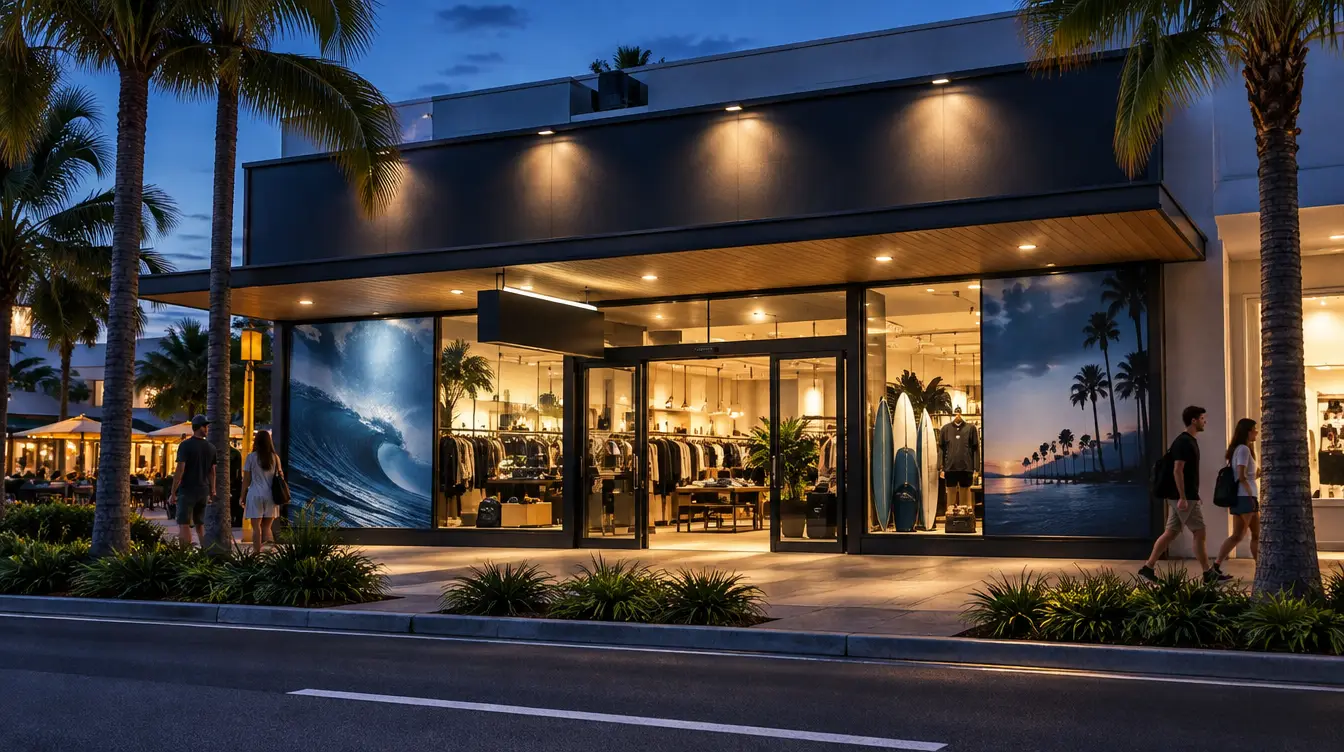
The best shop front signs on the Sunshine Coast match the sign type to the facade: fascia panels for permanent identity, illuminated lightbox or channel letters for night visibility, awning signs for pedestrians, and window graphics for offers. Use UV-stable, salt-resistant materials, check council and landlord approval before fabrication, and budget around size, illumination and access.
A shop front sign is the cheapest advertising you will ever run, because it works every hour you are open and plenty of hours you are not. It is also the one most likely to be bought in a hurry, installed badly and replaced early. On the coast, salt, UV and storm winds punish shortcuts quickly.
This guide is for owners and managers of cafés, retail stores, clinics, salons and trade counters in Maroochydore, Mooloolaba, Caloundra, Buderim, Nambour, Coolum and surrounds. It covers sign types, coastal materials, approvals, cost drivers and the process from brief to install. Pylon signs are covered separately in our Sunshine Coast pylon signs guide, so this article stays on the facade.
Key Takeaways
- Most facades need a combination of sign types: a fascia for identity, an awning sign for pedestrians and window graphics for detail.
- Illumination is what separates a sign that works at 3pm from one that also works at 7pm, which matters for dining, clinics with evening hours and tourist precincts.
- Coastal conditions are a specification problem. Aluminium, powder coat, UV-stable faces and sealed LEDs outlast cheaper alternatives.
- Approval depends on the site, not just the sign. Check the Sunshine Coast Planning Scheme, shopping centre guidelines and your lease before artwork is final. Noosa sits under a different council.
- Cost is driven by size, illumination, materials, access and install height. Any quote without a site measure is a guess.
- A site measure and a design proof protect you from the two most common mistakes: wrong size and wrong position.
Ready to make your business impossible to miss?
Design, manufacture and installation, all under one roof in Warana.
Get a Free QuoteShop Front Sign Types at a Glance
This table is qualitative. Actual suitability depends on your facade, landlord and zoning.
| Sign type | Best use | Works at night | Coastal durability note |
|---|---|---|---|
| Fascia or flat panel | Permanent business name above the entry | Only if lit separately | Aluminium composite with sealed edges performs well |
| Awning or under-awning | Pedestrians on strips and arcades | Optional | Check fixings and clearance, wind loading matters |
| Illuminated lightbox | Bold, even-lit branding on a flat facade | Yes | Needs sealed construction and quality LED modules |
| Channel letters | Premium, dimensional identity | Yes, front or halo lit | Sealed modules and stainless or coated fixings |
| LED neon accent | Atmosphere for cafés, bars, salons | Yes | Indoor placement is gentler than exposed outdoor use |
| Window graphics | Offers, hours, services, privacy | Limited | UV-stable films hold colour better than basic vinyl |
Why Your Shop Front Sign Matters on the Sunshine Coast
Your shop front sign is the first sales pitch most customers see, and on the Sunshine Coast it works for three audiences at once: locals walking a strip, drivers passing at speed, and holiday visitors who know nothing about your business. A clear, well-placed sign turns those glances into visits.
Strip shopping, centres and tourist precincts behave differently
A strip such as Aerodrome Road in Maroochydore or the main street in Nambour depends on drive-by visibility and pedestrian foot traffic. Signage there has to read from the road and again from the footpath. Shopping centres reverse the problem. Customers are already on foot, so the sign competes with the tenancy next door and has to follow the centre's design guidelines.
Coastal tourist precincts, think Mooloolaba Esplanade or Bulcock Beach in Caloundra, add a third factor: visitors. Holiday visitors have no loyalty and no habit. They choose on first impression, so a sign that is faded, peeling or unlit sends a poor message about the whole business.
The sign is also your after-hours salesperson
Sunshine Coast trade is heavily tied to evenings and weekends. A café that closes at 2pm still benefits from a clean sign that holds the brand in people's memory. A restaurant, bottle shop or late-opening clinic needs illumination to be found at all. Treat the sign as an asset that works when the doors are shut.
Shop Front Sign Types Compared
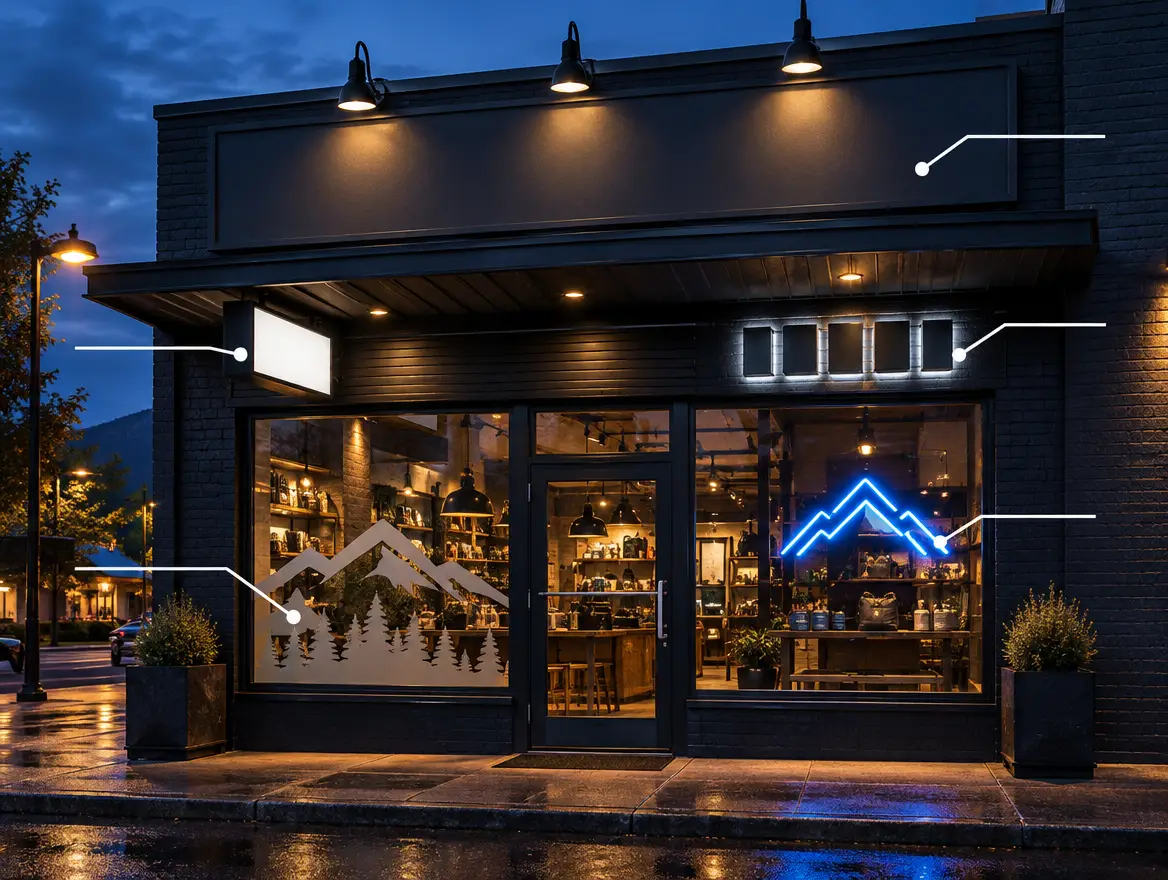 Each shop front sign type does a different job. Fascia and flat panel signs carry your name, awning signs speak to pedestrians, illuminated lightbox and channel letter signs win after dark, LED neon adds personality, and window graphics handle detail and offers. Most facades need a combination, not a single type.
Fascia and flat panel signs
The fascia sign sits above the entry and is the anchor of the facade. It is usually aluminium composite panel with printed or cut vinyl graphics, or routed and painted aluminium. It suits almost every business and is the most cost-effective permanent option. Its weakness is night performance. Unless it is lit by external lights or built as a lightbox, it disappears after dark.
Awning and under-awning signs
If your shop sits under a verandah or awning, a sign hung beneath it faces the footpath, which a fascia cannot do. This is the right tool for pedestrian-heavy strips and arcades. Mounting height and clearance matter, and wind loading matters more on exposed coastal sites. Fixings should be designed for the structure they attach to, not just screwed into whatever is there.
Illuminated lightbox and channel letter signs
A lightbox is a sealed aluminium cabinet with a translucent face lit from within. It gives even, bold light and suits flat facades and logos with solid colour. Channel letters are individually fabricated three-dimensional letters, lit from the front, the back (halo) or both. They look more premium and cost more to make and install. Both depend on quality LED modules, a suitably rated power supply and sound electrical work by a licensed electrician.
If illumination is on your shortlist, read our Illuminated, Lightbox and Channel Letter Signs guide for build options in more detail.
LED neon accents
Flexible LED neon has become a popular accent for cafés, barbers, salons and bars. It photographs well, which matters because customers share it on social media. It is best used as a secondary feature, often inside the window or on a feature wall, and not as your only identification. A Caloundra barber, for example, might keep a clean fascia for identity and add a neon logo inside the window for atmosphere. We cover design choices in our Custom LED Neon Signs guide and our Caloundra neon signs page.
Window graphics
Window graphics are the fastest and cheapest way to refresh a facade. Use them for opening hours, services, promotions, frosted privacy bands for clinics and salons, and branding that carries across glass. They are easy to update seasonally. Specify UV-stable film, because west-facing glass in a Queensland summer will fade budget vinyl.
Best Materials for Coastal Conditions
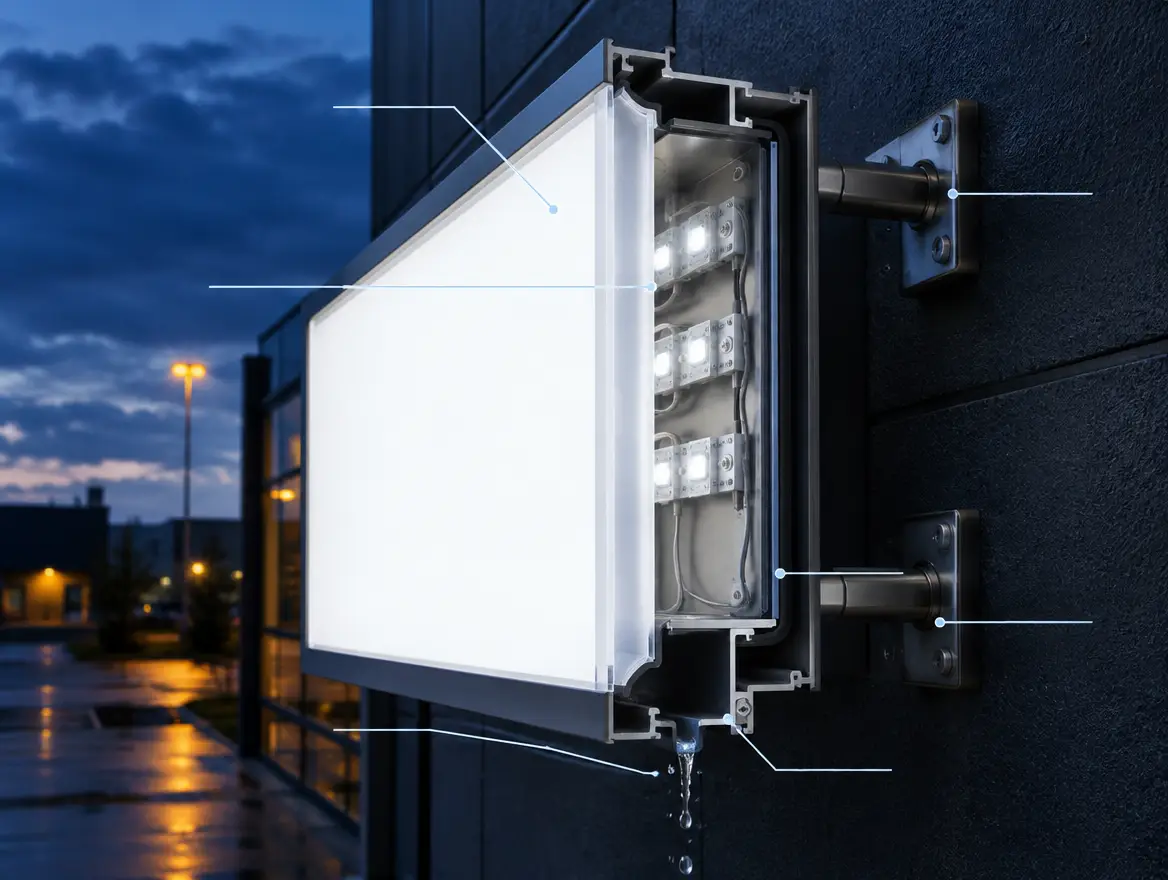 Coastal shop front signs are attacked by UV, salt air, humidity and summer storm winds. The safest specification is aluminium composite or aluminium framing with a quality powder-coated finish, UV-stable acrylic faces, and sealed LED modules with a suitable ingress protection rating. Unsealed edges and cheap substrates fail first.
UV fade
According to ARPANSA (https://www.arpansa.gov.au/), the UV Index in Queensland regularly reaches the extreme category in summer. That exposure bleaches inks, yellows cheap plastics and makes some adhesives let go. Ask for UV-stable inks and laminates, and be wary of any print that is not rated for long-term outdoor use. Reds and other strong colours are generally the first to shift on sun-exposed faces.
Salt air near the beachfront
Signs in Mooloolaba, Coolum, Caloundra and other beachside spots live in salt-laden air that corrodes bare steel and weak fasteners. Aluminium does not rust, and powder coating adds a durable barrier. Fixings should be stainless or properly coated, and different metals touching each other can cause galvanic corrosion, so isolate them. Cut edges on composite panels should be sealed so moisture cannot creep in.
Humidity and summer storms
Humidity gets into poorly sealed lightboxes and causes fogging, condensation and early LED failure. Sealed cabinets, drained bases and quality gaskets prevent most of it. For storms, the sign is only as strong as its fixings and the wall behind them. Wind loading on signs is assessed against the relevant Australian Standards, and a sign on an exposed corner needs more consideration than one in a sheltered arcade.
Material choices in plain terms
- Aluminium composite panel: flat, stable and light, a strong default for fascias and lightbox backs.
- Acrylic: the standard for lit faces and dimensional lettering. Choose UV-stable grades.
- Powder-coated aluminium: the right finish for frames, letter returns and brackets near the coast.
- Sealed LED modules: protected against moisture and dust, so they survive humid conditions and last longer than older lighting.
Council and Landlord Approvals
Whether your sign needs council approval depends on its size, projection, illumination, zoning and any overlays on the site. Some signs are exempt or self-assessable, others need a development application. Always check the Sunshine Coast Planning Scheme and your lease before fabrication, and note Noosa has its own planning scheme.
When council approval may apply
The Sunshine Coast Planning Scheme regulates advertising devices through its codes. Typical triggers include a sign that projects over a footpath, is large relative to the building, flashes or moves, or sits on a site with a heritage or character overlay. Structural changes to an awning can also require building approval. I can't give you a blanket yes or no, because the answer is specific to your address. Sunshine Coast Council is the authority, and its planning enquiry services can confirm what applies.
Shopping centres, landlords and heritage areas
In a shopping centre, your landlord approval often matters more than council. Centres set design guidelines for sign size, position, materials and illumination, and they commonly require tenant design approval before anything is made. For a strip tenancy, your lease may still limit alterations to the fascia or awning. Character or heritage areas can add extra requirements on materials, colours and how a sign attaches to older buildings.
Noosa is different
Noosa is administered by Noosa Council, not Sunshine Coast Council, and has its own planning scheme. If your shop is in Noosa Heads or Noosaville, check Noosa's requirements. Many businesses assume one set of rules covers the region, and that assumption causes avoidable delays.
How Sunquest Signs helps
We design, fabricate and install, so approvals are part of the plan, not an afterthought. We measure the site, flag likely approval triggers early, produce drawings and dimensions suited to a landlord or council submission, and keep the design within the likely rules so you are not redesigning after the fact. Final approval decisions sit with council and your landlord, and we will tell you plainly when they are needed.
What Drives the Cost of Shop Front Signs
Shop front sign cost is driven by size, illumination type, materials, site access and installation height. A simple printed fascia panel sits at the low end, while a large illuminated channel letter sign with electrical work and elevated access sits at the high end. Any honest quote starts with a site measure.
- Size: more material, more fabrication time and heavier fixings.
- Illumination: lit signs need LED modules, power supplies, wiring and a licensed electrician. Lightboxes and channel letters cost more than flat panels for this reason.
- Materials and finish: coastal-grade aluminium, UV-stable faces and marine-grade fixings cost more upfront and less over the life of the sign.
- Complexity: dimensional letters, custom shapes and multi-layer builds take longer than flat cut graphics.
- Access and height: a ground-level fascia is simple. A second-storey sign may need an elevated work platform, traffic management or after-hours work.
- Approvals and engineering: large or projecting signs may need drawings or engineering, which adds time and cost.
- Removal of the old sign: making good the wall, patching holes and disposing of old signage should be priced in.
Good advice on budget: spend where failure is expensive. A cheap sign that needs replacing costs more than a well-specified one, because you pay for installation twice.
From Brief to Install: The Process
The process runs in four steps: a site measure, a design proof, fabrication and installation. Approvals run alongside, and for a new tenancy they should start before artwork is final. Clear photos, your lease details and brand files at the start shorten the whole timeline.
1. Brief and site measure
We start with what you sell, who you want to reach and what is on the facade now. Then we measure on site: fascia dimensions, awning height, power access, wall construction and viewing distances from the footpath and the road. Measuring on site avoids the classic error of designing to a guessed size.
2. Design proof
You receive a proof showing the sign to scale on your actual facade. This is where you check readability, colour, placement and how it sits against neighbouring tenancies. Changes at proof stage are cheap. Changes after fabrication are not.
3. Fabrication
Signs are built to the approved proof, with materials suited to your location. For a beachside site, that means coastal-grade finishes and sealed components. Illuminated signs are tested before they leave the workshop.
4. Installation
Installation covers fixing, electrical connection by a licensed electrician where needed, safe access at height and tidy finishing. We aim to minimise trading disruption, which matters if you are trying to open on a deadline.
If you want your windows to work harder, our Window, Wall and Floor Graphics services pair well with a new fascia. Many businesses do both in one visit.
Design for the Walk-Up and the Drive-By, Then Specify for the Storm
Most shop front signs are designed on a screen at one scale and judged at two. Our view at Sunquest Signs is that the brief should name both viewing distances first, then specify the fixings, drivers and finishes for a Sunshine Coast storm, not just the artwork for a mock-up.
Here is the contrarian part. Most business owners start by asking what the sign should look like. I think the better first question is who needs to read it and from how far away. Consider a hypothetical Mooloolaba café upgrading to an illuminated fascia. From the road, the only job is the name and one word that says what it is. From the footpath, the job is the menu feel, the personality and the invitation to come in. Those are two different sets of information, and cramming both onto one fascia is the most common reason signs underperform. The fascia handles the road. The under-awning sign and window graphics handle the footpath.
The second point is about what customers never see. A sign's face can look identical in a proof whether it is a premium build or a cheap one. The difference is in the sealing, the fixings, the power supply and the finish, and it only appears after a few humid summers and a storm season. When comparing quotes, ask what the fixings are made of, how the cabinet is sealed and what the LED modules are rated for. If a quote does not say, that is information.
The third point is sequencing. For a new tenancy, I would raise approvals before artwork is finished. A landlord who rejects a lit sign after you have paid for design has cost you time you cannot get back. Ask for the sign guidelines on day one.
Book a Free Site Measure for Your Sunshine Coast Shop Front
If you are fitting out a new tenancy or refreshing a tired facade, Sunquest Signs can handle design, approvals support, fabrication and installation. Book a free site measure and design consultation, or send us photos of your facade for a quote. We service Maroochydore, Mooloolaba, Caloundra, Buderim, Nambour, Coolum and the wider Sunshine Coast.
References
- Sunshine Coast Council, planning scheme and development information
- Noosa Council, planning and development information
- ARPANSA, ultraviolet radiation and the UV Index
- Standards Australia, Australian Standards for structural design actions including wind
Talk to a signage expert
Tell us about your project and we'll come back with options and honest advice.
Get in TouchFrequently Asked Questions
Do I need council approval for a shop front sign on the Sunshine Coast?
It depends on the sign and the site. Size, projection over a footpath, illumination, zoning and heritage or character overlays can all affect whether approval is needed under the Sunshine Coast Planning Scheme. Shopping centre and landlord approval may apply regardless. Confirm with Sunshine Coast Council, or Noosa Council if you are in Noosa, before fabrication.
How much do shop front signs cost on the Sunshine Coast?
Cost depends on size, illumination, materials, access and installation height. A flat printed fascia panel is generally the most economical, while illuminated channel letters with electrical work and elevated access cost more. A site measure is the only reliable way to get an accurate quote for your facade.
What is the best sign type for a café?
Most cafés do best with a clean fascia for road visibility, an under-awning sign for pedestrians and window graphics for hours and offers. If you trade into the evening, add illumination. An LED neon feature inside the window adds atmosphere without replacing your main identification.
How do coastal conditions affect shop signs?
UV fades inks and plastics, salt air corrodes weak metals and fixings, and humidity damages unsealed lighting. Coastal-grade aluminium, powder coating, UV-stable faces, stainless or coated fixings and sealed LED modules reduce these problems and extend the life of the sign.
Can I install an illuminated sign on a leased shop?
Usually yes, but you need landlord consent and possibly council approval. Check your lease for alteration clauses and any shopping centre design guidelines. Electrical work should be done by a licensed electrician.
Related Articles
Signage in Kawana: Sign Options for Birtinya, Buddina and Warana Businesses, Approvals and Costs
Shop Front Signs in Caloundra: Precinct Styles, Coastal Materials, Council Rules and Costs
Sunshine Coast Signage Project Gallery: Real Local Sign Installs by Suburb and Sign Type
Signs that set you apart
Over 40 years on the Sunshine Coast. Design, compliance, manufacture and installation handled end to end.
Get a Free Quote