
CNC Cutting Tolerances and Material Capabilities: What Signage Buyers Should Expect
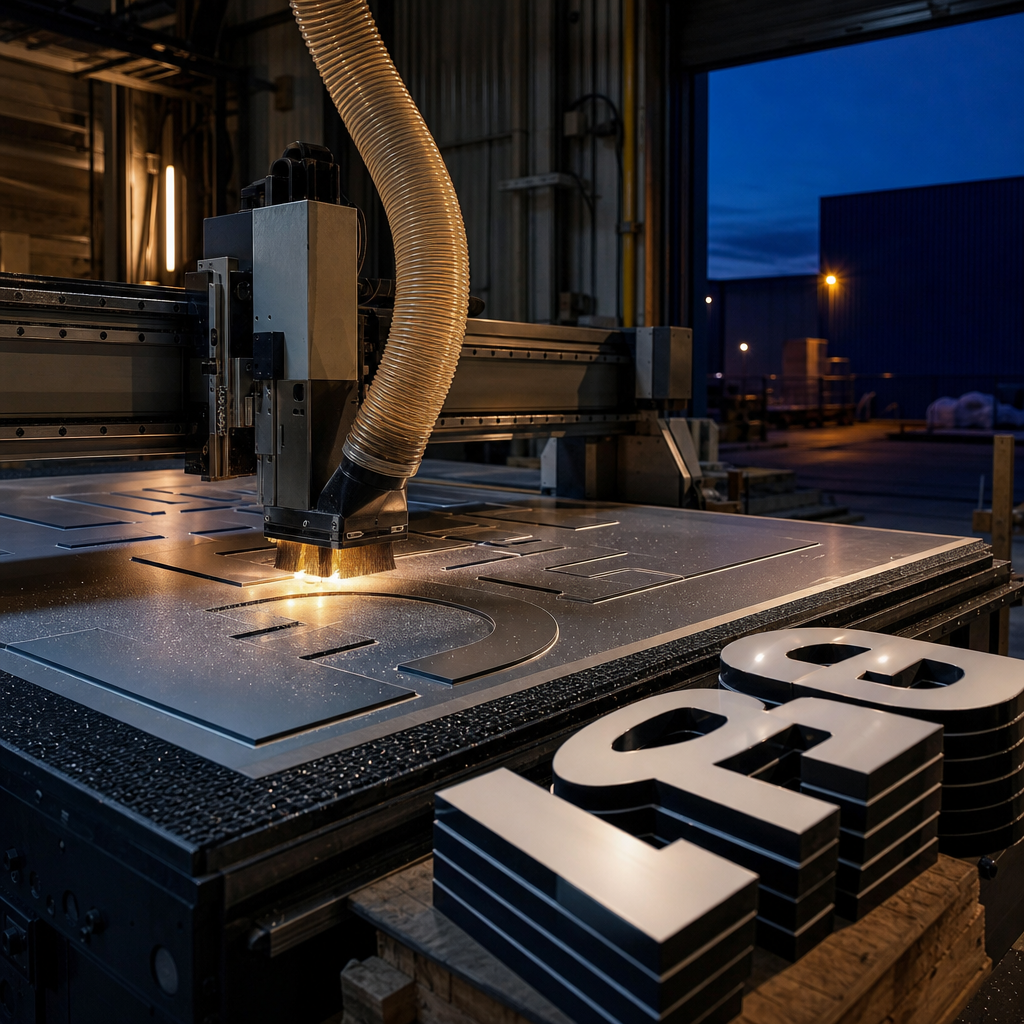
CNC cutting tolerance in signage work is the allowable variation between a drawn dimension and the finished cut, typically 0.1mm to 0.5mm depending on material and thickness. ACM, acrylic and aluminium hold the tightest tolerances. Timber, foam PVC and thicker sheet move more due to tool deflection, heat and material flex during cutting.
Most signage buyers ask for tolerance the wrong way. They want a single number that applies to every job, every material, every thickness. That is not how CNC fabrication works. A router cutting 3mm acrylic and the same router cutting 25mm plywood are governed by different physics, and the finished result reflects that.
This guide sets out what tolerance actually means in a fabrication workshop, what pushes it wider or tighter, and what each common signage material can realistically deliver. It is the technical companion to our separate guides on CNC routing for ACM and CNC routing for acrylic: this piece is about the fundamentals that sit underneath every material-specific job.
Key Takeaways
- Tolerance is not a single figure. It shifts with material, sheet thickness, tool diameter and cutting speed.
- Rigid sheet goods like ACM and acrylic hold tighter tolerances than timber, foam PVC or thick ply.
- Internal corners can never be perfectly square on a routed cut. The minimum internal radius is set by the tool diameter used.
- Letter strokes, counters and fine serifs below a certain width will not cut cleanly and need to be redrawn before production.
- Edge finish (flame-polished versus machined) is a separate decision from tolerance, and it affects both look and cost.
- Supplying closed vector paths at the correct scale is the single biggest factor in whether a job cuts right the first time.
Ready to make your business impossible to miss?
Design, manufacture and installation, all under one roof in Warana.
Get a Free QuoteSummary Table
| Material | Typical thickness range | Indicative cutting tolerance | Typical edge finish | Best suited to |
|---|---|---|---|---|
| Aluminium composite panel (ACM) | 3mm to 6mm | Around 0.1mm to 0.3mm | Machined, deburred, folded returns | Panel signs, tray signs, fascia cladding |
| Acrylic | 3mm to 25mm | Around 0.1mm to 0.3mm on thin sheet, wider on thick sheet | Flame-polished or machined | Built-up letters, illuminated faces, display panels |
| Aluminium sheet | 1.6mm to 6mm | Around 0.2mm to 0.4mm | Deburred, folded, welded | Structural letter returns, pylon cladding, fixings |
| Timber and ply | 3mm to 25mm | Around 0.3mm to 0.8mm, wider on thicker stock | Sanded, sealed, painted | Fret-cut screens, feature panels, interior signage |
| PVC and foam PVC | 3mm to 19mm | Around 0.2mm to 0.5mm | Machined, sanded | Lightweight panels, temporary signage, sign trays |
| Brass and stainless steel | 1.5mm to 6mm | Around 0.1mm to 0.3mm (specialist cutting) | Polished, brushed, etched | Plaques, name plates, premium reception signage |
These ranges are indicative, based on general CNC routing and sheet-material fabrication practice, and align with the intent of general tolerance classification standards such as ISO 2768. Actual achievable tolerance depends on the specific job, tool set and material batch. Confirm exact tolerance for a project with the fabrication team before finalising artwork.
What 'Tolerance' Actually Means in Sign Fabrication
Tolerance is the maximum acceptable difference between the dimension on your artwork file and the dimension on the finished cut piece. It is not a promise of perfection. Every cutting process has a margin, and 'as close as possible' is not a workable spec because it gives the fabricator nothing to measure against.
In practice, tolerance is expressed as a plus-or-minus figure against a stated dimension, for example a 600mm panel cut to plus or minus 0.3mm. That figure changes depending on what is being cut. A thin acrylic letter face behaves differently under the router than a 25mm plywood fret panel. Heat, tool wear and sheet support all play a part.
Buyers who understand this ask better questions before signing off artwork. Instead of asking for 'tight tolerance', ask what tolerance applies to the specific material and thickness in the job, and where in the piece it matters most: overall panel size, hole positions, or internal detail like counters and radii. That distinction saves rework later.
What Moves Tolerance Up or Down
Tolerance is not fixed. It moves with material type, sheet thickness, tool diameter, cutting speed, sheet flatness and heat generated during the cut. Get any one of these wrong and the finished piece drifts from the drawn dimension, sometimes visibly.
Material type sets the baseline. Rigid, stable materials like ACM and cast acrylic hold a line more predictably than softer or more flexible stock. Sheet thickness compounds this: a thin sheet supported flat on the bed cuts more accurately than a thick sheet where the tool has further to travel and more resistance to overcome.
Tool diameter directly limits detail. A 6mm cutter cannot produce a 2mm internal radius, no matter how well the machine is calibrated. Cutting speed matters too. Push a router too fast through acrylic and it generates heat that melts and re-fuses the edge, distorting the cut line. Run it too slow and heat builds anyway, from prolonged friction rather than speed.
Sheet flatness is an underrated factor. A sheet with even a slight bow will not sit true on the bed, and the cutting depth varies across the panel as a result. Finally, heat and material movement affect thermoplastics most: acrylic and PVC both expand slightly when warm and can shift by a fraction of a millimetre as they cool after cutting. None of these factors are exotic. They are the reason two identical-looking jobs in different materials can carry different tolerance figures.
Material Capability Run-Through: What Can Be Cut, Engraved and Fabricated
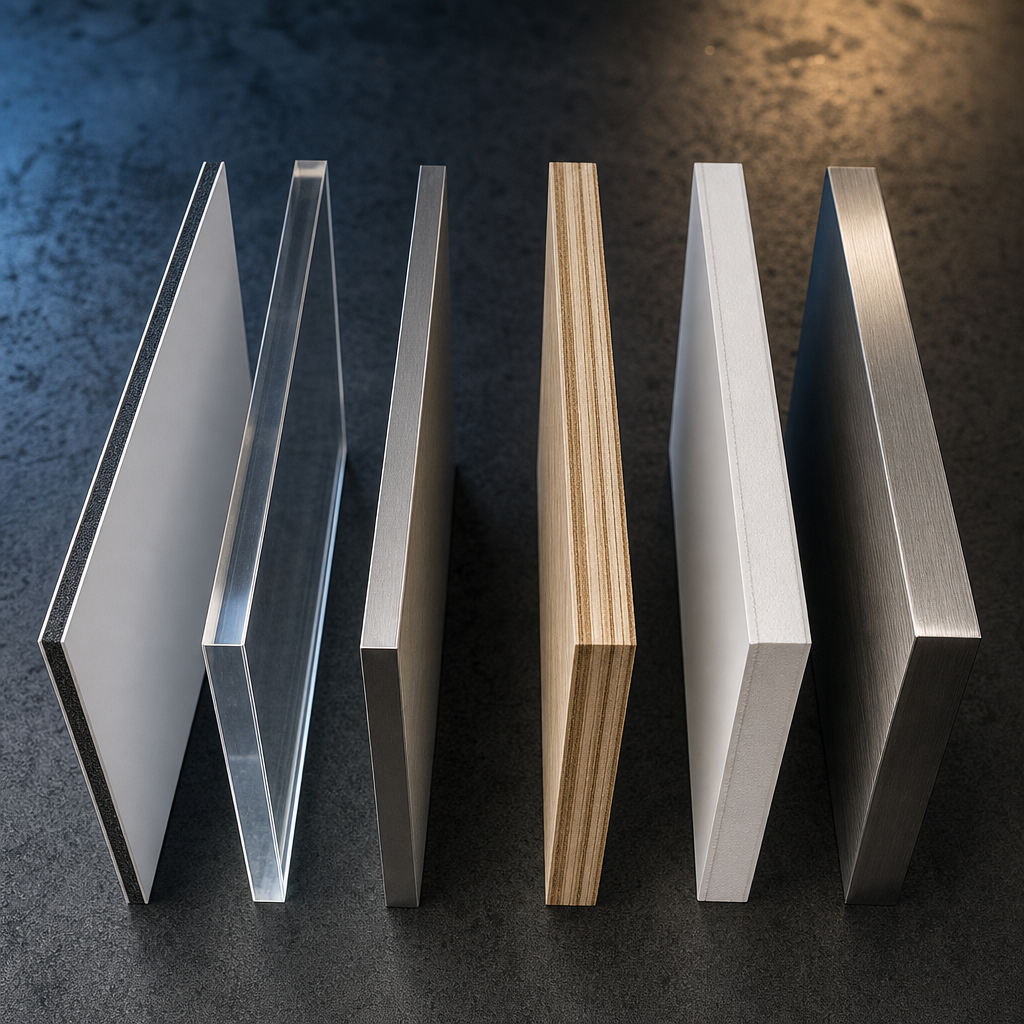
Sunquest's Sunshine Coast fabrication workshop cuts and fabricates ACM, acrylic, aluminium, timber and ply, PVC and foam PVC, and brass and stainless steel for specialist work, with delivery reach across Queensland and into interstate projects. Each material has its own realistic thickness range, edge behaviour and best-fit application.
Aluminium Composite Panel (ACM)
ACM is the workhorse of panel signage, typically supplied in 3mm and 6mm thickness. It cuts cleanly on a CNC router, holds a straight edge, and folds well for tray signs and fascia returns once the core is routed out along the fold line. Our CNC routing for ACM guide covers fabrication detail; here the key point is that ACM is one of the more forgiving materials for holding tight tolerance because it is rigid and dimensionally stable.
Acrylic
Acrylic ranges from 3mm sheet used for face-lit letters through to 25mm stock used for plinths and heavier display pieces. Thin acrylic holds tight tolerance and can be flame-polished for a glass-like edge. Thicker acrylic needs more conservative tolerance expectations because heat has further to dissipate and the tool has more material to clear. Full detail is in our CNC routing for acrylic guide.
Aluminium
Solid aluminium sheet, generally 1.6mm to 6mm, is used for structural letter returns, pylon components and fixings that need to survive outdoor exposure. It cuts well on a router fitted with the right bit, but it generates more heat and swarf than acrylic or ACM, so deburring is standard practice afterward.
Timber and Ply
Timber and ply, typically 3mm to 25mm, suit fret-cut screens, feature panels and interior signage where a natural material reads better than plastic or metal. Tolerance is wider than on rigid sheet goods because timber has grain, moisture content and a degree of natural inconsistency that acrylic and ACM do not.
PVC and Foam PVC
Foam PVC, generally 3mm to 19mm, is lightweight and machines easily, making it a common choice for temporary signage, sign trays and lightweight panels. It holds moderate tolerance and cuts with minimal heat distortion, though very thin foam PVC can flex under the router if not properly supported.
Brass and Stainless Steel
Brass and stainless, generally 1.5mm to 6mm, are used for plaques, name plates and premium reception signage where a polished or brushed metal edge is part of the brief. These materials need specialist cutting approaches rather than a standard timber-and-plastics router, and tolerance expectations should be discussed at the quoting stage.
Detail Limits: Minimum Radii, Letter Strokes and Fine Detail
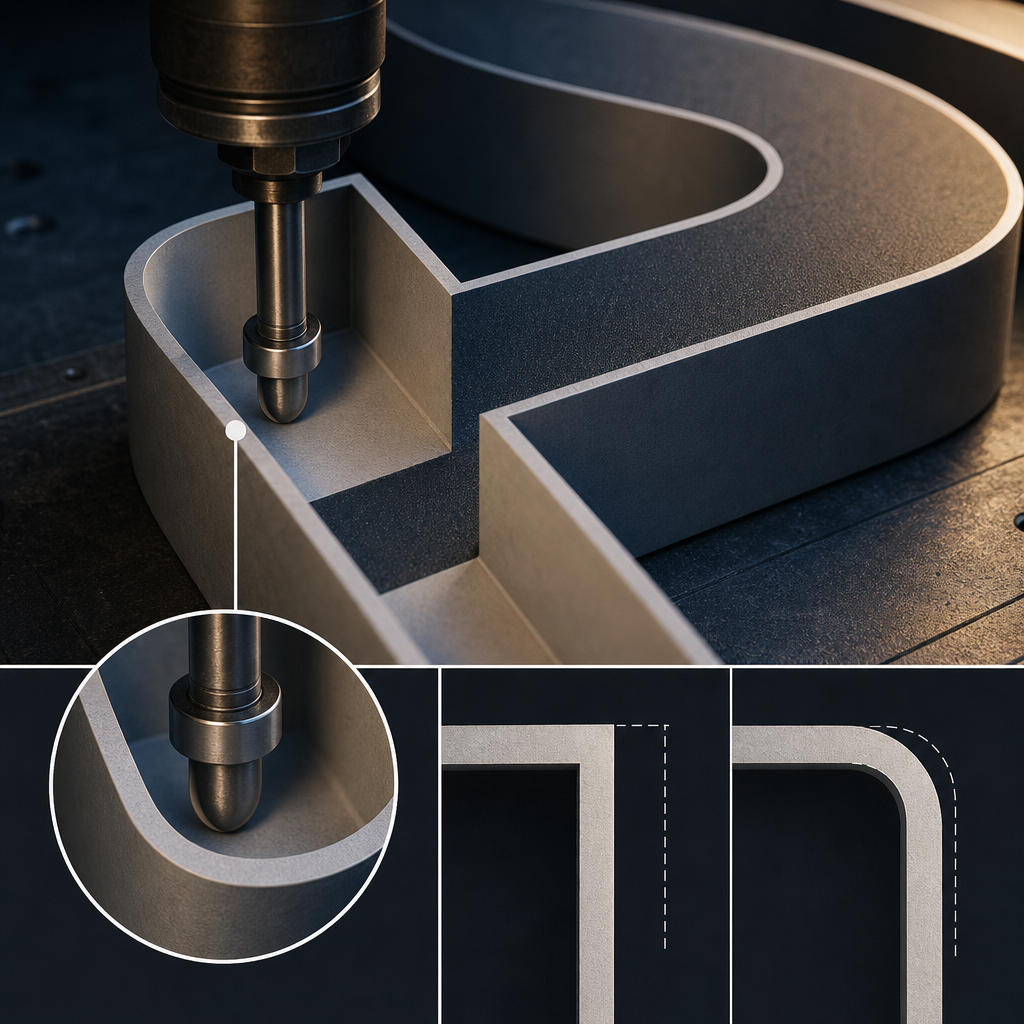
Every internal corner cut by a router bit is limited by the bit's own radius, because a round tool cannot produce a sharp inside corner. Minimum stroke widths on letters, and minimum counter sizes in typefaces, are governed by the same limit and must be checked before artwork goes to production.
A router bit is round, so the smallest internal radius it can cut equals its own radius, half its diameter. A common 6mm cutter leaves a minimum internal radius of roughly 3mm on every inside corner. Specify a 1mm internal radius on a design cut with that tool, and the machine will simply round it out to 3mm regardless of what the drawing says.
This matters most on typography. Built-up letters and fret-cut lettering both rely on internal counters, the enclosed or partially enclosed spaces inside letters like 'e', 'a', 'o' and 'g'. If a typeface has narrow strokes or tight counters, a standard cutting tool will blur or fill in that detail instead of reproducing it cleanly. Fine serifs behave the same way: a serif that tapers to a point on screen will end up rounded and blunted once cut.
The fix is straightforward. Redraw problem letterforms with slightly wider strokes and more open counters before sending artwork, or specify a smaller-diameter tool for the fine detail passes, accepting the longer cutting time that comes with it. A competent fabricator will flag this at the artwork stage rather than after the job is cut.
Edge Finishes and Secondary Processes
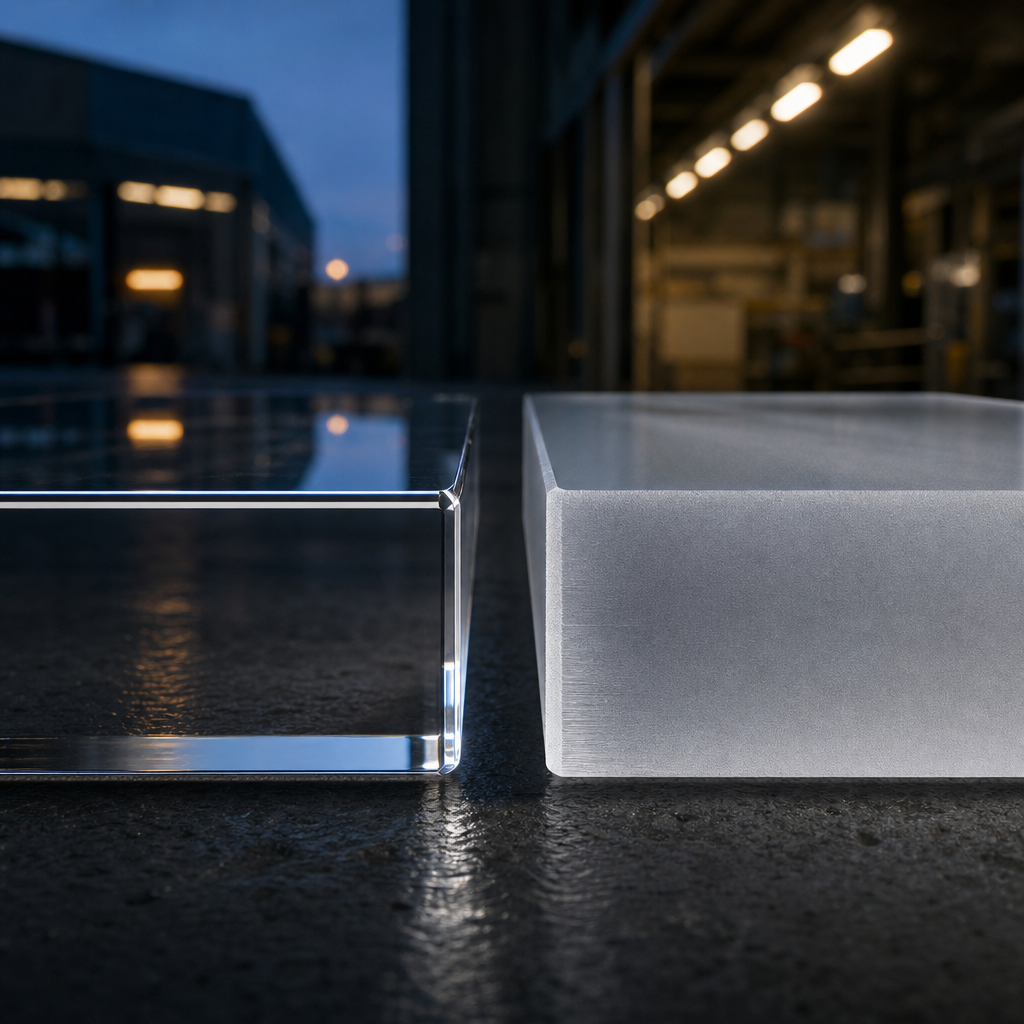
Edge finish is a separate decision from tolerance, and it changes both the look and the cost of a cut piece. Acrylic can be flame-polished to a clear, glass-like edge or left machined for a frosted, satin look. Metals need deburring, and some jobs require folding, welding or painting after cutting.
Flame polishing runs a flame quickly along a cut acrylic edge, melting the surface just enough to fuse the machining marks into a clear finish. It looks premium and suits face-lit or edge-lit letters where light passes through the edge. It works best on cast acrylic up to a moderate thickness. Very thick acrylic edges are harder to polish evenly and are often left machined instead.
Machined edges on acrylic and ACM are functional rather than decorative, appropriate where the edge will be painted, laminated, or hidden behind a frame or return. Metal parts need deburring after cutting to remove the fine burr left along the cut line, both for safety and for a clean fit against adjoining pieces. ACM panels are often routed with a V-groove along the fold line so the panel can be folded into a tray sign with square, seamless corners. Aluminium and stainless components may need welding at joints, followed by grinding and polishing to blend the weld into the surrounding surface. Painting and powder coating are usually the last step, and cut edges need to be clean and free of contamination before finishing goes on.
Supplying Artwork That Cuts Right the First Time

Artwork that cuts correctly the first time is supplied as vector outlines with fully closed paths, text converted to curves, dimensions set at true 1:1 scale, and clear separation between cut lines, engrave lines and score lines. Getting any one of these wrong is the most common cause of production delay.
Vector files (AI, EPS, PDF or DXF) give the router a precise path to follow. Raster images, screenshots or scanned sketches do not, and require redrawing before they can be cut. Every path intended as a cut line must be fully closed. An open path, even by a fraction of a millimetre, can cause the tool to cut an incomplete shape or stop partway through.
Text should always be converted to outlines before the file is sent. If a font is not installed on the fabricator's system, converting to curves is the only way to guarantee the letterforms cut as designed rather than substituting a default font. Files should be set to true scale, because a file drawn at 50 per cent and labelled '2x actual size' invites errors the moment someone forgets to check the label.
Where pieces need to fit together, such as a fret-cut screen inserted into a frame, or interlocking built-up letters, kerf allowance needs to be built into the drawing. Kerf is the small amount of material removed by the width of the cutting tool itself. Ignoring it produces parts that are technically correct on screen but too tight or too loose once cut. A rough hand sketch is a fine starting point for a feasibility check, but it should be developed into proper vector artwork before it goes to the machine.
Where Tolerance Genuinely Matters on a Finished Sign
Tolerance matters most where pieces need to align with each other or with a fixed structure: built-up letters, fret-cut screens, wayfinding and reception signage, and plinth or pylon components. Get it wrong in these applications and the fault is visible, not hidden.
Built-up letters, where a face, return and back are fabricated as three separate pieces and joined, need all three to match within a very small margin. A face that is 1mm larger than its return leaves a visible lip around the entire letter. Fret-cut screens depend on consistent internal radii across a repeating pattern; if radii vary from cut to cut, the pattern reads as uneven from a distance, which defeats the point of a decorative screen. Wayfinding and reception signage often involves multiple panels mounted edge to edge or in a modular frame, and small tolerance errors stack up across the run, so a fixing hole that is fine on one panel can be visibly off by the fifth panel. Plinth and pylon components carry structural load and need fixing holes positioned accurately enough to align with anchor points cast or drilled into a base.
Why We Don't Chase the Tightest Possible Tolerance on Every Job
The tightest achievable tolerance is not always the right spec for a sign, and pushing for it on the wrong job adds cost without adding anything a viewer will ever notice. Outdoor materials move with heat regardless of how precisely they were cut, so a tolerance tighter than that natural movement is effort spent on a number nobody will see.
This is a genuinely held position, and it runs against the instinct many buyers have to ask for the tightest tolerance quoted, on the assumption that tighter always means better. It doesn't, not in signage. An ACM panel mounted outdoors will expand and contract slightly with daily temperature swings, an amount that can exceed the machining tolerance itself. Specifying an ultra-tight cut on that panel does not improve the finished result, because thermal movement will outpace it anyway. The tolerance that actually matters on an outdoor panel sign is usually the fixing hole positions and the panel-to-panel alignment, not the decimal point on the overall cut dimension.
Where tight tolerance genuinely earns its cost is on the details covered above: built-up letters, fret patterns and multi-panel wayfinding runs, where small errors are visible up close and stack up across a job. Consider a set of individually built-up reception letters where the original artwork specified sharp 1mm internal corners on the counters of the letterforms. Cut with the shop's standard 6mm bit, those corners would round out to roughly 3mm, softening the letterforms just enough to be noticeable side by side with the original design. The practical fix in a case like this is to redraw the counters with a slightly larger minimum radius before cutting, so the finished letters match the intended look rather than fighting the tool's physical limit. The same principle applies to a fret-cut privacy screen with a repeating geometric pattern: the pattern needs to be drawn around the tool's minimum radius from the outset, not adjusted after a test cut reveals the problem.
If you're specifying custom-cut letters, panels or fabricated components and want to know what is genuinely achievable before you lock in artwork, send a sketch or file through to the Sunquest Signs fabrication team for a free feasibility check and quote. It is a faster and cheaper fix at the drawing stage than after the first cut.
References
- Standards Australia, AS 1428.1 Design for access and mobility, Part 1: General requirements for access, including requirements for tactile and directional signage.
- International Organization for Standardization, ISO 2768, General tolerances for linear and angular dimensions without individual tolerance indications.
- 3A Composites, technical resources for Alucobond and Dibond aluminium composite panel products.
- Austroads, Guide to Traffic Management, for wayfinding and directional signage standards referenced in commercial and public signage projects.
Talk to a signage expert
Tell us about your project and we'll come back with options and honest advice.
Get in TouchFrequently Asked Questions
What tolerance can I expect from CNC-cut acrylic signage?
Thin acrylic, up to around 6mm, generally holds tolerance in the order of 0.1mm to 0.3mm on a well set up router. Thicker acrylic used for plinths or heavy display pieces carries a wider margin because of increased heat and tool deflection. Confirm the exact figure against your specific thickness and application.
What is the difference between laser cutting and CNC routing for signage?
Laser cutting suits thin, flat materials and produces very fine detail with a narrow kerf, but it is limited in the thickness and material types it can handle safely, particularly reflective metals and some PVC formulations. CNC routing handles a much wider range of thicknesses and materials, including ACM, aluminium, timber and thick acrylic, at the cost of a slightly wider minimum detail size than laser cutting achieves.
What is the minimum internal radius I should design for?
The minimum internal radius equals half the diameter of the cutting tool used. A common 6mm router bit leaves a minimum radius of about 3mm on every inside corner. If your design calls for sharper internal corners, either redraw them with a larger radius or ask whether a smaller tool can be used for that pass.
Can Sunquest cut stainless steel or brass letters?
Yes, brass and stainless steel are cut for plaques, name plates and premium reception signage, generally in the 1.5mm to 6mm thickness range, using cutting approaches suited to metal rather than a standard timber and plastics setup. Tolerance and finish options should be confirmed at the quoting stage for metal work.
How do I supply artwork so it cuts correctly the first time?
Supply vector files with fully closed paths, text converted to outlines, dimensions set at true 1:1 scale, and cut, engrave and score lines clearly separated, usually by colour or layer. Include kerf allowance on any pieces designed to interlock or fit into a frame.
Does tolerance matter for outdoor signage exposed to heat?
Yes, but not in the way most buyers expect. Outdoor materials like ACM and acrylic expand and contract slightly with temperature, an amount that can exceed the original machining tolerance. Fixing hole position and panel-to-panel alignment usually matter more for outdoor signs than chasing the tightest possible cut tolerance on the overall dimension.
Related Articles
CNC Cutting in Toowoomba: Custom Routed Signage, Letters and Panels for Local Businesses
Laser Cutting in Hervey Bay: Custom Cut Signs, Letters and Panels for Fraser Coast Businesses
CNC Routing for Aluminium Composite Panels: Cutting, Folding and Finishing ACM Signage
Signs that set you apart
Over 40 years on the Sunshine Coast. Design, compliance, manufacture and installation handled end to end.
Get a Free Quote