CNC Cutting in Toowoomba: Custom Routed Signage, Letters and Panels for Local Businesses
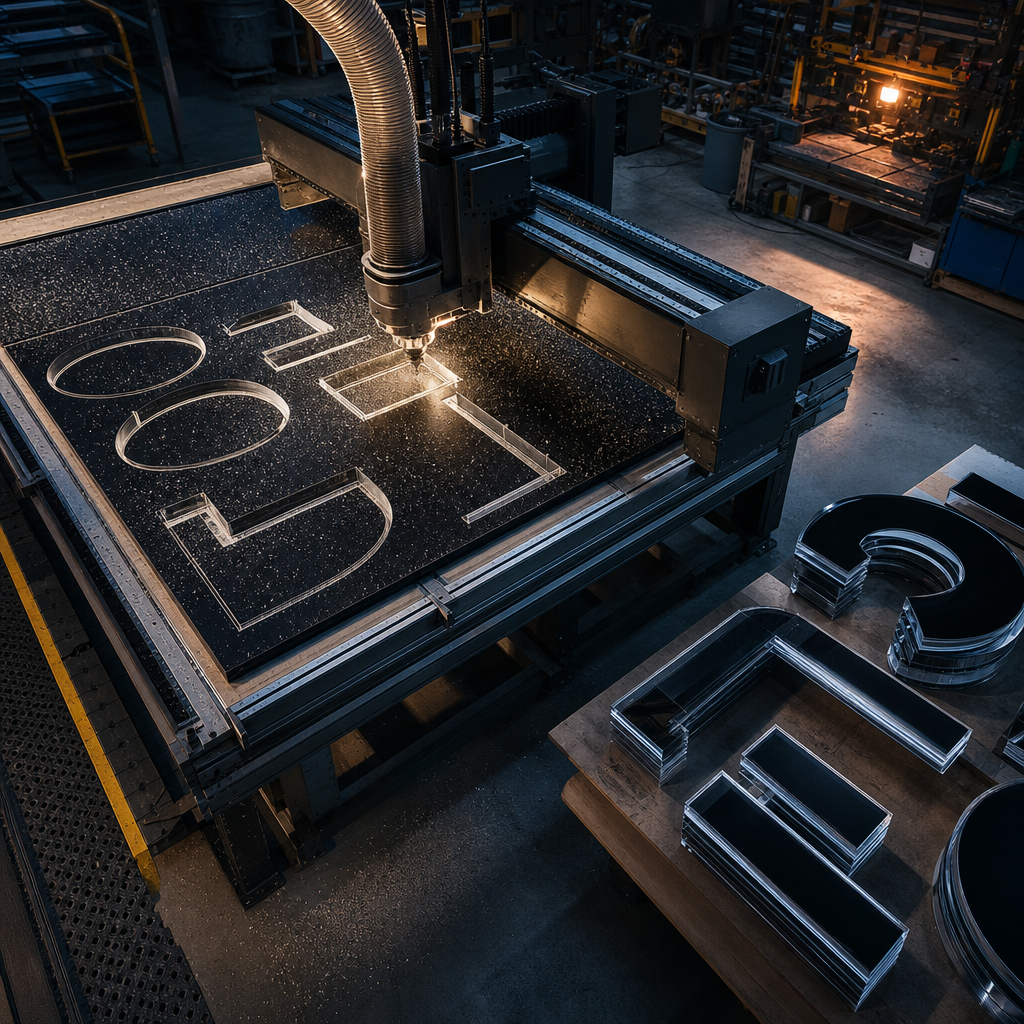
CNC cutting in Toowoomba delivers precisely routed acrylic, aluminium and composite components for shopfront letters, illuminated signs, pylon faces and wayfinding suites. A computer-guided router cuts every letter and panel from the same digital file, so multi-letter sets and multi-site rollouts match exactly, with clean edges ready for painting, laminating or powder coating.
Most Toowoomba business owners never see the router. They see the finished sign on the wall, the illuminated letters above the door, or the pylon panel on the highway frontage. But the quality of that finished sign starts with how it was cut. A wobbly hand-cut edge or a laser-scorched line on acrylic will show up the moment the sun hits it. CNC cutting is the step that decides whether your letters read as sharp and professional, or slightly off.
This guide breaks down what CNC cutting actually means for a business sign, which materials and products it suits in the Toowoomba and Darling Downs region, and what to check before you commit to a fitout, rebrand or new pylon sign.
Key Takeaways
- CNC cutting uses a computer-guided router to cut acrylic, aluminium composite (ACM), aluminium and PVC foam board to exact vector paths, ideal for shopfront letters, pylon faces and wayfinding panels.
- It differs from laser cutting (which uses a beam and suits thinner sheet with fine detail) and from hand-cut vinyl (which is limited to flat, thin film graphics, not structural letters or panels).
- Material choice matters in the Darling Downs climate: UV-stable acrylics and marine-grade or powder-coated aluminium hold their colour and shape better through Toowoomba's exposed, changeable weather.
- Tight tolerances and consistent registration are critical for multi-letter sets and multi-site signage rollouts, where every store needs to match.
- Artwork must arrive as vector paths with outlined fonts and minimum stroke widths respected, or the file will need rework before it can be cut.
- Toowoomba Regional Council requires development approval for many freestanding and pylon signs, so compliance checks belong early in the process, not after fabrication.
Ready to make your business impossible to miss?
Design, manufacture and installation, all under one roof in Warana.
Get a Free QuoteSummary: CNC Cutting vs Alternatives for Signage
| Method | Best suited to | Typical materials | Edge finish |
|---|---|---|---|
| CNC routing | Thicker letters, 3D signage, pylon panels, engraved plaques | Acrylic, ACM, aluminium, PVC foam board, brass, stainless | Clean mechanical cut, can be flame polished or laminated |
| Laser cutting | Fine detail, thin sheet, intricate logos | Thin acrylic, thin metal, card and film | Fast cut, can leave a slight scorched edge on some plastics |
| Hand-cut vinyl | Flat window and vehicle graphics, short-run decals | Self-adhesive vinyl film | No structural edge, film only |
What CNC Cutting Actually Means for a Business Sign
CNC cutting uses a computer-controlled router to cut a physical toolpath through a sheet of material, guided by a digital file rather than a hand or a laser beam. For signage, that means acrylic letters, aluminium panels and composite faces come out as an exact, repeatable shape every time.
The difference between CNC routing, laser cutting and hand-cut vinyl comes down to what each tool is physically doing. A CNC router spins a cutting bit through the material, which suits thicker stock: acrylic letters at 10mm or 15mm, aluminium composite panel, or timber-free foam board used for internal wayfinding. Laser cutting burns or melts a path with a focused beam, which is excellent for fine detail on thinner sheet but less suited to thicker, structural letter sets where a mechanical edge is needed. Hand-cut vinyl is a different category altogether: a blade cutting adhesive film for window graphics or vehicle decals, with no structural depth at all.
For a Toowoomba business comparing options, the practical question is rarely "which machine" but "which product". Shopfront letters, pylon faces and 3D built-up signage need the depth and rigidity that CNC routing provides. Window decals and short-run promotional graphics are a vinyl job. Fine, intricate logos on thin material can suit laser cutting and fabrication. A capable local fabricator uses all three, matched to the product, not just one tool because it is the one they own.
Materials Handled by CNC Routers for Signage
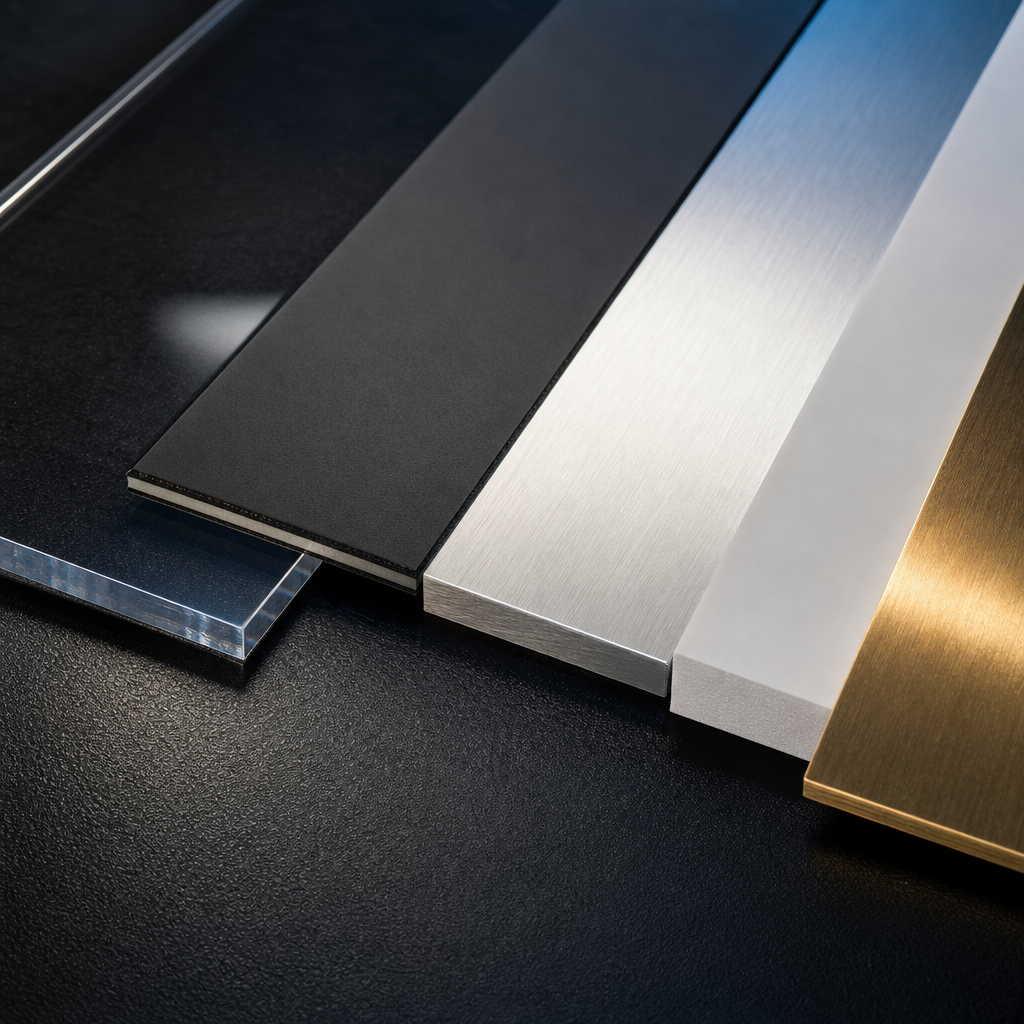
A CNC router can cut acrylic, aluminium composite panel (ACM), solid aluminium, PVC foam board, and metals like stainless steel and brass for plaques. Each material suits a different signage product, and each has its own thickness range and edge-finish requirements that affect how the final sign looks and wears.
Acrylic is the workhorse for custom cut acrylic letters in Toowoomba shopfronts, reception signage and illuminated faces. It routs cleanly, accepts paint and vinyl overlay, and can be flame polished for a glass-like edge on face-lit letters. Aluminium composite panel (ACM), two thin aluminium skins bonded to a solid core, is the standard for pylon and plinth faces and larger flat panel signage because it stays rigid across large spans without the weight of solid aluminium. Solid aluminium sheet is used where a sign needs more durability or a routed, engraved, or fold-formed edge, such as dimensional lettering or heavier-duty panels. PVC foam board suits internal wayfinding plates, directory panels and lightweight display signage where cost and ease of routing matter more than outdoor durability. Stainless steel and brass are reserved for engraved plaques, donor boards and heritage-style signage where a premium, tactile finish is the point.
Edge finish is where a fabricator's experience shows. A CNC-cut acrylic edge can be left raw, sanded, or flame polished depending on whether the letter will be lit from behind (halo-lit) or through the face (face-lit). ACM panels are usually cut with a router bit set to leave a clean, chip-free edge before the face is painted or laminated. Aluminium sign panels for outdoor use are typically powder coated after cutting, since raw aluminium exposed to the Darling Downs sun and rain will eventually show corrosion at cut edges if left untreated.
What Toowoomba Businesses Order Most
Toowoomba businesses most commonly order CNC cut shopfront letter sets, illuminated face-lit and halo-lit letters, reception logo walls, pylon and plinth panels, wayfinding suites, and engraved plaques. These products cover most fitouts, rebrands and highway-facing sites across the region.
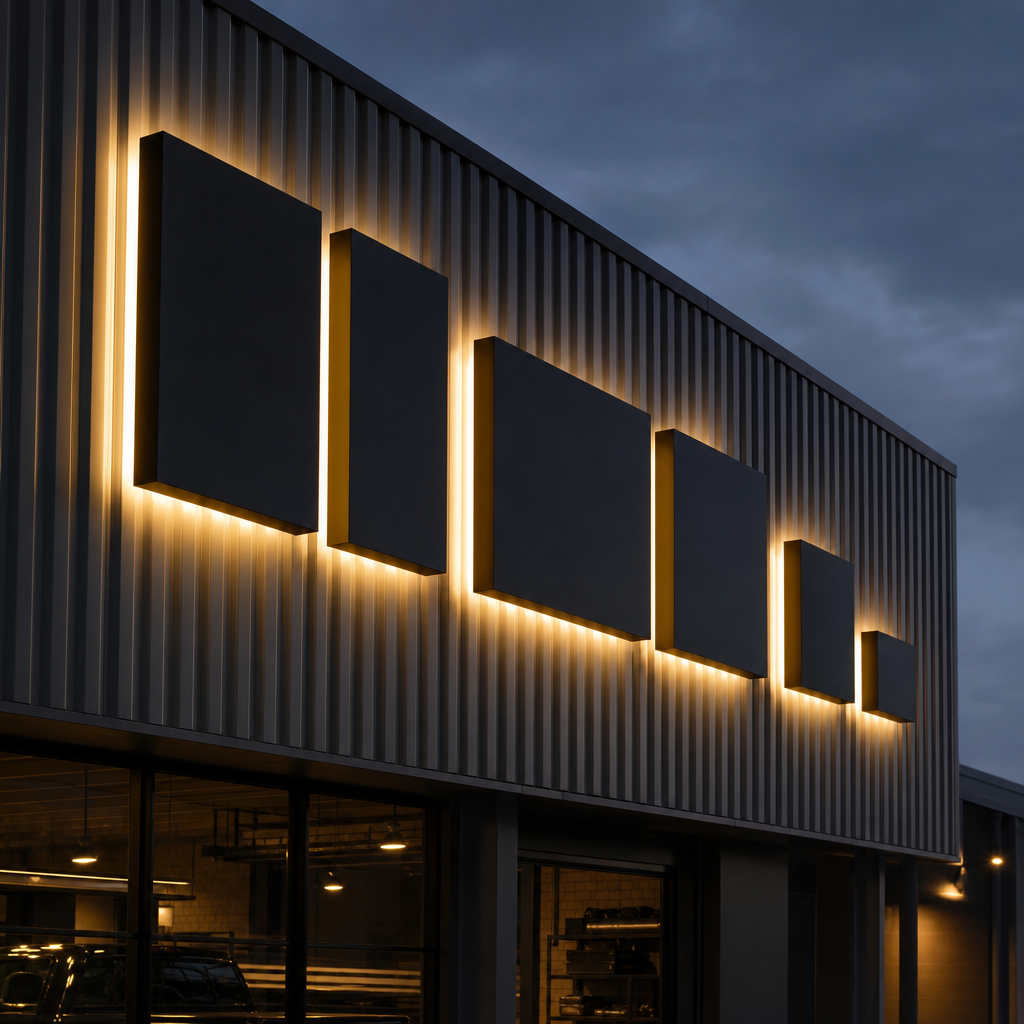
Shopfront letter sets are the most requested product, usually cut from acrylic or aluminium and either painted to match a brand colour or left in a brushed metal finish. Illuminated 3D signage letters, both face-lit (light shines through the front) and halo-lit (light glows around the back), are ordered heavily by retail tenants and franchise operators who need their signage visible at night along routes like Ruthven Street and James Street. Reception walls and internal logo signage lean on CNC cut acrylic or dimensional letters mounted off a painted or laminated ACM backing panel, giving depth without the cost of a fully built sign box. Pylon and plinth panels, cut from aluminium composite and faced with printed or painted graphics, are a common upgrade for service stations, medical centres and shopping strips fronting the highway. Wayfinding suites, directional plates and internal signage for aged care, medical and education sites rely on repeatable CNC cut panels so every plate in the suite matches. Engraved plaques and decorative screens round out the list, often in aluminium, stainless or brass for a more premium finish.
Consider a typical scenario on a busy Toowoomba arterial road: a pylon sign with a printed vinyl face that has faded and delaminated after several years of sun exposure. Replacing the flat printed panel with CNC cut, powder-coated aluminium letters and a routed ACM face gives the sign genuine depth and shadow line, rather than a flat sticker look. The result reads as a rebuilt sign rather than a patched-up one, and it holds its colour and shape far better under repeated UV exposure than a printed laminate ever will.
Precision, Tolerances and Repeatability
Precision matters most when a sign involves more than one letter or more than one site. Clean kerf, tight registration and consistent stroke widths make sure every letter in a set, and every sign across a multi-site rollout, matches exactly, without the size or spacing drift that hand fabrication can introduce.
Kerf is the small amount of material a cutting tool removes as it passes through. On a CNC router this is fixed and predictable, so a fabricator can compensate for it in the file and get a consistent result letter after letter. Registration is about how accurately a cut shape lines up with its intended position, particularly important when a logo has multiple layers, such as a routed backing panel with separately cut raised letters on top. Stroke width consistency matters most on letter sets with thin elements, like a script logo or a font with fine serifs. Hand-cutting or an inconsistent machine setup can produce letters where the thin strokes look noticeably different in width from one letter to the next, which is obvious to anyone standing in front of the sign.
For a business rolling out signage across several Toowoomba locations, or a franchise group standardising its look across the Darling Downs, this repeatability is the entire point of using CNC cutting rather than a manual process. The same file, cut on the same machine, produces the same letter every time. That is difficult to guarantee with hand tools, no matter how skilled the operator.
From File to Finished Sign
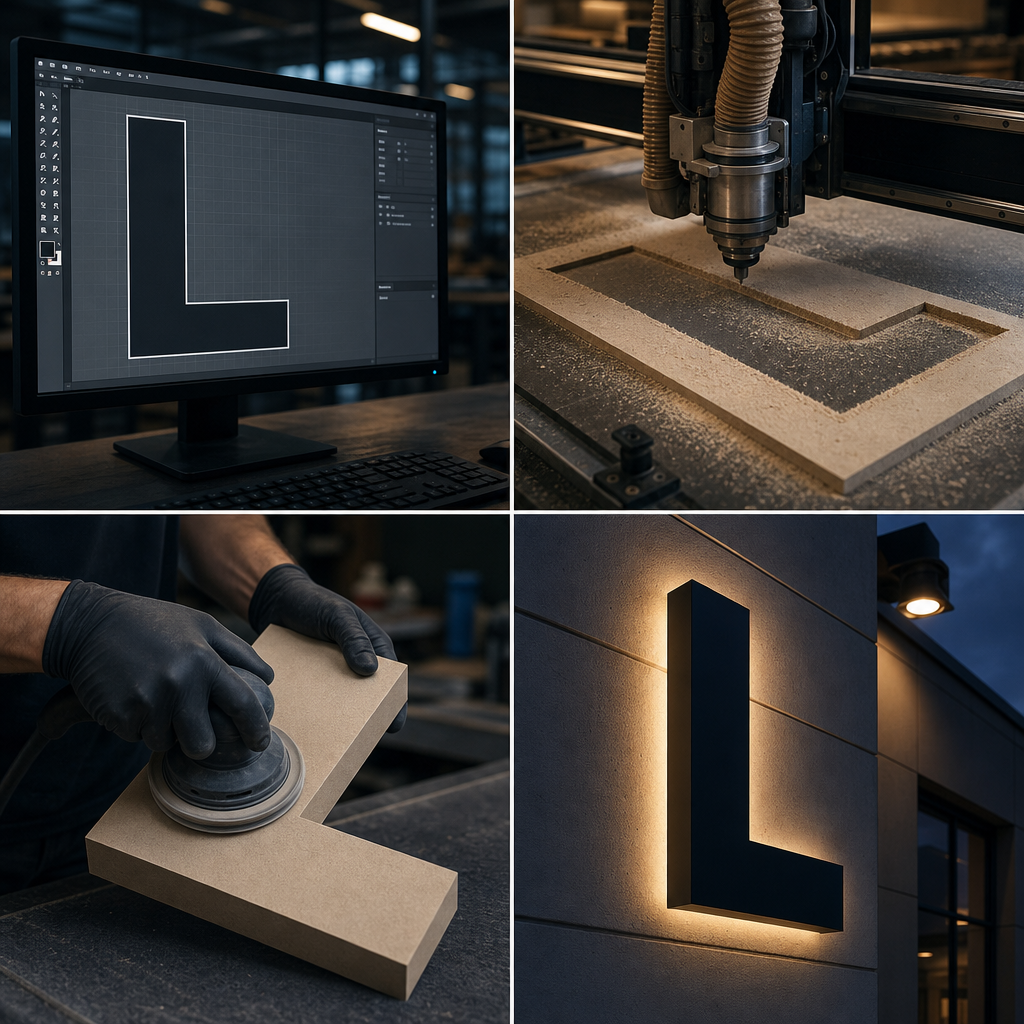
A CNC cut sign moves through five stages: artwork preparation, file setup, cutting, finishing, and installation. Artwork must be supplied as vector paths with fonts outlined and minimum stroke widths respected, since a router cannot cut a shape that is too thin or fragile to hold together once it leaves the sheet.
Artwork preparation is where most delays happen if it is skipped. Vector files (not flattened images) let the router follow an exact path rather than approximating a shape. Fonts need to be converted to outlines so the cutting software reads them as shapes, not as text linked to a font file that might not be installed on the production computer. Minimum stroke widths need checking against the material: a very thin serif that looks fine on screen may be too delicate to survive being routed from 10mm acrylic without snapping.
Once the file is confirmed, a fabricator sets up nesting (arranging shapes efficiently on the sheet to minimise waste), toolpaths and cutting parameters specific to the material and thickness. The router then cuts the components. Finishing follows: edges are sanded or flame polished, panels are painted or powder coated, and any assembly (laminating a printed face to a routed backing, or fixing raised letters to studs) happens in the workshop rather than on site. Painting and powder coating add lead time, since coated components typically need to cure before they are handled or installed. Installation is the final stage, and for illuminated or structural signage this includes wiring, mounting and, where required, engineering sign-off for wind loading on larger pylon and plinth structures.
Choosing a CNC Cutting Partner in Toowoomba
Choosing a local CNC cutting and fabrication partner comes down to lead times, how well they account for Darling Downs weather and UV exposure, whether they understand Toowoomba Regional Council approval requirements, and whether they fabricate in-house or outsource the cutting to a third party.
Lead times depend on artwork approval, material availability and finishing, and they vary by product: a flat-cut acrylic letter set moves faster than an illuminated pylon face that needs powder coating and wiring. Ask any prospective fabricator for a realistic, project-specific timeline rather than a generic promise, since the honest answer always depends on what is being built.
Darling Downs weather is genuinely a design consideration, not just a sales line. According to ARPANSA (arpansa.gov.au), UV levels across Queensland remain high for most of the year, which means outdoor acrylic and paint finishes need to be UV-stable or they will fade and become brittle faster than expected. Toowoomba's elevated position on the Great Dividing Range also brings wider daily temperature swings than the coast, which is a factor in choosing materials that hold dimensional stability rather than warping or expanding unevenly across a large pylon panel.
Compliance is the other piece that catches businesses out. Toowoomba Regional Council administers a planning scheme that requires development approval for many freestanding and pylon signs, particularly where they exceed certain height, area or setback thresholds, and landlords in shopping centres and business parks often layer their own signage criteria on top of council rules. A fabricator who has worked through this process before, rather than one seeing it for the first time, saves real delay.
Finally, consider whether a supplier fabricates in-house or outsources cutting to another business. In-house CNC cutting and fabrication under one roof, from design through to painting and installation, generally means faster turnaround, easier changes mid-project, and one point of accountability if something needs adjusting. An outsourced supply chain adds handling and communication steps that can stretch even simple jobs.
Why the Cut File Is Only Half the Job
Most signage guides talk about CNC cutting as though the router is the finished product. In practice, the cutting step is often the easiest part. The differentiator is what happens before and after: file preparation that respects material limits, and finishing that accounts for how a sign will actually be viewed and lit.
A genuinely well-prepared cut file already anticipates flame-polished edges for a face-lit letter, or a slightly oversized backing panel to hide mounting studs on a reception wall. A poorly prepared file might cut without error and still produce a sign that looks amateurish once it is lit or mounted, because nobody thought through how light or shadow would fall across the final install. If there is one thing worth pushing back on when comparing quotes for CNC cutting in Toowoomba, it is this: ask what happens to the component after it comes off the router, not just how accurately it was cut. That finishing step, sanding, polishing, laminating, painting or powder coating, is usually where quotes vary the most, and where cheaper suppliers cut corners that show up within the first year of sun exposure.
Get a CNC Cutting and Fabrication Quote
If you are planning a shopfront upgrade, a pylon refresh, or a new wayfinding suite, send Sunquest Signs your artwork, sketches or even a rough idea of what you are after. Call our Toowoomba team or fill in our online enquiry form to get a free quote on custom CNC cut signage, letters and panels for your business.
References
- ARPANSA (Australian Radiation Protection and Nuclear Safety Agency): UV Index information, arpansa.gov.au
- Toowoomba Regional Council: Planning Scheme and development approval requirements, tr.qld.gov.au
- Standards Australia: AS/NZS 1170.2 Structural design actions (wind actions), standards.org.au
- Bureau of Meteorology: Queensland climate data, bom.gov.au
Talk to a signage expert
Tell us about your project and we'll come back with options and honest advice.
Get in TouchFrequently Asked Questions
What is the difference between CNC cutting and laser cutting for signage?
CNC routing uses a spinning bit to physically cut a path, suiting thicker materials like acrylic letters, ACM panels and aluminium. Laser cutting uses a focused beam, better suited to thinner sheet and finer detail, but less practical for thicker, structural signage components.
What materials can be CNC cut for shopfront signage?
Acrylic, aluminium composite panel (ACM), solid aluminium, PVC foam board, and metals such as stainless steel and brass for plaques can all be CNC cut, with material choice depending on whether the sign is illuminated, structural, or purely decorative.
How long does custom CNC cut signage take in Toowoomba?
Turnaround depends on artwork approval, material availability and finishing steps like painting or powder coating. Simple flat-cut letter sets generally move faster than illuminated or powder-coated pylon panels. Ask for a project-specific timeline once artwork and specifications are confirmed.
Do I need council approval for a new pylon or shopfront sign in Toowoomba?
Often, yes. Toowoomba Regional Council requires development approval for many freestanding and pylon signs, particularly where height, area or setback thresholds are exceeded. Shopping centre and landlord approvals may also apply on top of council requirements.
Can CNC cut letters be illuminated?
Yes. CNC cut acrylic and aluminium letters are commonly built as face-lit or halo-lit illuminated signage, with the router preparing the letter shell and separate fabrication adding LEDs, wiring and a return depth for the light to sit in.
What file format do I need to supply for CNC cutting?
Vector files with fonts converted to outlines, such as AI, EPS or vector PDF. Flattened images or raster files (like JPG or PNG) cannot be cut directly and need to be redrawn as vector paths first.
Related Articles
CNC Cutting Tolerances and Material Capabilities: What Signage Buyers Should Expect
Laser Cutting in Caloundra: Precision Cut Signs, Letters and Panels for Local Businesses
CNC Cutting in Noosa: Custom Routed Signs, Letters and Panels for Local Businesses
Signs that set you apart
Over 40 years on the Sunshine Coast. Design, compliance, manufacture and installation handled end to end.
Get a Free Quote