Laser Cutting in Caloundra: Precision Cut Signs, Letters and Panels for Local Businesses
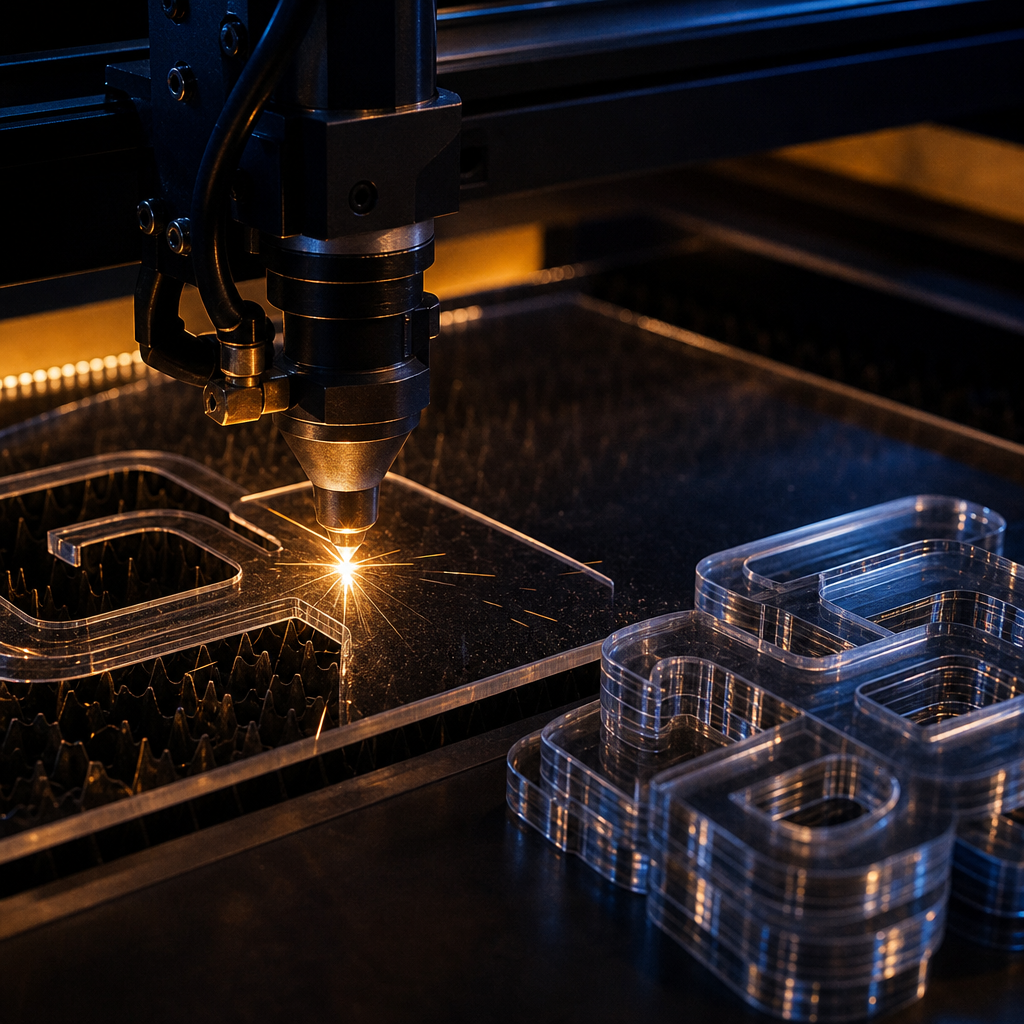
Laser cutting in Caloundra delivers flame-polished acrylic letters, sharp stainless and mild steel signage, and fine decorative screens with a level of edge quality and internal detail CNC routing cannot match. Sunquest Signs fabricates these pieces locally on the Sunshine Coast, cutting acrylic, stainless, aluminium and mild steel to size for shopfronts, reception areas and wayfinding, with no interstate freight wait or transit damage risk.
If you're comparing quotes for shopfront letters on Bulcock Street, a reception logo in the Caloundra Industrial Estate, or suite numbers for a new fit-out near Kings Beach, the process behind the sign matters as much as the design. Laser cutting and CNC routing both cut sheet material to a vector file, but they behave differently on fine lettering, thin gauge metal and small production runs.
This guide sets out what laser cutting actually does for Caloundra businesses: which materials suit it, where it beats CNC routing, where it doesn't, and what coastal exposure near Kings Beach and Golden Beach means for material choice and fixings. It's written for owners and specifiers comparing quotes, not for people who already know the trade.
Key Takeaways
- Laser cutting produces flame-polished acrylic edges and tight internal detail that CNC routing struggles to replicate on fine lettering and logos.
- Suitable materials include acrylic, stainless steel, mild steel, aluminium and some timber-look composites, each with practical thickness limits.
- Coastal exposure near Kings Beach and Golden Beach calls for marine-grade stainless or powder-coated aluminium, plus correctly specified fixings.
- Local Sunshine Coast fabrication removes the freight delay and transit damage risk that comes with interstate suppliers.
- Laser and CNC routing are complementary processes: laser suits fine detail and short runs, CNC suits large panels and heavier sheet.
- Supplying clean vector artwork with correct outlines is the single biggest factor in getting an accurate laser cutting quote.
Ready to make your business impossible to miss?
Design, manufacture and installation, all under one roof in Warana.
Get a Free QuoteSummary Table: Laser Cutting at a Glance for Caloundra Buyers
| Consideration | Laser Cutting | CNC Routing |
|---|---|---|
| Edge finish on acrylic | Flame-polished, glass-smooth edge straight off the machine | Tooled edge, usually needs secondary polishing for a glass look |
| Fine internal detail (thin letter strokes, logos) | Holds tight radii and narrow gaps well | Limited by cutter bit diameter, struggles on very fine detail |
| Typical material range | Acrylic, stainless, mild steel, aluminium, some timber-look sheet | Acrylic, ACM/Dibond, timber, foam board, thicker sheet stock |
| Best suited to | Letters, logos, decorative screens, small-run signage | Large fascia panels, thick substrates, bulk cutting |
| Run size economics | Efficient for one-off and small batch work | More efficient for large panels and longer production runs |
| Coastal durability | Marine-grade stainless or powder-coated aluminium recommended | Same material rules apply where metal is used |
What Laser Cutting Is and Why Caloundra Businesses Specify It
Laser cutting uses a focused beam to melt, burn or vaporise a path through sheet material, following a vector file with no physical tool touching the surface. For Caloundra signage, that means flame-polished acrylic edges, crisp lettering and repeatable small runs without the setup cost of tooling.
A CNC router removes material with a spinning bit, which is fast and economical on large panels but leaves a slightly rougher edge that often needs secondary flame polishing on acrylic. A laser beam is far narrower than any router bit, so it can hold tight internal corners, thin serifs and small counters in letters like "e", "a" and "o" that a router bit would round out or bridge over.
That precision is exactly why cafe, retail and professional services fit-outs around Bulcock Street and Caloundra CBD specify laser cut acrylic letters for shopfronts. A brand logo with fine strokes, a reception sign with a script font, or a set of suite numbers with a distinctive typeface all rely on the cutter holding detail a router can't. Laser cutting also suits short production runs well, because there's no custom tooling to amortise across a large batch, which matters for a single-shop fit-out rather than a chain rollout.
Materials and Thicknesses: What Laser Cutting Handles Well (and What It Doesn't)
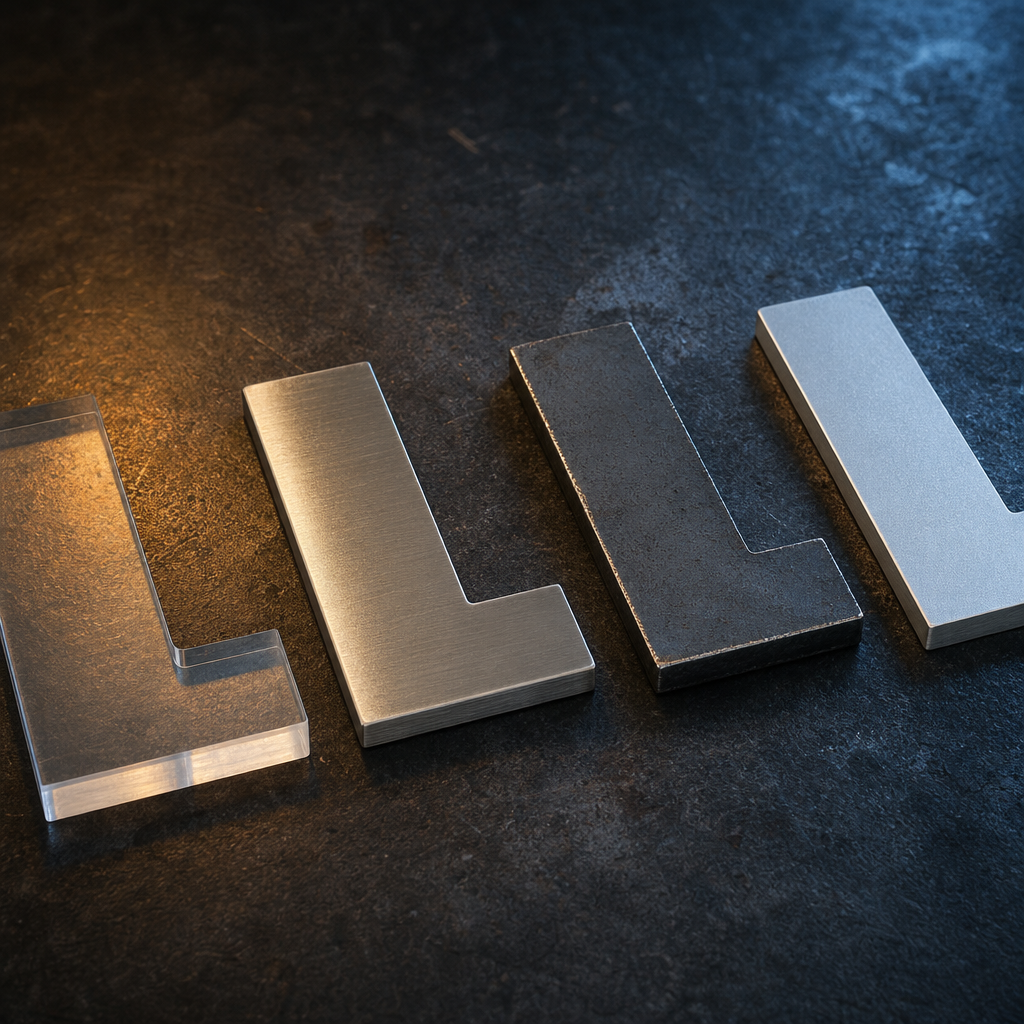
Laser cutting works best on acrylic up to moderate thickness, stainless and mild steel up to a few millimetres, and aluminium within similar limits, with thicker sheet and large panels usually better suited to CNC routing. Matching material and thickness to the process is where an experienced fabricator earns their fee.
Acrylic is the standard material for laser cut letters and reception logos, because the process gives a flame-polished edge with no secondary finishing needed. Cast acrylic laser cuts more cleanly than extruded acrylic, which matters on visible lettering edges. Beyond a certain thickness the cut slows down and edge quality can drop, at which point CNC routing with a polished edge finish becomes the more sensible choice for very thick or oversized letters.
Stainless steel and mild steel both laser cut cleanly at gauges typically used for signage letters, logos and small decorative panels, though heavier structural steel sits outside what a signage laser is built for. Aluminium laser cuts well at signage-relevant thicknesses and is a common choice where weight matters, such as on suspended or standoff-mounted letters. Timber-look laminates and some composite panels can be laser cut for decorative screens and feature signage, though genuine solid timber can scorch and char at the cut edge in a way that needs to be accounted for in the design.
The honest limit is thickness and panel size. Very thick metal, large ACM (aluminium composite panel) fascia sheets, and big flat panels generally run better and cheaper through a CNC router. A specifier who understands this from the start avoids paying laser cutting rates for a job that a router handles more efficiently, and Sunquest Signs' own CNC cutting resources on acrylic, ACM and cutting tolerances are worth reviewing alongside this guide if your project includes larger panel work.
Laser Cutting vs CNC Routing: Choosing the Right Process
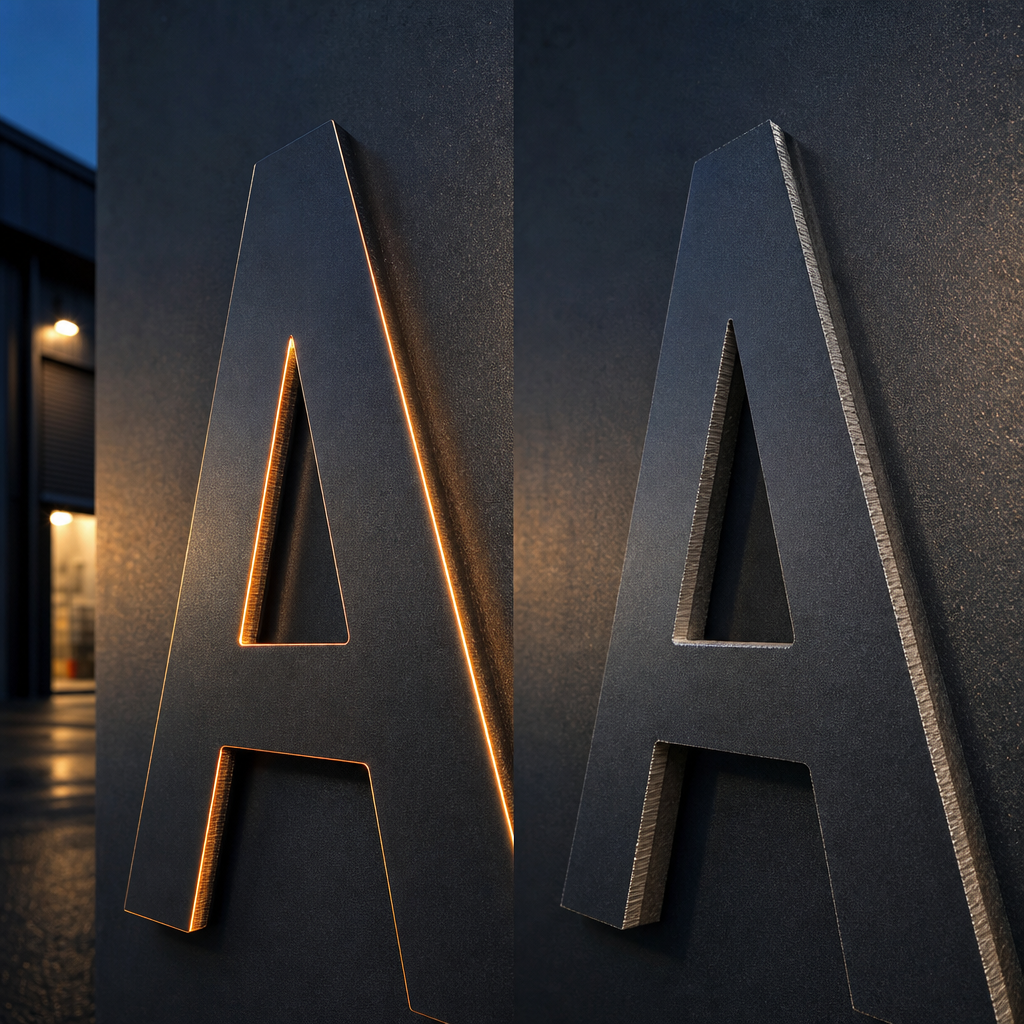
Laser cutting and CNC routing aren't competitors, they're complementary processes chosen by material, thickness and the level of detail needed. Fine lettering, logos and small decorative pieces favour laser. Large fascia panels, thicker substrates and bulk runs favour CNC routing.
The practical differences that matter to a Caloundra buyer comparing quotes:
- Edge quality on acrylic: laser gives a flame-polished finish straight off the bed, CNC gives a tooled edge that often needs a separate polishing pass to look the same.
- Detail capability: a laser beam is narrow enough to cut fine internal shapes and tight radii that a router bit physically cannot fit into.
- Material range: laser handles thin-to-moderate acrylic and metal well, CNC handles thicker sheet, ACM, timber and foam board more efficiently.
- Cost logic: laser cutting is efficient for one-off and small-run work with no tooling setup, CNC routing becomes more cost-effective as panel size and run length increase.
- Speed on large panels: CNC routing generally moves faster across a big flat panel than a laser does, simply because router bits remove material more aggressively.
A shopfront fit-out often uses both. Laser cut acrylic or metal letters for the brand name and logo, paired with a CNC routed fascia panel or ACM cladding behind them. If your project spans both, it's worth asking your fabricator to quote the full job across both processes rather than getting separate quotes from a laser specialist and a router shop, since the edge finishes and mounting details need to line up.
Where Caloundra Businesses Use Laser Cut Signage
Caloundra businesses use laser cut acrylic and metal for shopfront letters, lit and unlit fascia lettering, reception logos, wayfinding and suite numbers, and decorative screens. The common thread is fine detail, a clean edge, and a design that needs to read well from close range as well as from the street.
On Bulcock Street and around Caloundra CBD, laser cut acrylic letters are common on cafe and retail shopfronts, often mounted on standoffs so the fascia behind stays visible and the sign reads as three-dimensional rather than flat-printed. Fitness studios and gyms in the Caloundra Industrial Estate and surrounding commercial precincts often specify laser cut stainless or aluminium logos for a more industrial, durable look than printed vinyl or a lightbox.
Professional services and medical suites use laser cut acrylic or metal for reception signage and directional wayfinding, where the brief usually calls for a clean, premium finish rather than a printed panel. Wayfinding and suite signage in shared commercial buildings sometimes needs to meet accessibility requirements under Standards Australia's AS 1428.1, which covers tactile and directional signage in public and commercial buildings, and laser cutting handles the fine raised or cut-through lettering that standard often calls for.
Decorative screens are another growing use case around Caloundra, particularly for outdoor dining areas, feature walls and privacy screening where a laser cut pattern in aluminium or acrylic adds visual interest without the cost of a fully custom architectural screen. Vehicle-adjacent signage, such as laser cut logo panels mounted near a vehicle bay or loading dock, is common in the Industrial Estate where trade businesses want a durable, weatherproof identifier that doesn't rely on printed vinyl.
Coastal Considerations: Building Laser Cut Signage for Salt Air
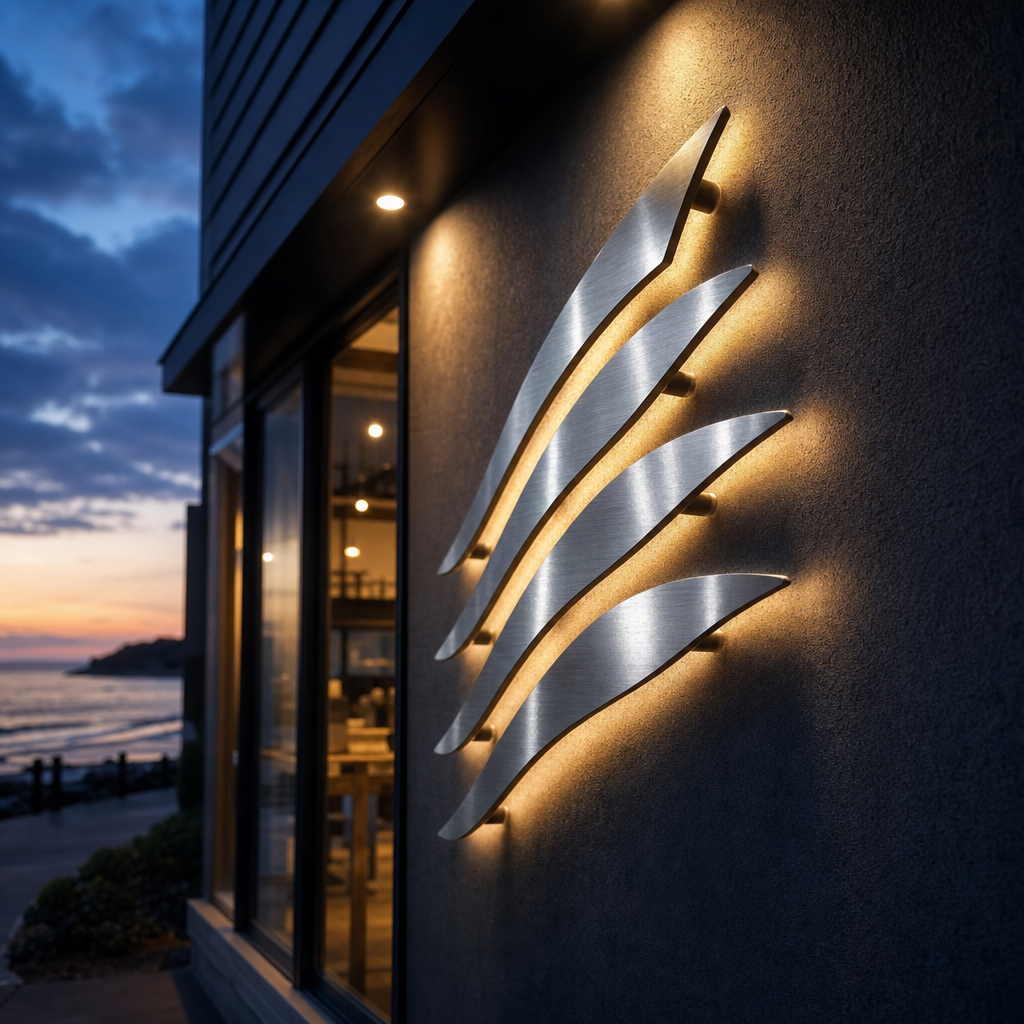
Signage near Kings Beach and Golden Beach faces higher salt exposure than inland sites, which affects material grade, fixing choice and mounting method. Marine-grade stainless steel or powder-coated aluminium generally outlasts standard mild steel or unfinished metal in these locations.
Standards Australia's AS/NZS 2312 guide to protecting steel against atmospheric corrosion classifies coastal environments among the more corrosive categories, and that distinction is real for anywhere within a few kilometres of the surf, which covers most of central Caloundra. Standard mild steel left unfinished or under-specified stainless can show surface staining and pitting within a relatively short period in this kind of environment, so grade selection matters more here than it would for a sign fifty kilometres inland.
For laser cut letters and panels near the coast, that usually means specifying marine-grade stainless over standard grades, or choosing aluminium with a quality powder coat finish where stainless isn't in the budget. Fixing selection matters just as much as the sheet material. Standoff mounts, screws and brackets should match the corrosion resistance of the sign itself, since a premium stainless letter fixed with a cheap zinc-plated screw will show rust streaks at the fixing point well before the letter itself shows any wear.
Standoff mounting is worth understanding on its own terms. It holds laser cut letters and panels slightly off the wall or fascia, which improves airflow behind the sign and reduces moisture trapping compared with a sign glued flat to the surface. That airflow gap is a small detail that makes a genuine difference to longevity in a salt-air environment.
From Artwork to Installed Sign: Files, Tolerances and What to Supply for a Quote
An accurate laser cutting quote depends on getting the right file format, realistic tolerances, and a clear idea of finish and fixing method from the start. Vector artwork with correctly closed outlines is the single biggest factor in a fast, accurate quote.
Laser cutters work from vector files, typically supplied as AI, EPS, PDF with vector paths, or DXF for straight-into-machine work. A logo supplied only as a low-resolution JPG or PNG has to be redrawn as vectors before it can be cut, which adds time and cost to the job. If your business has brand guidelines with a vector logo file, sending that through at the enquiry stage speeds everything up.
Tolerances on laser cut work are tight, but they're not limitless. Very thin material can distort slightly under heat, and very fine internal shapes have a practical minimum size below which the material becomes fragile or the cut simply can't hold the detail. A good fabricator will flag these issues at the quoting stage rather than after the file is already cut, which is one reason it's worth sending a rough sketch or reference image even before final artwork is locked in.
For an accurate quote, supply: the vector file or a clear reference image, overall dimensions, material preference if you have one, intended mounting method (standoffs, direct fix, or illuminated), and the install location. Because Sunquest Signs fabricates locally on the Sunshine Coast rather than freighting work in from interstate, a site measure can usually be arranged directly, which avoids the guesswork and remeasuring that comes with a supplier working purely from photos and phone calls. Local manufacture also removes the freight delay and transit damage risk that comes with panels or letters being shipped in from an interstate supplier, which matters on tight shopfitting timelines around Caloundra CBD and Kings Beach.
When Laser Cutting Isn't the Right Call (and When It's the Only One)
The honest position, and one worth stating plainly, is that laser cutting gets oversold for jobs it isn't built for. A large fascia panel or a full shopfront cladding job is almost always better value cut on a CNC router, and pushing every job through a laser purely because it sounds more precise wastes a client's budget on a process that offers no visible benefit at that scale.
Where laser cutting earns its cost is fine detail and small runs: a logo with narrow strokes, a script font, a decorative screen pattern, or a one-off reception sign where a router bit physically can't hold the shape. On those jobs, laser isn't a premium option, it's the only process that produces the result the design calls for.
Consider a hypothetical cafe fit-out on Bulcock Street replacing tired painted timber lettering with a slim serif logo in laser cut stainless, standoff-mounted so the original fascia stays visible behind the letters. A router simply cannot hold the narrow counters in that kind of typeface without bridging them shut or rounding the detail away. That's the practical test worth applying to any quote: if a router could realistically produce the same result at lower cost, ask why laser is being specified. If it can't, laser is the right call regardless of price difference. A specifier who applies that test consistently ends up with better-value signage across a whole fit-out, not just a single sign.
Get a Laser Cutting Quote for Your Caloundra Signage
If you've got a logo file, a rough sketch, or even just a photo of the fascia you're working with, send it through for a laser cutting quote and site measure. Sunquest Signs fabricates locally across Caloundra and the wider Sunshine Coast, so there's no interstate freight wait and no guessing on fit before install.
References
- Standards Australia, AS/NZS 2312: Guide to the protection of structural steel against atmospheric corrosion by the use of protective coatings. https://www.standards.org.au/
- Standards Australia, AS 1428.1: Design for access and mobility - tactile and directional signage requirements. https://www.standards.org.au/
- Australian Competition and Consumer Commission (ACCC), guidance on quotes and estimates for trades and services. https://www.accc.gov.au/
- Bureau of Meteorology, Sunshine Coast regional climate data. http://www.bom.gov.au/
Talk to a signage expert
Tell us about your project and we'll come back with options and honest advice.
Get in TouchFrequently Asked Questions
What is the difference between laser cut and CNC cut signage?
Laser cutting uses a focused beam and gives a flame-polished edge on acrylic plus tight internal detail on fine lettering. CNC routing uses a physical bit, suits larger panels and thicker sheet, and generally needs secondary polishing to match a laser edge on acrylic.
Can laser cutting handle metal signage as well as acrylic?
Yes. Laser cutting works well on stainless steel, mild steel and aluminium at gauges typically used for signage letters, logos and small panels. Heavier structural steel and very thick sheet sit outside the practical range for a signage laser.
How thick can laser cut acrylic letters be?
Laser cutting suits acrylic from thin sheet up to moderate thickness with a clean flame-polished edge. Beyond that, cut speed and edge quality drop, and CNC routing with a polished finish typically becomes the better choice for very thick or oversized letters.
Do laser cut signs cost more than CNC routed signs?
It depends on the job. Laser cutting is often more cost-effective for small runs and fine detail because there's no tooling setup, while CNC routing tends to be more economical on large panels and longer production runs.
How long does laser cutting take for a small business sign in Caloundra?
Because Sunquest Signs fabricates locally on the Sunshine Coast, turnaround is generally faster than an interstate supplier freighting panels in, since there's no shipping wait and no transit damage risk. Exact timing depends on artwork readiness, material and finish, so it's best confirmed at quoting stage.
Will laser cut stainless steel signage rust near Kings Beach?
Standard stainless can show surface staining in high salt exposure areas like Kings Beach and Golden Beach. Marine-grade stainless, or powder-coated aluminium as an alternative, holds up better in these coastal conditions, along with fixings that match the sign's corrosion resistance.
Related Articles
Window Decals and Graphics for Sunshine Coast Shopfronts: Types, Coastal Materials, Rules and Costs
Indoor vs Outdoor Neon Signage: How to Choose the Right LED Neon for Your Space
Business Logo Neon Signs: Turning Your Brand Mark into Custom LED Neon
Signs that set you apart
Over 40 years on the Sunshine Coast. Design, compliance, manufacture and installation handled end to end.
Get a Free Quote