Window Decals and Graphics for Sunshine Coast Shopfronts: Types, Coastal Materials, Rules and Costs
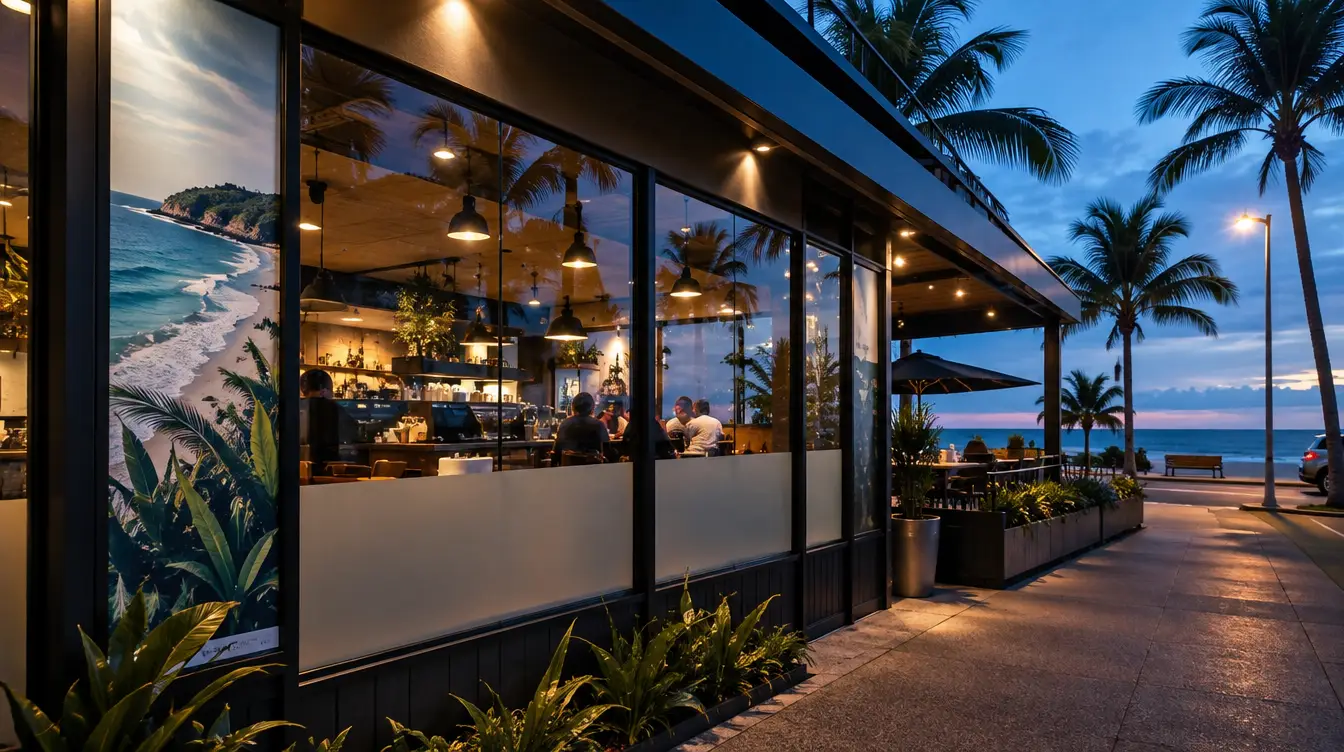
Window decals and graphics are vinyl or film applied to shopfront glass to carry branding, privacy, promotions and trading information. The main options are cut vinyl, full-colour printed graphics, frosted film, one-way vision film and short-term decals. On the Sunshine Coast, UV, heat and salt air make laminated, commercial-grade film the safer choice.
Your glass is the largest flat surface on your shopfront, and it is visible from the footpath, the road and the car park. Used well, it does a lot of work for a small share of a signage budget. Used badly, it ends up as faded, peeling, cluttered glass that undercuts the fascia above it.
This guide is written for owners and managers of retail stores, cafes, clinics and offices on the Sunshine Coast who are fitting out or refreshing a shopfront. It covers which treatment suits which goal, how local conditions affect materials, what approvals to check, and what drives cost, so you can brief a quote properly.
Key Takeaways
- Choose the window treatment by business goal first: branding, privacy, promotion or compliance. Then choose the material.
- Cut vinyl suits crisp logos and hours. Printed graphics suit imagery. Frosted film suits privacy. Perforated film suits large coverage while keeping the view out.
- Sunshine Coast UV, heat on west-facing glass and salt air near the beach shorten the life of cheap, unlaminated film.
- Always confirm requirements with your landlord and Sunshine Coast Council before you approve artwork, rather than assuming window graphics are exempt.
- Cost depends on size, print type, film grade, removal of old graphics and installation timing, so send measurements and photos for an accurate quote.
Ready to make your business impossible to miss?
Design, manufacture and installation, all under one roof in Warana.
Get a Free QuoteSummary Table: Window Graphic Options at a Glance
| Option | Best for | Visibility from inside | Coastal durability | Relative cost |
|---|---|---|---|---|
| Cut vinyl lettering and logos | Business name, hours, contact details | Clear view out | Strong when commercial grade | Lower |
| Full-colour printed graphics | Photography, menus, brand imagery | Blocked unless on perforated or clear film | Strong when laminated | Medium |
| Frosted and decorative film | Privacy for clinics, offices, meeting rooms | Light passes, view is diffused | Strong, with little fading risk | Lower to medium |
| One-way vision (perforated) film | Large coverage with a view out | Good in daylight, reduced at night with lights on | Good when laminated | Medium to higher |
| Short-term promotional decals | Sales, events, seasonal offers | Depends on material | Not built for long life | Lower |
What Do Window Decals and Graphics Do for a Business?
Window graphics do four jobs: they make your business visible from the street, keep branding working after hours, provide privacy where needed, and communicate trading hours and offers. Because glass sits at eye level, it is often read before the fascia is.
The fascia sign tells people what you are from a distance. Window graphics tell them what to do once they are close. A pedestrian walking past a cafe reads the name overhead, then the glass: the hours, the coffee offer, the menu highlights. If that second read is missing or messy, you lose the conversion step.
Street visibility and after-hours branding
Glass keeps working when the doors are shut. A well-designed window with a clear logo, a short description and your hours makes a closed shopfront still count as advertising. For businesses in tourist areas, many people walk past outside trading hours and make a mental note to return. Our approach is to treat the window as a permanent after-hours salesperson.
Privacy and trading information
Clinics, offices and professional services often need privacy without losing natural light. Frosted or patterned film does this cleanly. Practical information such as opening hours, phone numbers and website addresses also belongs on the glass, near the entry door and at a readable height.
For wider context on the signs that sit above and around your windows, see our Shop Front Signs on the Sunshine Coast and Retail Signage Fitouts on the Sunshine Coast pages. This article stays focused on glass.
Which Type of Window Graphic Suits Which Business Goal?
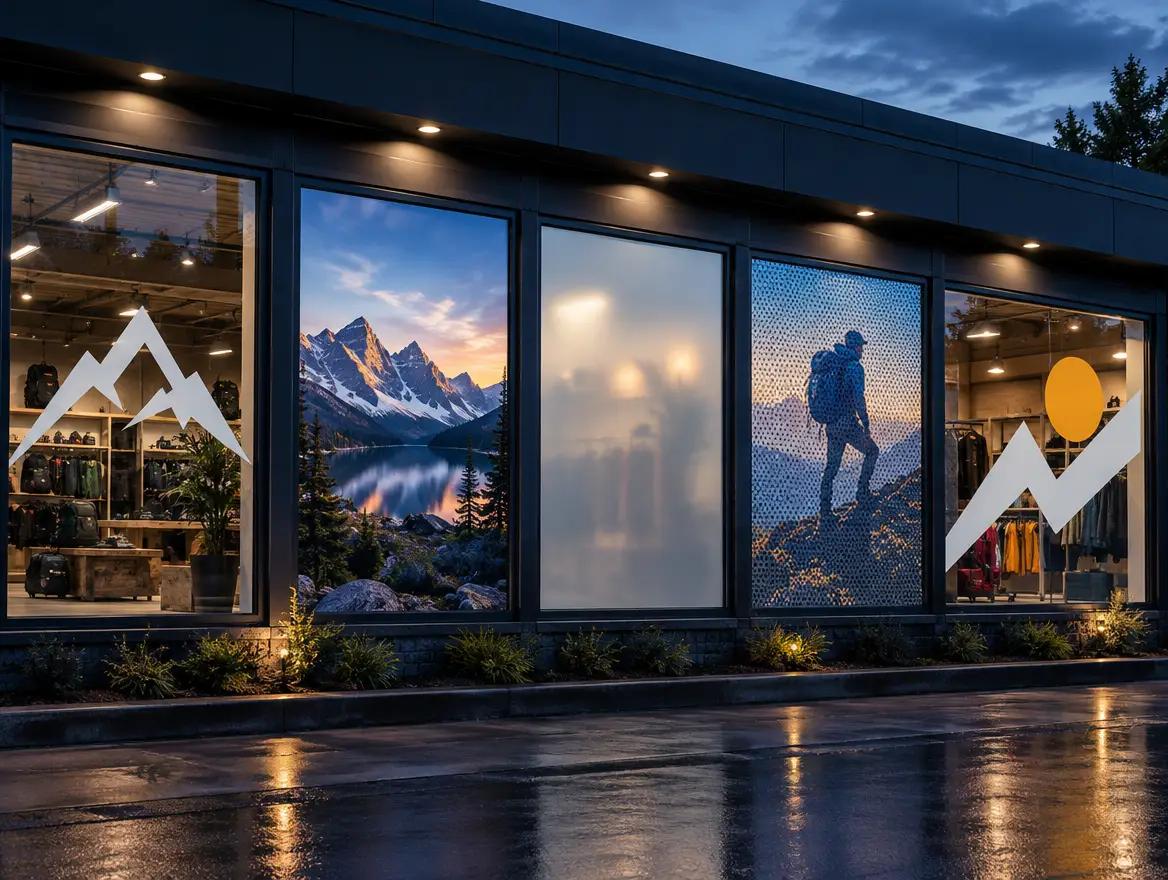
 Match the film to the job. Cut vinyl suits logos and hours, printed graphics suit imagery, frosted film suits privacy, perforated film suits large coverage with a view out, and short-term decals suit promotions. Most good shopfronts combine two of these rather than relying on one.
Cut vinyl lettering and logos
Cut vinyl is coloured film cut into letters and shapes, then transferred onto the glass. There is no background, so the glass shows through. It is the sharpest and most cost-effective way to show a business name, hours, phone number or a simple logo. It is also available in metallic, gold and silver finishes. It is limited to flat colours, so it cannot reproduce photographs or gradients.
Full-colour printed graphics
Printed graphics are digitally printed onto vinyl, then usually laminated. They handle photography, gradients, complex logos and menu imagery. On standard opaque vinyl they block the view through the glass, so they suit sections of window where you do not need to see in or out, such as lower panels or side windows. Printed on clear film, they allow light through but with less punch.
Frosted and decorative privacy film
Frosted film gives the look of etched glass. It diffuses the view while letting light in, which makes it popular for clinics, consulting rooms, offices and meeting rooms. Frosted film can also be cut into patterns, logos or bands. A frosted band at standing eye level with a cut vinyl logo over the top is a classic, clean combination.
One-way vision perforated film
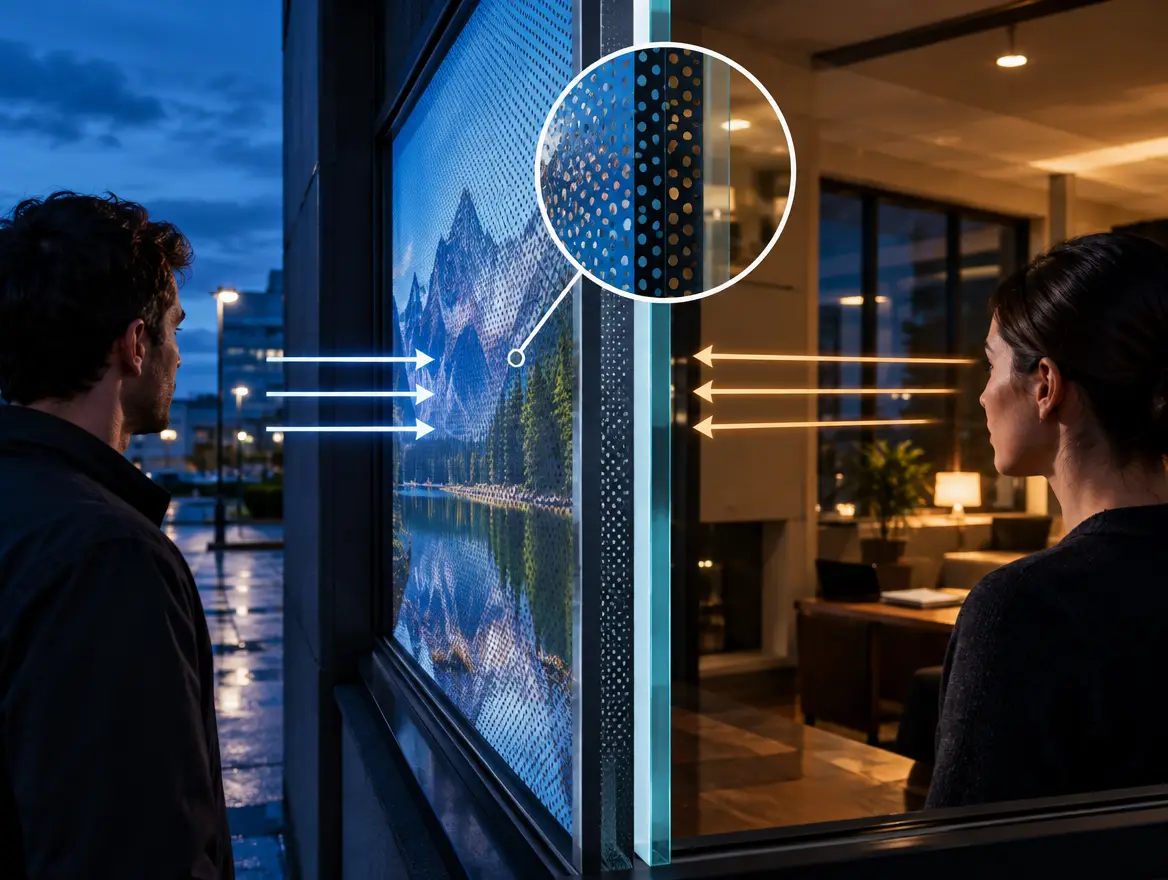
One-way vision window graphics use film with tiny perforations. From outside you see the printed image. From inside you can see out through the holes. This lets you cover a large window with full-colour branding while keeping natural light and a view of the street. The trade-off is that the effect depends on lighting. In daylight the outside looks like a solid graphic. At night with the interior lit, people outside can see through the perforations. For businesses open after dark, ask your installer how the film will behave with your lighting.
Short-term promotional decals
Promotional decals cover sales, events, seasonal offers and new product launches. They are designed to come off cleanly. Use removable adhesives or electrostatic options for glass you intend to change often. Keep promotional claims accurate, because the Australian Consumer Law applies to what you put in your window as much as to what you put in an advertisement.
How Do Sunshine Coast Conditions Affect Window Graphic Materials?
UV, heat and salt air all shorten the life of window graphics, so material quality matters more here than in cooler, inland climates. Laminated, commercial-grade film resists fading and abrasion best. Cheap, unlaminated print on west-facing or beachfront glass is the most common cause of early failure.
UV exposure and heat on west-facing glass
Queensland sits in a high-UV environment. ARPANSA publishes UV information for Australian locations, and the Bureau of Meteorology provides UV index forecasts. For signage, the practical effect is fading, particularly in reds and some inks, and adhesive stress under repeated heating and cooling. West-facing glass takes the hardest afternoon sun and the highest surface temperatures.
Dark, solid films absorb heat. On some glass types, that can create thermal stress. Before applying large areas of dark film to older, thick or double-glazed glass, ask your installer to check the glass type and what the film manufacturer's warranty requires.
Salt air near the beach
Shopfronts at Mooloolaba, Alexandra Headland, Caloundra, Noosa Junction and other coastal strips deal with salt-laden air. Salt does not eat vinyl, but it deposits grit and residue that dulls surfaces and attacks poorly sealed edges. Edges are where film fails first, so clean cuts, sealed edges and correct installation matter as much as the film choice.
Laminates: why they matter
A laminate is a clear protective layer over printed vinyl. It adds UV resistance, protects against scratching from cleaning and gives a gloss, satin or matt finish. For any printed graphic that will see direct sun or regular cleaning, laminate should be treated as standard rather than an upgrade. Cut vinyl does not need laminating because the colour is built into the film.
Inside versus outside application
Applying graphics to the inside face of the glass (second surface) protects them from weather, salt and cleaning chemicals, so they typically last longer. The artwork is then mirrored so it reads correctly from outside. Outside application suits glass where the inside is inaccessible, such as fixed displays or shopfronts with internal fitout in the way, but it exposes the film to everything. Perforated film is normally applied to the inside, with the printed side facing out.
An illustrative scenario: a beachside cafe
Consider a beachside cafe with west-facing glass. Its printed window graphics were applied outside, unlaminated, years ago. The reds have faded to pink, corners are lifting and the menu panel is scratched. This is an illustrative example, not a client job.
A sensible refresh would remove the old graphics fully and clean the adhesive residue. The new design would use laminated, commercial-grade printed vinyl applied to the inside face, with cut vinyl for the name and hours. A partial frosted band across the lower glass would give diners privacy from passing foot traffic while keeping the upper glass clear for light and ocean views. The result is a more durable, cleaner and more intentional window, and the whole package is easier to maintain.
How Should You Design and Lay Out Shopfront Window Graphics?
Balance coverage so people can still see in, keep text large and high-contrast, and design for how people read glass: from the footpath at walking pace and from the road at driving pace. Window graphics should repeat the fascia's brand, not compete with it.
Coverage balance
A window that is fully covered feels closed. A window with nothing on it feels empty. Most successful shopfronts sit in between, with a defined graphic zone and clear glass to show product or activity inside. Retail stores often need visible stock. Cafes benefit from visible energy and seating. Clinics and offices lean toward frosting for privacy, with a clear logo band.
Legibility and contrast
Test your design at the distance people actually see it. Footpath readers are within a few metres, so detail and small text can work. Roadside readers are further away and moving, so the name and one key message must be large and simple. Contrast is the part most often missed on glass, because the background changes constantly with daylight, reflections and what is behind the window. White or light vinyl works against dark interiors. Dark vinyl works on bright interiors or when backed by a light surface. Ask for a mock-up on a photo of your actual window.
Pairing with fascia, lightbox and neon
Window graphics should use the same typeface, colours and logo versions as your fascia. Where you have an illuminated sign, such as a lightbox or neon sign, the window graphic should support it rather than copy it. Neon in particular works well just behind clear glass, so leave that area free of film. Our Illuminated and Lightbox Signs and Neon Signs pages cover those options, and our Custom, Interior and Wayfinding Signs hub covers what happens inside the shop.
Hours, contact details and entry information
Place trading hours and contact details near the door, at a height people can read without stooping. Keep them in cut vinyl for crispness and easy updates. Include only what is current, because wrong hours on your glass are worse than no hours.
Do You Need Approval for Window Graphics on the Sunshine Coast?
It depends on your premises. Shopping centres usually have tenant design guidelines that cover windows, and council advertising device rules may apply in some situations. Do not assume exemption. Confirm with your landlord and Sunshine Coast Council before approving artwork or paying for production.
Landlord and shopping centre rules
If you lease, your lease and any tenant design guidelines are the first things to check. Shopping centres commonly control signage on glass, including what can be applied, how much of the window can be covered, the finish and whether promotional material is allowed. Many leases also require removal of graphics and repair of the glass at the end of the lease. Get the landlord's approval in writing, and send the approved artwork to your signage provider.
Council advertising device rules
Sunshine Coast Council administers local planning rules through the Sunshine Coast Planning Scheme, which includes provisions for advertising devices. Whether window graphics are caught by these rules can depend on the zone, whether the building is in a heritage or character area, and the size and nature of the graphics. We are not stating any coverage percentage here because the rules vary and change. Contact council or check their planning information to confirm what applies to your address.
Accuracy of what you display
Promotional claims on glass, such as discounts or special offers, need to be accurate and not misleading. The ACCC provides guidance on advertising and consumer law for businesses.
What Affects the Cost of Window Decals and Graphics?
Cost is driven by size, print type, film grade, the removal of existing graphics, and installation conditions. Cut vinyl is usually the lowest cost per window. Large laminated printed or perforated graphics cost more. A quote based on measurements and photos will always be more accurate than a rule of thumb.
Size and complexity
Larger windows need more material and more installation time. Fine detail, small lettering and complex shapes take longer to cut and weed. Multiple panels and mullions add alignment work.
Print type and film grade
Cut vinyl, standard printed vinyl, laminated print and perforated film all price differently. Higher-grade films with better UV resistance and longer warranties cost more upfront. On Sunshine Coast glass, the cheaper film is often the more expensive option once you factor in early replacement.
Removal of old graphics
Old vinyl and its adhesive must be removed cleanly. Sun-baked film can come off in small pieces and leave residue, which adds labour. Budget for removal if you are replacing existing graphics.
Installation: after-hours and changeovers
Installing during trading hours can disrupt customers and may be impractical for busy cafes. After-hours or early-morning installs reduce disruption but can carry a different rate. If you plan frequent changeovers for promotions, ask about removable materials and a repeatable template, which can reduce the cost of each change. Installation conditions also matter: glass should be clean and dry, and application in extreme heat or wind is harder to do well.
Why Window Graphics Should Be Your Most Flexible Sign
Here is my position: window graphics should be designed as the part of your shopfront you expect to change. Your fascia is a long-term commitment. Your glass is where you can test, update and respond, so design it with that in mind from day one.
Most businesses do the reverse. They brief the window graphics once, with everything on them: the logo, services, offers, hours, social handles and a tagline. Six months later the offer is out of date, the hours have changed and the glass looks cluttered. Because everything was bundled in one large print, the only fix is to replace the whole thing.
A better approach is to split the glass into permanent and changeable layers:
- Permanent layer: cut vinyl for the name, logo and core descriptor. This lasts and rarely needs updating.
- Semi-permanent layer: hours and contact details in cut vinyl, positioned so they can be replaced without touching anything else.
- Changeable layer: a defined panel or zone for promotions, using removable material and a standard size, so each campaign is a simple swap.
This costs little extra at the start and makes every later change faster and cheaper. It also keeps the window looking deliberate year-round. I would rather see a business with a clean glass layout and one changeable panel than a full-wrap printed window that is out of date in months.
The second part of my view is about the glass itself. Treat the window as part of a single signage package, not a separate purchase. The best shopfronts we see have a fascia, window graphics and, where it suits, an illuminated or neon feature that look like they were designed together, because they were.
Send Us Your Window Measurements and Shopfront Photos
If you are planning a refresh, send Sunquest Signs your window measurements and a few photos of your shopfront, including the direction it faces and any existing graphics. We will talk you through the options, show how they would look on your glass, and provide a quote. Window graphics work best as part of a consistent shopfront package, so tell us about your fascia and any illuminated signage as well. Visit Sunquest Signs to get in touch.
References
- Sunshine Coast Council, planning and development information
- ARPANSA, ultraviolet radiation information
- Bureau of Meteorology, UV index and forecasts
- ACCC, advertising and selling guidance for businesses
Talk to a signage expert
Tell us about your project and we'll come back with options and honest advice.
Get in TouchFrequently Asked Questions
What is the difference between window decals and window graphics?
In practice the terms overlap. Decals usually refers to smaller, individual pieces such as logos, lettering and stickers. Window graphics is the broader term, covering larger printed, frosted or perforated treatments across whole panes. A shopfront often uses both.
How long do window graphics last on the Sunshine Coast?
It depends on the film, the lamination, which way the glass faces and whether the graphic is inside or outside. Commercial-grade, laminated film applied to the inside face lasts longest. Unlaminated print on exposed west-facing glass fades and lifts sooner. Ask your installer for the manufacturer's warranty on the specific film.
Can you see out through one-way vision window graphics?
Yes, in most daytime conditions. The film is perforated, so from inside you can see through while people outside see the printed image. At night with the interior lit, people outside may be able to see in through the perforations. Discuss your trading hours and lighting before choosing it.
Is frosted window film a good option for a business?
Yes, for privacy and a clean look. Frosted film is popular for clinics, offices and meeting rooms because it lets light in while hiding detail. It can be applied in full, as a band, or cut into patterns and logos, and combined with cut vinyl branding.
Do I need council approval for window decals?
Not always, but you should not assume you are exempt. It depends on your zone, the building and the nature of the graphics. If you lease, your landlord or shopping centre may also have rules. Confirm with Sunshine Coast Council and your landlord before approving artwork.
Related Articles
Neon Signs in Caloundra: Custom LED Neon for Shopfronts, Cafés and Venues
Signage in Mooloolaba: Sign Types, Coastal Materials, Council Rules and Costs for Local Businesses
Indoor vs Outdoor Neon Signage: How to Choose the Right LED Neon for Your Space
Signs that set you apart
Over 40 years on the Sunshine Coast. Design, compliance, manufacture and installation handled end to end.
Get a Free Quote