Indoor vs Outdoor Neon Signage: How to Choose the Right LED Neon for Your Space

Indoor LED neon suits dry, sheltered spots like feature walls and counters. Outdoor LED neon needs a sealed IP65 or higher rated flex, UV-stable acrylic, a weatherproof driver and secure fixings to survive Queensland sun, humidity and salt air. A window-facing sign sits between the two, reading to the street while staying inside.
Introduction
Most café, bar, salon and retail owners on the Sunshine Coast and Fraser Coast start with the same question: "Can I put this neon sign outside?" The honest answer is yes, but it is a different product from the one you would hang behind the counter. The flex, the backing, the power supply and the fixings all change once a sign leaves the shop.
This guide is a decision tool, not a general neon explainer. It shows what actually changes between indoor and outdoor LED neon, where the in-between option of window-facing neon fits, what installation and approvals involve, and how to pick the right option for your location. As the founder of 3P Digital, I have seen plenty of businesses spend money on the wrong version of a good idea. Sunquest Signs designs, makes and installs LED neon for both settings, and the advice below reflects how that choice should be made.
Ready to make your business impossible to miss?
Design, manufacture and installation, all under one roof in Warana.
Get a Free QuoteKey Takeaways
- Indoor and outdoor LED neon are different builds, not the same sign with a different label. Sealing, backing, power supply and fixings all change.
- An IP rating has two digits. The first covers dust and solids. The second covers water.
- Outdoor signs in Queensland face UV, humidity, storms and, near the coast, salt air. Every component needs to be chosen for that.
- Window-facing neon is often the best value option for street visibility, but glass adds heat and glare to manage.
- Hardwired outdoor signs need a licensed electrician, and external signs may need council approval. Check both early.
- Choose by location, exposure, viewing distance, operating hours and budget, in that order.
Indoor vs Outdoor Neon at a Glance
Source: ingress protection (IP) code definitions from IEC 60529, published by the International Electrotechnical Commission (https://webstore.iec.ch/en/publication/2452). All other columns are qualitative.
| Feature | Indoor LED neon | Window-facing LED neon | Outdoor LED neon |
|---|---|---|---|
| IP rating | Basic protection is usually enough, as the sign stays dry | Basic protection, with care around condensation | Sealed flex rated IP65 or higher |
| Backing | Lighter acrylic or cut-to-shape backing | Clear or cut-out backing so light reads through glass | UV-stable acrylic or weather-resistant backing |
| Power supply | Plug-in driver on a standard power point | Plug-in driver kept inside, away from direct sun | Enclosed or weatherproof driver, often hardwired |
| Brightness | Easily read in controlled lighting | Needs to compete with daylight and glare | Needs to compete with full daylight and street lighting |
| Fixings | Wall screws, standoffs or hanging kits | Suction-free standoffs, chains or frame fixings | Secure, corrosion-resistant fixings built for wind and storms |
| Approvals | Usually landlord only | Landlord, sometimes council | Landlord, licensed electrician, often council |
| Typical uses | Feature walls, behind counters, menu highlights, photo spots | Cafés, salons and retail that want street presence | Shopfronts, awnings, building facades |
What Actually Changes When LED Neon Moves Outside?
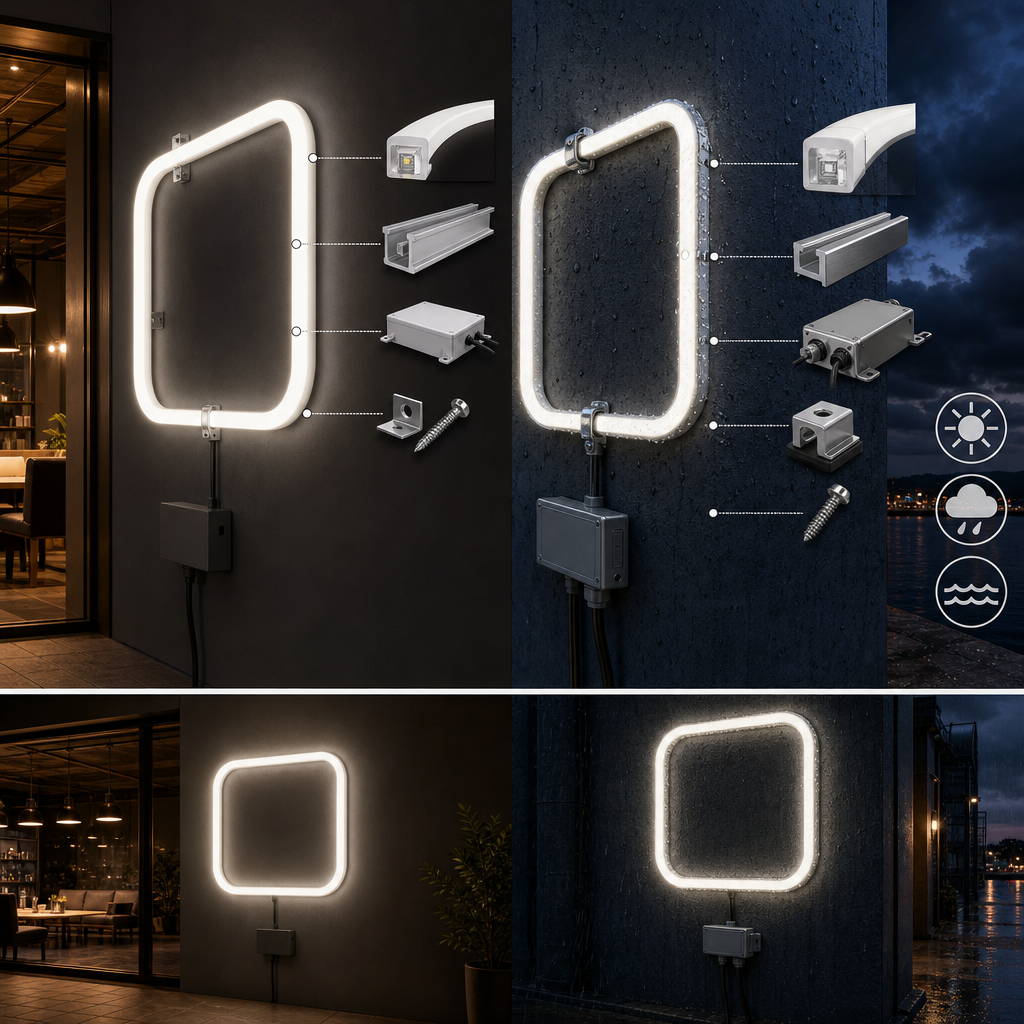
Five things change: the sealing of the LED flex, the stability of the acrylic against UV, the protection around the power supply, the way the sign is fixed to the building, and the approvals needed. Indoor signs can skip most of these. Outdoor signs cannot skip any of them.
It helps to picture the sign as a stack of parts. At the front is the LED flex, a silicone or PVC-style tube holding the LEDs. Behind it sits the backing, which carries the design. Then comes the wiring and the driver, which converts mains power to the low voltage the LEDs use. Finally there are the fixings that hold it to a wall. Each layer has an indoor version and an outdoor version.
How do IP ratings work?
An IP rating is a two-digit code. According to IEC 60529 (https://webstore.iec.ch/en/publication/2452), the first digit rates protection against solid objects and dust, and the second digit rates protection against water. A higher number means more protection. IP65, for example, means dust-tight and protected against water jets. IP67 adds protection against temporary immersion.
Two practical points matter for a business owner. First, an "X" in place of a digit simply means that aspect was not rated. Second, the rating applies to the specific product that was tested. A sealed flex can carry a strong rating while the driver beside it carries none. When you are quoted for an outdoor sign, ask what the rating covers: the flex, the driver, the joins, or the whole assembly.
Why does UV matter for outdoor signs?
Queensland has some of the strongest sun exposure in the country. ARPANSA (https://www.arpansa.gov.au/) monitors ultraviolet radiation across Australia, and anyone who has watched a plastic chair fade on a Coast verandah has seen the effect. Ordinary clear acrylic and unprotected flex can yellow, haze or turn brittle with sustained UV exposure.
That is why outdoor builds specify UV-stable acrylic and UV-resistant flex. A sign that looks perfect on install day can look tired within a season or two if the materials were chosen for an indoor room. This is the single most common reason cheap indoor signs fail when moved outside.
What do humidity and salt air do?
Humidity and salt air attack the parts you cannot see: connectors, screws, driver terminals and the edges of the backing. Moisture that gets inside a poorly sealed joint can corrode contacts or cause the sign to flicker or fail. Salt accelerates corrosion on cheap metal fixings.
If your business is near the water at Mooloolaba, Caloundra, Noosa, Hervey Bay or Rainbow Beach, assume salt air is part of the environment. Stainless or otherwise corrosion-resistant fixings and properly sealed cable entries are not optional extras at the coast. They are the baseline.
What about storms and wind?
Summer storms on the Sunshine Coast and Fraser Coast bring wind, driving rain and the occasional hail event. An outdoor sign has to stay on the wall and keep its seals intact through all of it. Fixings need to match the wall material, whether that is brick, render, timber or metal cladding, and the sign needs to be secure enough that a gust does not turn it into a hazard for people below.
Indoor Neon: Where Does It Work Best?
Indoor LED neon works best on feature walls, behind counters, beside menu boards and in photo spots. It can use lighter backings, runs from a plug-in driver, and gives you more design freedom because it does not need to survive weather. It is the lowest-complexity option and often the right first sign.
Feature walls and behind the counter
A feature wall is the classic use. A logo or a short phrase behind the counter becomes the visual anchor of the room. Customers see it while they order, wait and pay, and it appears in the background of their photos. For salons, a sign behind reception does the same job at the moment a client walks in.
Because the sign sits in a controlled environment, you can choose a backing for looks rather than survival. Lighter acrylic, cut-to-shape outlines and layered designs all work well. The driver can sit discreetly behind or beside the sign and plug into a nearby power point, so there is no electrical work beyond what a normal appliance needs.
Menu highlights and wayfinding
Smaller signs work hard in hospitality. A neon arrow, a "Cocktails" or "Brunch" label, or a toilet and exit marker can lift a venue's atmosphere while guiding customers. These pieces are lighter, cheaper to run and easy to reposition if you change layout.
Photo spots
A dedicated photo wall is one of the simplest ways to turn customers into marketing. A short name or hashtag in neon, placed where the lighting is flattering and the background is clean, gets shared without you asking. Indoor placement means you can tune the colour and brightness to the room, which is harder outdoors.
Design freedom
Indoors, you are not designing around wind loads or water ingress. That opens up finer detail, tighter curves, multi-colour layouts and larger backings. If your brand has a complex logo, indoor is often where it reproduces most faithfully. A logo-led sign is covered in more depth in our Business Logo Neon Signs guide, and our Custom LED Neon Signs complete guide covers the full design process.
Outdoor Neon: What Does a Shopfront Sign Need?
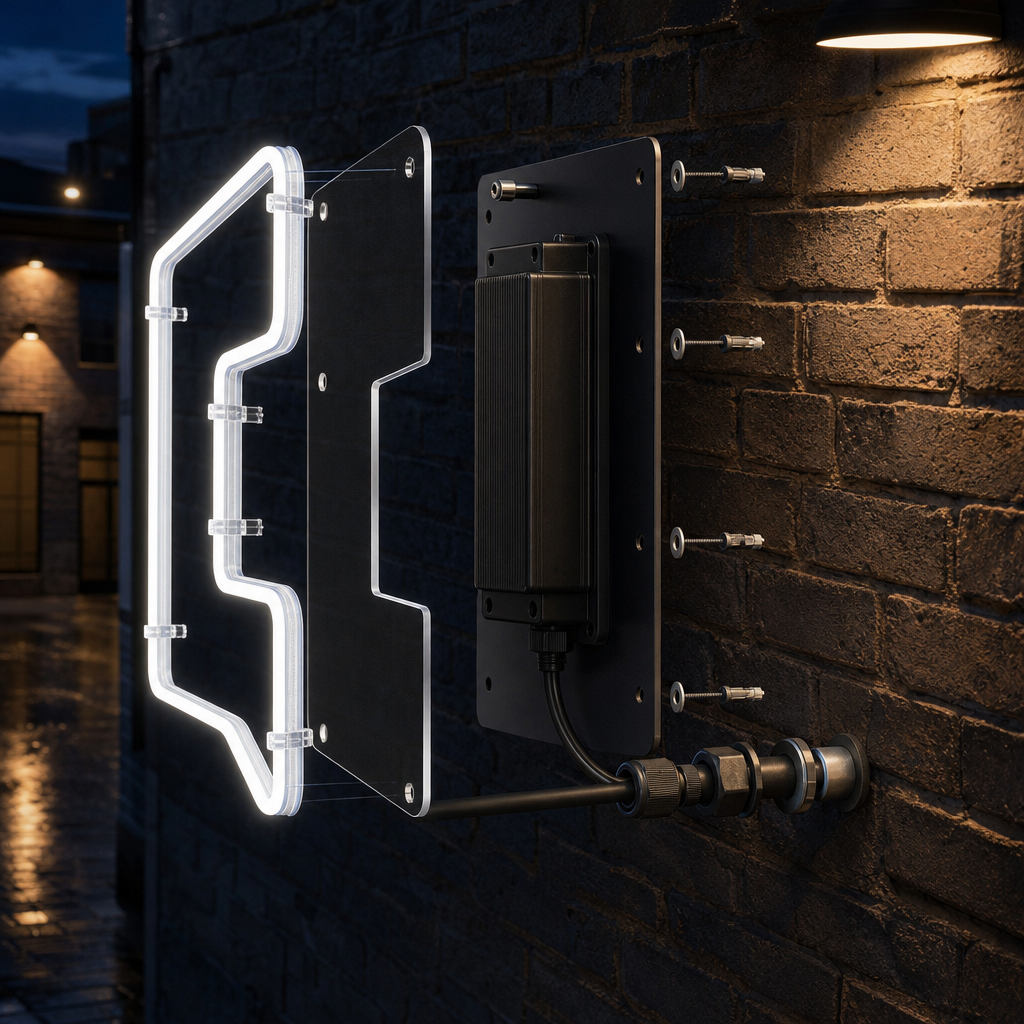
An outdoor neon sign needs sealed flex rated IP65 or higher, UV-stable acrylic, an enclosed or weatherproof driver, and secure corrosion-resistant fixings. These are chosen to withstand Queensland sun, humidity, storms and coastal salt air. Skip any one of them and the sign becomes the weak point on your shopfront.
Sealed flex with an IP65 or higher rating
The flex is the part customers see, so it carries the rating that matters most. IP65 or higher gives you a dust-tight tube that shrugs off rain and water jets. For signs exposed to direct rain, sprinklers or pressure cleaning nearby, ask about higher protection. Joins and end caps are where moisture typically gets in, so sealing quality there matters as much as the rating on the label.
UV-stable acrylic and backing
The backing carries the design and takes the sun. UV-stable acrylic resists yellowing and brittleness far better than standard indoor material. Colour choice matters too. Some pigments fade faster than others in strong sun, so it is worth asking how the chosen colours behave outdoors before you commit.
Weatherproof drivers and power
The driver is the electronics heart of the sign, and electronics hate water. Outdoor builds use an enclosed or weatherproof driver, mounted so water cannot pool around it. Cable entries should be sealed and drip loops used so rain runs away from connections rather than into them.
Many outdoor installations are hardwired into the building's electrical supply. That is licensed electrical work, which we cover in the installation section below.
Secure fixings for wind and weather
Fixings are the least glamorous part and the most important for safety. They must suit the wall, resist corrosion, and hold the sign against wind load. A sign on an awning or building facade above a footpath has a duty of care attached: if it comes loose, it falls on someone.
Shopfronts, awnings and facades
Three locations dominate. A shopfront sign above or beside the entry tells passers-by who you are. An awning sign sits in partial shade but still sees humidity, wind-driven rain and salt. A facade sign on a larger wall can be seen from further away and works for venues on busy roads. If you are weighing neon signs for shopfronts against other illuminated options, our Business and Shopfront Signs hub compares what is available.
Does shade make it safe to use an indoor sign outside?
No. A covered verandah or awning reduces direct sun and rain, but humidity, wind-driven moisture, dust and salt air still reach the sign. An indoor-rated sign under an awning is a common false economy. It may work for a few months and then fail at the driver or the connectors.
Window-Facing Neon: The In-Between Option
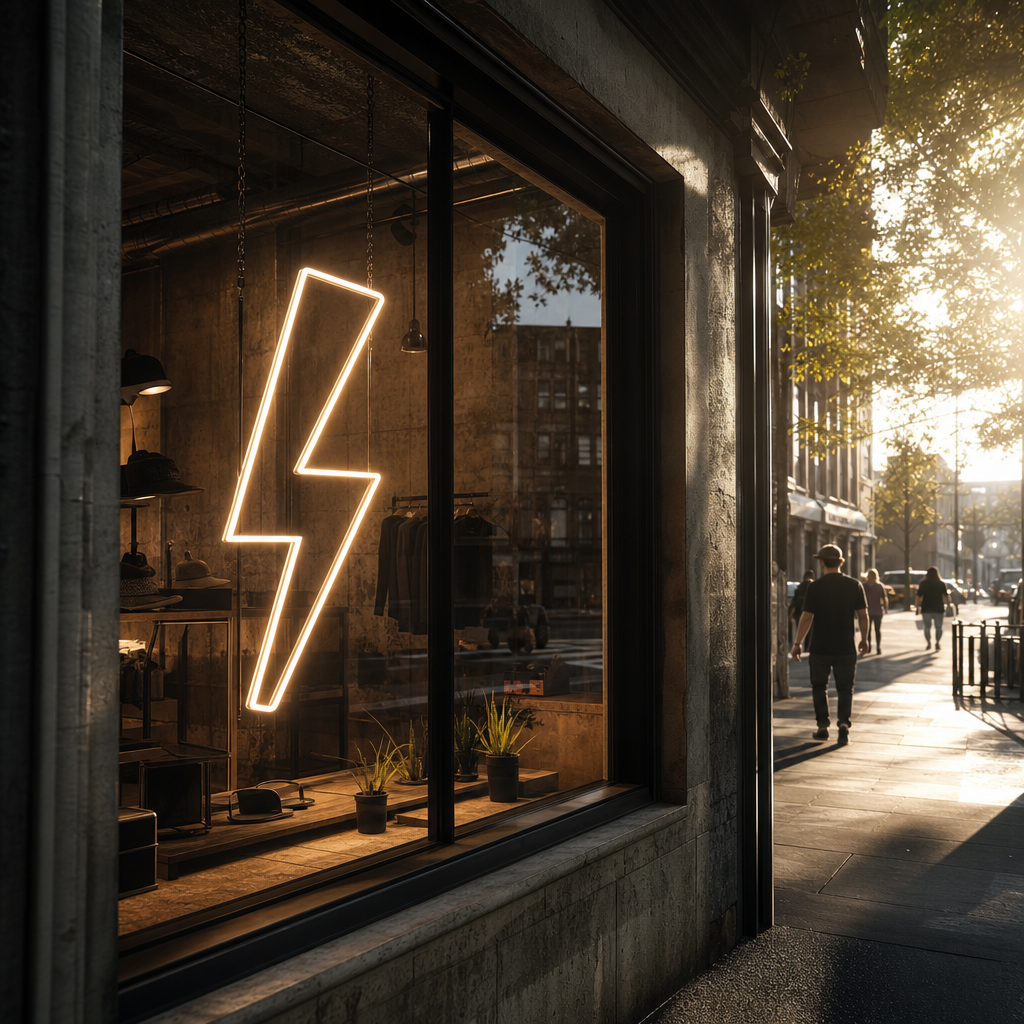
Window-facing neon sits inside your shop but reads to the street through the glass. It avoids most weather and approval complexity while still catching foot and car traffic. The trade-offs are heat and sun through the glass, reflections, and the challenge of staying visible in daylight.
Why it works
A window sign is protected from rain, wind and salt, so it can use a lighter build and a plug-in driver. It is also easier to change or relocate if you rebrand or move. For many small businesses, it delivers street presence at far less complexity than a full exterior install.
Heat and sun through the glass
Glass does not block heat. A north or west-facing window in a Queensland afternoon can get very hot, and direct sun hits whatever sits behind the glass. Components rated only for a cool indoor room can struggle there, and some materials fade or warp. Place the driver away from direct sun, allow airflow around the sign, and tell your sign maker which direction the window faces so the build suits it.
Visibility in daylight
Neon glow reads best when the surroundings are darker than the sign. In bright daylight, a window sign competes with sun and reflections. Your sign still helps, because bold shapes, strong colour contrast and a clear, simple design remain readable. At dusk and after dark, when many cafés and bars do their best trade, the sign comes into its own.
If your window already has graphics, a neon sign can work alongside them. Our Window Graphics hub covers how film and vinyl can complement an illuminated piece.
A hypothetical example
Consider a café on a main street in Caloundra. The owner wants to be seen from the footpath and from passing cars. A full exterior sign would mean a licensed electrician, a check with council and a landlord sign-off. The café opens early and closes mid-afternoon, so most trade happens in daylight, with only winter mornings and some evening events in the dark.
A window-facing sign above the counter, angled to read from the footpath, delivers visibility without exterior wiring or weather exposure. If trading hours extend later or the owner wants more reach down the street, an exterior sign can be added later. That is a scenario, not a client case study, but it shows the logic: match the sign to when and where people actually see it.
What Do Installation and Compliance Involve?
Hardwired outdoor neon signs need a licensed electrician, and external signs may need local council approval and landlord consent. Check these early, before you pay for a sign, because approvals can affect size, position and design. Sunquest can guide you through what to ask and who to ask.
Electrical work
Plug-in indoor signs usually need nothing beyond a power point. Hardwiring a sign into the building's supply is different. In Queensland, electrical work must be carried out by a licensed electrician, and the Electrical Safety Office (https://www.worksafe.qld.gov.au/) sets out the licensing and safety framework. Wiring in Australia also needs to comply with the AS/NZS 3000 Wiring Rules. A licensed electrician takes responsibility for safe connection, protection devices and compliance certification.
Do not hardwire a sign yourself, and be wary of any supplier that suggests it is fine to do so.
Council signage rules
External signs can be regulated by local government. Whether you need approval depends on factors such as the sign's size, illumination, position on the building, whether it projects over a footpath, heritage overlays and the zone your premises are in. Rules differ between councils, so check with Sunshine Coast Council (https://www.sunshinecoast.qld.gov.au/) or Fraser Coast Regional Council (https://www.frasercoast.qld.gov.au/) depending on where you trade. Some small or low-impact signs may be exempt, but do not assume. Ask.
Landlord and building consent
If you lease your premises, your landlord or body corporate may need to approve any external sign, and any fixing to the building. Get that in writing early. It is much easier to adjust a design before manufacture than after.
When to ask
The order matters. Confirm the location and landlord consent, check council requirements, then finalise the design and book the electrician. Sunquest can guide you through the process and handle installation, so the sign that arrives is the sign that can legally and safely go up. For ongoing care once it is installed, see our Illuminated Sign Maintenance guide.
How Do You Choose the Right Option for Your Location?
Choose by working through five questions: where the sign will go, how exposed that spot is, how far away people will see it, when you trade, and what you can spend. Most businesses find the answer is clear after the first two questions.
A short checklist
- Location. Is the spot inside, in the window, or on an external wall, awning or facade? This single answer decides most of the build.
- Exposure. Does the sign face direct sun, rain, wind or salt air? A west-facing wall near the beach is the hardest environment. A back wall in a dry room is the easiest.
- Viewing distance. Will customers be a few metres away at the counter, or reading the sign from across the road? Distance affects size, line thickness and brightness.
- Operating hours. If you trade after dark, a lit sign earns its keep. If you trade only in daylight, bold design and contrast matter more than glow.
- Budget. Outdoor builds involve more robust materials and often electrical and approval costs. An indoor or window sign usually has a simpler scope. Ask for a quote that separates sign, installation and any electrical work so you can compare like with like.
Common mismatches to avoid
- Buying an indoor sign and hanging it outside "under cover".
- Choosing outdoor-grade materials for a sign that will only ever sit behind the counter.
- Putting a window sign in full afternoon sun without telling the maker.
- Leaving council and landlord checks until after the sign is made.
If two options both suit your location, start with the simpler one. You can always add a second sign later.
Why the Best Neon Choice Is Often About Time of Day, Not Location
The usual question is "indoor or outdoor?" My view is that the better question is "who needs to see this sign, and when?" A shopfront sign that nobody reads at 7am is doing less than a window sign that glows at 6pm to the people walking past your door.
Here is the contrarian part. Many owners assume outdoor is the premium, ambitious choice and indoor is the compromise. In practice, I think it often runs the other way. An outdoor sign is competing with full daylight, passing traffic, other businesses and the elements. It also carries the most cost, the most risk and the most approvals. A well-placed window or interior sign, designed for the hours your customers actually pass or visit, can do more work for less complexity.
The second thing I would flag is where signs tend to fail. By logic, the weak points are the components that combine electronics with exposure: the driver, the cable entries and the joins. The flex itself is usually the sturdy part. So when you compare quotes, do not just ask "is it waterproof?" Ask where the driver goes, how the cable enters the sign, and what the IP rating applies to. A supplier who answers those clearly knows what they are building.
Finally, treat the first sign as a test. Start with a feature wall or a window piece, see how customers respond, and then decide whether an exterior sign is worth the extra work. That staged approach protects your budget and gives you real information about your own foot traffic.
Get a Free Mock-Up and a Recommendation
If you are still unsure, send Sunquest Signs your logo or idea, plus a photo of the wall, window or shopfront where you want the sign. We will prepare a free design mock-up and tell you whether indoor, window-facing or outdoor neon suits your location. If you are in Caloundra, Noosa or anywhere across the Sunshine Coast and Fraser Coast, we can also talk through electrical and council requirements before you commit.
References
- International Electrotechnical Commission. IEC 60529: Degrees of protection provided by enclosures (IP Code). https://webstore.iec.ch/en/publication/2452
- Electrical Safety Office Queensland (WorkSafe Queensland). Electrical safety and licensing information. https://www.worksafe.qld.gov.au/
- Standards Australia. AS/NZS 3000: Electrical installations (known as the Australian/New Zealand Wiring Rules). https://www.standards.org.au/
- Australian Radiation Protection and Nuclear Safety Agency (ARPANSA). Ultraviolet radiation information. https://www.arpansa.gov.au/
- Sunshine Coast Council. Planning and development information. https://www.sunshinecoast.qld.gov.au/
- Fraser Coast Regional Council. Planning and development information. https://www.frasercoast.qld.gov.au/
Talk to a signage expert
Tell us about your project and we'll come back with options and honest advice.
Get in TouchFrequently Asked Questions
Can I use an indoor neon sign outside?
No, not safely or for long. Indoor signs are not built to resist UV, humidity, rain or salt air. Moisture can reach the driver and connectors, and sun can fade or warp the materials. If you want a sign outdoors, it should be built for it from the start, with sealed flex, UV-stable backing and a weatherproof driver.
Are LED neon signs waterproof?
It depends on the build. Many LED neon flex products are water-resistant, but only signs specified for outdoor use should be exposed to weather. Look for an IP rating that states what level of protection applies and to which parts. A sealed flex alone does not make the driver or wiring waterproof.
What does IP65 mean on a neon sign?
IP stands for ingress protection. According to IEC 60529, the first digit rates protection against dust and solids, and the second rates protection against water. IP65 means the product is dust-tight and protected against water jets. It is a common minimum target for outdoor LED neon flex.
Do I need council approval for an outdoor neon sign?
Often you do, but it depends on the sign's size, illumination, position, any projection over a footpath, and the zone or heritage status of your premises. Check with your local council, such as Sunshine Coast Council or Fraser Coast Regional Council, and get landlord consent if you lease. Sunquest can guide you on what to ask.
Can I put a neon sign in my shop window?
Yes. Window-facing neon is a popular option because it sits indoors but reads to the street. Plan for heat and sun through the glass, reflections and daylight visibility. Tell your sign maker which direction the window faces so the materials and driver placement suit it.
Does a licensed electrician need to install my neon sign?
For hardwired signs, yes. In Queensland, electrical work must be done by a licensed electrician. Plug-in indoor signs usually connect to a standard power point and do not need hardwiring, but outdoor and mains-connected installations should always be done by a licensed professional.
Related Articles
Illuminated Sign Maintenance: How to Keep LED Signage Bright, Safe and Trading
Illuminated Signs on the Sunshine Coast: LED Lightboxes, Lit Letters and Pylon Signage That Survive the Coast
Business Signs in Caloundra: A Practical Guide to Shopfronts, Illuminated Signage and Vehicle Graphics
Signs that set you apart
Over 40 years on the Sunshine Coast. Design, compliance, manufacture and installation handled end to end.
Get a Free Quote