Illuminated Signs on the Sunshine Coast: LED Lightboxes, Lit Letters and Pylon Signage That Survive the Coast
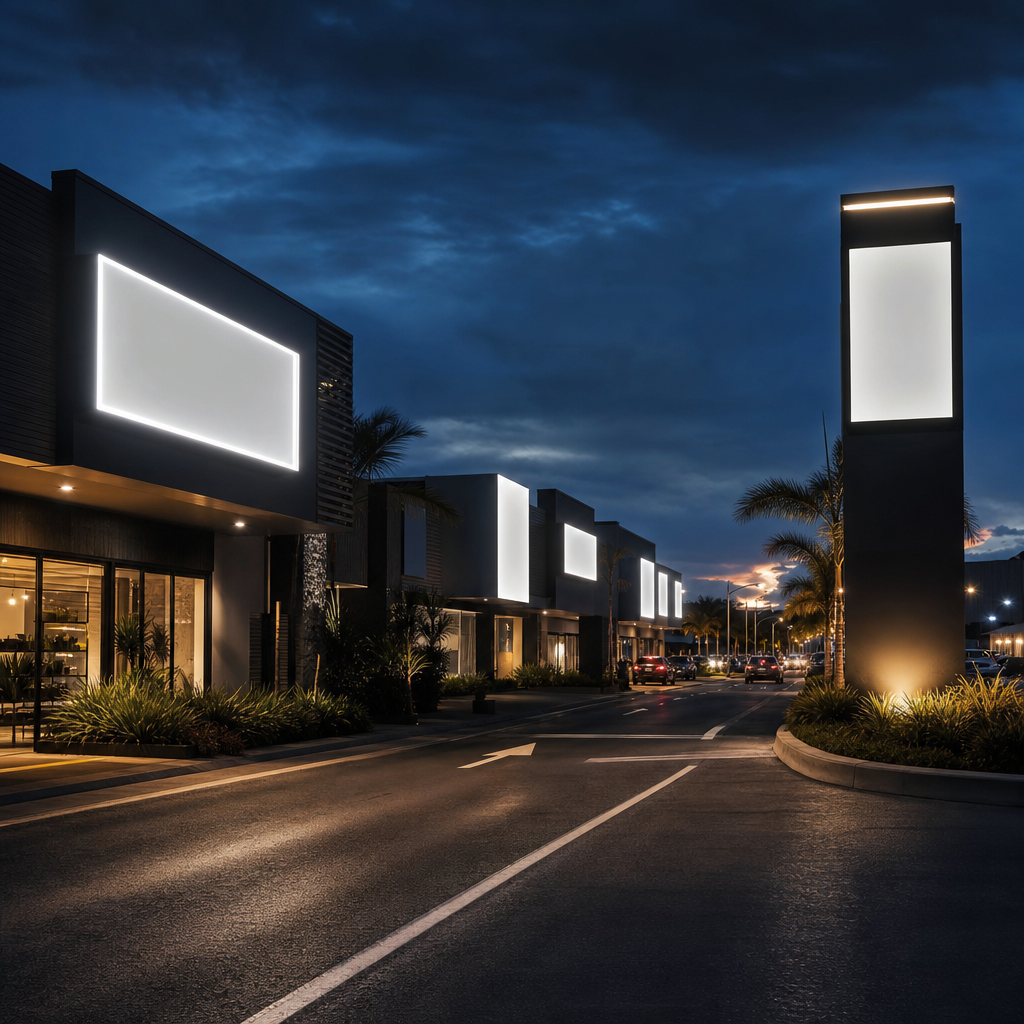
Direct answer: Illuminated signs on the Sunshine Coast need marine-grade aluminium, sealed IP65-rated LED modules and UV-stable acrylic faces to survive salt air, humidity and storm cycles. LED lightboxes, halo-lit letters and pylon signs built to this specification typically run for a decade or more, while budget units with unsealed housings often fail within two to three years.
Any business owner who has driven along Nicklin Way after 7pm knows which shopfronts are still working for their money and which ones have gone dark. The Sunshine Coast's mix of tourist traffic, extended hospitality trading and coastal weather makes illuminated signage a genuinely different engineering problem than it is in an inland suburb. Salt-laden air corrodes cheap fixings. UV load fades unstabilised acrylic within a couple of summers. Afternoon storm cells push wind and moisture into poorly sealed housings.
This guide sits above the individual suburb-level advice for Maroochydore, Caloundra and Noosa. It's written for anyone pricing an illuminated shopfront, pylon or under-awning sign for the first time, or replacing one that has already failed, and it explains what's actually inside a good illuminated sign, not just what it looks like from the footpath.
Key Takeaways
- Illuminated signage on the Sunshine Coast needs IP65 or higher-rated LED modules and drivers to resist salt air, humidity and wind-driven rain.
- The six main formats are LED lightboxes, face-lit acrylic letters, halo-lit reverse letters, under-awning/projecting signs, illuminated pylons, and window or wall-mounted LED panels.
- Marine-grade fixings, sealed returns and proper drainage matter more to long-term survival than the LED brand itself.
- Sunshine Coast Council and Noosa Council both require development or building approval for most pylon, projecting and some shopfront illuminated signs, separate from any landlord design criteria.
- Dimming and timer controls reduce running costs and glare without sacrificing visibility at dusk.
- A measured site visit, not a desktop quote, is the only reliable way to price an illuminated sign correctly on this coastline.
Ready to make your business impossible to miss?
Design, manufacture and installation, all under one roof in Warana.
Get a Free QuoteSummary Table: Illuminated Sign Formats Compared
| Format | Best suited to | Relative running cost | Coastal resilience (with correct spec) |
|---|---|---|---|
| LED lightbox / fabric-face tension frame | Shopfronts, tenancy signage in centres | Low to medium | Good, if seals and drainage are correct |
| Face-lit acrylic letters | Brand-forward shopfronts, showrooms | Low | Good, with UV-stable acrylic and sealed backs |
| Halo-lit (reverse-illuminated) letters | Premium retail, hospitality, corporate frontages | Low | Very good, LEDs are enclosed within the letter tray |
| Under-awning / projecting signs | Arcades, laneways, pedestrian-scale visibility | Low | Moderate, exposed to wind and driving rain |
| Illuminated pylon / monument signs | Highway frontage, shopping centres, service stations | Medium | Depends heavily on structural and electrical detailing |
| Window or wall-mounted LED panels | Cafes, retail, after-hours visibility | Low | Good indoors; needs IP-rated hardware outdoors |
Why Illuminated Signage Matters on the Sunshine Coast
Illuminated signage matters here because trading hours extend past dusk and traffic on routes like Nicklin Way, the Bruce Highway approaches and Maroochydore CBD peaks after dark. A lit shopfront or pylon stays visible when unlit competitors disappear into the streetscape, protecting drive-by recognition during the busiest evening trading hours.
The Sunshine Coast's economy leans heavily on hospitality, tourism and retail, all of which trade well into the evening for most of the year. A restaurant on the Maroochydore riverside or a takeaway near the Bruce Highway off-ramps depends on being noticed by drivers who are moving at speed and deciding in seconds. Unlit signage simply loses that contest once the sun drops, particularly during winter months when dusk arrives before the evening trading rush even begins.
Illuminated signs also do quiet work during the day. Under awnings and inside deep shopfronts, ambient light drops well below what's needed to read a sign clearly, even at midday. A halo-lit letter set or a lightbox keeps the brand legible regardless of weather, cloud cover or awning shadow, which matters on a coast known for sudden afternoon storm cells rolling in off the ranges.
The Main Illuminated Sign Formats Explained
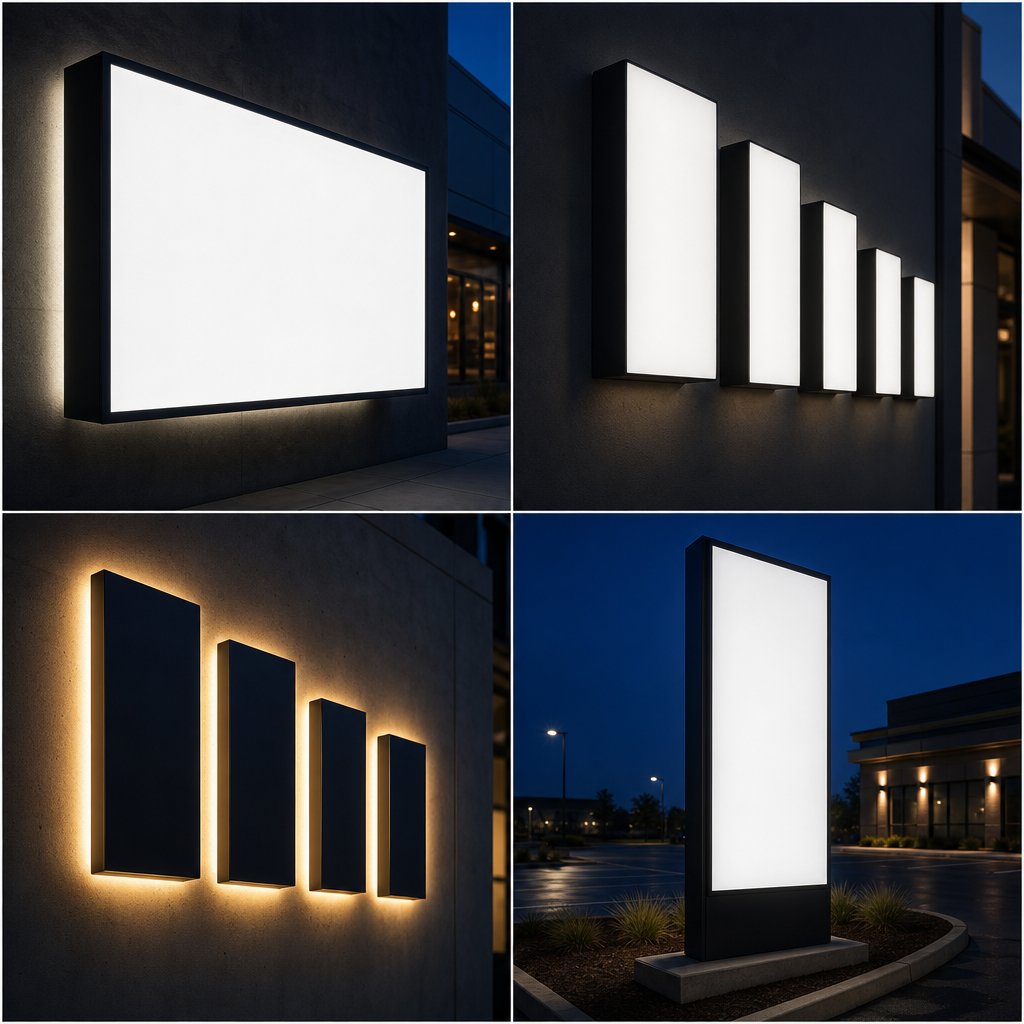
The Sunshine Coast market uses six main illuminated formats: LED lightboxes, face-lit acrylic letters, halo-lit reverse letters, under-awning and projecting signs, illuminated pylons, and window or wall-mounted LED panels. Each format lights differently and suits a different building type, from strip shopping centres to freestanding highway pylons.
LED Lightboxes and Fabric-Face Tension Frames
A lightbox is an internally lit box with a translucent acrylic or fabric face. LED modules sit inside, evenly spread across the back or edges to avoid hotspots. Fabric-face tension frames have largely replaced older push-through acrylic lightboxes because the fabric skin is lighter, easier to swap for a design refresh, and less prone to yellowing.
Face-Lit Acrylic Letters
Individual letters, usually CNC-routed from acrylic, with LEDs mounted behind or within the letter face so the whole letterform glows. This format gives strong daytime brand presence and a clean, even glow after dark, and it's a common choice for showrooms and premium retail frontages.
Halo-Lit (Reverse-Illuminated) Letters
Halo-lit letters are built on an aluminium or ACM tray with the LED facing backward into the wall, so light spills out from behind the letter as a soft glow. It reads as more premium than face-lit letters and is popular for corporate and hospitality brands wanting a subtler, upmarket look.
Under-Awning and Projecting Signs
These hang perpendicular to the shopfront, aimed at pedestrians rather than passing traffic. They're effective in arcades and laneways such as those in Mooloolaba and Noosa Junction, where foot traffic reads signage at close range rather than from a moving car.
Illuminated Pylon and Monument Signs
Pylon signs are freestanding structures, often multi-tenancy, positioned for maximum highway or arterial road visibility. Monument signs are lower, ground-based versions common at shopping centre entries. Both carry significant structural and electrical requirements because they're exposed to full wind loading and sit further from any building for maintenance access.
Window or Wall-Mounted LED Panels
Compact LED panel signs, often used for opening hours, menus or promotional messaging, mounted directly to glass or a wall. They're inexpensive and quick to install, but outdoor-facing units still need an IP-rated housing to survive condensation and driving rain.
Build and Materials: What Makes Illuminated Signage Survive Coastal Conditions
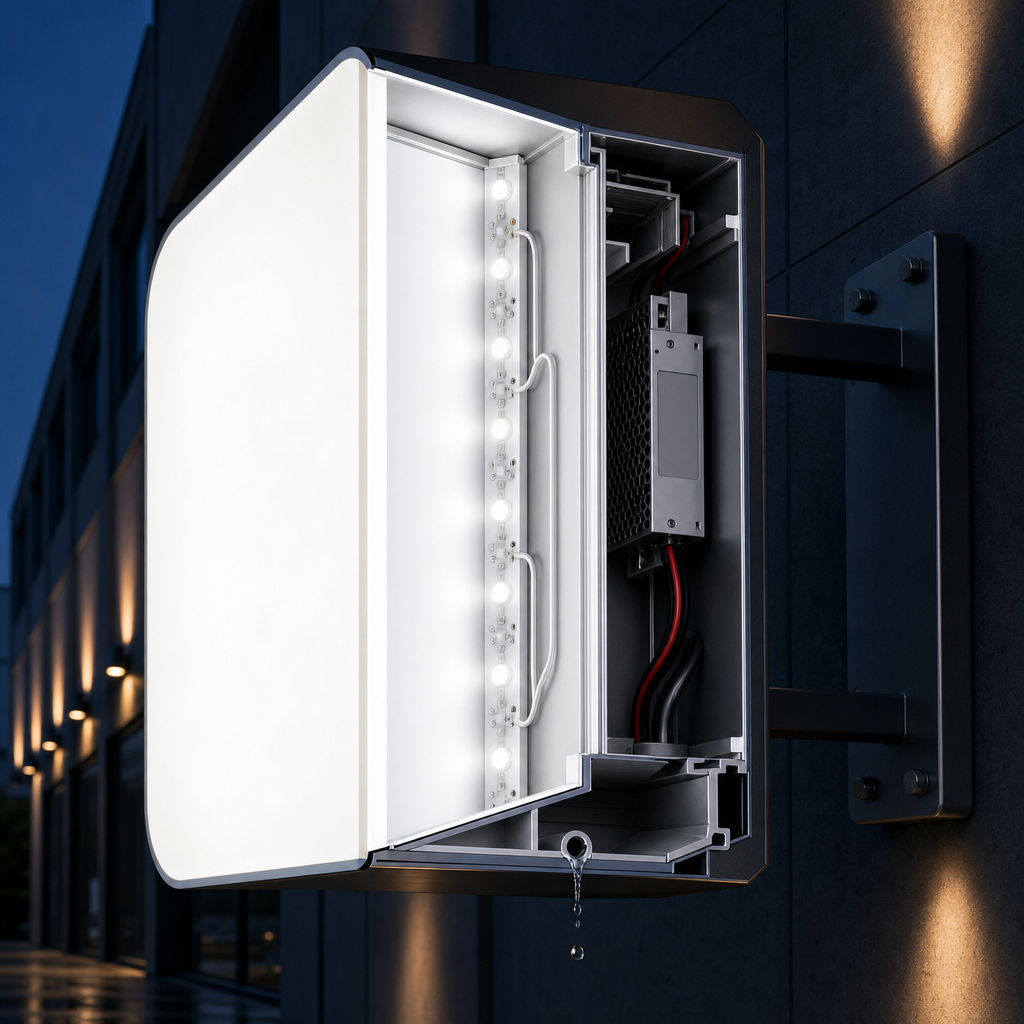
Illuminated signage survives the Sunshine Coast when it's built from CNC-routed acrylic or ACM faces, marine-grade aluminium trays, IP65-rated LED modules and power supplies, sealed returns and proper drainage. Every fixing exposed to salt air should be stainless steel or hot-dip galvanised, not standard mild steel or zinc-plated hardware.
According to the International Electrotechnical Commission's IP Code standard, IEC 60529 (https://www.iec.ch), an IP65 rating means a component is fully protected against dust and can withstand low-pressure water jets from any direction, while IP67 adds resistance to temporary immersion. For coastal signage, IP65 is generally the practical minimum for outdoor LED modules and power supplies, and IP67 is worth specifying for anything mounted low, near sprinklers, or in a position that collects pooling water after storms.
LED sign manufacturers commonly rate signage-grade modules to around 50,000 hours of operation before output drops to 70 percent of original brightness (an L70 rating), based on lumen maintenance testing methodology set out by the Illuminating Engineering Society's LM-80 standard (IES, https://www.ies.org). In practice, that's roughly a decade of typical evening and night trading before a noticeable dimming, assuming the modules themselves haven't already failed from moisture ingress, which is the more common cause of early failure on this coast.
Sealed returns matter as much as the LED choice. A lightbox or letter tray with a poorly sealed seam lets humid air in and out as the sign heats and cools daily. That moisture condenses inside, corrodes the driver board, and shortens the LED's working life well below its rated hours. Drainage weep holes, positioned so water can escape but insects and driving rain can't easily enter, are a small detail that separates a sign that lasts a decade from one that fails in two years.
Consider a takeaway shop on the Bruce Highway approach into the Sunshine Coast that had run ageing fluorescent light boxes for over a decade. The tubes needed replacing every year or two, ballasts hummed audibly, and the box itself had started rusting from the inside where condensation had been pooling against unsealed seams. A retrofit to sealed, IP65-rated LED modules with proper drainage removed both problems: the flicker and hum disappeared, and the enclosed, corrosion-resistant build stopped the internal rust that fluorescent housings were prone to in salt air. That's a realistic pattern across older Sunshine Coast strips still running fluorescent or first-generation LED boxes installed before sealed, marine-grade builds became standard practice.
Brightness, Colour and Control: Getting the Light Right
Getting illuminated signage right means matching lux output to the sign's viewing distance, colour-matching LEDs to the brand's exact palette, and adding dimming or timer controls so the sign isn't blazing at 2am when nobody's driving past. Over-bright signage looks cheap and irritates neighbours; under-bright signage disappears at dusk.
Highway-facing pylon signs need more raw output than a boutique shopfront sign viewed from three metres on a footpath. A sign specified for the wrong viewing distance either washes out in daylight or glares uncomfortably after dark, both of which undermine the brand rather than support it.
Colour accuracy is a genuine technical variable, not a given. Off-the-shelf white LEDs vary in colour temperature, and coloured LEDs can drift from a brand's Pantone or RGB reference if the signmaker isn't colour-matching against the actual brand file. Ask to see a physical sample under daylight and after dark before signing off on a large-format lightbox or pylon face.
Dimming and astronomical timers, which adjust switch-on and switch-off times automatically as sunset shifts through the year, cut running costs and LED wear without any loss of evening visibility. For a business trading past midnight, a scheduled dim to 50 percent brightness in the small hours is a simple way to extend module life while still meeting any centre or council requirement to keep signage illuminated.
Approvals and Site Practicalities on the Sunshine Coast and Noosa
Most illuminated pylon, projecting and larger shopfront signs need council approval before installation, separate from any landlord or shopping centre design criteria. Sunshine Coast Council and Noosa Council both assess signage against their respective planning schemes, and electrical connection must be carried out by a licensed electrician regardless of council sign-off.
Sunshine Coast Council (https://www.sunshinecoast.qld.gov.au) and Noosa Council (https://www.noosa.qld.gov.au) each maintain planning scheme provisions covering signage size, height, illumination and placement, and requirements can differ between the two local government areas even for neighbouring sites near the Noosa boundary. A pylon sign proposal typically needs site plans, elevations and structural details submitted as part of a development or building application, while a straightforward shopfront lightbox replacing an existing sign of the same size and position may not need a fresh approval at all.
Shopping centre tenants face a second layer of approval on top of council requirements: centre design criteria, which govern sign size, position, colour and sometimes the exact illumination method allowed within a tenancy's shopfront zone. These criteria are usually stricter than council rules and need checking before a design is finalised, not after.
Electrical connection for any illuminated sign must comply with the AS/NZS 3000 wiring rules administered by Standards Australia (https://www.standards.org.au), and outdoor power supplies need weatherproof isolators positioned for safe maintenance access. On pylon signs especially, the power run from the meter box to the sign location is often the most overlooked practical detail in early planning, and it can materially affect both cost and installation timing.
Cost Drivers and Lifespan: What You're Actually Paying For
Illuminated sign pricing is driven mainly by size, format, material grade, electrical complexity and site access, not by the LED chips themselves, which are a relatively small line item. A well-built sign priced correctly for coastal conditions costs more upfront than a budget import but avoids the module replacements and callouts that erode any early saving.
The format itself sets a cost floor: a simple face-lit letter set is generally cheaper than a halo-lit letter set on a fabricated aluminium tray, and both sit below a structurally engineered pylon sign requiring footings and wind-load certification. Electrical complexity, particularly a new power run to a freestanding pylon, frequently costs more than the sign face itself.
Warranty terms are worth scrutinising closely. A warranty on the LED modules and driver is only useful if the manufacturer and the installer are still around to honour it, and if the sign's build quality hasn't voided it through poor sealing or incorrect installation. Ask specifically what the warranty covers: modules, drivers, the acrylic or ACM face, and the structural frame are often covered separately with different terms.
Maintenance on a well-built illuminated sign should be minimal for years: an occasional clean, a check of seals after major storms, and eventual module replacement once brightness noticeably drops. Cheaper units tend to need driver or module replacement well inside the first few years, which is where the apparent upfront saving disappears.
How to Brief a Signmaker for an Accurate, Measured Quote
A reliable illuminated sign quote needs site photos, accurate elevations or measurements, the location of existing or planned power, and the brand's actual logo and colour files. Desktop quotes based on a description alone are guesswork; a measured site visit removes the variables that cause budget blowouts later.
Before contacting a signmaker, gather:
- Clear photos of the shopfront, wall or pylon location from multiple angles, including in daylight and, if possible, at dusk.
- Rough measurements of the available sign area, or an elevation drawing if one exists from the build or fit-out.
- The location of the nearest power point or switchboard, and whether new electrical work is likely.
- Brand files: logo in vector format, exact colour references (Pantone or RGB/HEX), and any centre or council design criteria already supplied to the tenant.
- Any known height, projection or illumination restrictions already communicated by a landlord or council.
- A rough budget range and preferred installation timeframe.
This checklist doesn't replace a site inspection, but it lets a signmaker give a realistic estimate before booking a measure-and-quote visit, which saves time on both sides.
The Corrosion Line Item Most Quotes Leave Out
Most illuminated sign quotes on the Sunshine Coast look nearly identical on paper: similar LED specs, similar warranty periods, similar turnaround times. The difference that actually determines whether a sign lasts three years or twelve rarely appears as a line item at all: it's the fixing hardware, the seal detail on the returns, and whether drainage was actually designed in or just assumed.
It's a genuine blind spot in how illuminated signage gets compared. Two quotes can spec the same LED module and the same acrylic thickness, yet one uses stainless fixings and a properly sealed, drained tray while the other uses standard hardware because it's cheaper and the difference isn't visible in a render. On an inland job, that gap might never show up. On a coastal frontage exposed to salt-laden onshore winds, it shows up within a couple of wet seasons as rust streaking down a letter tray or a driver board failing from condensation.
The practical takeaway for anyone comparing quotes: ask directly what fixing grade and sealing method each quote includes, not just what LED brand or wattage is specified. It's the detail that separates a sign built for the Sunshine Coast from a sign that was simply built and happened to be installed here.
If you're weighing up options for a shopfront, pylon or under-awning sign, sending through site photos and rough dimensions to the Sunquest Signs team gets you a measured quote and, where useful, a site inspection, rather than a guess based on a description alone.
References
- International Electrotechnical Commission, IEC 60529 IP Code standard for degrees of protection: https://www.iec.ch
- Illuminating Engineering Society, LM-80 lumen maintenance testing standard: https://www.ies.org
- Sunshine Coast Council, planning scheme and signage requirements: https://www.sunshinecoast.qld.gov.au
- Noosa Council, planning scheme and development approvals: https://www.noosa.qld.gov.au
- Standards Australia, AS/NZS 3000 electrical wiring rules: https://www.standards.org.au
Talk to a signage expert
Tell us about your project and we'll come back with options and honest advice.
Get in TouchFrequently Asked Questions
How much do illuminated signs cost on the Sunshine Coast?
Cost depends on format, size, material grade and electrical complexity rather than a fixed rate per square metre. A simple lightbox costs less than a halo-lit letter set, and a highway pylon with new power and footings costs more than either. A measured site quote is the only reliable way to get an accurate figure.
Do I need council approval for an illuminated sign in Queensland?
Often yes, particularly for pylon, monument, projecting and larger shopfront signs. Sunshine Coast Council and Noosa Council both assess signage against their planning schemes, and requirements vary between the two areas, so it's worth checking before finalising a design.
How long do LED illuminated signs last?
LED modules are commonly rated to around 50,000 hours before a noticeable drop in brightness, based on industry lumen maintenance testing standards. In practice, a well-sealed, correctly specified sign on the Sunshine Coast can run for a decade or more, while poorly sealed units often fail from moisture ingress well before the LEDs themselves wear out.
What's the difference between halo-lit and face-lit letters?
Face-lit letters glow across the whole letterform, giving a bright, even look both day and night. Halo-lit letters have the LED facing backward into the wall, producing a softer glow around the letter's edge, which reads as more premium and is common on corporate and hospitality frontages.
Can illuminated signs be repaired if they fail?
Most failures come down to a faulty driver, a failed section of LED modules, or moisture ingress through a poor seal, and all of these can usually be repaired without replacing the whole sign. Structural or corrosion damage to the tray or frame is harder to fix cost-effectively and may point to a full replacement instead.
Is LED signage cheaper to run than fluorescent or neon?
LED modules use less power than fluorescent tubes or neon for a comparable brightness, and they don't need the periodic tube or gas replacement that fluorescent and neon signage requires. Combined with dimming and timer controls, LED signage generally costs less to run and maintain over its working life.
Related Articles
Illuminated Sign Maintenance: How to Keep LED Signage Bright, Safe and Trading
Business Signs in Maroochydore: A Practical Guide to Shopfronts, Illuminated Signage and Fleet Graphics
Business Signs in Caloundra: A Practical Guide to Shopfronts, Illuminated Signage and Vehicle Graphics
Signs that set you apart
Over 40 years on the Sunshine Coast. Design, compliance, manufacture and installation handled end to end.
Get a Free Quote