Neon Signs in Caloundra: Custom LED Neon for Shopfronts, Cafés and Venues
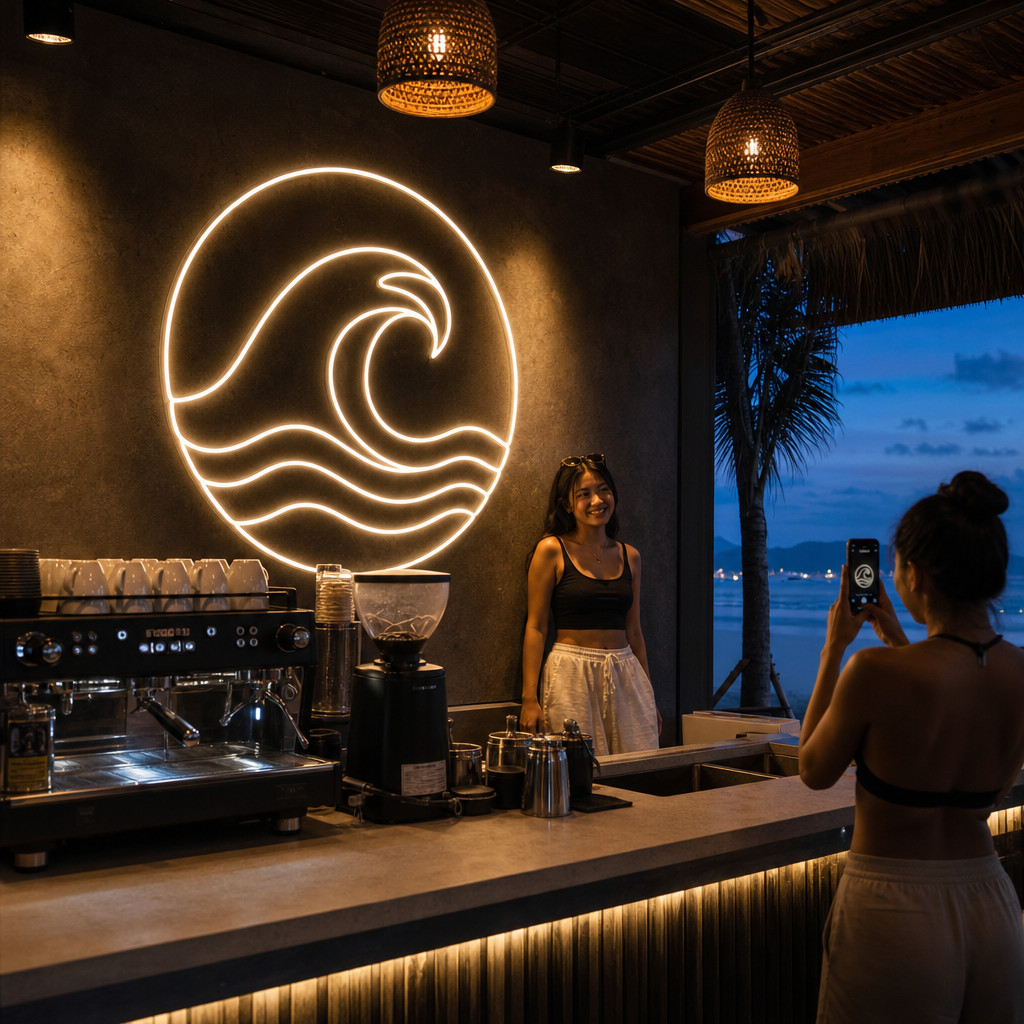
Custom LED neon signs in Caloundra suit cafés, bars, salons, boutiques and gyms that want a bright, photo-friendly feature for a window, feature wall or undercover frontage. LED neon uses far less power than glass neon, handles coastal conditions when built to the right rating, and Sunquest Signs designs, fabricates and installs locally.
Caloundra trades differently to most of the Sunshine Coast. Bulcock Street runs on retail and lunch trade, Kings Beach and Moffat Beach lean on beachfront cafés and evening dining, and newer communities like Pelican Waters and Caloundra South keep adding tenancies that need a strong brand presence from day one. A neon sign suits that mix because it works after dark and in the camera roll.
This guide is written for owners, managers and fit-out teams commissioning a custom LED neon sign. It covers where neon works best, how to design it, what to check with council, how to look after it, and how the process runs with Sunquest Signs. If you want the northern comparison, our Noosa neon guide covers that market separately.
Key Takeaways
- LED neon suits Caloundra's night trade, beachfront foot traffic and social-media-driven discovery.
- Windows, feature walls behind counters, alfresco areas and undercover frontages are the strongest placements.
- Salt air and moisture make the build rating matter. Indoor-rated and outdoor-rated signs are not interchangeable.
- Simplify your logo for neon. Strong shapes, fewer colours and a solid backing board give the best result.
- Exterior signage may fall under Sunshine Coast Council advertising device rules, so check before you install.
- A free design mock-up shows you the sign on your wall or window before you commit.
Ready to make your business impossible to miss?
Design, manufacture and installation, all under one roof in Warana.
Get a Free QuoteSummary Table
| Topic | What to decide | Practical guidance |
|---|---|---|
| Placement | Window, interior wall, alfresco or undercover frontage | Match the placement to where customers pause and photograph |
| Build rating | Indoor or outdoor-rated | Choose outdoor-rated for anything exposed to weather or salt air |
| Design | Logo, font and colours | Simplify to strong shapes and a limited palette |
| Backing | Clear, painted or laser-cut acrylic | Pick based on wall colour, glare and the look you want |
| Mounting | Wall-fixed, window-hung or freestanding | Depends on surface, tenancy rules and security |
| Approvals | Landlord and council | Check exterior requirements before fabrication |
| Care | Cleaning and periodic checks | Simple routine, backed by a maintenance guide |
Why LED Neon Suits Caloundra Businesses
LED neon suits Caloundra because the town's trade runs into the evening, foot traffic gathers along beachfronts and main streets, and customers photograph what they like. A glowing sign works as a night-time beacon and a shareable backdrop. It also draws far less power than traditional glass neon.
Night trade and beachfront foot traffic
A lot of Caloundra's best trading happens when the sun is going down. Think of the walk along Kings Beach after a swim, dinner at Moffat Beach, or a Friday night stroll on Bulcock Street. Daytime signage does its job until dusk, then often disappears. A lit neon sign keeps working while the street is still busy.
That matters most for venues. A bar or restaurant with no lit identity can look closed from fifty metres away. A warm, well-placed neon in the window tells people you are open and gives them a reason to look in.
Photo-friendly branding
Neon gets photographed. Customers stand in front of it, tag the venue and post it. For a café, salon or gym, that is free local reach. The sign becomes part of the product experience, not only a label above the door.
This is why placement should be planned around where people actually pose, not only where the sign is most visible from the street. We cover that in more detail in the insight section below.
Why LED rather than glass
LED neon is a flexible LED strip set in a silicone or similar diffuser, shaped to look like glass tubing. It does not rely on fragile bent glass or high-voltage transformers. According to the US Department of Energy (https://www.energy.gov/energysaver/led-lighting), LED lighting uses significantly less energy than traditional lighting and lasts longer. We have deliberately not quoted a specific saving for neon here, because the figure depends on the product and the comparison, and any number should be sourced before it is published.
For a coastal business, the practical benefits are clear: lower running costs, cooler operation and a more robust build when it is specified correctly.
Where Neon Works Best in a Caloundra Tenancy
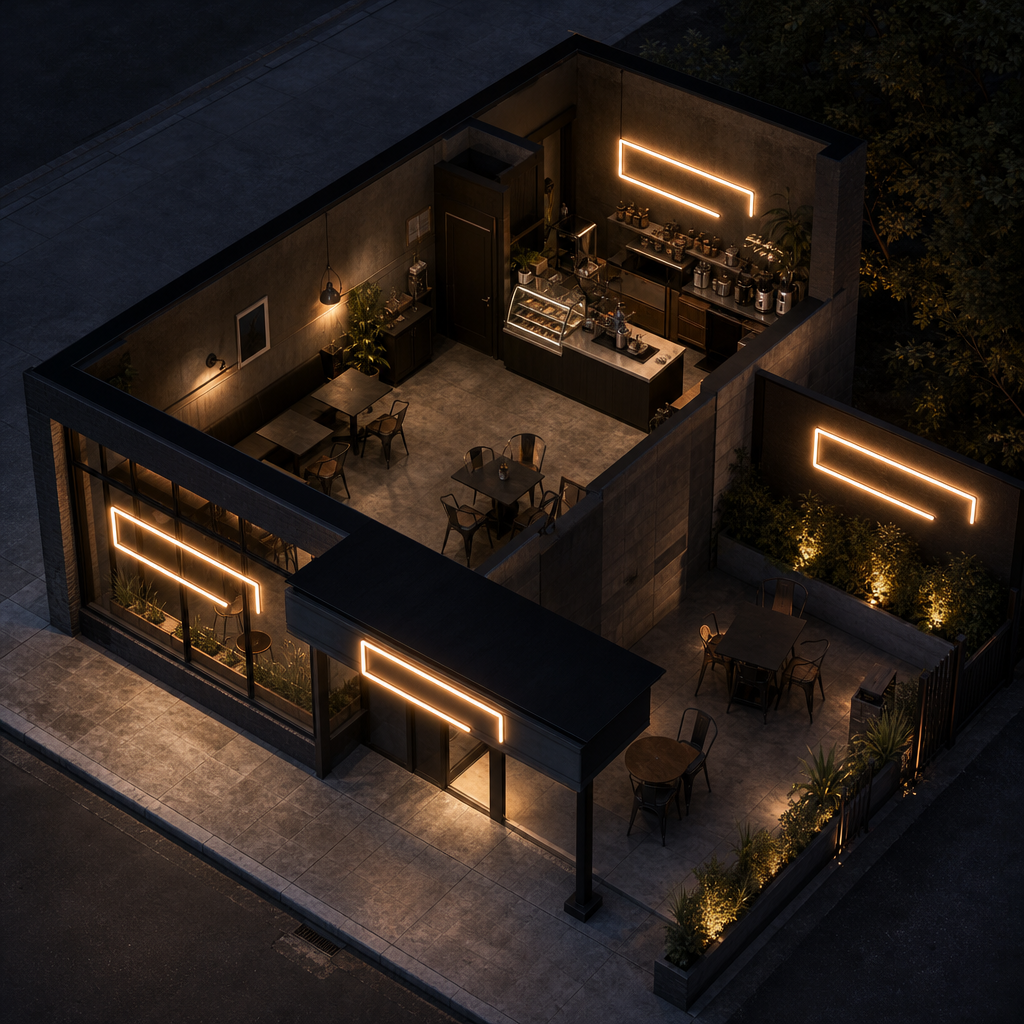 Neon works best where people pause, queue or photograph: shopfront windows, feature walls behind counters, alfresco areas and undercover frontages. The right location depends on trading hours, sightlines and exposure to weather. Indoor placements are simplest, while anything exposed to sea air needs an outdoor-rated build.
Window displays
A window sign reaches passing trade without taking up floor space. It suits boutiques and salons on Bulcock Street, where customers browse on foot and glance into windows. Hung just inside the glass, the sign is protected from direct weather but still visible from the footpath.
Keep two things in mind. Afternoon sun can wash out a lit sign in a west-facing window, so choose a brighter build or a bolder colour. Also consider glare and reflections on the glass when you position it.
Feature walls behind counters
The wall behind the counter is where customers wait, order and look. A neon sign here is seen by everyone who walks in, and it frames the staff and the product. For cafés and bars, it is often the best-value placement because it is indoors, protected and photographed constantly.
A laser-cut acrylic backing can lift this placement further, giving the sign depth and a clean edge against a textured or busy wall.
Alfresco areas and undercover frontages
Caloundra's climate pushes a lot of trade outdoors. Alfresco seating at Kings Beach, Moffat Beach and Golden Beach venues is a natural home for a feature sign. But "covered" does not mean "protected". Wind-driven rain, humidity and salt can reach under awnings.
If the sign sits in an open-sided area, treat it as an exterior install. That means an outdoor-rated build and a council check where it faces the street.
Indoor versus outdoor-rated builds
Ingress Protection (IP) ratings, defined in the international standard IEC 60529, describe how well an enclosure resists solids and liquids. The first digit covers solids such as dust, and the second covers water. A higher second digit generally means better protection against moisture.
In plain terms:
- Indoor-rated: suited to dry, climate-controlled interiors. Not intended for rain, spray or sustained humidity.
- Outdoor-rated: built with sealed construction and protected connections so it can handle weather exposure.
Near the coast, we recommend specifying for the real conditions, not the best-case ones. A sign on a beachfront wall faces salt-laden air even on a dry day. Moisture protection, sealed power connections and corrosion-resistant fixings are worth the extra consideration at the start.
Designing Your Custom LED Neon Sign
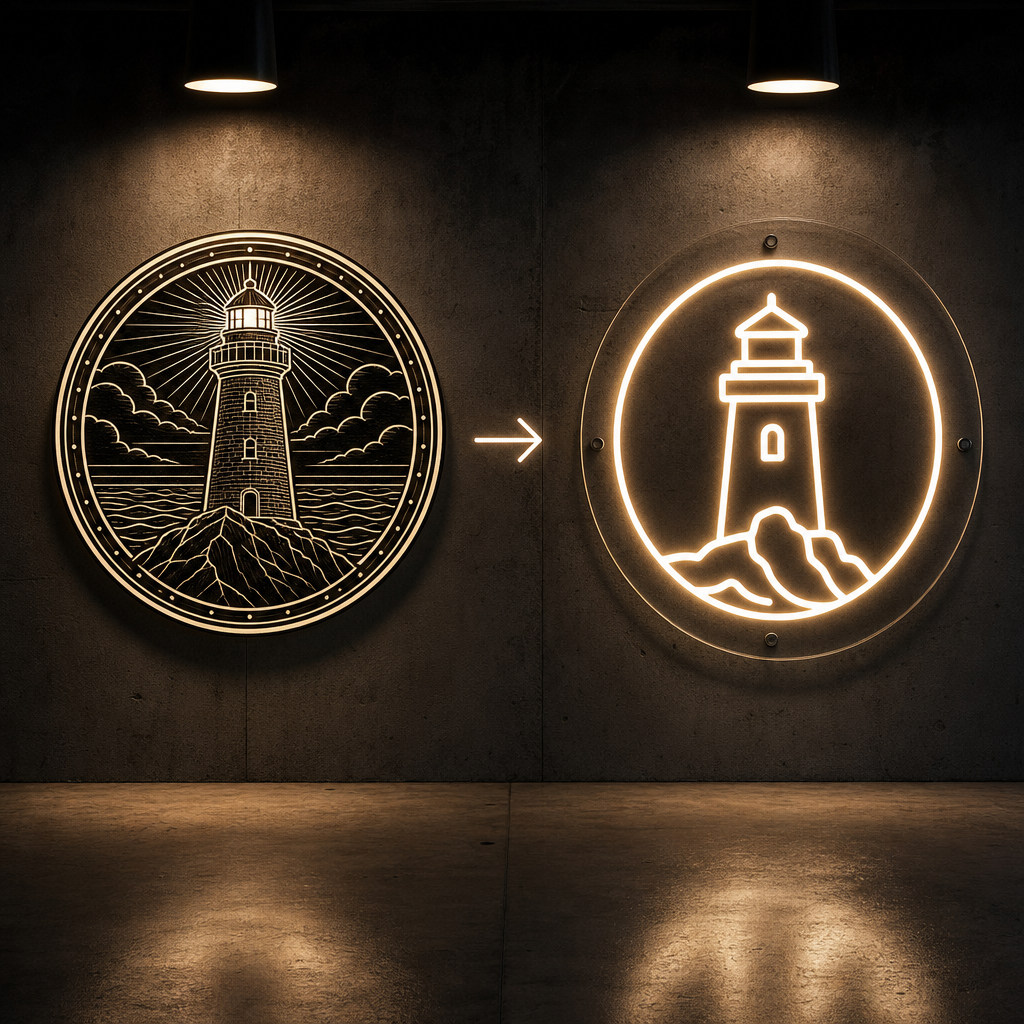 A good neon design starts with a simplified version of your logo, a readable font, a limited colour palette and a backing and mounting method that suits the wall. The goal is a sign that reads clearly at distance, looks good in photos and installs securely.
Logo conversion
Neon is drawn with continuous lines, so logos with fine detail, gradients or tiny text rarely translate directly. The designer traces the core shapes and reduces them to paths the LED strip can follow. Expect some simplification.
Send your logo as a vector file if you have one, such as AI, EPS or SVG. A clear PNG or PDF also works as a starting point. If you only have a rough idea, that is fine too, and a mock-up can develop it.
Font choice
Script fonts feel on-brand for beachside cafés and salons, but they need thick enough strokes and enough spacing to stay legible when lit. Tight, thin scripts can blur into one glowing shape. Clean sans-serif lettering is more forgiving and reads better at a distance, which suits gyms and bars.
If your brand font is thin or ornate, ask for a neon-friendly alternative that keeps the same personality.
Colour selection
Choose colours that suit both your brand and your wall. Warm white and soft pink sit well in cafés and salons. Cool white and blue read as clean and modern. Saturated colours look strong at night but can look flat in daylight when unlit, so consider how the sign appears during the day too.
Fewer colours usually mean a stronger sign. Two is often better than five.
Backing boards and laser-cut acrylic
The backing board holds the LED neon in shape and hides the wiring. Common options include:
- Clear acrylic: the sign appears to float on the wall or glass. Good for windows.
- Painted or coloured acrylic: adds contrast and a defined shape.
- Laser-cut acrylic: the backing follows the outline of the design, which gives a neat, custom silhouette.
Laser-cut backings give precise edges and work well for logos with distinct shapes. Sunquest Signs also offers laser cutting in Caloundra for related projects, such as custom-cut panels and display pieces.
Mounting options
The mounting method depends on the surface and your tenancy conditions:
- Wall-fixed: standoffs or brackets into brick, render or plasterboard with the correct fixings.
- Window-hung: chains or cables from the ceiling or frame, with no drilling into glass.
- Freestanding: a base or frame for events, pop-ups or temporary displays.
Check your lease before choosing. Landlords often have rules about drilling into walls or altering frontages.
Permits and Placement: Check With Sunshine Coast Council First
Exterior signage may fall under Sunshine Coast Council's advertising device rules, and landlord approval may also apply. Interior signs usually sit outside those rules, but the position, size and illumination of exterior signs can matter. Check with council before installation rather than after.
We are not quoting specific regulations here, because requirements depend on the property, zoning and the type of sign, and they can change. The best step is to contact Sunshine Coast Council (https://www.sunshinecoast.qld.gov.au) or check its published guidance for advertising devices.
A few practical points help:
- Interior versus exterior: a sign inside your window is treated differently from one fixed to the outside of the building.
- Illumination: lit signs facing a street or footpath may have additional considerations.
- Landlord and body corporate: many tenancies and complexes need written consent regardless of council rules.
- Timing: get approvals sorted before fabrication so the finished sign is not held up.
If you are fitting out a new tenancy, raise signage early. It is much easier to plan power, fixings and approvals during the fit-out than after the shopfront is finished.
Running Costs, Lifespan and Care
LED neon is generally cheap to run and long-lasting compared with traditional glass neon, because LEDs use less power and produce less heat. Care is simple: dust it, wipe it gently and have it checked if a section dims or flickers. Outdoor signs near the coast benefit from regular cleaning.
Running costs
LED neon draws a fraction of the power of traditional glass neon, and LED lighting in general is far more efficient than older lighting technologies, according to the US Department of Energy (https://www.energy.gov/energysaver/led-lighting). For a sign that runs through every evening of trade, that adds up over time. We have not included a dollar figure, because the cost depends on the sign's size, hours of use and your electricity tariff.
Lifespan
LED components are generally rated for long operating lives, but the actual lifespan of a sign depends on build quality, power supply, heat, moisture and how it is used. A well-built sign in a protected position will usually outlast one in a harsh exposed spot. Ask for the manufacturer's expected lifespan and warranty terms for your specific build.
Care and cleaning
A simple routine keeps a sign looking sharp:
- Turn the sign off and isolate power before cleaning.
- Dust with a soft, dry microfibre cloth.
- For marks, use a slightly damp cloth, never a spray directly on the sign.
- Avoid harsh solvents on acrylic or the neon tubing.
- On coastal installs, wipe salt deposits regularly and check fixings and connections.
For more detail, see our illuminated sign maintenance guide, which covers inspection and care for lit signage.
The Sunquest Signs Process
The process runs in four stages: consultation, design mock-up, fabrication and installation. You share your logo or idea and the wall or window dimensions, we show you the sign in context, then we build and install it. There is no obligation to proceed after the mock-up.
1. Consultation
We start by understanding where the sign will go and what it needs to do. We ask about the space, the lighting, the viewing distance and whether it is indoors, undercover or exposed. We also talk through power access, mounting and anything your landlord requires.
2. Design mock-up
This is where you see the result before you commit. We convert your logo or idea into a neon-ready design, suggest colours and backing options, and show it on your wall or window. Changes are easier to make at this stage than after fabrication.
3. Fabrication
Once you approve the design, the sign is built to suit the placement. That includes the right build rating for indoor or outdoor use, the chosen backing and the mounting hardware. Details such as laser-cut acrylic are specified here.
4. Installation
We install the sign securely and test it in place. For tenancies and new fit-outs, installation can be coordinated around other trades. Where a sign goes on a shopfront, the earlier approvals and power planning pay off here.
Once your neon is in, you may also want to consider related work, such as window, wall and floor graphics that complement the sign, or wider business and shopfront signage that ties the frontage together.
Design for the Camera Roll as Well as the Street
My view is that most Caloundra businesses plan neon for the street and forget the phone. The sign that earns the most for a café or salon is often the one customers stand next to, not the one drivers see. Plan the sign around where people will pose, and around three viewing distances.
Here is the practical test I would apply to any placement. It is a framework based on how neon behaves, not a claim about measured results.
Distance one: the street glance. Can someone passing at walking pace read the name or recognise the mark in a second or two? If not, simplify the design or make it bigger.
Distance two: the doorway. From the threshold, does the sign signal the mood of the place? This is where colour and style matter most.
Distance three: the table or queue. Is there a clear spot where a customer can stand or sit with the sign behind them and a clean background around it? A sign hidden behind a coffee machine or a menu board does not get photographed.
Consider a hypothetical Kings Beach café that trades through breakfast and into early evening. Its logo sits on a sign above the door, but after dark the frontage goes quiet. The owner adds a warm-white LED neon on a laser-cut backing on the feature wall behind the counter, with a second small piece in the window. Evening customers now see a lit, inviting interior from the footpath, and the wall behind the counter becomes the obvious place to take a photo. This is an illustration of how to plan, not a real client result.
The contrarian part: do not try to put your whole logo in neon. Choose the strongest element, such as the name, a symbol or a short tagline, and let it do one job well. A simple sign beats a complicated one every time, in the street and on the screen.
It is also worth thinking about how the neon area fits your wider branding. Window, wall and floor graphics, shopfront signage and a feature neon all work best when they share colours and lettering, so the frontage looks like one idea.
Request a Free Design Mock-Up and Quote
If you run a café, bar, salon, boutique, gym or venue in Caloundra, Bulcock Street, Kings Beach, Moffat Beach, Golden Beach, Pelican Waters or Caloundra South, send Sunquest Signs your logo or idea along with the dimensions of the intended wall or window. We will prepare a free design mock-up and quote for a custom LED neon sign, so you can see it in place before you decide.
References
- US Department of Energy, Energy Saver: LED Lighting. https://www.energy.gov/energysaver/led-lighting
- International Electrotechnical Commission, IEC 60529: Degrees of protection provided by enclosures (IP Code). https://www.iec.ch
- Sunshine Coast Council, advertising devices and signage information. https://www.sunshinecoast.qld.gov.au
- Australian Bureau of Statistics. https://www.abs.gov.au
Talk to a signage expert
Tell us about your project and we'll come back with options and honest advice.
Get in TouchFrequently Asked Questions
How much does a custom LED neon sign cost in Caloundra?
Cost depends on size, design complexity, number of colours, backing type, and whether it is indoor or outdoor-rated. A small single-colour sign will cost less than a large multi-colour outdoor piece. The quickest way to get a figure is to send your logo and the intended dimensions for a free quote.
Do I need council approval for a neon sign in Caloundra?
Interior signs generally sit outside advertising device rules, but exterior signage may fall under Sunshine Coast Council requirements, and your landlord may also need to approve. Check with council and your landlord before installation, because requirements vary by property and sign type.
Can LED neon be used outdoors near the beach?
Yes, if it is built and rated for outdoor use. Salt air and moisture are harder on electronics and fixings than inland conditions, so specify an outdoor-rated sign with sealed connections and corrosion-resistant hardware, and clean it regularly.
How long does an LED neon sign last?
LEDs are generally long-lasting, but lifespan depends on build quality, the power supply, moisture and heat. A sign in a protected indoor position will usually last longer than one exposed to weather. Ask for the expected lifespan and warranty for your specific sign.
Can you turn my logo into a neon sign?
Yes. We convert logos into neon-ready designs, which often means simplifying fine detail and reducing colours. Send a vector file if you have one, or a clear image, and we will show you a mock-up before you commit.
Related Articles
Window Decals and Graphics for Sunshine Coast Shopfronts: Types, Coastal Materials, Rules and Costs
Neon Signs in Noosa: Custom LED Neon for Cafés, Bars and Boutiques on the Coast
Sunshine Coast Signage Project Gallery: Real Local Sign Installs by Suburb and Sign Type
Signs that set you apart
Over 40 years on the Sunshine Coast. Design, compliance, manufacture and installation handled end to end.
Get a Free Quote