Neon Signs in Noosa: Custom LED Neon for Cafés, Bars and Boutiques on the Coast
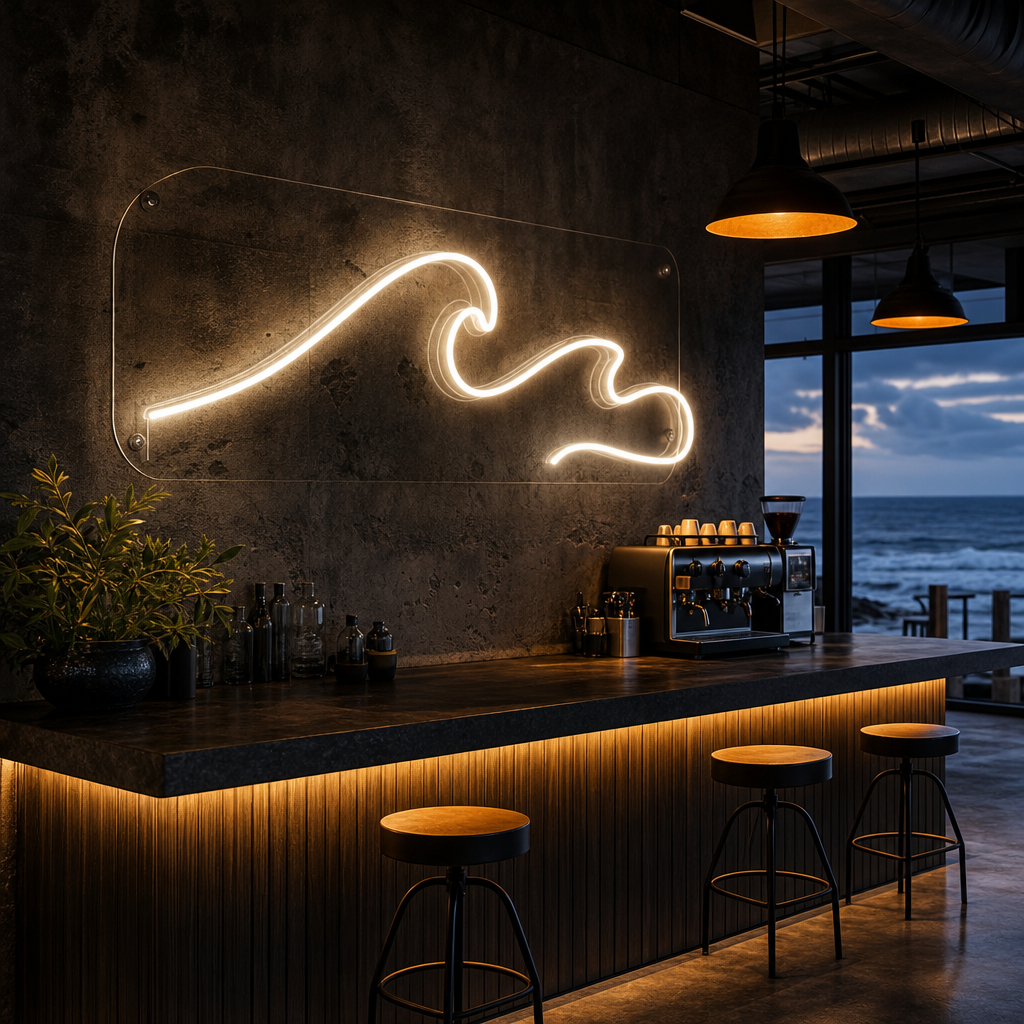
Neon signs in Noosa work best as LED neon flex: a silicone-sheathed LED strip shaped into your logo or wording. It runs cool, draws less power than glass neon, and copes with coastal humidity when specified properly. For anything near salt air, choose an IP65 or IP67 rating, UV-stable silicone, sealed connections and a sheltered position.
Noosa is a town that sells atmosphere. Whether you run a café on Hastings Street, a bar in Noosa Junction, a boutique at Sunshine Beach or a restaurant on Gympie Terrace in Noosaville, your sign is part of the mood. Neon gives you a glowing, photographable brand mark that earns attention after dark, when much of the town's dining and drinking trade happens.
But the coast is hard on electrical products. Salt, humidity and strong UV shorten the life of poorly specified signs. This guide covers what LED neon is, where it works, how to specify a piece that lasts, and what to check with council and your electrician. It focuses on neon only. Lightboxes, lit letters and pylons are covered separately in our guide to illuminated signs in Noosa.
Key Takeaways
- LED neon flex suits Noosa's relaxed coastal style and is the practical choice for most new venues: cooler, lower power and more durable than glass.
- Indoor feature walls, window displays and covered alfresco areas are the best positions. Direct weather exposure is where coastal neon fails.
- For outdoor or semi-outdoor use, specify IP65 or IP67, UV-stable silicone, sealed joins, marine-grade fixings and a dry power supply.
- Good neon design means simple lines, a legible font, a colour that reads against your wall, and a dimmer to tune the glow.
- Check the Noosa Plan before installing any illuminated or externally visible sign, and use a licensed electrician for hardwired connections.
- Regular wipe-downs and seasonal checks of seals and fixings do more for lifespan than any other single habit.
Ready to make your business impossible to miss?
Design, manufacture and installation, all under one roof in Warana.
Get a Free QuoteSummary Table
| Topic | Best choice for Noosa | Why it matters |
|---|---|---|
| Neon type | LED neon flex | Cooler, lower power, more resilient than glass |
| Best positions | Indoor feature walls, windows, sheltered alfresco | Out of direct rain, spray and sun |
| Outdoor rating | IP65 or IP67, matched to exposure | Resists water ingress in humid, salty air |
| Sheath material | UV-stable silicone | Resists yellowing and hardening under strong sun |
| Backing board | Outdoor-grade acrylic, cut-to-shape or rectangular | Affects look, mounting and salt build-up |
| Controls | Dimmer or controller | Tunes brightness for day, dusk and night |
| Compliance | Check the Noosa Plan, licensed electrician for hardwiring | Avoids removal orders and electrical safety risks |
| Care | Soft damp cloth, fresh water rinse, seasonal seal checks | Protects the sign from salt build-up |
Why Neon Suits Noosa's Cafés, Bars and Boutiques
Neon suits Noosa because the town trades on atmosphere. Visitors and locals choose venues by how they feel after dark, and a warm, glowing sign signals a relaxed, premium room. It also gives guests a ready-made photo backdrop, which spreads your brand across social feeds without an advertising budget.
Think about how people use the town. On Hastings Street, foot traffic builds through the evening as diners move between restaurants and bars. Along Gympie Terrace, the river walk gives venues a slow-moving audience that notices what glows. In Noosa Junction and Sunshine Beach, locals choose their regular spots by feel as much as by menu. In each case, a lit sign does two jobs: it tells people you are open, and it tells them what kind of place you are.
Brand recognition after dark
A neon version of your logo becomes visual shorthand for your venue. Guests who have only seen it on a phone screen recognise it when they walk past. That is the real value: not the light itself, but a consistent, memorable image repeated across photos, tagged posts and Google Maps uploads.
The Instagrammable feature wall
Hospitality owners already know a feature wall gets photographed. Neon makes that wall work harder. A short phrase, a logo or a simple icon behind the counter or above a banquette gives guests a reason to take the shot, and your name sits in the frame. We will not promise a specific uplift in bookings or sales here, because it depends on your venue, your location and your audience. What we can say is that a well-placed neon costs you nothing to run as a marketing asset once it is installed.
LED Neon Flex vs Traditional Glass Neon
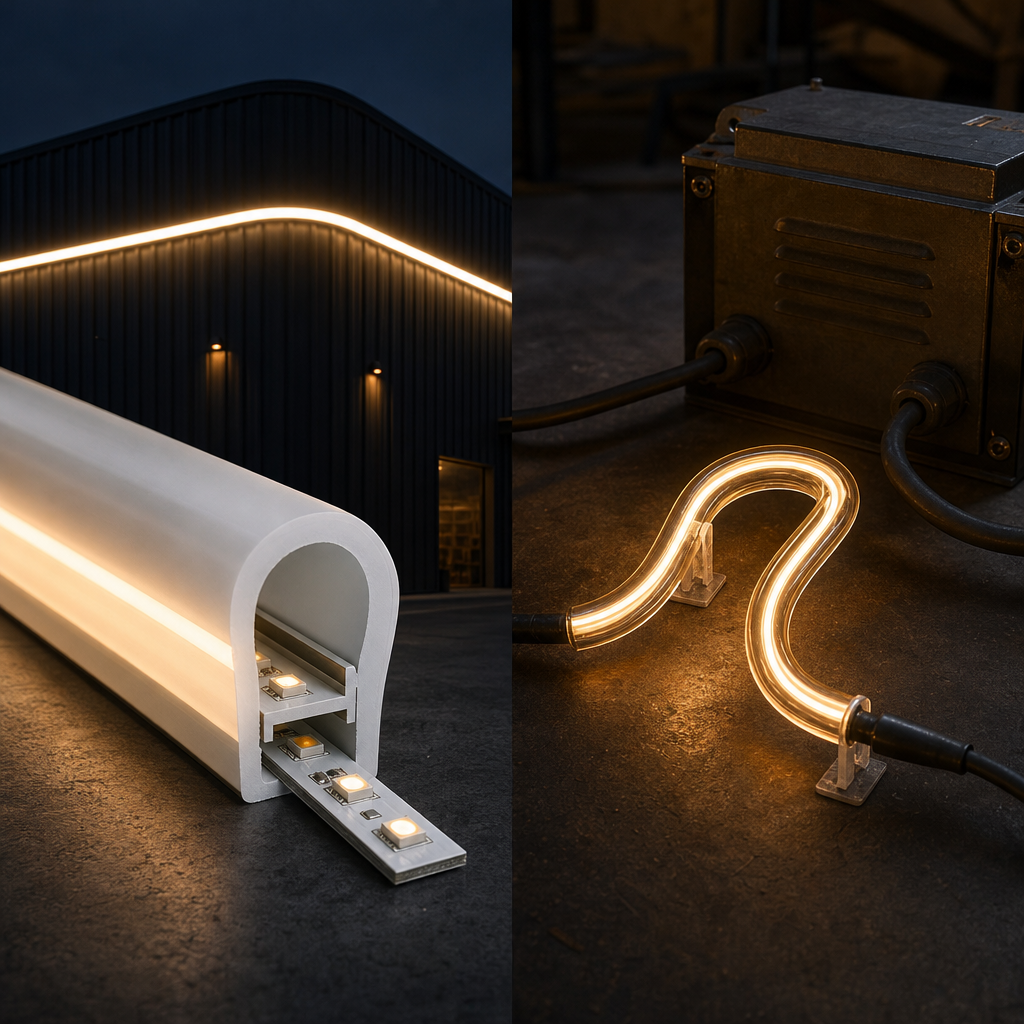 LED neon flex is a flexible LED strip inside a silicone or PVC sleeve, bent to shape. Compared with glass neon it runs cooler, uses less power, resists knocks and operates on low voltage. That is why most modern cafés, bars and boutiques now specify it for new signs.
Glass neon is a hand-bent glass tube filled with gas and driven by a high-voltage transformer. It has a distinctive look and a loyal following. LED neon flex imitates that continuous glow using a diffused LED strip, and the best products are very hard to tell apart at normal viewing distance.
| Factor | LED neon flex | Traditional glass neon |
|---|---|---|
| Energy use | Considerably lower | Higher, with a high-voltage transformer |
| Heat | Runs cool to the touch | Tubes and transformer run warm |
| Durability | Flexible sleeve, resists knocks | Fragile glass, can crack in transit or handling |
| Safety | Low-voltage strip | High-voltage supply |
| Shape flexibility | Bends to a set minimum radius | Very fine detail possible by hand |
| Look | Even, smooth glow | Classic gas-discharge glow |
Lifespan and energy use: what we can and cannot say
Manufacturers rate LED neon in tens of thousands of hours. For a venue that lights its sign only in the evening, that is many years of service. The exact rating varies with LED quality, driver quality and operating temperature, so we have not quoted a single figure here. Ask your supplier for the rated hours on the product data sheet, and ask what the rating assumes about brightness and temperature.
The same applies to energy savings. LED neon draws considerably less power than a glass neon of similar size, but the exact saving depends on the products being compared. Request wattage figures for the specific sign being quoted, and you can work out your own running cost from your electricity tariff.
Why most Noosa venues choose LED
Three reasons come up again and again. First, LED neon is far more forgiving to transport and install, which matters for fit-outs on tight schedules. Second, the low-voltage strip is safer around guests, staff and children. Third, the sleeve can be specified for outdoor conditions. That last point is the one that matters most on the coast. This guide focuses on LED neon flex, and where we mention a feature, it is a feature of LED neon flex products in general.
Where Neon Works Best in a Coastal Venue
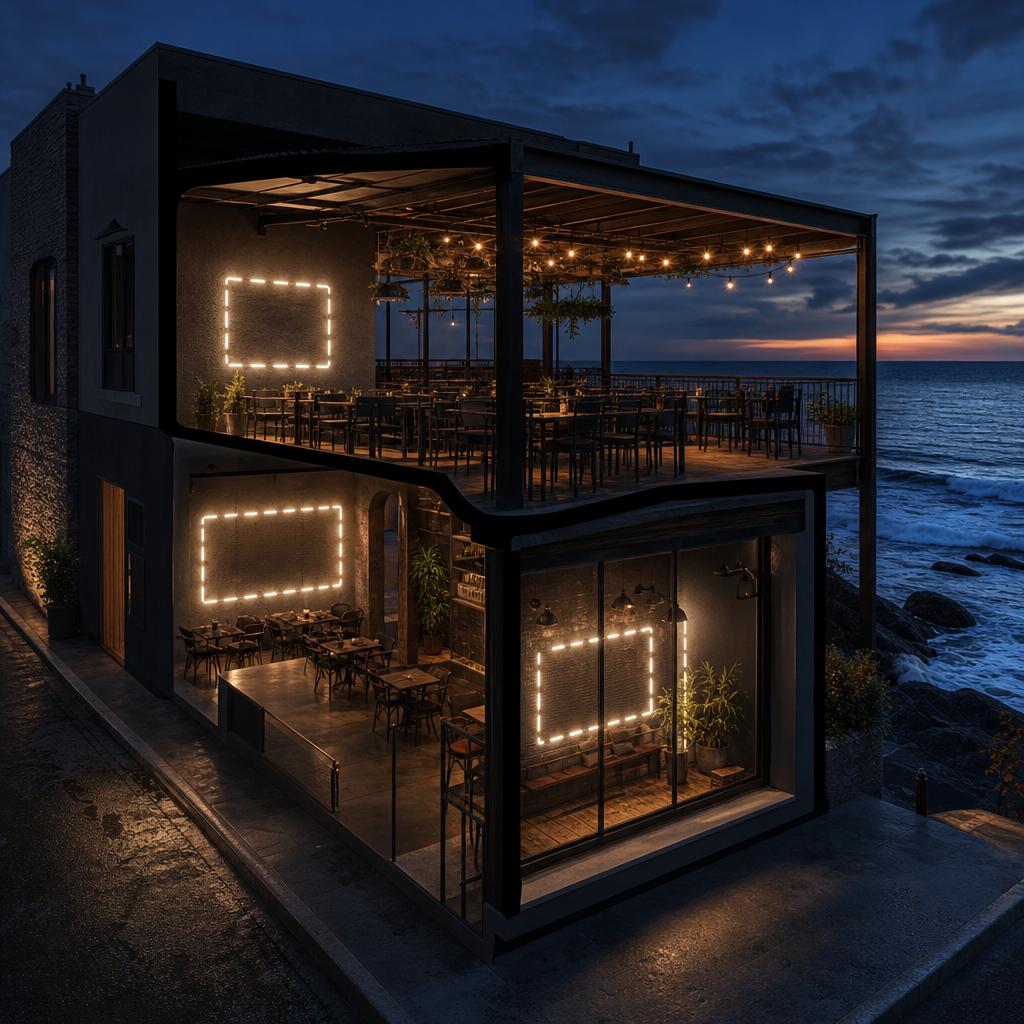 Neon works best where it is seen up close and sheltered: indoor feature walls behind the counter, inside window displays facing the street, and covered alfresco areas. These spots give you the photo and the street presence without exposing the sign to direct rain, spray and afternoon sun.
Indoor feature walls
This is the lowest-risk, highest-return placement. Behind a bar, above a banquette or beside a boutique's fitting rooms, the sign is out of the weather and in the guest's line of sight. You can choose a slimmer, more delicate design because it does not need to survive hose-downs or wind.
Window displays
A neon hung just inside the glass reaches the street while staying protected by the window. A few things to plan for. Daytime glare can wash out a lit sign, so a dimmer or controller helps. Reflections can double the glow at night, which looks good but needs checking in the mock-up. And in full sun, the sign will sit behind glass that heats up, so ask your supplier about operating temperature limits.
Sheltered alfresco areas
Covered terraces and verandahs are where Noosa venues often want neon, and where specification matters most. Under a solid roof and away from the open edge, a properly rated sign can work well. On an open edge facing the prevailing sea breeze, salt-laden air will reach it. In that case, treat the position as outdoor and specify accordingly (see the next section).
An illustrative example
This is a hypothetical example, not a client case study. Imagine a Noosaville café on Gympie Terrace that does strong trade at breakfast and lunch but sees little foot traffic after 4pm. The owner adds a window neon of the café's logo and the word "Open", on a dimmer, and extends trading into the early evening for riverside walkers.
The sign does three things. It signals the café is open when daylight fades. It gives the café a recognisable mark for evening passers-by. And it provides a backdrop for guests who photograph their coffee and dessert. To judge whether it works, the owner would compare after-dark walk-ins for a set period before and after installation, rather than relying on a feeling. That is the discipline we recommend for any neon investment.
Indoor vs Outdoor Neon on the Coast: How to Specify for Salt and Humidity
For coastal outdoor use, specify an IP65 or IP67 rated sign with UV-stable silicone, sealed connections and a power supply kept dry indoors or in a weatherproof enclosure. Place it under cover, out of direct rain and spray. Salt air and humidity attack connections and fixings long before they affect the LEDs.
Understanding IP65 and IP67
IP ratings come from the international standard IEC 60529. The first digit covers solids and the second covers water. Both IP65 and IP67 are dust-tight. IP65 means the enclosure is protected against water jets. IP67 means it is protected against temporary immersion in water.
In practice, IP65 is often adequate for a sign under a solid awning or verandah. IP67 is the safer specification for positions that get driven rain, spray or regular washdowns, such as an open terrace near the beach. Remember the rating applies to the product as tested. It does not cover the joins you make on site, which is why the next two points matter.
UV-stable silicone
Queensland sun is relentless. Cheaper sleeves can yellow, stiffen and crack over time, which lets moisture in and dulls the glow. Ask the supplier whether the sleeve is UV-stable silicone, and whether the white or coloured finish is rated for outdoor use. If the answer is vague, treat the product as indoor only.
Sealed connections and power
Most coastal failures happen at the joins, not along the strip. Look for end caps that are sealed and bonded, cable entry points sealed with appropriate glands or heat-shrink, and drip loops so water runs away from connections. Keep the power supply dry. Mount it indoors or in a weatherproof enclosure out of the weather. Use marine-grade stainless fixings, such as 316 stainless, to resist corrosion, and avoid mixing metals that corrode each other.
Backing boards: acrylic, cut-to-shape or rectangular
The backing board holds the neon in shape and mounts it to the wall. Clear acrylic is the most common choice because it keeps the sign light and lets the wall show through. Two main formats suit different venues:
- Cut-to-shape: The acrylic follows the outline of the design. It gives a floating, clean look and less surface area to collect salt film and dust. It suits simple logos and script wording.
- Rectangular: A rectangular panel is simpler to mount, hides wiring neatly behind the sign and is more robust to handle. It suits complex designs, multi-line wording or walls with uneven texture.
For coastal use, ask for outdoor-grade, UV-stable acrylic. Precision cutting matters for cut-to-shape boards, and our related guide on acrylic laser cutting for signage covers how that works.
Designing a Custom Neon Sign
A strong custom neon starts with a simple, legible design: a font with consistent stroke width, a colour that reads against your wall, a size matched to viewing distance, and a dimmer to tune the glow. Complex logos usually need simplifying into continuous lines so the neon can follow them.
Choosing a font
Neon follows a single continuous line, so fonts with uniform stroke width work best. Script fonts are popular on the coast because they feel relaxed and handmade. Avoid fonts with very tight curves, thin hairlines or tiny counters (the enclosed parts of letters like a, e and o), because the tubing has a minimum bend radius and will not resolve fine detail.
Colour and colour temperature
White neon comes in warm and cool tones. Warm white reads cosy and suits cafés, wine bars and boutiques. Cool white reads crisp and modern, and suits some salons and retail. Coloured neon looks different on camera than to the eye, so ask for a mock-up photographed or rendered on your actual wall. Also check how the sign looks when it is switched off. In a window, it will be a coloured tube for most of the day, and that matters as much as the lit look.
Sizing for viewing distance
The farther the viewer, the larger and simpler the sign needs to be. A feature wall seen from a few metres can carry more detail than a window sign read from across the street. The best method is to mock the sign up at scale on a photo of your wall or window, and view it from where your guests will actually stand.
Dimmers and controllers
A dimmer lets you lower the brightness in a dim room, where full output can look harsh, and raise it when ambient light is high. Controllers can add flashing or colour effects, but restraint usually looks better in Noosa's relaxed setting. Ask what drivers are compatible with the dimmer you choose, as not every combination works smoothly.
Logo complexity
If your logo has gradients, fine lines or intricate icons, plan to simplify. A good neon version keeps what makes the logo recognisable and drops the rest. Sometimes the answer is to neon only the wordmark or only the icon, and keep the full logo elsewhere. A mock-up before you commit will show you what the simplified version looks like.
Council and Compliance Basics for Neon in Noosa
Check Noosa Council's Noosa Plan before installing any illuminated or externally visible sign, and use a licensed electrician for hardwired connections. Rules depend on your location, sign type and whether the sign is visible from public space, so confirm before you order rather than after the sign arrives.
Noosa Council and the Noosa Plan
A sign inside your shopfront window can still be "externally visible", and illuminated signs are often treated differently from non-illuminated ones. Hastings Street in particular has a carefully managed streetscape, so do not assume anything. Contact Noosa Council or read the current Noosa Plan to confirm whether your sign needs approval, and keep any written advice. If you lease, check with your landlord or body corporate too, as lease terms and building rules may add their own requirements.
This article is general information, not legal or planning advice. Your situation may differ.
Electrical work
In Queensland, electrical work must be carried out by a licensed electrician. A neon sign typically has a low-voltage strip fed by a power supply, but the mains side of that supply still needs safe, compliant connection. For any hardwired install, such as wiring into a circuit or switchboard, use a licensed electrician who works to the wiring rules (AS/NZS 3000). Do not let a supplier or fit-out contractor skip this step.
Care and Lifespan: Keeping Neon Bright on the Coast
Care is simple: wipe the sign with a soft damp cloth, rinse salt build-up from exposed pieces with fresh water while the power is off, and check seals and fixings each season. Call for servicing if you see flicker, dead sections, moisture inside the sleeve or corroded fittings.
Cleaning
Switch the sign off at the wall first. Use a soft, damp, lint-free cloth. Avoid solvents, abrasive pads and pressure washers, which can scratch acrylic and force water past seals. For acrylic backing, use a cleaner that is suitable for acrylic, as some glass cleaners can craze the surface.
Protecting against salt build-up
Salt film is invisible at first, then dulls the glow and attacks metal. For signs in exposed spots, rinse with fresh water on a regular schedule, and more often after storms or strong onshore winds. Look at fixings, brackets and cable entries each time you clean. Early corrosion is easy to fix, but late corrosion usually means replacement.
When to call for servicing
Do not wait for a total failure. Call for service when you see:
- flickering or sections that do not light
- condensation or moisture inside the sleeve
- discolouration or cracking in the silicone
- rust or white crusting on fixings and connectors
- a power supply that buzzes, runs hot or has water around it
For a broader approach to looking after lit signage, see our illuminated sign maintenance guidance.
Design for the Seat, Not the Street
My view is that most Noosa owners place neon in the wrong spot first. They ask where the most passers-by will see it, and the answer is usually the street-facing facade, which is also the most exposed position on the coast. I think the better question is: where will a guest be sitting or standing when they take the photo?
Noosa's trade leans heavily on visitors who find venues through maps, social posts and friends' photos. For those guests, the sign that matters most is the one in the frame of the picture, and that is usually inside, above the table or behind the bar. An indoor neon is cheaper to specify, as it does not need the highest weather rating, it avoids the salt-air risk almost entirely, and it can carry more delicate detail.
The street-facing window neon still earns its place, mainly for after-dark visibility. But I would put the feature wall first, and add the window piece second. This is an opinion drawn from how coastal conditions treat electrical products and how guests use their phones, not a measured result, so test it against your own venue. If you can only afford one sign this year, put it where the camera and the seat are.
Send Us Your Logo for a Custom Neon Mock-Up
If you run a business in Noosa and want a custom neon, the fastest way to start is to send Sunquest Signs your logo or wording. We will prepare a neon mock-up and a quote, covering indoor or outdoor use. To get the most accurate quote, include:
- your logo file or the exact wording
- a photo of the wall or window, and where guests will view it from
- whether the sign will be indoors, in a sheltered alfresco area or fully outdoors
- any size, colour or dimming preferences
Visit sunquest.com.au to get in touch.
References
- International Electrotechnical Commission. IP Ratings (IEC 60529, Degrees of protection provided by enclosures). https://www.iec.ch/ip-ratings
- Noosa Council. Noosa Plan and planning information. https://www.noosa.qld.gov.au/
- WorkSafe Queensland, Electrical Safety Office. Electrical licensing and safety information. https://www.worksafe.qld.gov.au/
- Standards Australia. AS/NZS 3000, Electrical installations (Wiring Rules). https://www.standards.org.au/
Talk to a signage expert
Tell us about your project and we'll come back with options and honest advice.
Get in TouchFrequently Asked Questions
How much do custom neon signs cost in Noosa?
Cost depends on size, design complexity, colour, backing board, outdoor rating and installation needs. A small indoor wording sign sits at the simpler end, while a large outdoor logo with a cut-to-shape backing and hardwired power sits at the other. The most reliable way to get a price is to send your logo or wording for a custom quote.
Do I need council approval for a neon sign in Noosa?
Possibly. Illuminated or externally visible signs may be regulated under the Noosa Plan, even if the sign is inside your window. Check with Noosa Council before ordering, and confirm any lease or body corporate rules. Hardwired installs also need a licensed electrician.
Is LED neon as good as glass neon?
For most hospitality and retail uses, yes. LED neon flex runs cooler, uses less power, resists knocks and operates at low voltage. Glass neon has a distinctive look that some owners prefer, but it is more fragile and uses a high-voltage supply. LED suits most Noosa venues.
Can neon signs be used outdoors near the beach?
Yes, if specified correctly. Choose an IP65 or IP67 rated product with UV-stable silicone, sealed connections, marine-grade fixings and a dry power supply, and place it under cover where possible. Direct exposure to rain, spray and sun shortens the life of any neon, so shelter helps.
How long do LED neon signs last?
Manufacturers typically rate LED neon in tens of thousands of hours, which can mean many years for a sign lit only in the evening. Actual life depends on product quality, operating temperature, power supply quality and how well the sign is protected from salt and moisture. Ask for the rated hours on the data sheet.
Will a neon sign show up in a shopfront window during the day?
It will be visible, but less striking in strong daylight, and it will look like a coloured tube when switched off. A dimmer helps tune the glow, and a mock-up on a photo of your window will show how it looks at different times of day.
Related Articles
Neon Signs in Caloundra: Custom LED Neon for Shopfronts, Cafés and Venues
Sunshine Coast Signage Project Gallery: Real Local Sign Installs by Suburb and Sign Type
Window Decals and Graphics for Sunshine Coast Shopfronts: Types, Coastal Materials, Rules and Costs
Signs that set you apart
Over 40 years on the Sunshine Coast. Design, compliance, manufacture and installation handled end to end.
Get a Free Quote