Laser Cutting in Hervey Bay: Custom Cut Signs, Letters and Panels for Fraser Coast Businesses
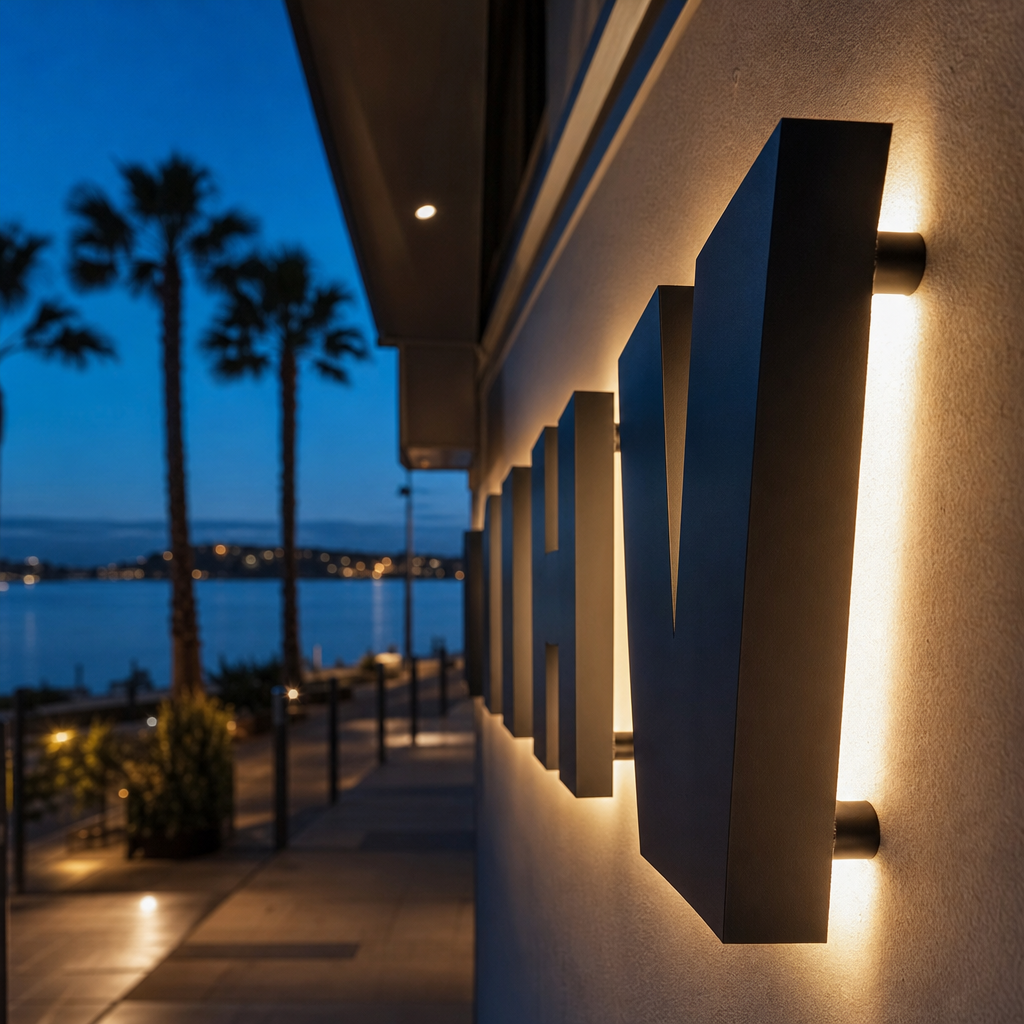
Laser cutting in Hervey Bay delivers precise, clean-edged signage cut from acrylic, aluminium, aluminium composite and stainless steel, suited to the salt air along the Esplanade and Urangan marina. Sunquest Signs fabricates on the Sunshine Coast and freights or installs across the Fraser Coast, with tight tolerances, fast proofing and finishes built to resist coastal corrosion.
Hervey Bay runs on tourism trade, marine operators and a solid base of trades and light industrial business in Torquay and Eli Waters. Every one of those businesses needs signage that looks sharp from day one and still looks sharp after a few wet seasons of salt-laden air off Platypus Bay. That is a tougher brief than it sounds, and it is exactly where laser cutting earns its keep over hand-cut alternatives.
This guide covers what laser cutting actually does well, which materials suit which job, how to spec signage so it survives a coastal climate, and what the process looks like from a rough sketch to an installed sign on a Pialba shopfront or an Urangan boat shed. We also cover pricing drivers and realistic lead times, because "it depends" is not an answer a business owner can plan around.
Key Takeaways
- Laser cutting produces cleaner edges and tighter internal detail than hand fabrication, which matters for lettering, logos and decorative screens.
- Acrylic, aluminium, aluminium composite (ACM) and stainless steel are the main laser cut materials for Hervey Bay signage; timber and MDF suit interior fit-outs.
- Salt air off Hervey Bay and Platypus Bay is the real durability test. Fixing choice, finish and mounting method matter as much as the material itself.
- Stand-off mounting keeps moisture from sitting behind a letter, which is the single biggest factor in coastal sign longevity.
- Sunquest Signs operates from the Sunshine Coast and regularly freights and installs laser cut signage across the Fraser Coast, including Hervey Bay, Urangan, Pialba and Torquay.
- Lead times and pricing depend on material thickness, total cut length, finishing and quantity, not just the size of the sign.
Ready to make your business impossible to miss?
Design, manufacture and installation, all under one roof in Warana.
Get a Free QuoteAt a Glance: Laser Cutting Materials for Hervey Bay
| Material | Best For | Coastal Performance | Typical Use in Hervey Bay |
|---|---|---|---|
| Acrylic | Fine detail, backlit letters, indoor and sheltered outdoor | Good when UV-stabilised grade is used; avoid direct marine spray zones | Shop fascia lettering, illuminated letter faces, reception signage |
| Aluminium (sheet) | Durable flat panels, fascia lettering, directory signs | Strong, especially powder coated, light but rigid | Exterior wayfinding, trade signage, trailer plates |
| Aluminium composite (ACM) | Large panels, feature cladding, directory boards | Very good; lightweight and corrosion-resistant | Directory panels, decorative screens, large fascia panels |
| Stainless steel | Premium fascia letters, architectural detail | Excellent, especially marine-grade finishes | Marina signage, premium shopfronts, architectural lettering |
| Timber / MDF | Interior signage, feature walls, decorative screens | Poor outdoors; interior use only | Office and reception signage, interior directory panels |
What Laser Cutting Actually Is, and Why Hervey Bay Buyers Choose It
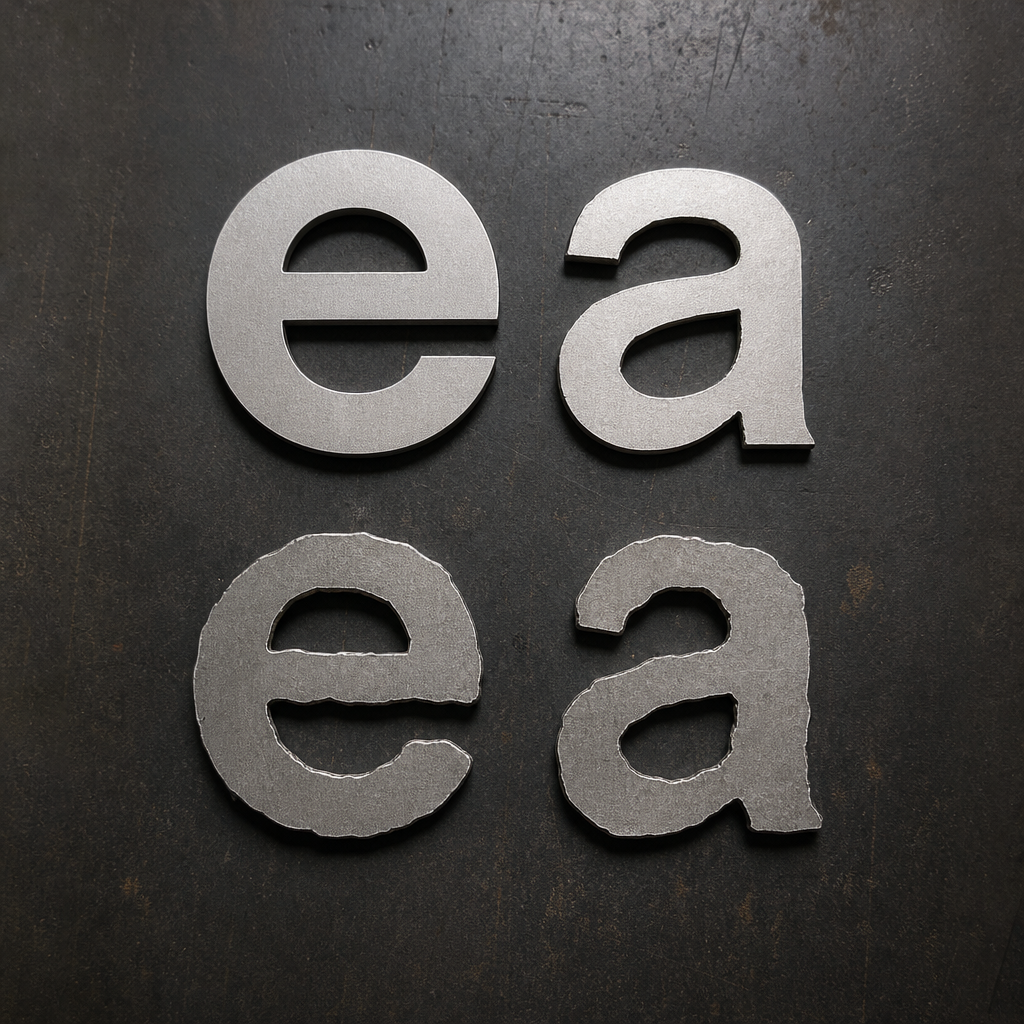 Laser cutting uses a focused beam to cut a material along a programmed path, producing clean edges and repeatable detail that hand tools cannot reliably match. For Hervey Bay businesses, that means sharper lettering, tighter internal corners and consistent results across a whole set of letters or panels.
Hand-cut or jigsaw-fabricated signage has its place, but it struggles with fine internal detail. Think of a logo with a thin letterform like an "e" or an "a", where the enclosed space needs to stay crisp and even. A laser follows the vector path exactly, every time, so the tenth letter in a set looks identical to the first.
This matters more than it might seem for a tourism-facing business on the Esplanade. Whale watching operators, cafes and retail strips in Urangan and Pialba are competing for a visitor's attention in a glance. Clean, sharp lettering reads as professional. Slightly uneven, hand-finished edges read as amateur, even if the underlying business is excellent.
Laser cutting also handles small production runs efficiently. A single set of fascia letters, a short run of directory panels, or a one-off decorative screen can all be cut from the same programmed file without the tooling costs associated with other cutting methods. That is a genuine advantage for Fraser Coast businesses that need one good sign rather than a thousand identical units.
Materials and Thicknesses: Matching the Cut to the Job
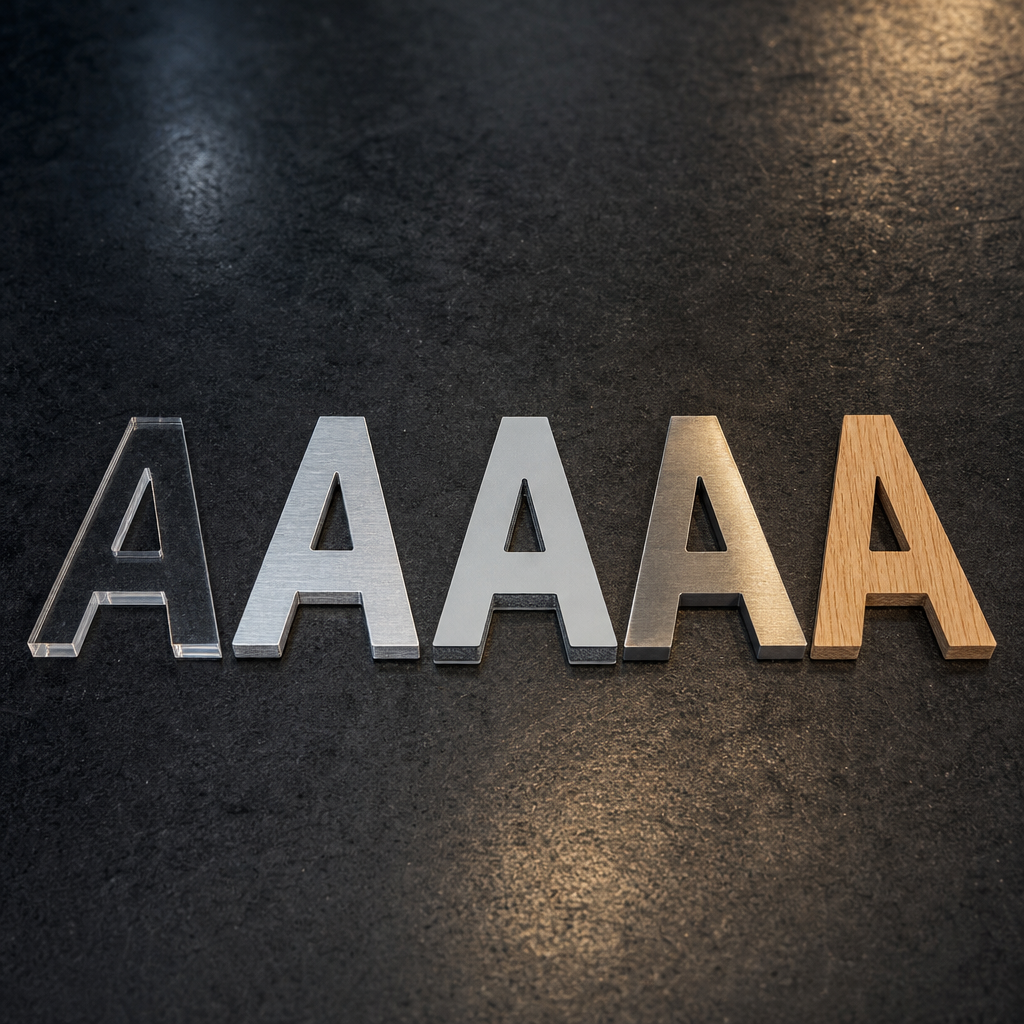 Acrylic, aluminium, aluminium composite and stainless steel each suit different jobs, and the right choice depends on exposure, budget and finish. Interior work often suits timber or MDF instead. Sunquest Signs offers both laser cutting and CNC routing, and the better tool depends on material and thickness, not personal preference.
Acrylic is the go-to for illuminated letters, backlit signage and detailed logos where light needs to pass through or around the material. It cuts with a polished edge straight off the laser, which saves a finishing step. Acrylic performs well in sheltered positions but should be specified in a UV-stabilised grade for anything facing direct Hervey Bay sun and weather.
Aluminium sheet is the workhorse for exterior fascia lettering and directory signage. It is light enough to mount with standard fixings, strong enough to hold its shape over a wide letter run, and takes a powder coat finish well. For Torquay and Eli Waters trade and light industrial signage, aluminium is usually the first material we spec.
Aluminium composite panel (ACM) is two thin aluminium skins bonded to a polymer core. It is the right call for larger panels, feature cladding and directory boards where a solid aluminium sheet would be heavier and more expensive than the job needs.
Stainless steel is the premium option for architectural lettering and marina-facing signage where a brushed or mirror finish needs to hold up against constant salt exposure. It costs more than aluminium, but for a premium Esplanade shopfront or a marina operator's branding, the finish and longevity often justify it.
Timber and MDF cut cleanly on a laser and suit interior signage, feature walls and reception displays. They are not a coastal exterior material. If a job calls for thicker timber, deeper relief cuts, or routed edge profiles rather than through-cuts, CNC routing for acrylic and timber is usually the better tool than laser cutting, and we will say so rather than force the wrong process onto a job.
Tolerances follow the same logic as our CNC cutting tolerances and material capabilities work: thinner acrylic and aluminium hold tighter tolerances with finer detail, while thicker stainless and ACM need slightly more allowance around very fine internal shapes. We size the file and the cut path to the material, not the other way around.
Coastal Durability: Why Salt Air Changes the Spec
Salt-laden air off Hervey Bay and Platypus Bay accelerates corrosion on exposed metal fixings and traps moisture behind flush-mounted letters. The fix is a combination of material choice, finish, fixing hardware and mounting method, not any single factor on its own.
This is the real buying trigger for Fraser Coast businesses, and it is worth being specific about why. A marine environment carries fine salt particles that settle on any exposed surface. Over time, those particles draw moisture and accelerate corrosion on untreated or poorly finished metal. Standards Australia's guide to protecting metals from atmospheric corrosion (AS/NZS 2312.1) is the reference point the sign and coatings industry uses for specifying protective finishes in exactly these conditions.
Three decisions matter most for a Hervey Bay installation:
Powder coating over raw metal. A quality powder coat finish on aluminium creates a barrier against moisture and salt. Raw or mill-finish aluminium will oxidise faster, and untreated mild steel has no place in an exterior coastal sign at all.
Stainless fixings, not mixed metals. Mounting aluminium letters with mild steel screws sets up a corrosion reaction at the contact point. Stainless fasteners cost a little more and avoid this entirely.
Stand-off mounting over flush mounting. This is the detail most hand-fabricated signage gets wrong. Mounting a letter flush against a wall traps moisture behind it with nowhere to drain or evaporate. Stand-off mounting, where the letter sits on spacers a few millimetres proud of the wall, lets air circulate behind the letter and lets any moisture drain away instead of sitting against the fixing and the wall surface. For anything within a few hundred metres of the water in Urangan, Scarness or along the Esplanade, we treat stand-off mounting as the default, not an upgrade.
Common Hervey Bay Applications
Laser cut signage shows up across Hervey Bay in shopfront fascia lettering, reception and office signage, directory panels, decorative screens, vehicle plates and as cut elements within illuminated signs. Each application has a slightly different material and finishing brief.
Shop front fascia lettering for Esplanade cafes, Pialba retail and Urangan tourism operators is the most common job. Aluminium or ACM letters, powder coated to match a brand colour, mounted on stand-offs, is the standard specification for anything facing weather.
Reception and office signage for Fraser Coast businesses, from real estate offices to marine service operators, usually works well in acrylic. Interior signage does not face the same salt exposure, so acrylic's clean finish and backlighting options make it the practical choice.
Directory and wayfinding panels for retail strips, business parks and marina precincts need to survive weather while staying legible from a distance. ACM or aluminium with high-contrast vinyl or engraved detail handles this well.
Decorative screens are an underused option for Hervey Bay hospitality and retail fit-outs. Laser cut patterns in aluminium or acrylic create a feature wall, privacy screen or outdoor dining divider with a level of detail that would be slow and expensive to achieve by hand.
Vehicle and trailer-mounted plates for trades and marine operators in Torquay and Eli Waters need to survive being on the road and on the water. Aluminium with a protective laminate or powder coat is the standard here.
Illuminated signage often uses laser cut acrylic or aluminium face letters combined with LED illumination. The laser cutting provides the clean letterform; the sign maker then builds the lit element around it. Businesses looking at illuminated signs for a Hervey Bay storefront should plan the laser cut component and the lighting build as one job, not two separate quotes, since the fixing and depth requirements need to match.
From Artwork to Install: What the Process Actually Looks Like
A laser cut signage job runs from vector artwork through proofing, cutting, finishing and freight or install, usually inside a few weeks depending on material and finish. Getting the file right at the start is what keeps that timeline tight.
File formats. We work from vector outlines, typically supplied as AI, EPS, PDF or SVG. A logo supplied as a flattened JPEG or PNG needs to be redrawn as vector artwork before it can be cut, which adds a step and a cost. If a Hervey Bay business only has an old raster logo or a hand sketch, that is fine, we can redraw it, but supplying vector artwork up front speeds things up.
Minimum stroke widths. Very fine letterforms or script fonts have a practical minimum width before a cut becomes structurally weak or distorts during handling. As a general guide, thin acrylic and aluminium hold finer detail than thicker stainless or ACM, which need slightly heavier minimum strokes to stay rigid once cut free. We flag this at the proofing stage rather than after cutting.
Kerf and tolerance. The laser removes a small amount of material along the cut line, known as kerf. On signage-scale work this is a minor factor, but it matters for parts that need to interlock or sit flush against each other, such as layered letters or panel inlays. We account for kerf in the file before cutting, consistent with the tolerance ranges we quote for CNC cutting tolerances and material capabilities on thicker material.
Proofing. Every job gets a proof showing layout, dimensions and material before cutting starts. For multi-letter fascia sets, we also confirm spacing and mounting points against the actual shopfront dimensions, not just the artwork file.
Lead times. Simple acrylic or aluminium letter sets typically move faster than powder coated stainless or large ACM panels, since coating and curing add their own schedule. Busy periods around peak tourist season can extend turnaround, so Hervey Bay businesses planning a launch or refit should get artwork in early rather than at the last minute.
Freight and install. Sunquest Signs is based on the Sunshine Coast and regularly freights laser cut signage to the Fraser Coast, with install arranged for larger fascia and wayfinding jobs. Smaller panels and letter sets can often be self-installed with the fixing hardware and instructions supplied.
What It Costs and What Drives Price
Laser cut signage pricing is driven by material type and thickness, total cut length and complexity, finishing, and quantity, not by sign size alone. A small, highly detailed logo can cost more to cut than a large, simple panel.
Material and thickness set the baseline. Acrylic is generally the most economical option for detailed letterforms. Aluminium and ACM sit in the middle. Stainless steel carries the highest material cost and is usually reserved for premium or architectural applications.
Cut length and complexity matter more than overall dimensions. A letter set with lots of internal detail, such as a script font or an intricate logo, has a longer total cut path than a simple block letter of the same size, which affects machine time.
Finishing adds cost but also adds longevity. Powder coating, polishing, laminating or vinyl application are separate steps after cutting, and for coastal Hervey Bay installs, this is rarely the place to cut corners given the salt air durability question covered above.
Quantity brings the per-unit cost down. A single sign carries the full setup cost on its own. A run of identical directory panels or a full set of shop front letters spreads that setup cost across more units.
The honest advice: get a quote against an actual brief rather than trying to estimate from a square metre rate. Material choice and finish swing the price more than size does.
The Spec Mistake We See Most on the Fraser Coast
The most common spec error we see on Fraser Coast signage enquiries is businesses over-speccing the material and under-speccing the fixing and mounting method. A premium material with the wrong fixing will fail faster near the water than a mid-range material mounted correctly.
Consider a hypothetical shopfront on the Esplanade choosing stainless steel letters because "stainless doesn't rust", then having them flush-mounted with standard galvanised screws. The letters themselves will hold up fine. The fixings and the trapped moisture behind the letter will not. Within a couple of years, streaking and corrosion around the fixing points will look worse than a well-finished aluminium letter mounted on stand-offs with stainless fasteners from day one.
Our view at Sunquest Signs is that fixing and mounting method deserve at least as much attention in a Hervey Bay quote as the headline material. It is also where a quote that looks cheaper on paper can end up costing more over the life of the sign, because a flush-mounted sign with the wrong fasteners usually needs remedial work well before a correctly specified one does. When we quote for Hervey Bay, Urangan or Torquay, we ask about exposure and distance from the water before we lock in a material, because that answer changes the fixing recommendation more than it changes the material recommendation.
References
- Standards Australia, AS/NZS 2312.1:2014, Guide to the protection of structural steel and other metals from atmospheric corrosion: use of protective coatings
- Bureau of Meteorology, www.bom.gov.au, climate data for Hervey Bay and the Fraser Coast region
- Fraser Coast Regional Council, www.frasercoast.qld.gov.au
- Geoscience Australia, www.ga.gov.au, coastal processes and environment information
Ready to get a laser cut signage quote for your Hervey Bay or Fraser Coast business? Send through your artwork, logo file or even a rough sketch and we will come back with material options, a realistic lead time and a price. Get in touch with Sunquest Signs to request a quote for custom laser cut letters, panels or signage built for coastal conditions.
Talk to a signage expert
Tell us about your project and we'll come back with options and honest advice.
Get in TouchFrequently Asked Questions
Does Sunquest Signs service Hervey Bay and the wider Fraser Coast from the Sunshine Coast?
Yes. Sunquest Signs is based on the Sunshine Coast and regularly freights laser cut signage to Hervey Bay, Urangan, Pialba, Torquay and Eli Waters, with install available for larger fascia, directory and wayfinding jobs.
What material lasts longest in Hervey Bay's salt air?
Powder coated aluminium and marine-grade stainless steel perform best in direct coastal exposure, but the mounting method, particularly stand-off mounting and stainless fixings, matters as much as the material choice itself.
Can you laser cut letters for shop fascia and illuminated signage?
Yes. Laser cut acrylic and aluminium letters are commonly used as the face element for illuminated signs, with the laser providing the clean letterform and an LED build completing the lit sign.
What's a realistic lead time for laser cut signage to Hervey Bay?
Simple acrylic or aluminium letter sets generally move faster than powder coated stainless or large ACM panels, since coating and curing add their own schedule. Peak tourist season can extend turnaround, so earlier artwork submission helps.
Do you cut stainless steel and aluminium, or just acrylic?
Sunquest Signs laser cuts acrylic, aluminium, aluminium composite and stainless steel, and also offers CNC routing for thicker timber, MDF and acrylic where routing is the better tool for the job.
How much does laser cut signage cost?
Price is driven by material type and thickness, total cut length and complexity, finishing and quantity, not sign size alone. The most accurate way to get a figure is a quote against an actual brief or artwork file.
Related Articles
Custom Laser-Cut Signage Components: Letters, Faces, Panels and Fixings Explained
Laser Cutting in Maroochydore: Custom Cut Signs, Letters and Panels for Local Trade
CNC Cutting Tolerances and Material Capabilities: What Signage Buyers Should Expect
Signs that set you apart
Over 40 years on the Sunshine Coast. Design, compliance, manufacture and installation handled end to end.
Get a Free Quote