
CNC Routing for Aluminium Composite Panels: Cutting, Folding and Finishing ACM Signage
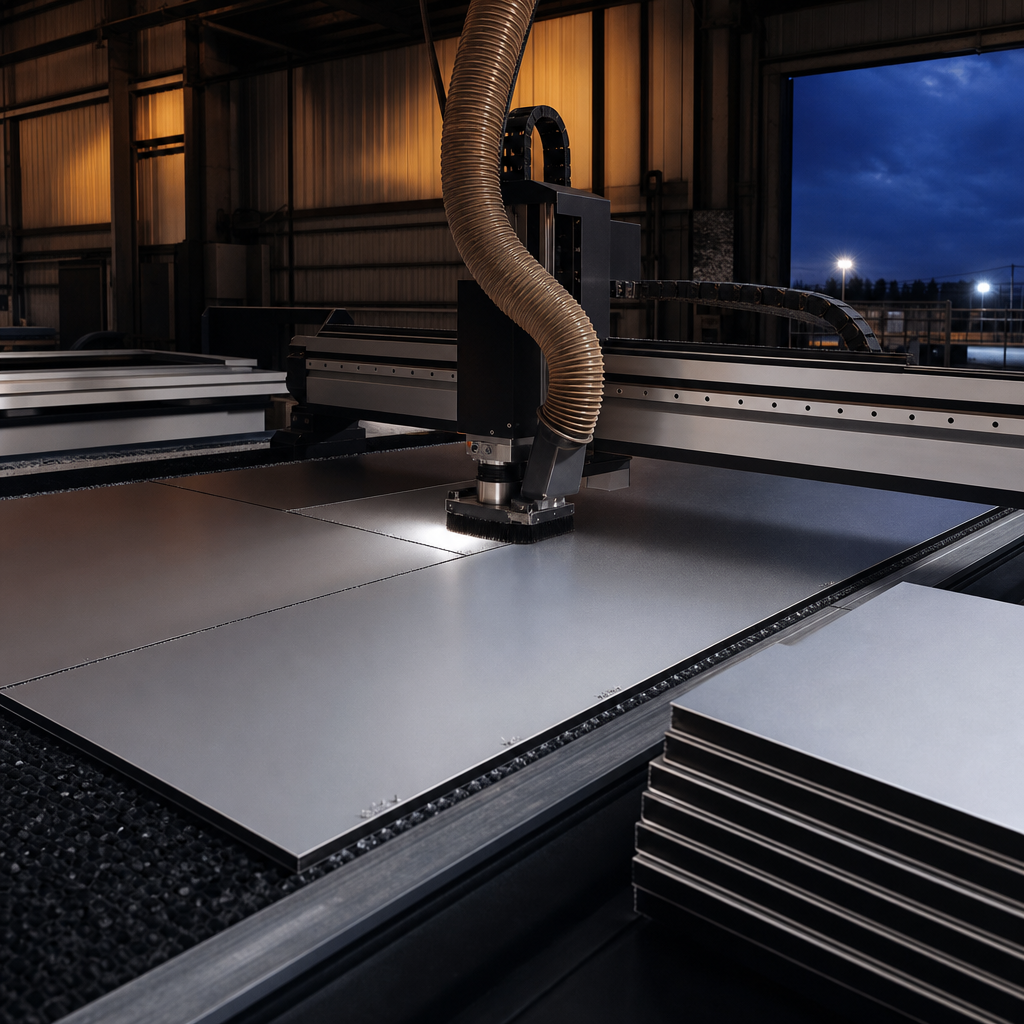
CNC routing for aluminium composite panels (ACM) uses a computer-guided router to cut, groove and drill 3mm or 4mm ACM sheet with sub-millimetre accuracy, producing clean-edged fascia panels, cut-out logos, radiused corners and V-grooved folds that turn a flat sheet into a rigid, tray-formed sign face without heat-forming or welding.
If you're specifying a fascia sign, a pylon face, a hoarding panel or a directory board in Australia, chances are ACM is already on the quote. It's the default substrate for a reason: it's light, flat, weather-stable and, when it's routed properly, it looks sharp for years. The problem is that most buyers never see what happens between the artwork file and the finished panel, so they don't know what to ask for, or what to push back on.
This guide walks through what ACM actually is, why CNC routing is the right tool for cutting and folding it, and where the substrate hits its limits. It's a companion to our guide on CNC routing for acrylic signage, which covers a different material with different behaviour under the router. Here we're staying strictly on metal-faced composite panel, because ACM cuts, grooves and folds nothing like plastic sheet.
Key Takeaways
- ACM is two thin aluminium skins bonded to a polyethylene or mineral (fire-rated) core, most commonly supplied in 3mm and 4mm thicknesses.
- CNC routing holds tighter tolerances than shearing or jigsaw cutting, which is what makes clean logo cut-outs and consistent radiused corners possible.
- A partial-depth V-groove lets a flat ACM sheet fold into a rigid tray without welding, giving fascia and pylon faces a returned edge instead of a raw cut edge.
- Finish options include factory colour coatings, brushed and anodised-look laminates, digital print, cut vinyl overlay and separately applied acrylic or ACM letters.
- ACM is well suited to fascias, pylon and plinth faces, hoardings, wall signage and directory boards, but it's the wrong choice for deep three-dimensional letterforms or load-bearing structural work.
- Fire-rated core selection matters when a sign panel sits close to, or is fixed to, a building's external cladding system.
Ready to make your business impossible to miss?
Design, manufacture and installation, all under one roof in Warana.
Get a Free QuoteSummary Table: ACM Panel Types and Typical Signage Use
| Panel Type | Core | Common Thickness | Typical Signage Use |
|---|---|---|---|
| Standard PE-core ACM | Solid polyethylene | 3mm | Fascia signs, pylon and plinth faces, directory boards |
| Standard PE-core ACM | Solid polyethylene | 4mm | Larger wall signs, hoarding panels, tray-formed fascias |
| Fire-rated (FR) ACM | Mineral-filled core | 4mm | Signage fixed to or adjacent to rated building cladding |
| Anodised-look laminate ACM | Polyethylene | 3mm | Premium fascia and entry signage where a metal finish is wanted without real anodised aluminium cost |
What ACM Actually Is
Aluminium composite panel is two thin aluminium skins bonded either side of a solid core, usually polyethylene or a mineral-filled fire-rated compound. The metal skins give it rigidity and a factory-perfect flat finish that raw sheet aluminium can't match at the same weight.
Standard signage-grade ACM comes in 3mm and 4mm overall thickness. The aluminium skins themselves are typically around 0.2mm to 0.5mm per side, with the core making up the bulk of the panel depth. That skin-and-core structure is what makes ACM behave so differently to solid aluminium or plastic sheet under a router bit: you're cutting through metal, then a soft core, then metal again, in one pass.
Sheet sizes matter more than most buyers expect. The common stock sizes in the Australian market are 1220mm x 2440mm and 1500mm x 3000mm. A pylon face or fascia panel that's designed to nest efficiently within those dimensions avoids joins, offcut waste and extra freight. A shopfitter briefing a 4.2 metre fascia run, for example, needs to know upfront whether that's one panel with a visible join or two panels split at a return, because that decision changes both the routing job and the fixing detail.
Colour and finish are usually baked into the panel at manufacture, via a factory-applied PVDF or polyester coating on the aluminium skin, rather than painted on site. That's part of why ACM holds a flat, consistent colour better than most painted metal signage over the same outdoor lifespan.
Why CNC Routing Suits ACM
CNC routing suits ACM because it cuts through both aluminium skins and the core in a single controlled pass, producing a straight, consistent edge that a guillotine, shear or handheld jigsaw simply can't replicate on curves, cut-outs or small radii. The router follows a digital file exactly, every time, on every panel in a run.
Shearing is fine for straight rectangular blanks. It's fast and cheap for a plain fascia panel with square corners. But the moment a job needs a logo cut-out, a radiused corner, a series of drilled fixing holes on precise centres, or a shape that isn't a straight line, shearing and hand tools fall short. A jigsaw can follow a curve, but the cut edge is rougher, the radius is operator-dependent, and no two panels in a batch will be identical.
A CNC router removes that variability. The same digital file that produced panel one produces panel fifty with the same corner radius and the same hole centres. For directory board systems or a run of identical wayfinding panels across a shopping centre or a council reserve, that repeatability is the entire value proposition. It's also what makes cut-out lettering possible: routing a company name directly through the panel face, backed with an illuminated or contrasting substrate, gives a dimensional look without applying separate letters.
Drilled and countersunk fixing points are routed in the same operation as the outline cut, on the same machine bed, so hole positions line up precisely with the mounting structure behind the panel. That matters on a pylon face where fixing centres have to match a steel frame that was measured and built weeks earlier.
V-Groove Routing and Folding: Turning Flat Sheet into a Tray
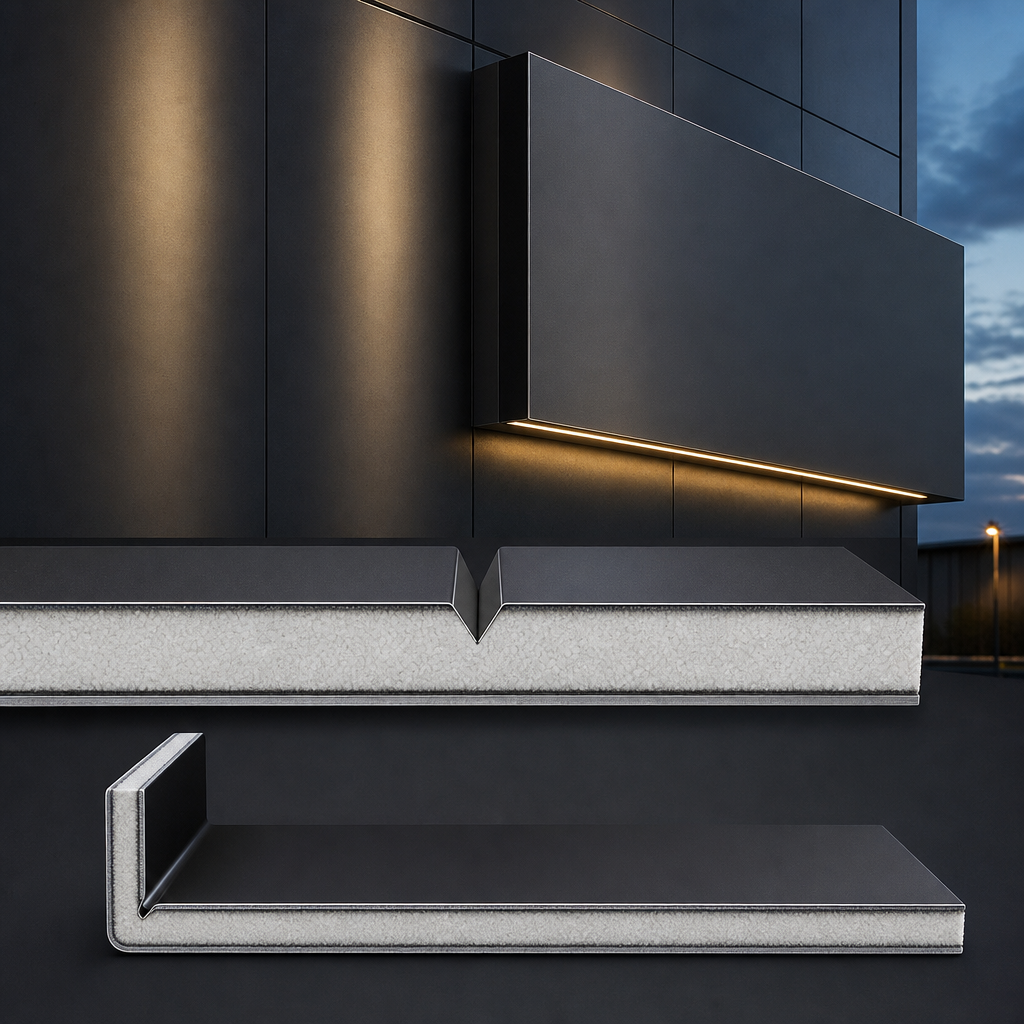
V-groove routing cuts a precise, partial-depth channel through the front aluminium skin and most of the core, leaving the rear skin intact as a hinge. The panel then folds cleanly along that groove line, turning a single flat ACM sheet into a rigid, tray-formed panel with a returned edge instead of a raw cut edge.
This is the technique behind most tray-formed fascia and pylon signage in Australia. Instead of welding separate flat panels and a return edge together, or building a face-and-frame assembly, the fabricator scores four V-grooves into one sheet, folds the edges down, and rivets or bonds the corner joins. The result is a single-piece tray with none of the visible weld lines, filler and grinding that welded aluminium trays need.
The groove depth is critical. Cut too shallow and the fold cracks the rear aluminium skin at the bend line. Cut too deep and the panel loses rigidity or separates before it's even folded. Getting that depth right, consistently, across every groove on every panel, is a machine-and-tooling issue as much as a design one, which is another reason this work sits with CNC routing rather than hand tools.
Tray-formed ACM panels look sharper on shopfronts and pylon faces because the returned edge reads as a solid, finished object rather than a flat sheet screwed to a frame. It also gives the fabricator a closed cavity to run illumination or conduit through, which is useful on internally lit pylon and monument signs.
Finishes and Decoration for ACM Signage
ACM signage can be finished with a factory colour coating straight off the roll, a brushed or anodised-look laminate, full-colour digital print direct to the panel, cut vinyl graphics applied over the coating, or separately fixed acrylic or ACM letters standing off the face. Each option changes how the sign is fabricated and how it ages outdoors.
Factory-coated panels are the lowest-maintenance option because the colour is part of the aluminium skin, applied under controlled conditions before the panel ever reaches the workshop. Brushed and anodised-look laminate finishes give a premium metal appearance at a lower cost than genuine anodised aluminium, and route cleanly because the laminate layer is thin.
Digital print direct to ACM works well for full-colour artwork, photographic imagery or complex branding that would be impractical to reproduce in cut vinyl. It needs a laminate overlay for outdoor durability, and colour accuracy depends on the printer being properly profiled to the panel's coating.
Cut vinyl is still the workhorse for single or two-colour logos and text on a routed panel, because it's fast to apply, cheap to replace if a business rebrands, and doesn't affect the panel's structural routing. Applied lettering, whether acrylic or routed ACM built up off the face, adds genuine depth and shadow that flat print and vinyl can't match, at the cost of extra fixing and installation time.
Where ACM Is the Right Call (and Where It Isn't)
ACM is the right substrate for fascia signs, pylon and plinth faces, hoardings, wall signage and directory boards, because it's flat, light, weather-stable and routs cleanly into precise shapes. It's the wrong substrate for deep three-dimensional letterforms or heavy load-bearing structural elements, where cast, folded aluminium or extruded sections do a better job.
On a fascia, ACM's flatness is the selling point. A shopfront fascia panel needs to read as a perfectly straight, unbroken plane from across the street, and ACM holds that flatness better than thin sheet aluminium, which oil-cans and shows every fixing point. On a pylon or plinth face, the same flatness plus the tray-forming option makes ACM the standard choice across the Australian signage industry.
Hoarding panels benefit from ACM's weight-to-rigidity ratio. A construction hoarding needs to span a reasonable distance between posts without sagging, and needs to survive a building site for months, sometimes years. Coated ACM does that without the weight of solid aluminium or the fire and impact concerns of some plastic sheet options.
Where ACM comes up short is genuine three-dimensional letterforms with real depth and return, the kind used in premium retail fit-outs or corporate reception signage. Those jobs usually call for built-up acrylic letters, cast metal, or fabricated aluminium letters, because ACM's core doesn't hold a machined edge the way solid material does once you're routing deep, narrow forms. It's also not a structural material. ACM shouldn't be specified anywhere it's expected to carry load, such as a freestanding sign face without a proper frame behind it, or a walkway or platform element.
Specifying ACM Well: Thickness, Fire Rating and Coastal Exposure
Specifying ACM correctly means choosing the right thickness for the panel size and fixing method, confirming whether a fire-rated core is required for the location, and accounting for coastal UV and salt exposure if the sign sits anywhere near the Sunshine Coast or another Australian coastline.
Thickness selection is mostly about panel size and support spacing. A small directory board panel supported on a full frame can run at 3mm. A large unsupported fascia span, or a hoarding panel with wide post centres, generally needs 4mm to avoid visible flex or oil-canning under wind load.
Fire rating is a genuine question, not a box-ticking exercise, particularly for signage fixed to or immediately adjacent to a building's external wall cladding. Following high-profile cladding fires in Australia, including the Lacrosse building fire in Melbourne's Docklands in 2014, building regulators tightened scrutiny of aluminium composite panel used in external cladding systems. A sign panel isn't cladding, but where a fascia or wall sign is fixed directly to, or forms part of, a building's external wall assembly, it's worth confirming with the building owner or certifier whether a fire-rated (mineral core) panel is expected under the National Construction Code provisions for that building class. When in doubt, ask before you order, not after installation.
Coastal exposure on the Sunshine Coast and similar environments means UV load and salt-laden air both work on a panel continuously. A quality factory-coated ACM panel with a PVDF-type coating is built to handle that combination, but coating quality varies between manufacturers, and cheaper panels sourced without a clear specification sheet are the ones that chalk, fade or delaminate early. Fixing hardware matters just as much here: stainless steel or coated fixings avoid the corrosion staining that plain steel rivets or screws will eventually bleed down a light-coloured fascia panel.
Artwork and File Prep for CNC-Routed ACM
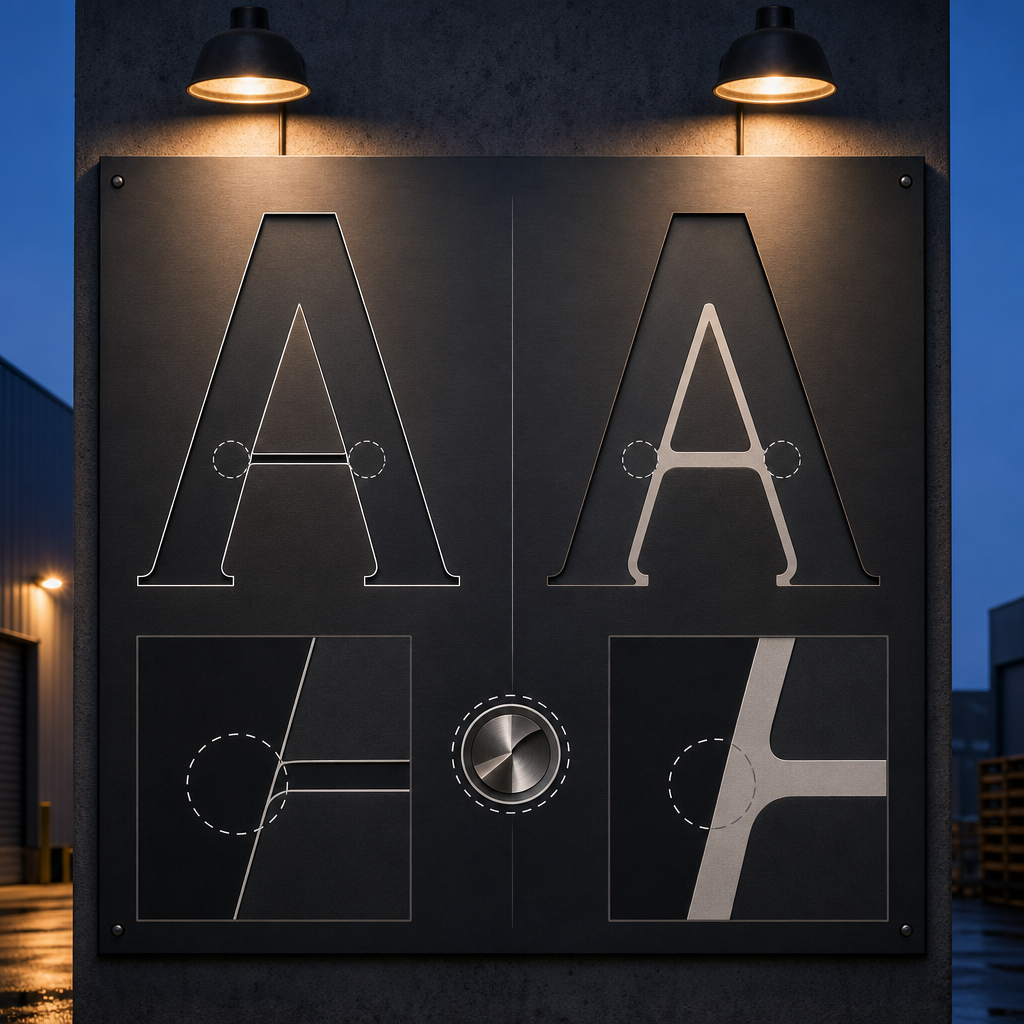
Artwork for CNC-routed ACM needs to be supplied as clean vector outlines, with cut lines, fold lines and drill points on separate, clearly labelled layers, and with tolerances that respect the router bit diameter and the physical limits of the material. Fine detail that looks fine on screen doesn't always survive being cut into metal-faced sheet.
A router bit has a real physical diameter, commonly somewhere between 3mm and 6mm for ACM work, and it can't cut an inside corner sharper than its own radius. Artwork with hairline serifs, tightly kerned letterforms or narrow slot cut-outs needs those details either simplified or opened up before the file goes anywhere near the machine. Bleed and tolerance also need to be built in deliberately: a cut-out logo that's dimensioned to the millimetre with no allowance for kerf will come out slightly undersized once the bit width is accounted for.
Consider a common scenario: a client supplies print-ready artwork for a routed logo panel, with fine internal cut-outs between letterforms only a couple of millimetres wide. On screen, in a PDF, it looks crisp. Fed straight to a router, those narrow aluminium-and-core webs between cut-outs would flex, tear or simply fall away mid-cut, because there's not enough structural material left in the panel to survive the process. The fix is straightforward once it's caught early: thicken the internal webs, merge letterforms where the gap is too fine, or move that specific detail to cut vinyl or digital print layered over a solid routed panel instead of asking the router to cut it. Catching that at the file-prep stage, rather than after a panel has already been run and scrapped, is the difference between a same-week turnaround and a re-cut delay.
Why We'd Rather Slow Down the File Than Rush the Router
The honest, unglamorous truth about CNC-routed ACM is that most of the quality difference between a sharp sign and a mediocre one is decided before the machine ever starts, at the file-prep stage. A router is only as precise as the vector file it's given, and it will faithfully reproduce a mistake at exactly the same tolerance as it reproduces a correct detail.
Our position, and it's a genuinely held one rather than a sales line, is that a fabricator should push back on artwork that's technically too fine for the substrate, even when a client is in a hurry and just wants the job run as supplied. It costs an extra conversation and sometimes a day's delay. It saves a wasted panel, a second freight run on stock sheet, and a client getting a sign with a snapped internal web or a blown-out corner three weeks after installation. Fabricators who skip that conversation to hit a faster turnaround are the ones whose panels come back for warranty work. It's a slower way to quote a job, and it's the right one.
References
- Australian Building Codes Board (ABCB), National Construction Code, provisions for external wall cladding and fire performance: https://www.abcb.gov.au
- Cladding Safety Victoria, established following the Lacrosse building fire, Docklands, 2014: https://www.claddingsafety.vic.gov.au
- Standards Australia, AS 1530 series, Methods for fire tests on building materials, components and structures: https://www.standards.org.au
Ready to spec a routed ACM panel? Send us your artwork or a rough sketch of the fascia, pylon or directory board you need, along with rough dimensions, and we'll come back with a fabrication-ready quote. If the job needs an on-site measure to confirm fixing centres or building fire rating requirements, we can arrange that too.
Talk to a signage expert
Tell us about your project and we'll come back with options and honest advice.
Get in TouchFrequently Asked Questions
What thickness of ACM should I use for a fascia sign?
Most fascia signs use 3mm ACM where the panel is fully supported by a frame or wall behind it. Larger unsupported spans, or fascias exposed to strong wind loading, generally need 4mm to avoid visible flex.
Can ACM be routed and folded without cracking the aluminium skin?
Yes, provided the V-groove depth is set correctly for the panel thickness. The groove needs to cut through the front skin and most of the core while leaving the rear skin intact as a hinge; get the depth wrong and the fold will crack or split.
Is aluminium composite panel fire rated?
Standard ACM has a solid polyethylene core and is not fire rated. Fire-rated (FR) ACM uses a mineral-filled core instead and is the appropriate choice where a sign is fixed to or forms part of a building's external cladding system, subject to National Construction Code requirements.
How long does outdoor ACM signage last in Australian conditions?
Quality factory-coated ACM panels are built for long-term outdoor exposure, though actual lifespan depends on coating quality, UV and salt exposure, and installation detail. Coastal locations place higher demand on both the coating and the fixing hardware than inland sites.
What is the difference between CNC routing and laser cutting for ACM?
CNC routing physically removes material with a rotating bit and can cut, groove and drill in one setup, making it well suited to ACM's layered aluminium-core-aluminium structure and to V-groove folding. Laser cutting is generally better suited to thinner, single-material sheet rather than composite panel with a plastic or mineral core.
Can CNC routers cut fine text and logos into ACM?
Yes, within limits set by the router bit's physical diameter. Text and logo cut-outs need internal details and stroke widths kept above the bit radius, or the fine webs between cut-outs risk tearing away during the cut.
Related Articles
CNC Cutting Tolerances and Material Capabilities: What Signage Buyers Should Expect
CNC Routing for Acrylic: A Practical Guide to Cut Edges, Thicknesses and Finishes for Signage
Sunshine Coast Signage Project Gallery: Real Local Sign Installs by Suburb and Sign Type
Signs that set you apart
Over 40 years on the Sunshine Coast. Design, compliance, manufacture and installation handled end to end.
Get a Free Quote