Custom LED Neon Signs: A Complete Guide to Design, Backing, Costs and Care
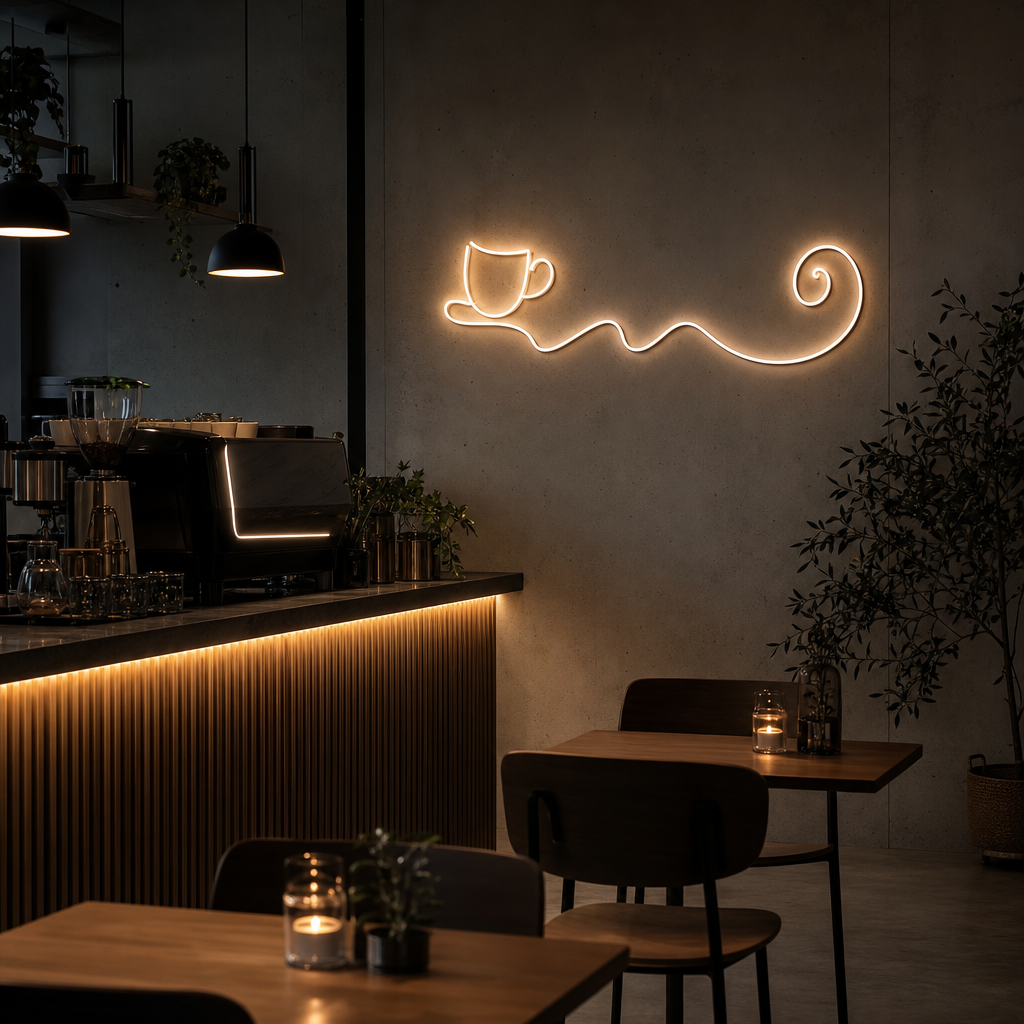
Custom LED neon signs use flexible LED strip set inside a silicone diffuser, shaped to your logo or lettering and mounted on a backing such as clear acrylic. They run on low voltage, stay cooler than glass neon, resist knocks better, and can be made for indoor or outdoor use with the right protection rating.
A neon feature is one of the few signage upgrades that works as both a sign and a piece of interior design. It gives a café wall, bar back wall, salon reception or office feature wall a focal point that customers photograph and share. The trouble for first-time buyers is that the product is rarely explained properly. Most pages show gallery shots and a quote form, and skip the decisions that decide whether the sign looks good and lasts.
This guide is the plain-English version. I will walk through how a logo or sketch becomes an installed sign, what limits apply to design, how backing and mounting work, what changes for outdoor use, what drives cost and lead time, and how to look after the sign afterwards. It is location-neutral, so it applies whether you are in a regional town or a capital city.
Key Takeaways
- Custom LED neon is flexible LED strip inside a silicone diffuser. It is low voltage, runs cooler and is far less fragile than glass tube neon.
- Not every logo converts directly. Neon is drawn as a continuous line, so fine detail, tiny text and very thin strokes usually need simplifying.
- Backing is a design decision, not an afterthought. Cut-to-shape clear acrylic, rectangular panels, coloured and mirrored finishes all change how the sign reads, by day and by night.
- Outdoor signs need a suitable IP rating, UV-stable materials, sensible power supply placement and, for external signage, a check of council requirements.
- Cost and lead time are driven by size, total neon length, complexity, colour count, backing, controllers and installation. Any sign can be quoted accurately once you share the logo, size and location.
- Care is simple: gentle cleaning, a protected power supply, and a service call when something flickers, fails or gets wet.
Ready to make your business impossible to miss?
Design, manufacture and installation, all under one roof in Warana.
Get a Free QuoteSummary Table
| Decision | Options | What it affects | Best suited to |
|---|---|---|---|
| Technology | LED neon or glass tube neon | Safety, durability, running cost, look | LED for most businesses; glass for a purist look |
| Design | Logo conversion, script lettering, simplified icon | Legibility, build complexity, cost | Bold logos and clean script fonts |
| Colour | Single colour, multi-colour, RGB with controller | Brand match, flexibility, controller cost | Fixed brands: single colour. Venues: RGB |
| Backing | Cut-to-shape acrylic, rectangular panel, coloured or mirrored acrylic | Visual style, daytime appearance, install | Cut-to-shape for a floating look; panels for busy walls |
| Mounting | Standoffs, hanging kit, window mount | Installation method, wall type, visibility | Wall: standoffs. Ceiling or window: hanging kit |
| Environment | Indoor or outdoor | IP rating, materials, power supply, approvals | Outdoor needs weather-rated build |
| Care | Cleaning, power supply protection, servicing | Lifespan and reliability | All signs |
What are custom LED neon signs and how do they differ from glass neon?
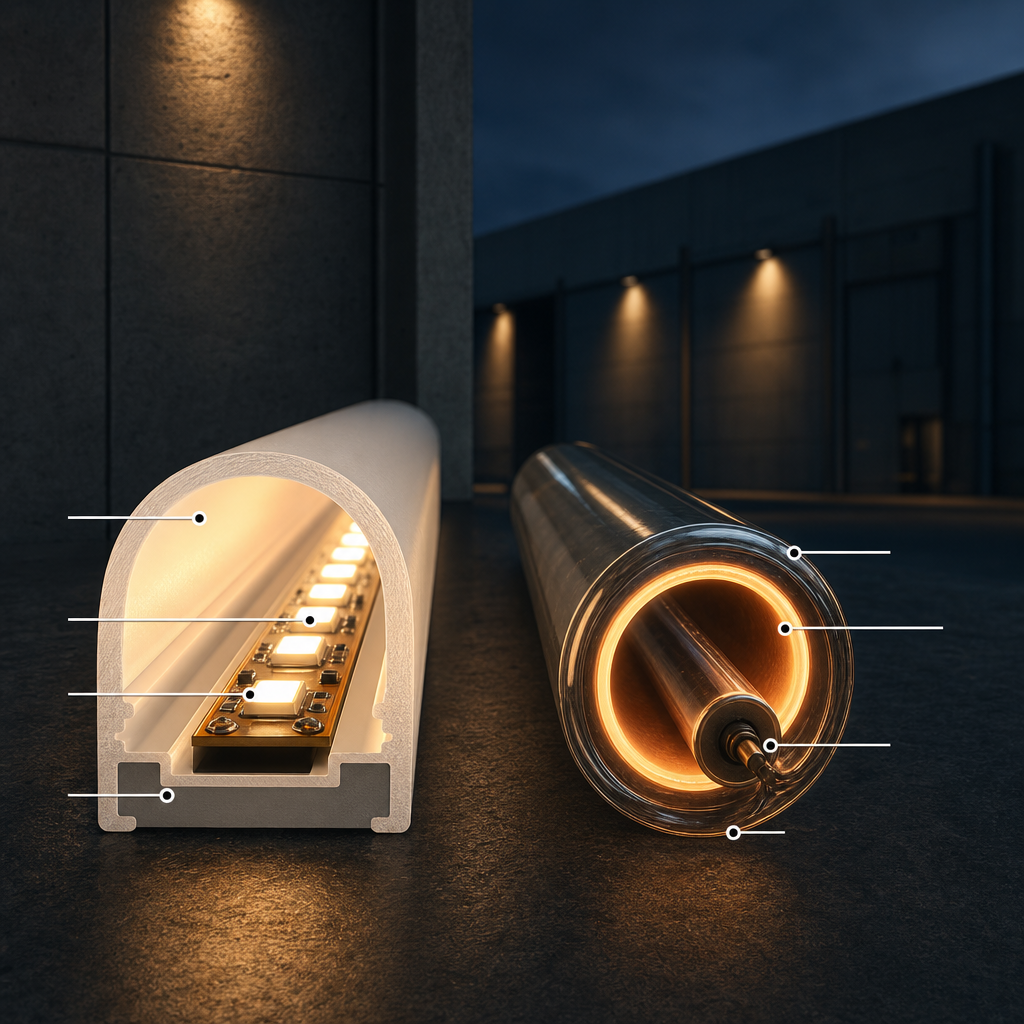 Custom LED neon signs use a flexible LED strip enclosed in a silicone diffuser that is bent into letters or shapes. The silicone spreads the light into a continuous glowing line, mimicking glass tube neon. Because the LEDs run on low voltage, the sign is cooler, safer to handle and much harder to break.
Traditional neon is hand-bent glass tube filled with gas and driven by a high-voltage transformer. It produces a distinctive glow, and some people still prefer it. But glass is fragile, heavy and needs specialist handling. LED neon was developed to give a similar look without those drawbacks.
Low-voltage operation
LED neon is powered through a low-voltage driver (the power supply) that converts mains power down before it reaches the sign. That means no high-voltage transformer sitting behind the lettering. For venues with staff, customers and children moving around, this is a practical safety benefit. It also makes installation more flexible, since the sign itself is a light, low-voltage fitting. The power supply still needs to be installed correctly and protected, which I cover below.
Cooler running and lower power draw
LEDs convert more of their power into light and less into heat. In general, LED neon draws less power than glass neon and the surface stays much cooler. That suits signs placed near fabrics, timber walls, shelving or in tight bar and café fit-outs. I am deliberately not quoting running costs here, because they depend on sign size, colour and how many hours a day it is on.
Impact resistance and handling
A silicone-encased strip flexes rather than shatters. Glass tube can crack from a knock, a hot-and-cold cycle or a bumpy delivery. LED neon also ships and installs more easily, which matters for large signs and for venues where fit-out schedules are tight.
Where glass neon still wins
Glass neon has a particular depth of glow and a heritage quality that some brands want. If that exact look is central to your concept, it is worth discussing. For most business uses (branding a wall, a window or a feature area) LED neon is the more practical choice, which is why it dominates the custom signage market.
How do you design a custom neon logo sign?
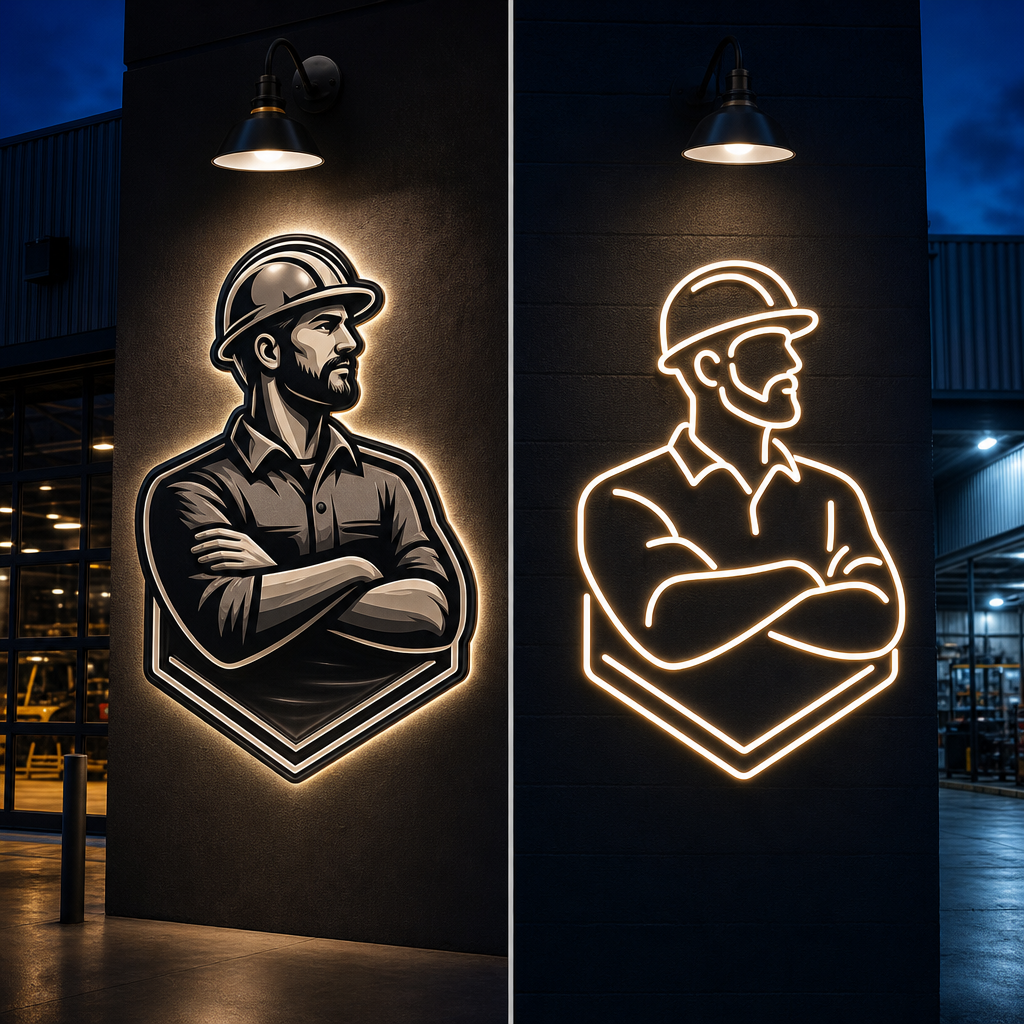 You design a custom neon logo sign by simplifying your logo into clean, continuous lines that the LED strip can follow, then choosing colour, backing and controls. A designer converts your artwork into a neon-ready path and sends a proof. You approve the layout before anything is built.
The key point is that neon is a line, not a filled shape. Where a printed logo can use gradients, shadows, thin hairlines and small text, neon has to express the same idea with one bendable strip.
Converting logos and script fonts
Bold, simple logos convert best. Script fonts with a consistent stroke weight also work well, which is why handwritten-style lettering is so common in neon. Problems come from:
- Very fine hairlines that have no thickness to carry a strip
- Tight gaps between letters or strokes that would force two lines to overlap
- Detailed icons with many small internal shapes
- Tiny taglines under a main logo
- Gradients and shadows, which neon cannot reproduce as such
The usual fix is to simplify. A detailed icon might become an outline. A tagline might be dropped or set in a cleaner, larger font. The brand stays recognisable, and the sign reads from across the room. Where a logo includes a filled shape, there are two common solutions: outline the shape in neon, or print or cut the filled element onto the backing.
Minimum letter height and stroke detail
There is a practical minimum size for any neon letter. The LED strip and its silicone diffuser have a set thickness and a limit on how tightly they can bend. Small text with tight curves, such as a lower-case script with small loops, needs more height than a plain block capital. I will not publish a single figure, because the right minimum depends on the font and the strip used. Send us your artwork and we will confirm what is feasible at your chosen size on the proof. If the answer is that your text needs to be larger, it is far better to learn that at proof stage than after fabrication.
Colour selection
LED neon is available in a wide range of colours, and you can combine several in one sign. Two things are worth knowing before you pick:
- Lit versus unlit colour. A neon strip looks different when it is off. Many diffusers appear white or tinted by day. If the sign sits in a bright shopfront or café, the daytime appearance matters as much as the night look.
- Brand colour matching. LED colour will not match a printed Pantone swatch exactly, because light and ink behave differently. Aim for a close, flattering match rather than an identical one. Warm white versus cool white is a common area of debate, so ask for a sample or description of the white you are getting.
More colours generally add build complexity, since each colour is a separate run of strip with its own joins. If budget matters, a single-colour sign with a strong layout often looks better than a busy multi-colour one.
Colour-changing RGB and dimmers
RGB signs can shift between colours using a controller, remote or app. They suit bars, venues and event spaces that want different moods through the day, or that change colour with a promotion. The trade-off is that RGB can look less crisp than a single, deliberately chosen colour, and it adds a controller to the build. Dimmers are a smaller, useful add-on. Neon in a dark venue can feel intense at full brightness, while the same sign in a bright shopfront may need full output. Being able to dial the brightness gives you control in both settings.
What backing and mounting options are available for neon signs?
Most custom LED neon signs are fixed to a laser-cut clear acrylic backing, cut either to the shape of the design or as a rectangular panel. Coloured or mirrored acrylic changes the look further. The sign is then mounted with standoffs on a wall, a hanging kit from a ceiling, or a window mount.
Backing is where many first-time buyers underestimate the choices. The neon strip needs something to hold its shape, route its wiring and attach it to a surface. That something also sets how the sign looks when it is turned off.
Cut-to-shape versus rectangular panels
Cut-to-shape acrylic follows the outline of the lettering or logo. The backing nearly disappears, so the sign appears to float on the wall. It suits clean walls where you want the neon to be the only thing seen. It also tends to look more premium, and it is the better choice when the wall colour or texture is part of the look.
Rectangular panels are a clear sheet cut to a simple box. They are easier to produce, simple to handle and mount, and they give the sign a defined frame. They suit busy backdrops, signs with many separate elements, and installations where you want some protection around the letters.
Coloured and mirrored acrylic
Coloured acrylic behind the neon adds contrast, which can help a sign hold up in a bright room. Mirrored acrylic reflects the glow and doubles the visual impact, but it will also reflect everything else in the room, so placement matters. A mirror finish near a window or a bright light source can create glare. Neither option is better in general. It comes down to the wall, the lighting and how you want the sign to read in the daytime.
The type of acrylic itself affects the quality of cut edges and how the sheet behaves over time. If you want the detail, Sunquest Signs has a separate guide on laser cutting acrylic for signage, covering cast versus extruded sheet.
Standoffs, hanging kits and window mounting
- Standoffs hold the backing slightly off the wall, which adds a shadow effect and hides wiring. They are the standard choice for wall-mounted signs. Your wall type (plasterboard, brick, timber, tile) will affect the fixings needed.
- Hanging kits use cables or chains to suspend a sign from a ceiling or a bracket. They suit open-plan spaces and signs seen from both sides.
- Window mounting places the sign inside the glass so it can be seen from the street. The sign needs to be secured safely, and the angle and glare from the glass should be considered. A sign that looks great at night can be lost in the reflections of a bright shopfront by day, so we look at viewing conditions before suggesting a layout.
Whichever you choose, think about where the power cable will run. A neat install hides the wiring, and a good proof shows where the cable and power supply sit.
Can LED neon signs be used outdoors?
Yes, outdoor LED neon signs are available, but they must be built for it. That means a suitable IP rating for dust and water, UV-stable materials, weather-resistant fixings and a protected power supply. Without those, sun, rain and salt air will shorten the life of a sign made for indoor use.
Indoor signs are not sealed against moisture, and plain acrylic and silicone can discolour in strong sun. Putting an indoor sign on a covered balcony or in a window that gets direct afternoon sun is a common mistake.
IP ratings explained
IP stands for Ingress Protection, and the rating system is defined in the international standard IEC 60529. The first digit describes protection against solid objects such as dust, and the second digit describes protection against water. A higher second digit means protection against stronger exposure, from drips and splashes up to jets and temporary immersion. When you ask for an outdoor sign, ask for the IP rating of the neon strip and of the power supply separately. They are often different, and the weakest component sets the real limit.
UV-stable materials
Sunlight breaks down some plastics over time, causing yellowing or brittleness. Outdoor signs should use materials intended for UV exposure, including the silicone diffuser and the backing. If a sign faces north or west in Australia, assume it will take a lot of sun.
Coastal salt air
Salt air is hard on metal fixings, connectors and exposed electronics. For signs near the coast, such as those across the Sunshine Coast and Fraser Coast, corrosion-resistant fixings and good sealing at joins matter. Even a sign that is not in direct spray will see salt in the air. Plan for a regular wipe-down as well (see the care section).
Power supply placement
The power supply should be kept dry, ventilated and accessible. It should not sit where water pools or where it cooks in direct sun. In many outdoor builds it is mounted inside a building or in a weather-rated enclosure, with only low-voltage cable running to the sign. Electrical work should be done by a licensed electrician in line with the Australian wiring rules, AS/NZS 3000.
Council requirements for external signage
External signs can need approval from your local council or landlord, depending on size, position, illumination and whether the sign faces a public place. Rules vary between councils and zones, and heritage overlays add more requirements. Check with your council planning department before you order, and check your lease. A window sign fully inside the glass may be treated differently from a sign fixed to an external wall, so confirm which applies to you.
What affects the cost and lead time of a custom neon sign?
Cost and lead time are driven by overall size, the total length of neon strip, design complexity, number of colours, backing type, controllers and installation. Because each sign is built to order, there is no fixed price list. A quote based on your actual artwork, size and location is the only reliable figure.
I am not publishing price figures in this guide, because they would be misleading without your design in front of us. What I can do is show you which levers move the price.
- Overall size. A larger sign needs more strip, more backing and more handling.
- Total length of neon. This is often a better predictor than width and height. A small, intricate script can use more strip than a large, simple shape.
- Design complexity. Many curves, joins, tight corners and separate elements add build time.
- Number of colours. Each colour is a separate run of strip and extra joins.
- Backing type. Cut-to-shape acrylic takes more design and cutting work than a simple rectangle. Coloured or mirrored finishes are different again.
- Controllers. Dimmers, remotes and RGB controllers are add-ons.
- Installation. A small sign that you hang yourself differs from a large wall piece, a window fit or an outdoor install requiring an electrician and access equipment.
Lead time follows the same logic. Simple signs move faster. Large, multi-colour, outdoor or heavily customised pieces take longer, and approval delays at proof stage add to the clock. The fastest way to shorten the timeline is to send clear artwork early and approve the proof promptly.
Illustrative scenario: a café logo on cut-to-shape acrylic
This is a hypothetical example to show how the process works, not a real client project.
Imagine a café whose logo is a coffee cup icon with a hand-lettered name beneath it and a small tagline. The owner wants a wall-mounted piece above the service counter.
- Artwork review. The designer notes that the cup icon has fine steam lines and the tagline is very small. Both would be difficult to build in neon at a sensible size.
- Simplification. The cup becomes a single outline with two steam curves. The tagline is dropped from the neon and, if wanted, can be added as a small printed or engraved element on the backing.
- Colour. The owner picks warm white for the lettering and a single accent colour for the cup, keeping the colour count low.
- Backing. Cut-to-shape clear acrylic is chosen so the sign floats on a painted wall without a visible panel.
- Mounting and power. Standoffs hold the sign off the wall, and the power supply is placed in a nearby cupboard with a dimmer so staff can adjust the brightness.
- Proof and approval. The owner sees the layout at actual size on a mock-up of the wall, confirms it, and the build begins.
The result is a sign that keeps the brand recognisable, reads clearly across the room and avoids detail that neon cannot carry.
How do you care for a custom LED neon sign?
Care is simple. Dust the sign with a soft dry cloth, wipe gently with a barely damp cloth if needed, keep water away from the power supply, and call for servicing if you notice flickering, dead sections or moisture. Regular light maintenance protects the look and the electronics.
Cleaning
Turn the sign off and let it cool. Use a soft microfibre cloth. Avoid harsh solvents, abrasive pads and strong glass cleaners, which can cloud acrylic and damage silicone. On outdoor signs, a gentle wipe with mild soapy water removes dust and salt. Do not pressure wash a neon sign.
Protecting the power supply
The power supply is the most vulnerable part. Keep it dry, clear of dust build-up and out of direct heat. Do not cover it with stock or cardboard, and make sure it has room to ventilate. Use a surge-protected outlet where possible. If it is outdoors, check the enclosure and seals now and then.
Lifespan
LED neon lifespan is usually quoted by manufacturers as a rating in operating hours. Treat these as manufacturer ratings under test conditions, not a guarantee. Real life depends on how many hours the sign runs, heat, moisture, power quality and how well it was built. A sign that is switched off after trading hours will last longer than one running all day and night.
When to call for servicing
Contact a signmaker or electrician if you see:
- Sections that flicker, dim or fail
- Colour that has shifted or looks uneven
- Moisture inside the diffuser or near the power supply
- A power supply that is hot to touch, noisy or intermittent
- Loose fixings or a sign that has moved
Do not open the power supply yourself. For wider guidance on keeping lit signage in good shape, see Sunquest Signs' guide to illuminated sign maintenance.
What most guides miss: design for the sign when it is off
Most neon pages sell the glowing photo. My view is that the more important question is what the sign looks like when it is switched off, because that is a large part of its working life.
A café open from morning has its neon on for a few hours of the day at most in bright light. A salon with a window sign might leave it off through the afternoon. A gym may only light the sign for evening classes. In each case, the visible object is a clear acrylic panel with tubes on it. If the backing is cluttered, the fixings are visible, the wiring is messy or the diffuser looks grey in daylight, the sign looks cheap for most of the day.
So my advice is to judge a neon proposal on three views: lit at night, lit in daylight and unlit. Ask your signmaker how it looks in all three. Cut-to-shape acrylic, hidden wiring, tidy standoffs and a considered colour choice for the diffuser make the biggest difference. This is also why I would put money into backing and installation before putting it into a more elaborate design or extra colours. A simpler sign that looks good in all three conditions will do more for your brand than a complex one that only works after dark.
How do you get started with a custom neon sign?
Send your logo, sketch or idea along with the approximate size and where it will go: indoor, window or outdoor. That is enough for Sunquest Signs to assess what is feasible, then prepare a design proof and a quote.
A useful brief includes:
- Your logo file, a photo of a sketch, or a description of the wording
- Approximate size or the wall space available
- Location: indoor wall, window or outdoor, and whether it faces direct sun or the coast
- Preferred colours and whether you want RGB or a dimmer
- Any deadline, such as a venue opening
Sunquest Signs works with businesses across the Sunshine Coast and Fraser Coast and has dedicated pages for neon signs in Caloundra and neon signs in Noosa. If you are also planning shopfront signage or window, wall and floor graphics, we can scope those alongside the neon so everything matches. Use the contact form on the Sunquest Signs website, or give the team a call, and we will take it from there.
References
- International Electrotechnical Commission (IEC). IEC 60529, Degrees of protection provided by enclosures (IP Code). https://www.iec.ch
- Standards Australia. AS/NZS 3000, Electrical installations (known as the Wiring Rules). https://www.standards.org.au
- Sunshine Coast Council. Planning and development information for signage. https://www.sunshinecoast.qld.gov.au
- Fraser Coast Regional Council. Planning and development information. https://www.frasercoast.qld.gov.au
Talk to a signage expert
Tell us about your project and we'll come back with options and honest advice.
Get in TouchFrequently Asked Questions
What are custom LED neon signs made of?
They are made from flexible LED strip inside a silicone diffuser, bent into the shape of your lettering or logo. The strip is fixed to a backing, usually laser-cut clear acrylic, and powered by a low-voltage supply. Controllers such as dimmers or RGB remotes can be added.
Can any logo be turned into a neon sign?
Most logos can be adapted, but not always exactly as drawn. Neon works as a continuous line, so fine detail, hairlines, tiny text and gradients usually need simplifying. A designer reviews your artwork and sends a proof showing what the neon version will look like before it is built.
Are outdoor LED neon signs available?
Yes, but they need an outdoor build. That means a suitable IP rating, UV-stable materials, corrosion-resistant fixings in coastal areas and a protected power supply. External signs may also need council approval, so check your local rules and your lease before ordering.
How long do LED neon signs last?
Manufacturers usually rate LED neon by operating hours, and those ratings are given under test conditions. In practice, lifespan depends on how long the sign runs each day, heat, moisture and power quality. Good installation and regular gentle cleaning help it last.
How is LED neon different from glass neon?
LED neon uses flexible LED strip in silicone and runs on low voltage. Glass neon uses gas-filled glass tube and a high-voltage transformer. LED neon generally draws less power, runs cooler and is much less fragile, while glass neon has a traditional look some buyers still prefer.
Related Articles
Shop Front Signs in Caloundra: Precinct Styles, Coastal Materials, Council Rules and Costs
Pylon Signs in Noosa: Design, Coastal Materials, Council Approvals and Installation
Pylon Signs on the Sunshine Coast: Design, Materials, Approvals and Installation
Signs that set you apart
Over 40 years on the Sunshine Coast. Design, compliance, manufacture and installation handled end to end.
Get a Free Quote