
Pylon Signs in Noosa: Design, Coastal Materials, Council Approvals and Installation
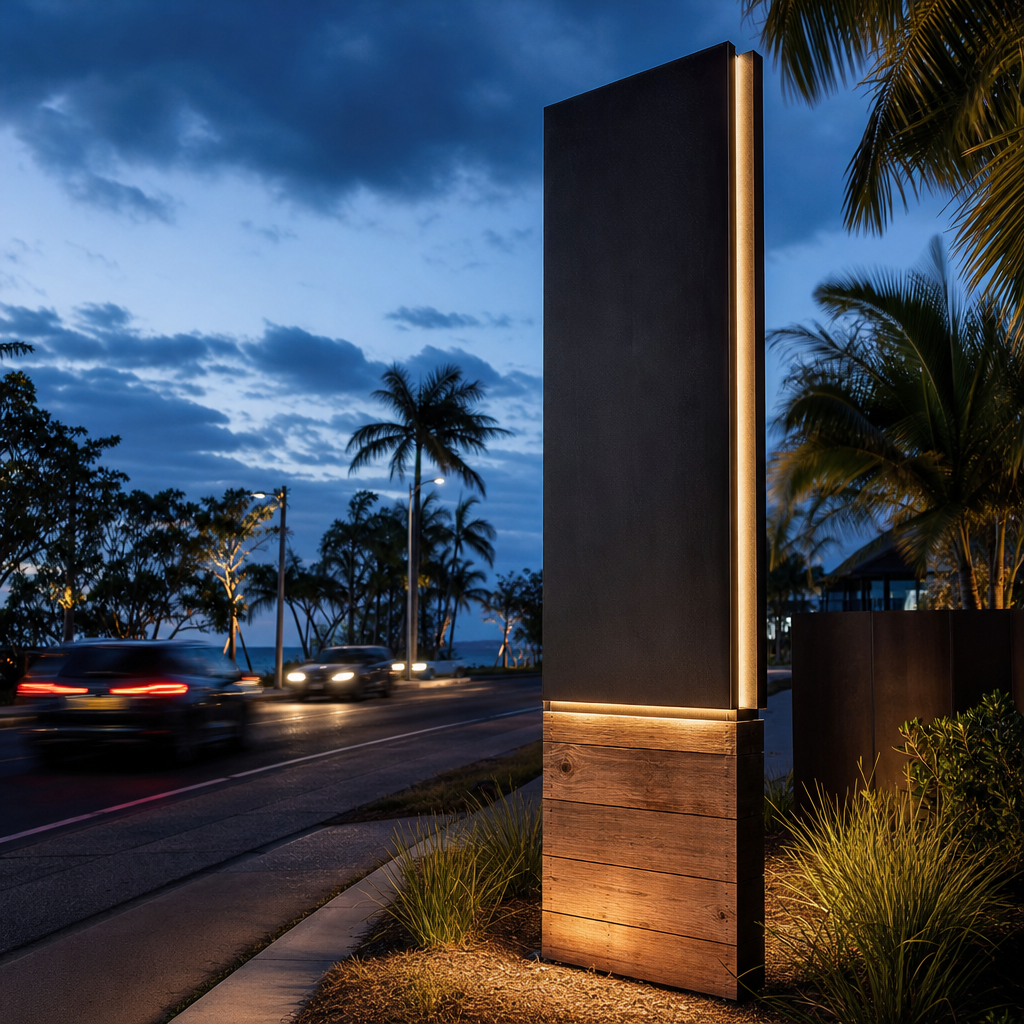
Pylon signs in Noosa are freestanding, engineered signs that give roadside visibility to businesses in Noosaville, Tewantin and surrounding areas. To get one approved and built to last, use restrained design, marine-grade materials, footings engineered to AS/NZS 1170.2 wind loading, and confirm advertising device requirements with Noosa Council before fabrication.
Noosa is a hard place to be seen from the road. Planning controls are tight, visual amenity is taken seriously, and salt air punishes anything built cheaply. Yet drivers on the main roads still need to find your driveway in time to turn in.
This guide covers what suits Noosa: where pylons earn their place, how to design one that gets approved, which materials survive the coast, how illumination should be handled, and what the build process looks like from site assessment to installation. It does not repeat our general Sunshine Coast pylon guide. It is focused on Noosa conditions and expectations.
Key Takeaways
- A restrained, well-proportioned pylon is more likely to be supported in Noosa than a tall, bright one. Good design and approvability point the same way.
- Marine-grade aluminium, quality powder coating, stainless fixings and humidity-rated LEDs decide whether a sign still looks sharp after several coastal summers.
- Advertising devices are assessed under the Noosa Plan 2020 planning scheme. Whether you need a development application depends on the site, size, height and illumination, so confirm with council early.
- Engineering certification, including wind loading to AS/NZS 1170.2 and a footing design, is part of doing the job properly, not an optional extra.
- Dimmable, curfew-friendly illumination is easier to defend with neighbours and assessors than a full-brightness sign running all night.
Ready to make your business impossible to miss?
Design, manufacture and installation, all under one roof in Warana.
Get a Free QuoteSummary Table
| Topic | What Noosa expects | Practical move |
|---|---|---|
| Design | Natural tones, modest bulk, quality finishes | Timber-look or rendered base, limited colour palette |
| Materials | Salt and humidity resistance | Marine-grade aluminium, high-grade marine stainless steel fixings, UV-stable faces |
| Approvals | Compliance with the planning scheme and building rules | Confirm requirements with council before design is locked |
| Structure | Engineer-certified for wind | Footing design and wind loading to the Australian wind actions standard |
| Illumination | Restrained, controlled glare | Dimmable LEDs with timer or curfew settings |
| Installation | Safe, services-aware works | Site assessment, Before You Dig search, then fabrication and install |
Why Pylon Signs Work in Noosa
Pylon signs work in Noosa because most customers arrive by car on a handful of main roads, often unfamiliar with the area. A pylon gives them a clear, early cue to turn in. It also lets several businesses on one site share a single, well-managed presence.
Noosa's visitor economy means a large share of your potential customers are navigating by phone and glancing at signs. A shopfront sign mounted on the building is often set back, angled away from the road or hidden by street trees and landscaping. A pylon sits at the boundary, at driver eye line, where the decision to slow down is made.
Three situations suit pylons best:
- Main-road frontages. Businesses in Noosaville along Gympie Terrace, in Tewantin and around the Noosa Junction approaches rely on drive-by traffic. A readable sign has seconds to work.
- Tourist-facing sites. Motels, cafes, tour operators and medical practices serving visitors need directional clarity more than a clever design.
- Multi-tenant sites. Retail centres, trade complexes and light industrial estates around Cooroy and Noosaville need one structure that lists several tenants without turning into clutter.
If your site is walkable and pedestrian-led, such as the Hastings Street strip, a pylon is the wrong tool. Other signage types suit those locations better, and we cover them under shopfront and business signs and neon signs in Noosa.
Designing a Pylon Sign That Suits Noosa's Character
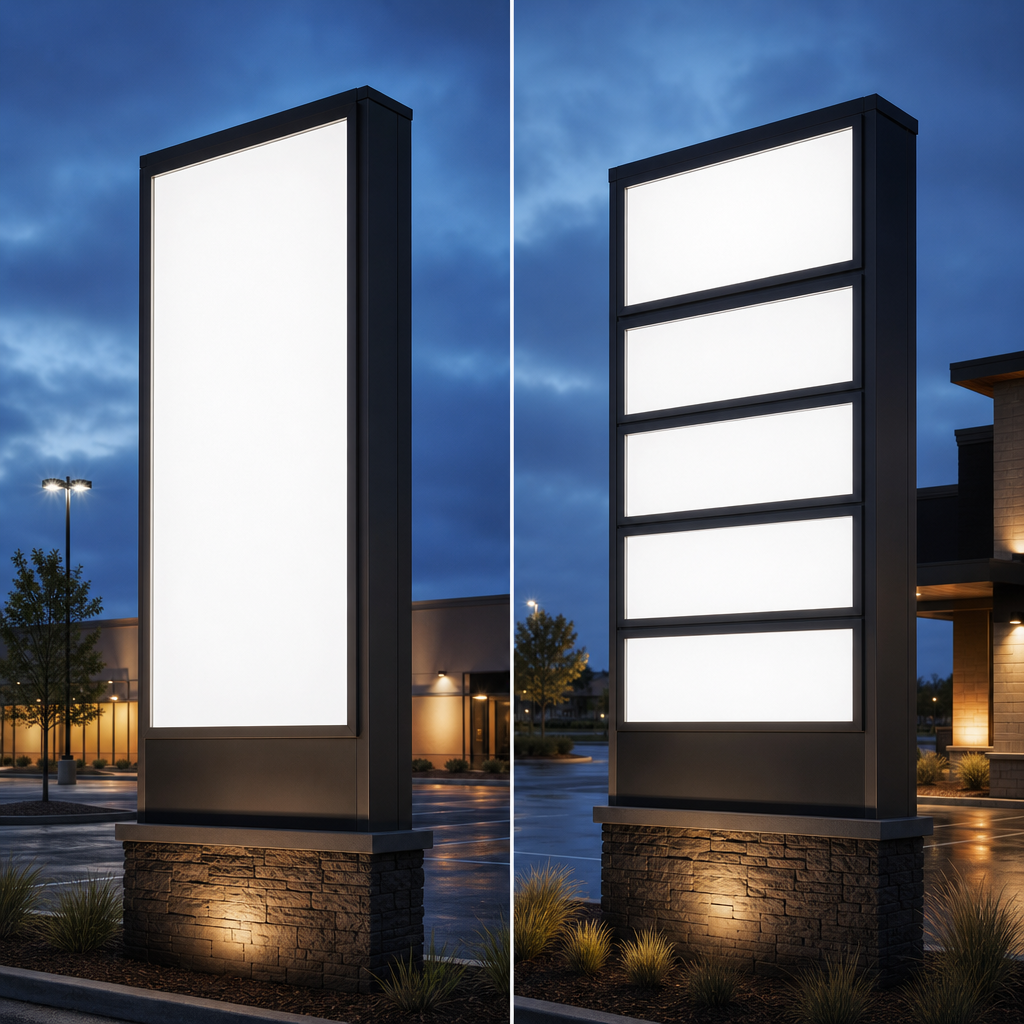
A Noosa pylon should look like it belongs to the place: natural tones, honest materials, modest proportions and controlled lighting. Restraint is not a limit on visibility. A clear, uncluttered face with strong contrast reads faster from a moving car than a busy one.
Start with what the surroundings already say. Noosa's built environment leans on earthy colours, timber, stone-look finishes and greenery. A pylon with a timber-look cladding or rendered base in a muted tone will sit comfortably in that setting. A bright, oversized, high-gloss structure will stand out for the wrong reasons, and may draw questions during assessment.
Design principles that work
- Limit the palette. Two or three colours, with your brand colour used as an accent rather than flooding the whole face.
- Prioritise legibility. Large letterforms, generous spacing and high contrast. Drivers read a business name and one descriptor, not a paragraph.
- Keep the base honest. A rendered or timber-look base anchors the sign visually and hides the footing connection.
- Match scale to the road. Height and width should reflect traffic speed and the setback, not the biggest size you might get away with.
Single-site versus multi-tenant layouts
A single-site pylon can use the whole face for one brand, which is the strongest option for visibility. A multi-tenant pylon needs a hierarchy: usually the centre or complex name at the top, then tenant panels beneath in a consistent format.
For multi-tenant pylon signs on the Sunshine Coast, consistency is what keeps them looking professional. Use identical panel sizes, a shared font and a uniform background so tenants can change over without the sign looking patchy. Designing panels as removable inserts means a tenant change is a quick swap, not a rebuild. Laser-cut components can add crisp detail, such as cut-out lettering or feature screens, without adding visual weight.
Coastal Materials That Survive Salt Air
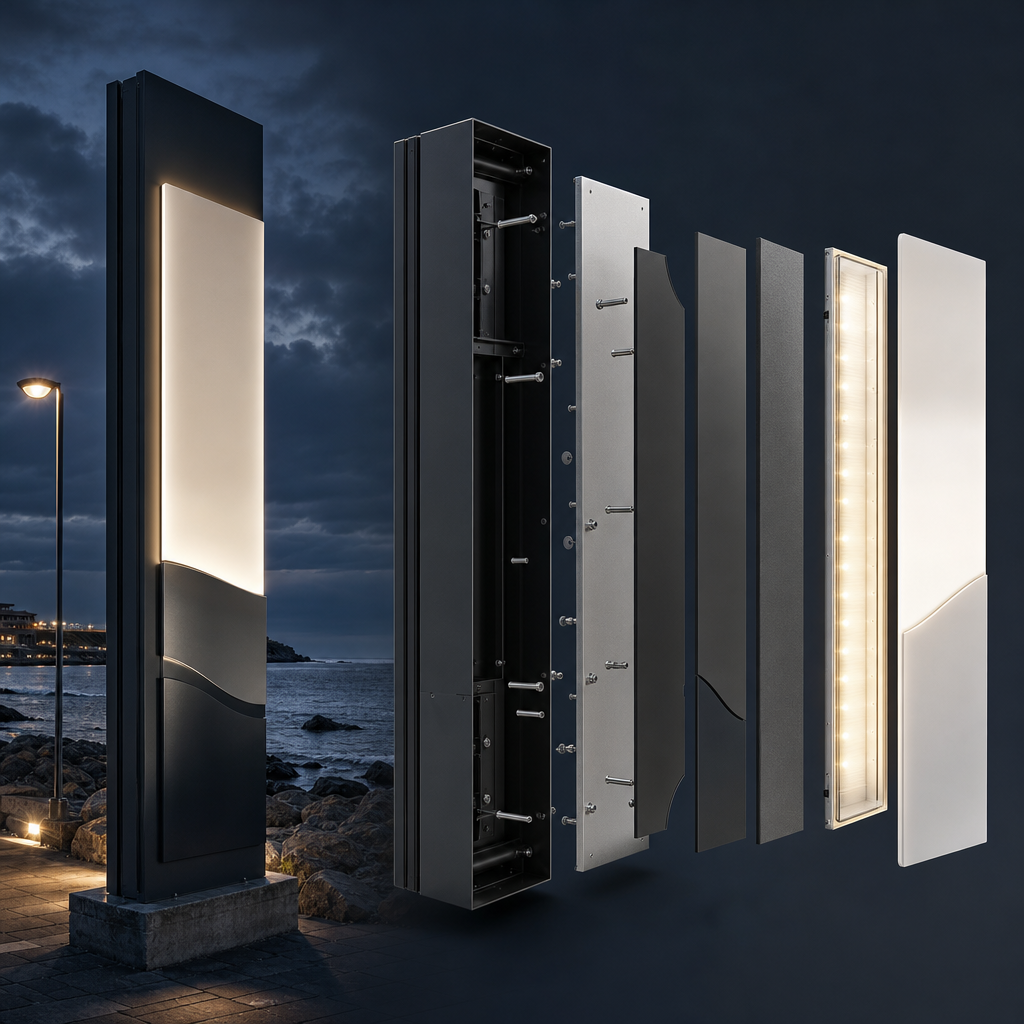
Marine-grade materials survive Noosa's coastal conditions because they resist salt-driven corrosion, UV breakdown and moisture ingress. For pylon signs, that means marine-grade aluminium, quality powder coating, 316 stainless steel fixings, UV-stable faces and LED modules rated for humidity.
Noosaville and Tewantin sit close to the river, estuary and ocean. Salt-laden air and constant humidity attack cheap fixings and thin coatings first. Failure usually shows as rust streaks, bubbling paint, yellowed faces or flickering LEDs. All of it is avoidable at the specification stage.
What to specify
- Structure and cladding. Marine-grade aluminium alloys, such as 5052 or 5083 sheet, resist corrosion far better than mild steel. Where steel is needed for the structural column, it should be hot-dip galvanised and properly coated, with isolation between dissimilar metals to prevent galvanic corrosion.
- Powder coating. A quality architectural powder coat applied over correct pre-treatment is the key defence. Ask your fabricator which standard the coating is applied to. AS 3715 covers thermoset powder coatings for architectural aluminium.
- Fixings. Use 316 stainless steel bolts, washers and anchors. Standard 304 stainless can show tea staining in coastal air. Using 316 costs little against the whole sign.
- Faces. UV-stable polycarbonate or acrylic faces, chosen for resistance to yellowing and brittleness. Cheap faces fade and crack under Queensland sun.
- LEDs and power supplies. Modules and drivers with a suitable ingress protection (IP) rating, sealed cable entries and drainage points so condensation does not collect inside the cabinet.
Maintenance still matters. A periodic fresh-water rinse removes salt build-up and extends coating life. Ask your supplier for a simple care schedule when the sign is handed over.
Noosa Council Approvals and Engineering Certification
Pylon signs in Noosa are assessed against the advertising device provisions of Noosa Plan 2020, the local planning scheme. Whether you need a development application depends on your zone, the sign's height, size and illumination, and the site's frontage. Always confirm current requirements with Noosa Council before finalising design.
Council rules change over time, so treat this section as orientation, not advice. The reliable path is to check the current planning scheme and speak with council's planning team at the start of the project.
When a development application is likely
Signs in many zones can be self-assessable or code-assessable, while others trigger impact assessment. Factors that commonly push a proposal towards a development application include:
- greater height or sign area than the scheme allows for that zone
- illumination, especially in or near residential or tourist accommodation areas
- sites with heritage, character or environmental overlays
- frontage to a state-controlled road, where Queensland's Department of Transport and Main Roads may have its own requirements about roadside advertising
- multi-tenant signs that increase total sign area
A sign that respects the scheme's intent (modest scale, quality finishes, controlled lighting) is simply easier to take through assessment. That is a design reason to keep Noosa pylons restrained.
Engineering and building requirements
A pylon is a vertical structure with a large face area, so wind is the governing load. Structural design should reference AS/NZS 1170.2, the Australian and New Zealand standard for wind actions. The design wind speed depends on your wind region, terrain category and the sign's height, so it cannot be guessed from a rule of thumb.
An engineer then designs the footing for the soil conditions on site. Noosa's mix of sandy coastal soils, floodplain and fill means a footing that works in one suburb may not suit the next. Depending on size and structure, building approval and certification may also be required.
If you want to see how wind ratings vary across regions, our Toowoomba pylon work is a useful contrast. Inland, elevated sites present different wind assumptions from the Noosa coast.
The approvals pathway is easier when documentation is assembled once: scaled drawings, elevations showing height and setback, materials and finishes, illumination details and engineering certification. Sunquest Signs can support that documentation, but council makes the decision, so always confirm what applies to your site.
Illumination Options for Noosa Pylon Signs
The three main illumination options for pylon signs are internally lit lightbox panels, routed and push-through faces, and externally lit or non-lit panels. In Noosa, the best choice is usually the one with controlled glare and dimming that can be set to meet any approval conditions.
Illuminated pylon signs in Noosaville and elsewhere in the shire need to balance night visibility against local sensitivities. Many sites have accommodation or residences nearby, so softer, well-controlled lighting is easier to justify.
| Option | How it works | Best for |
|---|---|---|
| Internally lit lightbox panel | LED-lit cabinet with a translucent face | Multi-tenant panels and clear, even lighting |
| Routed and push-through face | Letters cut from the face, with acrylic pushed through and lit from behind | Premium single-site signs with a crisp, defined look |
| Non-illuminated or externally lit | Reflective or ground-lit panel | Sites with tight lighting limits or daytime-only trade |
Curfew-friendly dimming
Modern LED systems can be dimmed and put on timers. That lets you set lower brightness in the evening and switch the sign off at an agreed time. If council attaches illumination conditions to an approval, this control makes compliance simple, and it also cuts energy use. Ask for dimming and timer control to be included in the design, not added later.
A push-through face is worth considering for restraint. Light comes only from the lettering, so the sign reads as refined rather than glowing like a billboard. Our illuminated, lightbox and channel letter range covers these formats in more detail.
The Installation Process, Step by Step
A pylon installation runs in a set order: site assessment, design and approvals support, engineering and footing design, service locating, fabrication, then installation. The timeline depends mostly on approvals and engineering, not on the physical build.
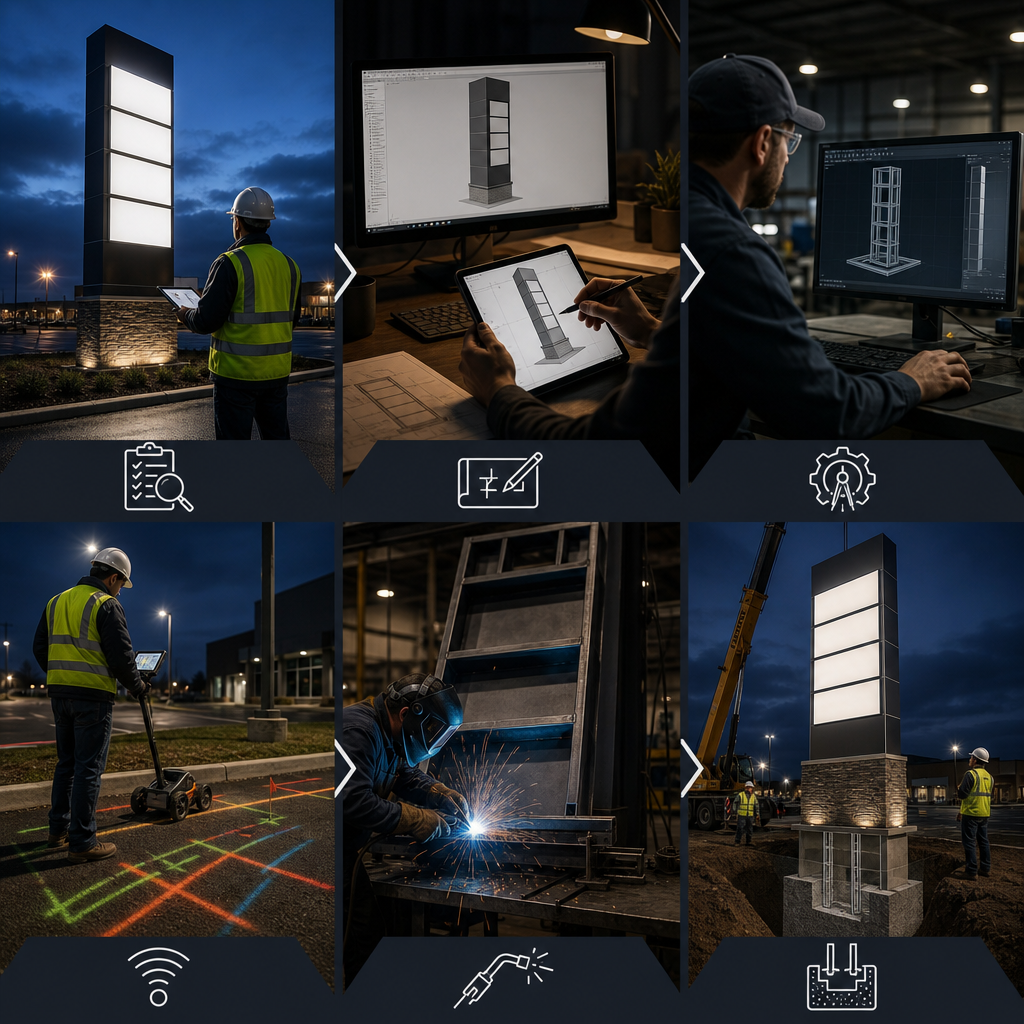
- Site assessment. We check frontage, sightlines, setbacks, soil conditions, power access and anything that could constrain height or position, such as trees, overhead lines and driveways.
- Design and documentation. Concept drawings in context, with the materials, finishes and illumination specified. This is also the pack used for any council submission.
- Engineering. The structure is designed for wind to AS/NZS 1170.2, and the footing is designed for your soil.
- Service locating. Before any excavation, underground services must be located. Before You Dig Australia provides a free search for this purpose, and on-site locating confirms the results.
- Fabrication. The sign is built in controlled workshop conditions, including coating, LED assembly and testing. Powder coating cure times and engineering sign-off are the main workshop milestones.
- Installation. Footing excavation and concrete, then curing time before the structure is erected and connected to power by a licensed electrician.
Concrete needs time to cure before it carries load, so the footing and erection are not a single-day job. Plan for approvals and engineering to take longer than fabrication, and ask for a written timeline once your site is assessed rather than relying on general estimates.
What Noosa Rewards: Fewer Panels, Better Proportion
My view, after designing signs for coastal Queensland sites, is that most pylon problems in Noosa are not materials problems or approval problems. They are brief problems. The brief asks for maximum size and maximum content, and that is exactly what an assessor, a neighbour and a passing driver all resist.
Here is the contrarian position I hold: on a Noosa site, a smaller pylon with fewer messages often outperforms a larger one. Imagine a motel with a tall structure carrying its name, star rating, vacancy light, restaurant, wifi and phone number. A driver at road speed reads perhaps the name and the word vacancy. Everything else is noise that adds bulk and approval risk.
The discipline that works is a three-item rule for the face: the name, one descriptor, and one cue to act, such as an arrow or entry marker. Everything else belongs on your website, your Google Business Profile or a smaller on-site sign at the driveway. A cleaner pylon is cheaper to engineer, easier to take through council and easier to read.
[PLACEHOLDER FOR ALEX: Sunquest Signs Noosa-area pylon project. Add the real project details below before publishing. Do not publish with this block unfilled.]
- Project and location: [suburb, business type, single-site or multi-tenant]
- Challenge: [e.g. approval constraints, wind exposure, salt exposure, restricted frontage]
- Solution: [design, materials, illumination and engineering approach]
- Result: [verified outcome, such as approval achieved, install completed, client feedback. Use only real figures.]
References
- Noosa Council, Noosa Plan 2020 (local planning scheme): https://www.noosa.qld.gov.au
- Standards Australia, AS/NZS 1170.2 Structural design actions, Part 2: Wind actions: https://www.standards.org.au
- Standards Australia, AS 3715 Metal finishing: Thermoset powder coating for architectural applications of aluminium and aluminium alloys: https://www.standards.org.au
- Before You Dig Australia, underground services search: https://www.byda.com.au
- Queensland Department of Transport and Main Roads, roadside advertising guidance: https://www.tmr.qld.gov.au
Book a Noosa Site Assessment
If you want roadside visibility that suits Noosa, book a site assessment and design consultation with Sunquest Signs. We handle design, approval documentation support, fabrication and installation end to end, so one team is accountable from first concept to the day the sign is switched on.
Talk to a signage expert
Tell us about your project and we'll come back with options and honest advice.
Get in TouchFrequently Asked Questions
Do I need council approval for a pylon sign in Noosa?
Often yes, in some form. Advertising devices are assessed under Noosa Plan 2020, and requirements depend on your zone, sign size, height and illumination. Some signs may be self-assessable, others need a development application. Confirm current requirements with Noosa Council before you commit to a design.
What is the difference between a pylon sign and a monument sign?
A pylon sign is a tall, freestanding structure, usually narrow and elevated for road visibility. A monument sign is lower and wider, closer to ground level. Pylons suit fast roads and long sightlines. Monuments suit slower roads and sites where council limits height.
How long do pylon signs last in Noosa's coastal conditions?
Lifespan depends on specification and maintenance, not a fixed number. Marine-grade aluminium, quality powder coating, 316 stainless fixings and UV-stable faces extend life considerably. Rinsing away salt build-up periodically and checking seals and fixings keeps the sign looking sharp.
How much does a pylon sign cost in Noosa?
Cost depends on height, face area, materials, illumination, footing complexity and approvals work. A single-site non-illuminated sign sits at one end, and a tall, internally lit multi-tenant structure sits at the other. A site assessment is the only way to give an accurate quote.
Can an illuminated pylon sign stay on all night?
That depends on your approval conditions and surroundings. Sites near accommodation or homes may face limits on brightness or hours. Specifying dimmable LEDs with timer control from the start lets you comply easily if curfew conditions apply.
Related Articles
Pylon Signs on the Sunshine Coast: Design, Materials, Approvals and Installation
Shop Front Signs in Caloundra: Precinct Styles, Coastal Materials, Council Rules and Costs
Pylon Signs in Toowoomba: Design, Wind Ratings, Council Approvals and Installation
Signs that set you apart
Over 40 years on the Sunshine Coast. Design, compliance, manufacture and installation handled end to end.
Get a Free Quote