
Illuminated Pylon Signs: Lighting Options, Running Costs, Council Rules and Maintenance
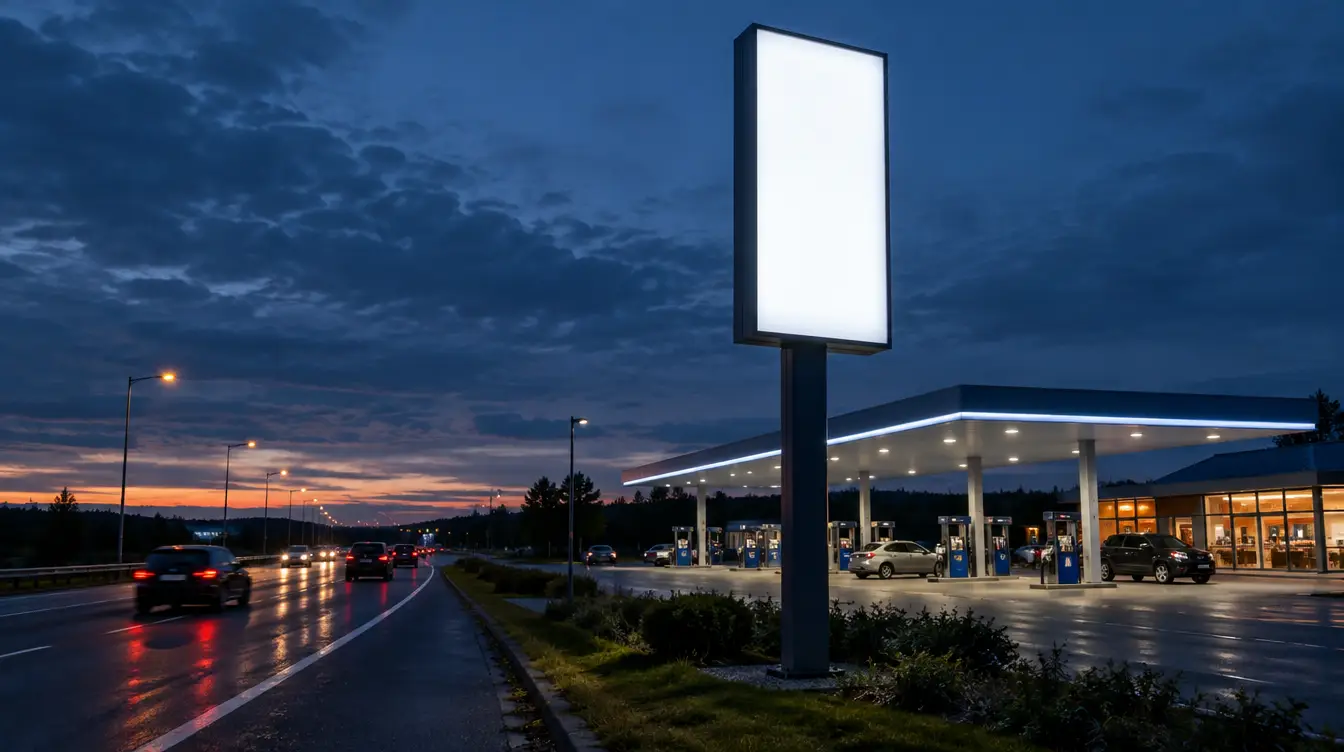
The best illuminated pylon sign for most Queensland businesses is an internally lit lightbox with LED modules and a UV-stable face. It gives even, brand-consistent light at night with low running costs. Push-through acrylic, routed backlit aluminium, channel letters and floodlighting suit specific sites, budgets and council conditions.
Most pylon conversations start with height, size and structure. Lighting gets decided late, often as an afterthought, yet it controls how the sign performs after dark, what it costs to run and how often someone has to climb a ladder to fix it.
This guide is for business owners, franchise operators, property managers and service station or car yard operators who already know they want a pylon. It compares the main lighting methods, explains LED against legacy fluorescent, covers council and obtrusive-light considerations, and finishes with a planning checklist you can take straight into a quote request.
Key Takeaways
- Internally lit lightbox faces are the default choice because they balance legibility, durability and cost. The face material (flex face or rigid acrylic) matters as much as the light source.
- Push-through acrylic, routed aluminium and channel letters give a more premium night-time look, but they cost more and suit shorter, bolder messages.
- External floodlighting is the cheapest way to light an existing face, but it is the most likely to cause glare and spill light complaints.
- LED modules beat fluorescent tubes on energy use, lifespan and colour stability, provided the cabinet is designed to avoid hot spots.
- Council requirements vary by location and road. Confirm them locally, and have all electrical connection done by a licensed electrician.
- Set your lighting specification around trading hours and viewing distance, not just sign size.
Ready to make your business impossible to miss?
Design, manufacture and installation, all under one roof in Warana.
Get a Free QuoteSummary Table: Pylon Lighting Methods at a Glance
| Method | Night-time look | Best for | Main trade-off |
|---|---|---|---|
| Internally lit flex face | Even glow, full-colour graphics | Large faces, franchise branding, service stations | Face can sag or fade if poorly specified |
| Internally lit rigid acrylic | Flat, crisp, even glow | Smaller to medium faces, long-term durability | Heavier, higher cost to replace |
| Push-through acrylic | Letters and logos glow against a solid face | High-contrast branding, short messages | Higher fabrication cost |
| Routed aluminium with LED backlighting | Sharp glowing graphics on a dark face | Premium sites, corporate and commercial centres | Needs careful LED layout and heat management |
| Channel letters on blades | Individually lit letters | Short brand names, premium presence | More components, more wiring |
| External floodlighting | Lit from outside the sign | Existing opaque faces, tight budgets | Glare, spill light, higher maintenance |
Why Does Illumination Matter on a Pylon Sign?
Illumination matters because a pylon sign only works for the hours drivers can actually see it. For businesses trading after dark, an unlit or dim sign disappears into the roadside, so customers keep driving. Lighting also keeps your colours and logo consistent between day and night.
After-hours trade
Service stations, takeaway outlets, medical and pharmacy sites, gyms and shopping centres with evening trade all depend on a sign that is legible once the sun goes down. In Queensland, early winter sunsets mean a large share of weekday trade happens in the dark.
Roadside and highway visibility
A driver approaching at speed has a few seconds to read your sign, decide and signal. At night, contrast between the lit face and its surroundings does most of the work. A sign that is too dim gets lost in street lighting and competing signs. A sign that is too bright washes out its own lettering and can draw complaints.
Brand consistency at night
A red logo can look orange once tubes age. White backgrounds go yellow as faces degrade. Consider a roadside business with an older cabinet where two tubes have failed and the face has faded unevenly. During the day it looks tired but readable. At night it looks half-closed. That gap between day and night appearance is a brand problem, and it is a lighting problem.
Which Pylon Lighting Method Is Right for Your Site?
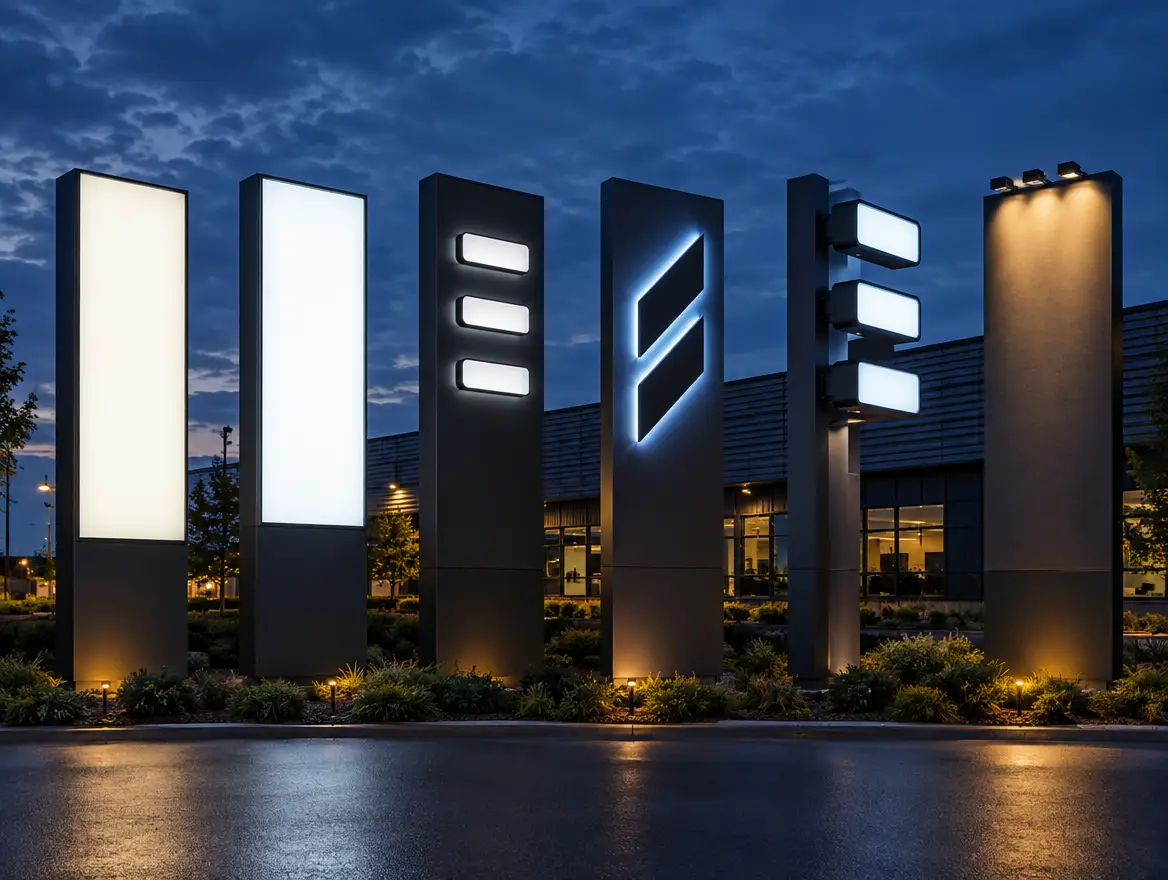 Five lighting methods suit pylon signs: internally lit lightbox faces, push-through acrylic, routed aluminium with LED backlighting, fabricated channel letters on blades, and external floodlighting. Internally lit faces are the most common choice because they balance cost, legibility and durability. The others solve specific design or site problems.
Internally lit lightbox faces: flex face vs rigid acrylic
An internally lit pylon sign (often called a lightbox pylon sign) houses light sources inside an aluminium cabinet. The light passes through a translucent face carrying your graphics. The face material is the big decision.
Flex face
- Printed translucent membrane stretched tight across the frame.
- Suits large faces where rigid sheets would be heavy and expensive.
- Full-colour printing makes logos and imagery straightforward.
- Faces can be replaced without rebuilding the cabinet.
- Needs correct tensioning and a UV-stable material, or it can sag and fade.
Rigid acrylic
- Flat sheets with applied translucent vinyl or printed graphics.
- Holds a crisp, flat appearance and resists sagging.
- Often the better choice for small to medium faces and sites where appearance must stay sharp.
- Heavier and usually costlier to replace than flex.
For most franchise and roadside sites, either works. The deciding factors are face size, wind exposure, how often branding changes and how much you want to spend at replacement time.
Push-through acrylic letters
Push-through signage cuts the letters or logo out of an aluminium face and fits thick acrylic that sits flush or slightly proud. Light from the cabinet glows through the acrylic only, so the message stands out against a solid, opaque face.
The result is high contrast and very crisp edges. It suits short brand names and simple logos. Precision matters, so accurate cutting is essential. This is where laser-cut components earn their place.
The trade-off is cost, plus the need for clean internal light spread behind every letter.
Routed aluminium faces with LED backlighting
A routed aluminium face has the graphics machined out of a solid panel, with acrylic or other diffusing material behind and LEDs lighting it from within. At night the logo glows sharply on a dark face. In daylight it reads as a clean, solid panel.
This suits premium retail, commercial and corporate sites. It resists UV well and looks refined. The design needs careful LED layout and heat management, since cramped modules behind small routed areas can run hot or show uneven light.
Fabricated channel letters on pylon blades
Channel letters are individually fabricated letters, each with its own LED light source, mounted on the pylon blade or panel. They can be face-lit (light through the front) or halo-lit (light reflected from the wall behind).
They give a strong, three-dimensional presence and work well when a brand name is short. The downsides are more components, more wiring and more points of potential failure. They also add wind loading, which the pylon engineering must allow for.
External floodlighting
External floodlighting aims lights from the ground or from arms at the face of a sign. It is often used on existing opaque or non-translucent faces because it avoids rebuilding the cabinet.
It is also the method most likely to cause problems. Light can spill past the sign, create glare for passing drivers, light up neighbouring properties and send light upward. Fittings collect dirt, insects and moisture on lenses. Where a pylon sits near homes or busy roads, floodlighting deserves close scrutiny under obtrusive-light guidance.
How Do LED Modules Compare With Fluorescent Tubes in Pylon Signs?
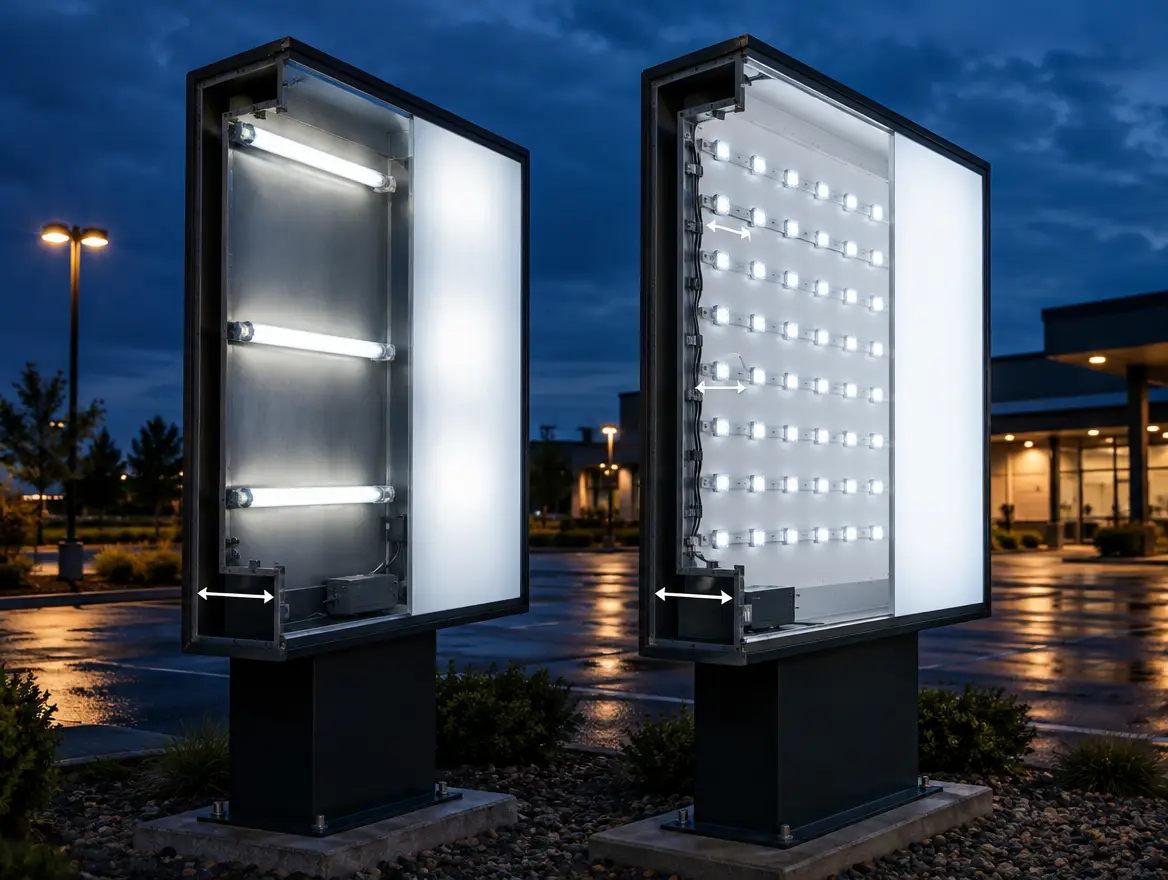 LED modules use less power, last longer, hold colour better and spread light more evenly than fluorescent tubes when the cabinet is designed correctly. Fluorescent cabinets dim, flicker and shift colour as tubes and ballasts age. Exact savings depend on the product, so ask for datasheet figures.
Energy use and lifespan
The US Department of Energy notes that LED lighting is more energy efficient and longer lasting than traditional lighting (see References). For signs, the practical measures are:
- Power draw (watts) for your cabinet size. Ask suppliers to compare the existing tube and ballast load against the proposed LED modules and drivers.
- Rated lifespan. Reputable manufacturers publish rated life on their datasheets, usually as hours until output falls to a set percentage of the original. Use the manufacturer's figure for the exact module, not a generic claim.
- Replacement frequency. Fewer lamp changes mean fewer access visits, which matters when a pylon needs an elevated work platform.
Treat any quoted lifespan as a typical rating under test conditions. Heat, moisture and power quality in a roadside cabinet can shorten real-world life, which is why enclosure design matters.
Colour consistency and even light spread
Fluorescent tubes drift in colour and brightness as they age, and replacing one tube in a set leaves a visible mismatch. LEDs hold colour more steadily, but only if the modules come from the same production batch and colour temperature. Mixing batches years later can leave patchy faces, so record the module specification at installation.
Avoiding hot spots
Hot spots appear as bright dots or bands behind the face. They usually come from modules that are too far apart, a cabinet that is too shallow, or a face that is too translucent for the layout. Fixes include:
- Matching module spacing to the cabinet depth and face material.
- Using diffuser layers or a lighter-transmission face where needed.
- Painting the cabinet interior white to bounce light evenly.
- Choosing dimmable drivers so output can be tuned after installation.
A good LED cabinet looks uniform from the road. A poor one looks like a grid of dots.
Retrofitting existing pylons: fluorescent to LED
Retrofitting is often the sensible first option when the pylon structure is sound. A typical upgrade involves inspecting the cabinet and structure, removing tubes and ballasts, fitting LED modules and drivers, replacing or refreshing the face, and resealing the cabinet.
Check these before committing:
- Structure and corrosion. If the frame, footings or cabinet are compromised, lighting is the lesser issue.
- Water ingress. Old cabinets often leak. New LEDs in a wet cabinet will fail early.
- Face condition. A faded or yellowed face wastes the benefit of new lights. Replace it at the same time, and choose a UV-stable material.
- Wiring and isolation. Old wiring, transformers and switches may need replacing. All electrical work must be done by a licensed electrician.
- Weight and wind loading. If the new face or components differ from the original, confirm the structure can carry them.
If the structure is in poor shape, or your branding and size needs have changed, a new pylon may cost less over time than patching an old one.
What Council and Lighting Rules Apply to Illuminated Pylon Signs?
Council and lighting considerations for illuminated pylons centre on brightness, hours of operation and glare. Requirements differ by council, zone and road, so confirm them locally before you design. Obtrusive-light guidance under AS/NZS 4282 is a useful benchmark, and all electrical connection must be done by a licensed electrician.
Brightness near homes and roads
Councils typically care about two things: light spilling into nearby homes, and glare that distracts drivers. A pylon beside residential suburbs or a busy intersection draws more scrutiny than one in an industrial estate. We do not quote specific limits here because they vary by council and by approval conditions. Check the conditions attached to your development approval or ask the council directly.
Timers and dusk sensors
Two controls make a practical difference:
- Dusk sensors (photocells) switch the sign on when natural light falls and off at dawn, so it does not run in daylight.
- Timers switch the sign off or dim it after your trading hours, which cuts energy use and reduces light nuisance.
If your approval sets operating hours or brightness conditions, these controls make compliance easier. Dimmable LED drivers allow a lower night-time output after peak traffic.
Obtrusive light and AS/NZS 4282
AS/NZS 4282, Control of the obtrusive effects of outdoor lighting, is the Australian and New Zealand standard that addresses spill light, glare and sky glow from outdoor lighting. Councils and designers often refer to it when assessing lit signage near homes. Whether and how it applies to your sign depends on the local planning conditions, so ask your council or a lighting designer to confirm.
If your sign is visible from a state-controlled road, the Queensland Department of Transport and Main Roads may also have requirements for advertising devices. Confirm this early.
Electrical connection
Electrical work on a pylon, including connecting the sign to mains power, installing isolators and wiring drivers, must be carried out by a licensed electrician in Queensland. Do not accept shortcuts here. It is a safety issue and an insurance issue.
Where to check approvals
Approval pathways differ between regions. Our location guides for pylon signs on the Sunshine Coast, in Noosa and in Toowoomba cover those areas, and our multi-tenant pylon sign guide covers layout questions for shared sites. Confirm local requirements with your council before you commit to a lighting design.
How Do You Maintain an Illuminated Pylon Sign?
Maintain an illuminated pylon sign by choosing UV-stable faces, sealing the cabinet against moisture and insects, fitting proper access panels and inspecting the sign at least once a year. Replace LED modules when brightness drops visibly, sections fail or colour no longer matches, rather than waiting for a full outage.
UV-stable faces
Queensland sun is hard on signage. Cheap faces yellow, fade or become brittle. Specify UV-stable flex or acrylic and ask about the manufacturer's warranty on colour retention. A faded face wastes the lighting behind it and weakens the brand.
Sealing against moisture and insects
Humidity, storms and coastal air are the main causes of premature LED failure. Good cabinets use sealed joins, drainage paths for condensation, gaskets on access panels and cable glands that stop water travelling along wires. Insects get into poorly sealed cabinets and block light, so screening and sealing details matter. Along the Sunshine Coast, salt-laden air adds a corrosion risk for fixings and frames.
Access panels
A cabinet that cannot be opened easily does not get maintained. Plan access panels at a height and position that suit your service provider, and consider whether an elevated work platform will be needed. Easy access reduces service time and cost.
When to replace LED modules
LEDs rarely fail all at once. They dim gradually. Replace modules when:
- The face looks noticeably dimmer than when installed.
- Individual modules or sections have failed.
- Colour no longer matches across the face.
- Drivers or power supplies show faults.
Compare operating hours against the rated lifespan in the manufacturer's datasheet. If the sign runs from dusk to dawn every night, it reaches that rating sooner than one that is switched off after trading hours. Replacing the full set at once keeps colour and brightness even.
Pylon Lighting Planning Checklist
A planning checklist for pylon lighting covers six decisions: viewing distance, face materials, power supply location, operating hours, council conditions and budget priorities. Settling these before quoting prevents redesign, avoids over-specifying, and helps the fabricator size the lighting correctly for your road.
- Viewing distance and speed. How far away, and how fast, will drivers be when they first need to read the sign? Size lettering and choose contrast for that, not for the view from the footpath.
- Face material. Flex face, rigid acrylic, push-through or routed aluminium? Match it to size, wind exposure and how long the branding will stay unchanged.
- Light source and layout. LED modules sized to the cabinet depth, with dimmable drivers where council conditions or neighbours make that useful.
- Power supply location. Where will mains power reach the pylon? Trenching and cable runs can be a significant cost, and a licensed electrician must make the connection.
- Operating hours and controls. Dusk sensors, timers and any after-hours dimming. Decide whether the sign lights all night or only during trading hours.
- Budget priorities. Decide whether upfront cost, running cost or low maintenance matters most. Good LED systems usually cost more at install but less to run and service.
Also confirm approvals and conditions with your council before finalising the design. Our team can also coordinate related signage such as lightbox signs, channel letters and shopfront and business signs so everything on the site matches at night.
Ready to quote? Contact Sunquest Signs for a site assessment and quote on a new illuminated pylon or an LED upgrade of an existing pylon. Tell us the site location, the road the sign faces and your trading hours, and we will recommend a lighting method that suits.
Why Trading Hours Should Decide Your Pylon Lighting, Not Sign Size
Our view at Sunquest is that most pylon lighting is specified backwards. Buyers choose the face and size first, then ask what lighting fits. The better order starts with trading hours and the road, because those decide how much brightness you need, how long it runs and how hard the sign works.
Consider two hypothetical sites. The first is a car yard on an arterial road that closes at six in the evening. The second is a 24-hour service station on a highway bypass. Both might order a similar-sized lightbox pylon. But the car yard needs strong dusk-to-close visibility and an automatic switch-off or dim setting. The service station needs a sign that runs every night, so driver quality, cabinet sealing and module access matter far more than they do for the car yard.
The second part of our position is contrarian: brighter is not better. An over-driven face blows out lettering, reduces contrast and attracts neighbour complaints. A well-diffused, moderately bright face with dimming usually reads better from the road than a harsh one. We would rather specify lower output with good contrast and dimmable drivers than maximum output that someone has to turn down after a complaint.
The third point is about retrofits. Upgrading tubes to LED behind a faded, yellowed face is the most common false economy. The new light shines through old material and the improvement is muted. If you are spending money on LED modules, replace the face at the same time.
References
- Standards Australia, AS/NZS 4282 Control of the obtrusive effects of outdoor lighting
- US Department of Energy, LED Lighting
- WorkSafe Queensland, Electrical Safety Office
Talk to a signage expert
Tell us about your project and we'll come back with options and honest advice.
Get in TouchFrequently Asked Questions
How much does it cost to run an illuminated pylon sign?
Running cost depends on the sign size, the light source, the hours it operates and your electricity tariff. LED modules draw less power than fluorescent tubes, and timers or dimming reduce hours and output further. Ask your supplier for the wattage of the proposed system and multiply by your operating hours.
Are LED pylon signs better than fluorescent?
Generally yes. LED modules use less energy, last longer, hold colour more steadily and need fewer lamp changes than fluorescent tubes. They need a properly designed cabinet to avoid hot spots and to protect them from heat and moisture.
Do I need council approval to light a pylon sign?
Often yes, either as part of the sign approval or through conditions on brightness and hours. Requirements vary by council, zone and road, so confirm them with your local council before design. All electrical connection must be done by a licensed electrician.
How long do LED modules last in a pylon sign?
Manufacturers publish rated lifespans on datasheets, usually as hours until output falls to a set level. Real-world life depends on heat, moisture, power quality and operating hours. Replace modules when the face dims noticeably or sections fail, and replace them in full sets to keep colour even.
Can I upgrade an existing pylon to LED without replacing the structure?
Often you can, if the structure and cabinet are sound. A retrofit replaces tubes and ballasts with LED modules and drivers, and should include a new UV-stable face and resealing. An inspection will confirm whether corrosion, water damage or wiring issues make a full replacement the better option.
Related Articles
Pylon Sign Engineering and Installation: Footings, Wind Loads, Certification and What Happens on Site
Acrylic Laser Cutting for Signage: Cast vs Extruded, Edge Finishes and Design Tips
Sunshine Coast Signage Project Gallery: Real Local Sign Installs by Suburb and Sign Type
Signs that set you apart
Over 40 years on the Sunshine Coast. Design, compliance, manufacture and installation handled end to end.
Get a Free Quote