
Sign materials comparison guide
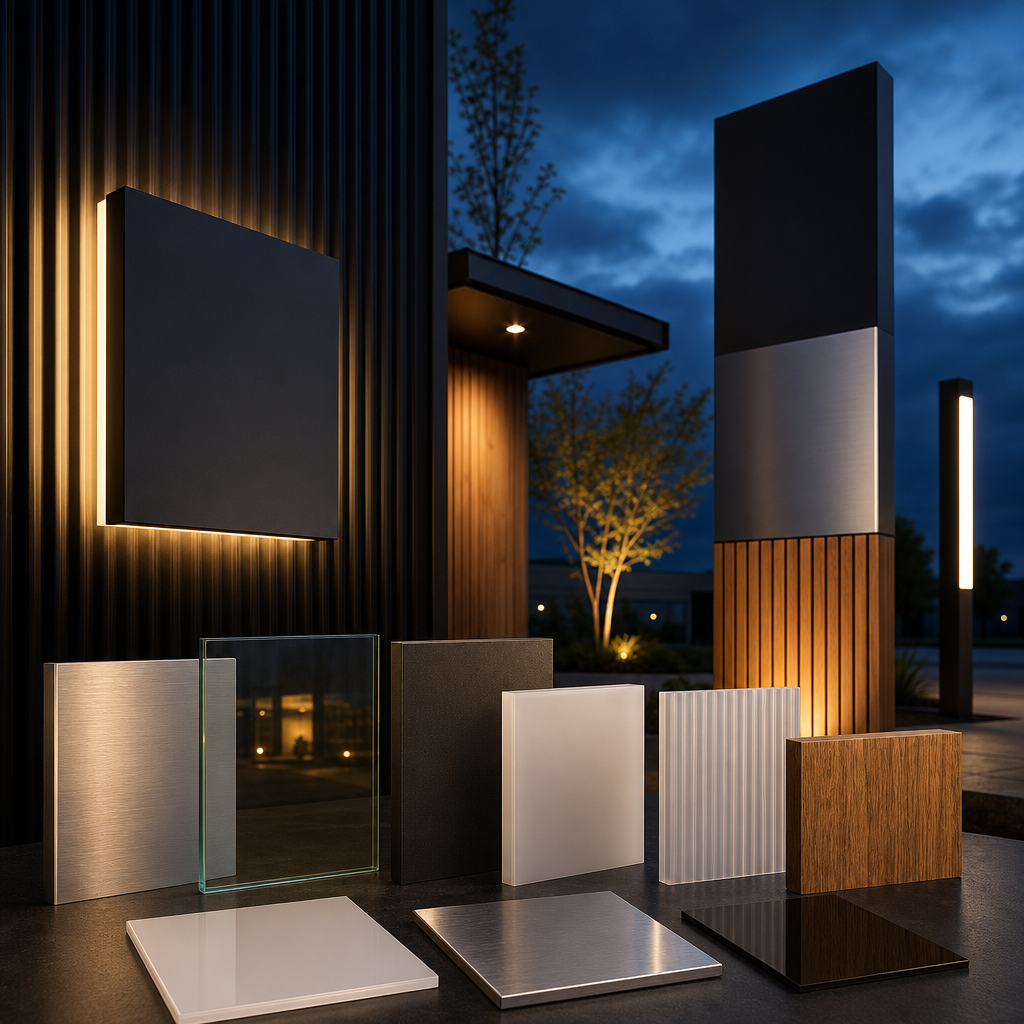
The right sign material depends on its location, exposure, structure, finish, installation method and required service life. Aluminium and aluminium composite material suit many outdoor signs, while acrylic, PVC, glass, timber, fabric and vinyl serve more specific purposes. Compare the complete sign system, not the face material alone.
Choosing signage from a sample board can be misleading. A material that looks convincing indoors may fade, warp, corrode or become difficult to clean once installed in an exposed Australian location.
This guide compares the main commercial sign materials, explains where each works, and shows how to assess weather, structural loads, maintenance, print compatibility, sustainability and whole-of-life cost.
Key takeaways
- Aluminium sheet and aluminium composite material are versatile choices for permanent commercial signage.
- Acrylic delivers a polished finish but needs appropriate support, expansion clearance and impact protection.
- PVC foam and corrugated polypropylene are better suited to controlled indoor settings or temporary campaigns.
- Outdoor performance depends on the complete system, including coatings, graphics, fixings, edges and supporting structures.
- Coastal exposure, heat, wind, fire requirements and maintenance access should influence material selection.
- The cheapest panel is rarely the cheapest installed sign over its full service life.
Ready to make your business impossible to miss?
Design, manufacture and installation, all under one roof in Warana.
Get a Free QuoteSummary table
| Material | Best suited to | Main strengths | Main limitations | Relative cost position |
|---|---|---|---|---|
| Solid aluminium | External identification, directional and regulatory signs | Durable, rigid, corrosion resistant and recyclable | Can dent and requires the correct coating system | Medium to high |
| Aluminium composite material | Fascia panels, wall signs and printed panels | Flat surface, low weight and efficient fabrication | Core composition and fire suitability must be checked | Medium |
| Acrylic | Reception signs, lettering, lightboxes and displays | Clean finish, strong colour and good light transmission | Can crack under impact and moves with temperature | Medium to high |
| PVC foam board | Indoor retail, displays and short-term promotions | Easy to print, cut and fabricate | Less suitable for heat, impact and prolonged exposure | Low to medium |
| Corrugated polypropylene | Temporary site, campaign and event signs | Lightweight, water resistant and economical | Limited rigidity and premium appeal | Low |
| Stainless steel | Architectural lettering and premium plaques | Strong, refined and corrosion resistant in the correct grade | Higher material and fabrication cost | High |
| Glass | Internal directories and architectural identification | Premium appearance and easy surface cleaning | Heavy, breakable and installation dependent | High |
| Timber | Hospitality, tourism and character-led signage | Natural appearance and easy custom shaping | Requires ongoing coating and moisture management | Medium to high |
| Fabric | Events, exhibitions and tensioned displays | Lightweight, portable and suitable for large graphics | Can soil, stretch or move in airflow | Medium |
| Self-adhesive vinyl | Windows, vehicles and panel graphics | Flexible, detailed and available in specialised films | Performance depends on film, ink, laminate and substrate preparation | Low to high |
What should you compare when choosing a sign material?
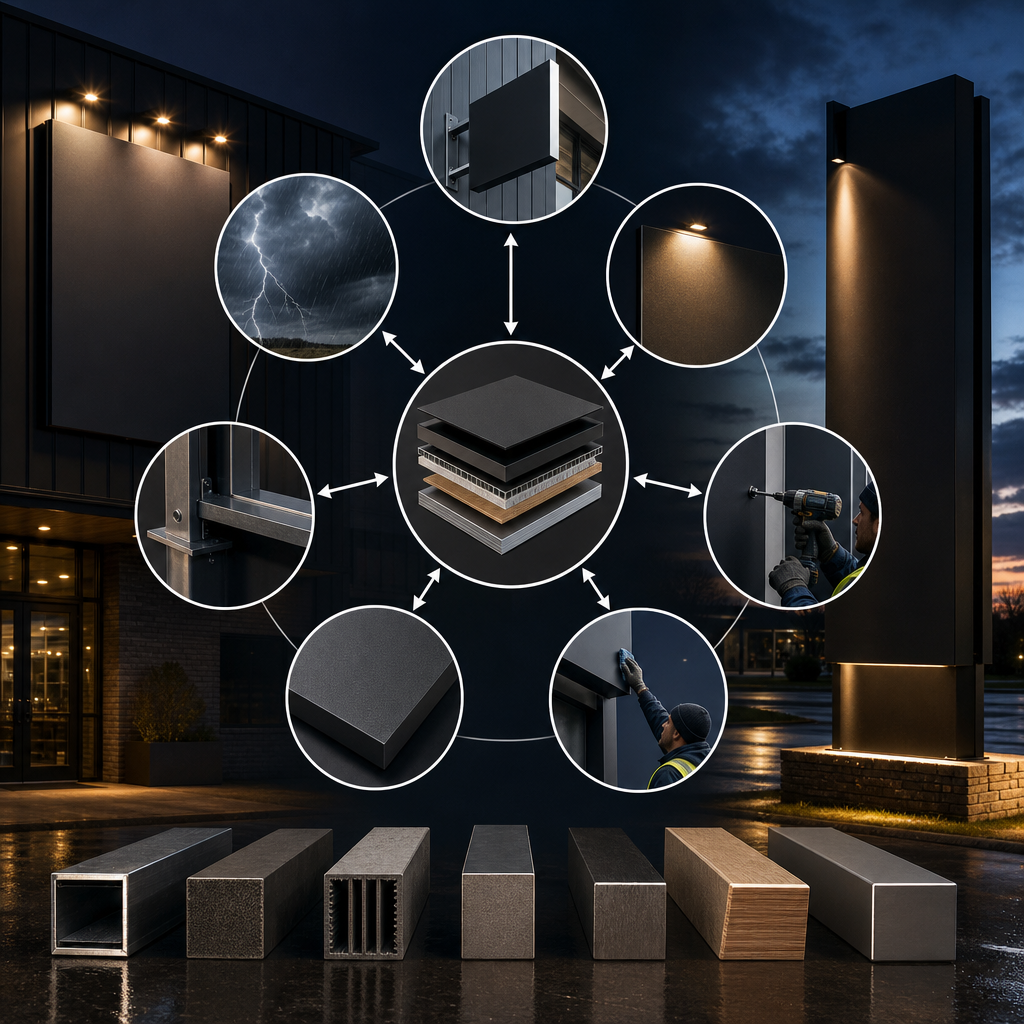
Compare the sign's environment, viewing distance, structural role, expected service life, finish, maintenance access and removal requirements. Material price matters, but it should follow these practical questions. A suitable panel with the wrong coating, fixings or graphic film can still produce an unreliable sign.
Indoor, sheltered or fully exposed
Start by defining exposure accurately. An indoor reception sign faces different risks from a west-facing fascia or a freestanding sign near the coast.
A sign beneath an awning is not necessarily protected. Wind-driven rain, airborne salt, dust and reflected heat can still reach it. Likewise, signs behind glazing may receive strong solar heat even though they never get wet.
For exposed positions, assess:
- Direct sun and the orientation of the sign
- Rainfall, humidity and standing water
- Coastal salt and industrial contaminants
- Heat around dark surfaces or enclosed cavities
- Wind pressure and vibration
- Likely impact, vandalism or cleaning chemicals
- Access for inspection and maintenance
Permanent, changeable or temporary
A permanent building sign should use materials and fixings that can be maintained without rebuilding the entire assembly. A menu board may need replaceable graphics. A construction sign may prioritise fast installation and removal instead of an architectural finish.
Avoid specifying a permanent-grade structure when the message changes frequently. Instead, separate the durable carrier panel from the replaceable graphic layer. This makes updates easier and can reduce waste.
Face material versus complete sign system
The visible panel is only one component. A typical sign may also include a frame, printed film, laminate, paint, adhesive, fixings, spacers, electrical components and wall penetrations.
These parts must be compatible. Corrosion can occur where unsuitable metals meet in wet conditions. Moisture can enter through unsealed edges. An otherwise durable vinyl may fail if installed over contaminated paint or an unstable substrate.
Specify the sign as a system rather than writing a single material name on a purchase order.
How do the main sign materials compare?
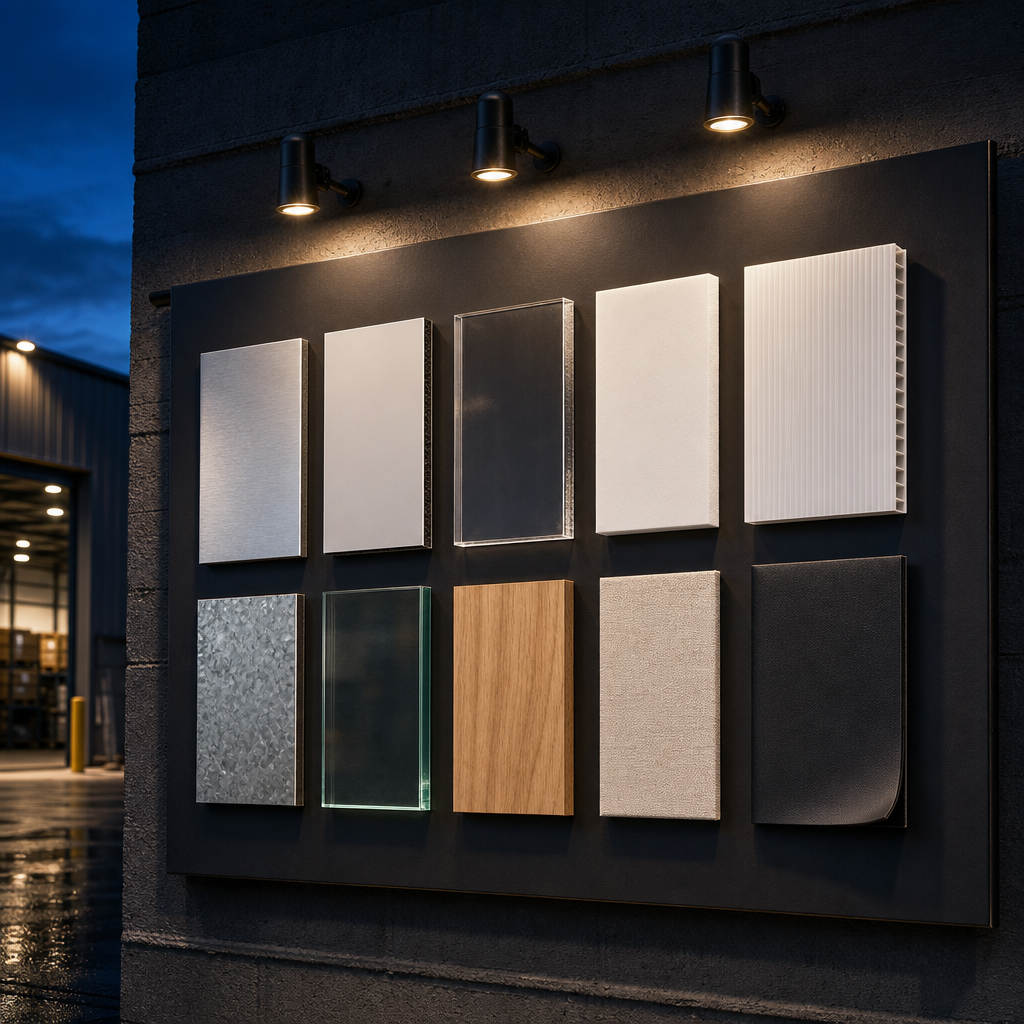
Aluminium offers the broadest outdoor versatility, while acrylic provides a more polished architectural finish. PVC foam, corrugated polypropylene and fabric suit lighter or shorter-term work. Stainless steel, glass and timber answer specific design needs but usually require more careful fabrication, installation or maintenance planning.
Solid aluminium
Solid aluminium is a dependable choice for outdoor sign faces, folded trays, directional systems and identification panels. It does not rust like untreated mild steel, accepts suitable paint systems and can be folded or reinforced for rigidity.
Its weaknesses are mostly design related. Large flat sheets can flex without returns or framing. Thin faces can dent. Cut edges, fixings and contact with dissimilar metals also need attention.
Choose solid aluminium when the sign needs a long-term external face, shaped tray or robust fabricated form. It is particularly useful where a damaged graphic may need replacement without discarding the metal panel.
Aluminium composite material
Aluminium composite material, commonly called ACM, combines thin aluminium skins with a core. It is light, flat and efficient to route, fold and mount. These qualities make it common for fascia panels, printed wall signs and flat building graphics.
Not every ACM product is interchangeable. Core composition, skin thickness, coating quality and fire performance vary. A product suitable for a detached roadside panel may not be suitable for every facade or building classification.
Where facade fire performance is relevant, material selection must be checked against the current National Construction Code and project-specific requirements. The Australian Building Codes Board publishes the NCC at https://ncc.abcb.gov.au/.
Acrylic
Acrylic is widely used for reception signs, dimensional lettering, illuminated faces, display panels and polished plaques. It can be clear, coloured, translucent, frosted or printed, making it useful when visual finish matters.
Acrylic expands and contracts as temperatures change. Large panels need suitable holes, clearances and support rather than rigid restraint at every point. Unsupported sections can bow, while overtightened fixings can create stress around holes.
Use acrylic where its edge quality, depth or light transmission contributes to the design. Do not select it merely as a more expensive substitute for a flat printed panel.
PVC foam board
PVC foam board is easy to print, route and fabricate. It works well for indoor retail graphics, exhibition displays, menu boards and wall-mounted promotional signs in controlled conditions.
Prolonged heat and external exposure can reveal its limitations. Large unsupported panels may move, and dark printed faces can absorb significant heat. It is also easier to dent than metal-based panels.
Treat PVC foam as a practical display substrate, not a default external building material. Where outdoor use is proposed, confirm the manufacturer's application guidance and provide adequate support.
Corrugated polypropylene
Corrugated polypropylene is a lightweight sheet used for temporary site signs, event directions, campaign material and short-term real estate signage. It resists ordinary moisture and can be printed directly.
Its fluted construction limits stiffness, edge quality and premium presentation. Wind can damage poorly supported sheets, while cable ties through unreinforced holes may tear the material.
It is appropriate when speed, portability and temporary use matter. It is usually the wrong choice for a permanent business identity sign.
Stainless steel
Stainless steel suits architectural lettering, plaques, directories and high-quality identification signs. Brushed, polished and fabricated finishes can retain a refined appearance when the correct grade and maintenance process are specified.
Stainless steel is not maintenance free. Coastal deposits and contaminants can still cause staining. Surface finish, grade, fabrication quality and cleaning access influence performance. The Australian Stainless Steel Development Association provides guidance on stainless selection and maintenance at https://www.assda.asn.au/.
Glass
Glass can produce a clean result for internal directories, reception signs and architectural panels. It works with printed films, etched effects, stand-off fixings and reverse-applied graphics.
Safety, edge treatment, weight and fixing design are critical. The glass type cannot be chosen on appearance alone. Holes and cut-outs must be coordinated before relevant heat treatment, and replacement access should be considered during design.
Glass is most effective where it complements the architecture. Acrylic may be more practical when lower weight, easier machining or impact tolerance is the priority.
Timber
Timber provides warmth and character for hospitality, tourism, retail and interpretive signs. It can be carved, painted, routed or combined with metal lettering.
Species selection, grain direction, moisture movement and coating maintenance all matter. Exposed end grain and horizontal ledges can retain water. Dark coatings can also increase surface heat.
Timber should be selected with an accepted maintenance commitment. Without that commitment, a convincing initial finish can deteriorate unevenly.
Fabric
Fabric works well for exhibition systems, tensioned displays, event backdrops and some illuminated boxes. It is light, transportable and capable of carrying large graphics without heavy rigid panels.
The fabric, print process, seam construction and tensioning system must suit the application. Loose fabric looks untidy, while airflow can create movement or noise. Cleaning methods should be established before purchase.
Self-adhesive vinyl
Vinyl is generally a graphic layer rather than a structural sign material. It is used on vehicles, windows, walls and rigid panels. Options include opaque, translucent, reflective, perforated and removable films.
Performance depends on the exact film, adhesive, ink, laminate, substrate and installation conditions. A premium film cannot compensate for chalking paint, silicone contamination, rough masonry or moisture beneath the surface.
Ask for the proposed product series and application specification. The term vinyl alone is too broad for meaningful comparison.
Which materials perform best in Australian outdoor conditions?
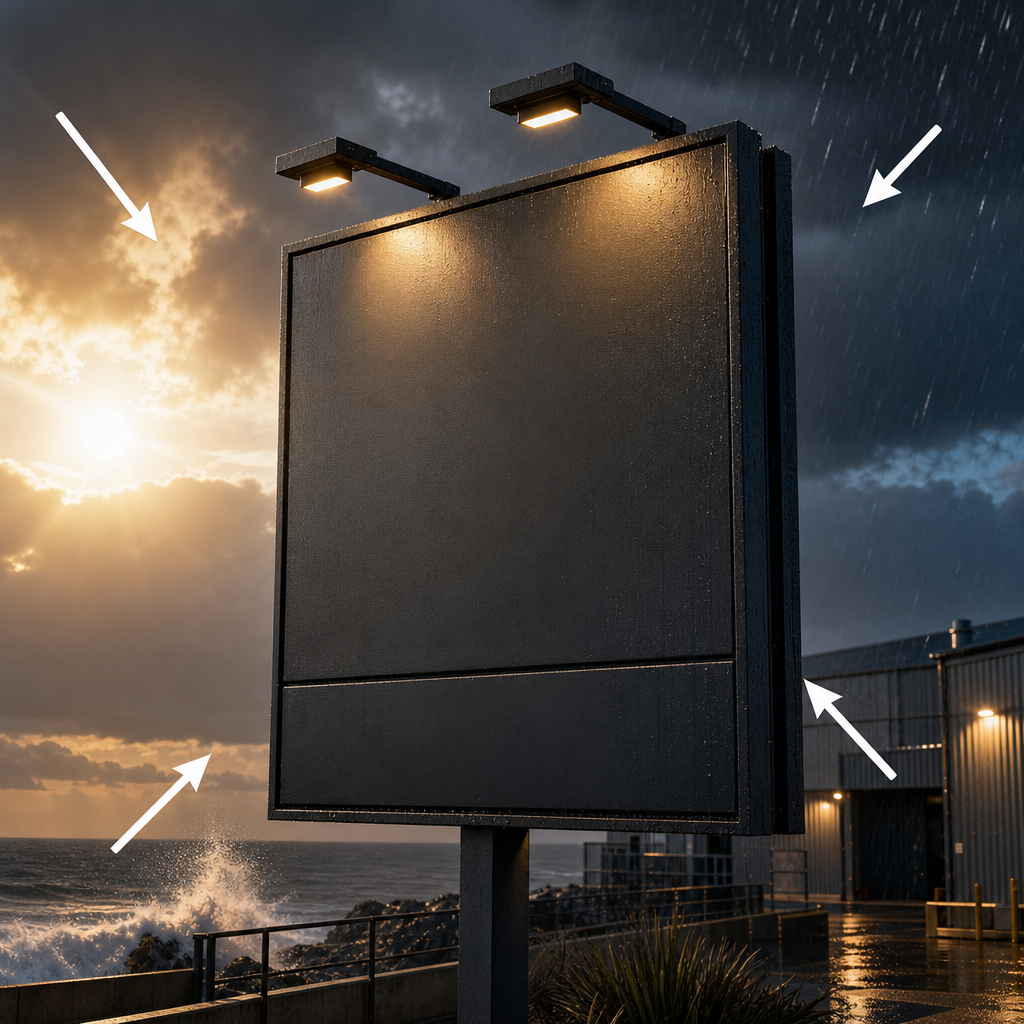
For many Australian outdoor locations, coated aluminium and suitable ACM provide a practical balance of rigidity, weather resistance and fabrication flexibility. However, coastal salt, intense sun, wind exposure, bushfire considerations and facade rules can change the answer. Site exposure should be assessed before artwork or fabrication begins.
Coastal and high-salt locations
Salt deposits can affect fixings, metal interfaces, coatings and electrical components. A sign near surf or prevailing coastal winds may face more aggressive exposure than a site farther inland.
Material choices should account for:
- Appropriate metal grades and protective finishes
- Isolation between dissimilar metals
- Drainage rather than sealed moisture traps
- Accessible surfaces for washing
- Fixings matched to the substrate and exposure
- Protected electrical connections in illuminated signs
Calling a material corrosion resistant does not remove the need for cleaning. Deposits can remain on sheltered surfaces because rain does not wash them away.
Heat and ultraviolet exposure
North-facing and west-facing signs can receive severe solar exposure. Dark colours commonly reach higher surface temperatures than light colours, which can increase movement across panels, films and adhesives.
Check whether the proposed print, laminate, paint or acrylic is intended for external use. Manufacturer warranties often depend on orientation, colour, application surface, installation method and geographic exposure. A generic promise about outdoor vinyl is not enough.
Design can also reduce risk. Smaller panel modules, appropriate expansion gaps and replaceable graphic faces make future maintenance more manageable.
Wind and structural loading
A large sign acts as a sail. The panel, frame, posts, brackets, anchors and supporting building all form part of the load path.
Structural design should consider the site's wind region, terrain, shielding, height and sign geometry. AS/NZS 1170.2:2021, Structural design actions, Part 2: Wind actions, is the relevant Australian and New Zealand standard for determining wind actions. Standards Australia lists the standard at https://store.standards.org.au/product/as-nzs-1170-2-2021.
Engineering requirements should be confirmed by a suitably qualified professional where the sign's size, location or mounting warrants it. A thicker face panel does not correct inadequate posts or anchors.
Fire and building facade considerations
Signs attached to buildings may interact with facade, egress, electrical and fire requirements. This is particularly important for composite panels, illuminated assemblies and signs installed near exits or on regulated building elements.
Do not infer compliance from a generic material description. Confirm the exact product, core, test evidence, installation detail and building application against the current NCC and approval requirements.
How do print, finish and lighting affect material choice?
Print method, surface finish and illumination can narrow the suitable substrate list before structural considerations begin. Direct print suits many flat panels, applied film allows replacement, dimensional lettering creates depth, and translucent materials support lighting. The intended visual result should be specified alongside durability and maintenance requirements.
Direct print or applied film
Direct printing places ink onto the sheet. It can simplify production for flat signs and short campaigns. Applied film creates a separate graphic layer and can make future replacement easier when the carrier panel remains sound.
Neither approach is automatically superior. The decision depends on expected updates, edge exposure, surface texture, colour requirements and available protective coatings.
For a frequently updated tenancy board, replaceable vinyl graphics on a durable panel may be sensible. For a temporary promotional board, direct print may avoid unnecessary layers.
Paint and powder coating
Painted and powder-coated finishes can create consistent corporate colours and protect metal surfaces. The substrate preparation, pretreatment, coating chemistry and exposure category all affect performance.
Colour matching should also account for sheen and surrounding materials. The same nominated colour can appear different on textured powder coat, gloss acrylic, printed vinyl and illuminated faces.
Dimensional letters
Dimensional letters can be produced from acrylic, aluminium, stainless steel, PVC and layered combinations. Material thickness alone does not determine quality. Edge finishing, mounting depth, return construction and shadow lines influence the final result.
For public-facing installations, consider whether projecting elements can be reached, climbed on or damaged. Concealed fixings can improve appearance, but they must remain inspectable where practical.
Illuminated signs
Illuminated signs require coordination between the face material, light source, internal spacing, ventilation, access and electrical design. Translucent acrylic and flexible sign-face products serve different structures and scales.
Uneven illumination often results from the complete internal layout rather than the face material alone. The design should allow safe maintenance without removing unrelated facade components.
How should you compare sign cost and expected service life?
Compare total installed and maintained cost, not the price of the blank panel. Include design, engineering, fabrication, coatings, graphics, access equipment, approvals, installation, cleaning, graphic replacement and eventual removal. A higher-cost reusable structure may be better value when messages change but the sign location remains constant.
Why material-only quotes mislead
A low panel price can be offset by extra framing, difficult edge finishing or frequent replacement. Conversely, an expensive architectural material may add little value where the sign is viewed briefly from a road.
Request quotations that separate:
- Sign face and structural frame
- Printed graphics or coatings
- Brackets, posts and fixings
- Engineering and approvals where required
- Electrical work for illumination
- Access equipment and traffic management
- Removal of existing signage
- Maintenance and replacement assumptions
This makes competing proposals easier to compare. It also exposes cases where one quote excludes essential work.
Match material life to message life
A sign face can remain structurally sound long after its branding or information becomes obsolete. This mismatch creates avoidable waste.
Consider a hypothetical medical centre directory. The external cabinet may remain in place while practitioner names change. A durable frame with modular inserts is more practical than replacing the whole sign whenever a tenancy changes.
The opposite applies to a short event. Specifying a heavy permanent panel and elaborate concealed mounting may add cost without improving the outcome.
Treat warranties carefully
Warranties usually apply to named products under defined preparation, exposure and installation conditions. They may cover material defects without covering removal, access equipment, reprinting or installation labour.
Ask what the warranty covers, who provides it and what maintenance records are required. Avoid using a warranty term as a substitute for a site-specific material assessment.
Which sign materials are more sustainable?
No sign material is automatically sustainable. The better choice usually minimises unnecessary material, lasts for the required period, allows message updates and has a realistic recovery pathway. Reusable aluminium structures can perform well, while temporary plastics may be justified when they prevent a heavier, over-specified installation.
Start with reduction and reuse
The strongest opportunity often sits in the design. Use replaceable inserts, removable films, standard panel modules and mechanical fixings where appropriate. These choices can preserve the main structure during a brand or tenant change.
Avoid bonding mixed materials together unless the assembly requires it. Permanent adhesives can make separation and recycling more difficult.
Ask what happens locally
A material being technically recyclable does not prove that local collection, separation and processing are available. Printed surfaces, adhesives, composite cores and contamination can affect acceptance.
Ask the supplier to identify the likely waste stream for offcuts and removed signs. Then verify that pathway with the relevant local service rather than relying on a recycling symbol.
Be precise with environmental claims
Broad claims such as green, eco-friendly or fully recyclable can mislead when they lack context. The ACCC's Making environmental claims: A guide for business explains that environmental claims should be accurate, evidence-based and clear about relevant conditions. The guide is available at https://www.accc.gov.au/about-us/publications/making-environmental-claims-a-guide-for-business.
A useful specification states what is reduced, reusable, recycled or recoverable. It should also identify any limitations.
What installation and maintenance issues should be planned early?
Installation and maintenance should influence the design before material is ordered. Panel weight, access, wall condition, wind loading, hidden services, drainage, cleaning and replacement routes all affect the finished result. A visually suitable material may still be impractical if it cannot be fixed safely or serviced economically.
Confirm the mounting substrate
Brick, concrete, metal cladding, glass and framed walls need different fixing strategies. Cladding alone may not provide adequate structural support. Waterproofing details also matter where fixings penetrate a building envelope.
A site survey should identify dimensions, levels, access restrictions, electrical supply, likely hidden services and the condition of the mounting surface. Do not rely solely on architectural drawings for an existing building.
Design out water traps
Folded trays, frames and letter returns should drain rather than retain water. Horizontal ledges collect dirt and organic material. Unsealed cut edges may expose vulnerable components within composite products.
Drainage details should not send staining across a visible facade. The installation also needs to preserve required building seals.
Plan cleaning around the finish
Aggressive solvents, abrasive pads and pressure cleaning can damage graphics or coatings. Cleaning instructions should identify suitable products, tools and inspection points.
Coastal signs may need deposit removal even when they look clean from the ground. Illuminated signs also need periodic checks for water entry, failed components and cable condition.
Make replacement possible
A sign is easier to own when damaged faces, lamps, power supplies or tenant panels can be accessed independently. Concealed fixings should not turn routine maintenance into destructive removal.
Before approving a design, ask how each visible and electrical component will be replaced. If the answer requires dismantling the surrounding facade, revise the detail.
The most expensive mistake is choosing the material before the sign system
The common buying sequence is backwards. Buyers often choose acrylic, metal or ACM from a sample, then ask how it should be mounted. A better sequence defines exposure, message life, structure, replacement method and finish first. Material selection becomes clearer once those constraints are fixed.
This is the practical position behind a sound sign materials comparison guide: substrate rankings are less useful than failure-path analysis.
For each option, ask what is most likely to fail first. The answer might be the print, an adhesive edge, a coating, a fixing, the wall substrate or the message itself. Improving a different component may produce a better result than upgrading the panel.
Consider a hypothetical coastal cafe fascia. Replacing ACM with solid aluminium may not solve staining if unsuitable fixings, trapped salt and inaccessible ledges remain. The material upgrade addresses only one failure path.
Now consider an internal directory. Premium stainless steel may last, but a fixed layout becomes wasteful whenever tenants change. A modular insert system on a simpler structure may serve the site better.
Use this decision sequence:
- Define where the sign will sit and what reaches it.
- Decide how long the structure and message need to remain useful.
- Establish wind, facade, fire, access and approval constraints.
- Choose whether graphics should be permanent or replaceable.
- Compare substrates that meet those constraints.
- Detail coatings, edges, fixings, drainage and maintenance.
- Review whole-of-life cost before approving fabrication.
Sunquest Signs can assess the site, intended finish and installation requirements before recommending a material. To discuss a project, visit /contact.
References
These sources provide authoritative guidance for structural wind actions, building compliance, stainless steel selection and environmental marketing claims. Product-specific decisions should also use current technical data from the chosen material, coating, adhesive and graphic-film manufacturers, together with advice from relevant building and engineering professionals.
- Australian Building Codes Board, National Construction Code: https://ncc.abcb.gov.au/
- Standards Australia, AS/NZS 1170.2:2021 Structural design actions, Part 2: Wind actions: https://store.standards.org.au/product/as-nzs-1170-2-2021
- Australian Competition and Consumer Commission, Making environmental claims: A guide for business: https://www.accc.gov.au/about-us/publications/making-environmental-claims-a-guide-for-business
- Australian Stainless Steel Development Association, technical information and stainless steel guidance: https://www.assda.asn.au/
FAQ_SCHEMA_JSON
Talk to a signage expert
Tell us about your project and we'll come back with options and honest advice.
Get in TouchFrequently Asked Questions
What is the best material for an outdoor business sign?
Coated aluminium or suitable aluminium composite material works for many outdoor business signs because both can provide a flat, weather-resistant face. The better choice depends on size, framing, facade requirements, coastal exposure and finish. Acrylic or stainless steel may be preferable where depth, illumination or architectural presentation is central.
Is aluminium composite material suitable for every building facade?
No. ACM products differ in core composition, aluminium skin, coating and fire performance. Suitability depends on the exact product, building classification, location and installation detail. Check the current National Construction Code, approval requirements and relevant product evidence.
Is acrylic better than aluminium for signage?
Neither is universally better. Acrylic is useful for polished lettering, clear panels and illuminated faces. Aluminium is generally more impact tolerant and versatile for fabricated outdoor sign bodies. The design may use both materials.
What is the cheapest sign material?
Corrugated polypropylene and some lightweight display boards commonly occupy the lower end of material cost, but they serve different applications from fabricated metal signs. Compare installed cost, expected use, replacement frequency and removal rather than panel price alone.
How long should outdoor signage last?
There is no responsible universal lifespan. Exposure, orientation, coating, print system, colour, cleaning, fixings and structural design all influence service life. Request product-specific documentation and distinguish between the sign structure, printed graphic, illumination and brand message.
Can old sign materials be recycled?
Some metal panels and frames may enter established recycling streams, while printed films, adhesives and composite products can be harder to process. Local acceptance varies, so confirm available recovery pathways before making a recycling claim.
Signs that set you apart
Over 40 years on the Sunshine Coast. Design, compliance, manufacture and installation handled end to end.
Get a Free Quote