
Window decals and one-way vision graphics
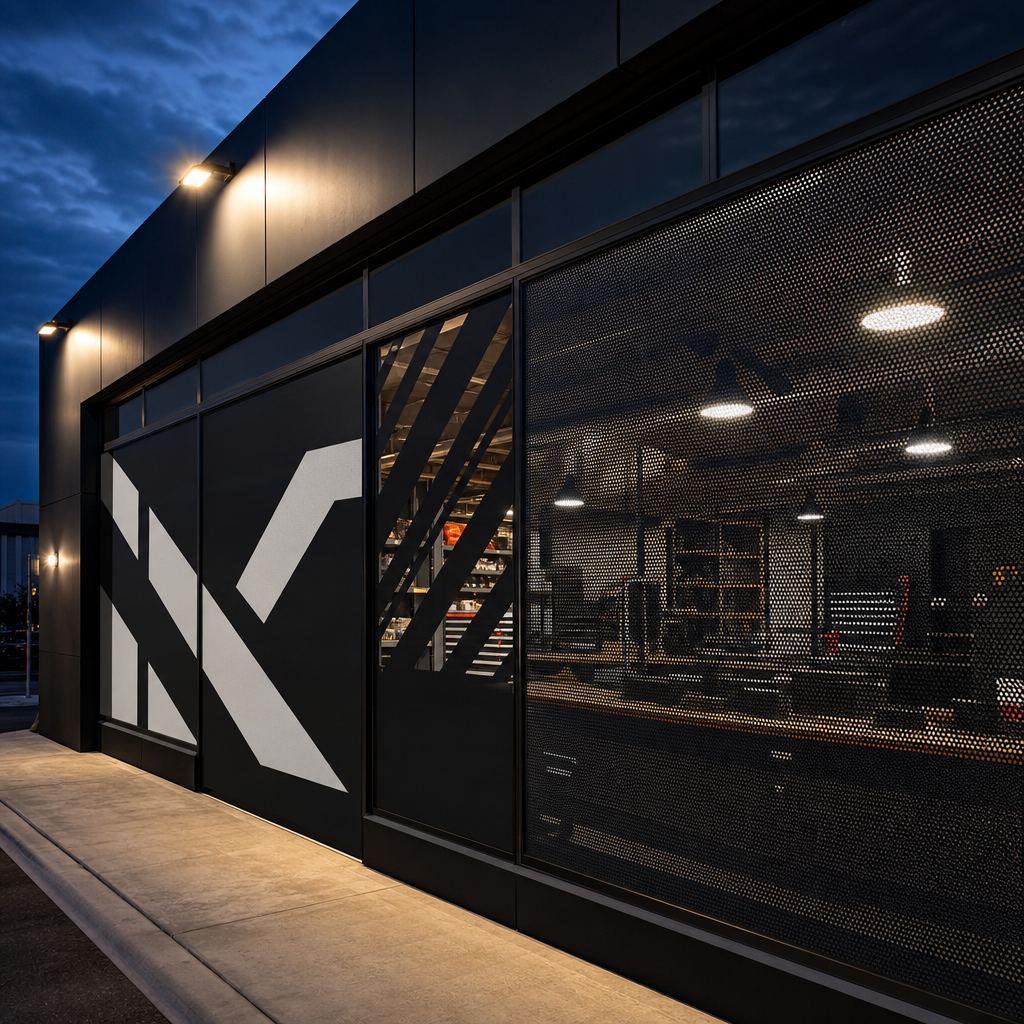
Window decals place printed, cut or frosted graphics on glass, while one-way vision graphics use perforated film to display an image outside while preserving views from the darker side. The right choice depends on privacy, visibility, lighting, artwork, glass type, installation conditions and whether the application is a building or vehicle.
Glass is valuable advertising space, but the wrong film can block natural light, weaken visibility or create a privacy result that fails after sunset. Product labels alone do not tell you what will work.
This guide explains the material choices, design requirements, installation risks and maintenance decisions Australian organisations should assess before ordering window graphics.
Key takeaways
The best window graphic is selected around the glass, viewing conditions and practical objective, not simply the artwork. These points cover the decisions most likely to affect appearance, privacy, durability and safe installation. They also explain why one film cannot perform every window signage task equally well.
- Standard decals suit solid branding, promotional messages and precise cut lettering.
- One-way vision film balances advertising coverage with outward visibility from the darker side.
- One-way privacy depends on relative lighting and may reverse when the interior becomes brighter.
- Artwork must account for perforations, window frames, viewing distance and interrupted panels.
- Glass condition, sealants and previous coatings can determine whether film adheres correctly.
- Vehicle and building applications require separate compliance checks before production.
Ready to make your business impossible to miss?
Design, manufacture and installation, all under one roof in Warana.
Get a Free QuoteSummary comparison
Window decals and one-way vision graphics solve different problems. The table below compares the practical characteristics that matter during product selection. It is intentionally qualitative because film specifications vary between manufacturers, adhesives, perforation patterns and installation environments. The final recommendation should follow inspection of the actual glass and intended viewing conditions.
| Option | Best suited to | View through glass | Privacy behaviour | Main design consideration |
|---|---|---|---|---|
| Printed window decal | Logos, promotions and solid visual areas | Blocked where opaque print is applied | Provides screening only where coverage is solid | Keep critical content away from frames and joins |
| Cut vinyl lettering | Trading hours, names and simple messages | Mostly retained around individual elements | Minimal privacy | Use suitable letter size and spacing for the viewing distance |
| Frosted film | Offices, consultation rooms and decorative screening | Diffuses detail while allowing light through | More consistent than perforated film | Balance screening height with sightlines and accessibility needs |
| Clear printed film | Subtle graphics and applications needing transparent areas | Retained through unprinted or transparent sections | Limited | White ink or backing may be needed for colour strength |
| One-way vision film | Shopfront advertising and selected vehicle windows | Retained from the darker side | Depends on lighting contrast | Use bold artwork that remains clear across perforations |
| Removable promotional graphic | Short campaigns and changing offers | Depends on material and coverage | Depends on coverage | Confirm removal expectations before selecting the adhesive |
What are window decals?
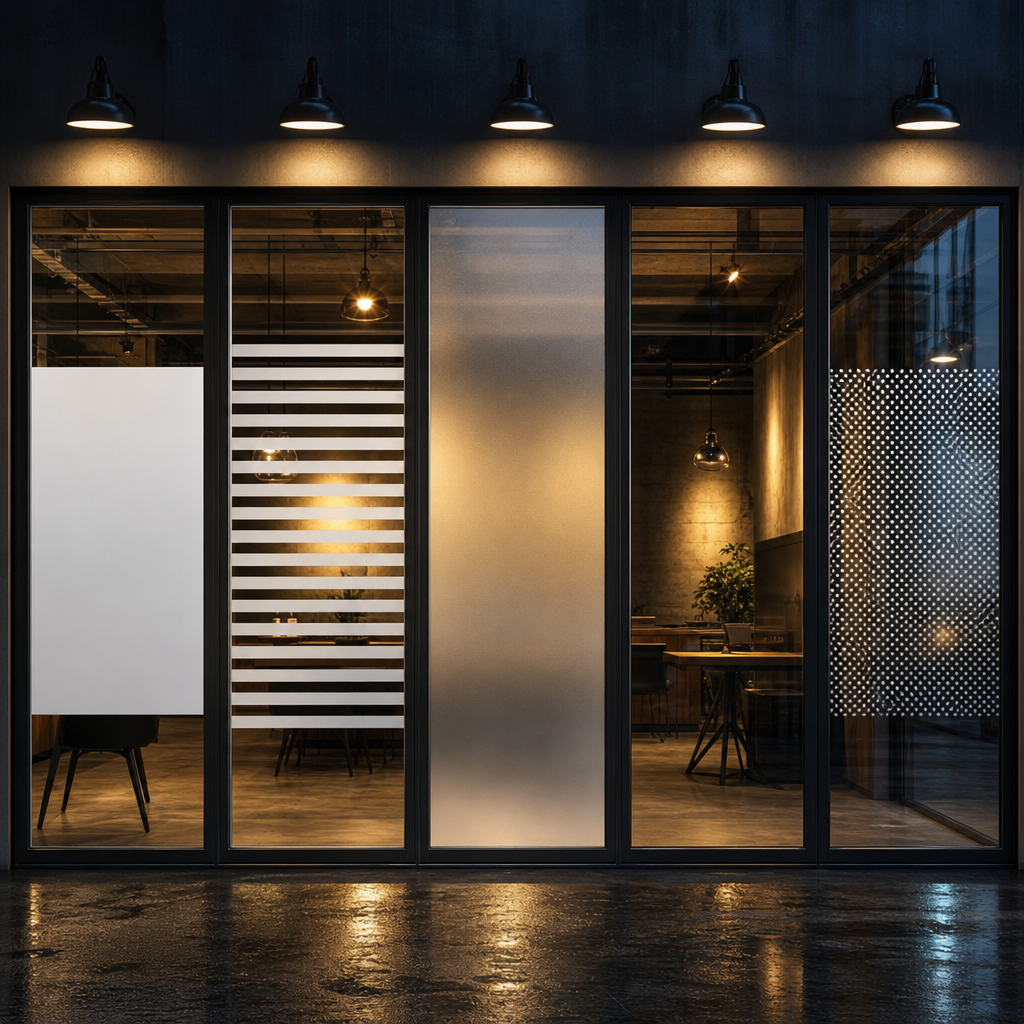
Window decals are graphics made from adhesive or cling-based films applied to glass. They can carry printed artwork, solid colours, cut lettering, frosting effects or transparent details. Unlike one-way vision film, a conventional opaque decal does not preserve visibility through the printed area unless transparency is deliberately built into its design.
The term "window decal" covers several materially different products. Treating them as interchangeable can lead to poor adhesion, difficult removal or artwork that looks weak from the intended side.
Printed adhesive vinyl
Printed vinyl is the direct choice for logos, campaign graphics, product photography and solid colour coverage. The graphic may be installed on the outside surface or reverse-printed for installation inside the glass.
Inside-glass installation protects the face from handling and weather, but it changes the material and print requirements. Standard opaque adhesive applied behind the glass may present the adhesive side to the viewer rather than the intended image. A sign supplier must specify a compatible clear film, white backing or layered print method.
Outside-glass installation generally gives a more direct visual result. It also exposes the film to weather, cleaning, pedestrian contact and edge contamination. Access and surface preparation therefore become more important.
Cut vinyl lettering
Cut vinyl uses individual letters or shapes rather than a printed rectangular panel. It works well for business names, opening information, entry instructions and restrained branding.
Its strength is visual simplicity. The glass remains open around the letters, and there is no unwanted clear border around the design. Its weakness is complexity. Fine strokes, intricate shapes and closely spaced elements can be harder to manufacture, apply and maintain.
Frosted and translucent films
Frosted film diffuses the view through glass without creating a fully opaque wall. It is commonly considered for meeting rooms, clinics, reception areas and offices where natural light is useful but direct sightlines are not.
Frosting can be installed as solid coverage, bands, patterns or cut branding. The position of the film matters as much as its design. A decorative strip placed below or above the actual sightline may provide little practical screening.
Static cling and low-tack options
Cling products can suit temporary promotions on compatible, clean glass. They avoid some adhesive removal concerns, but they are not automatically suitable for every orientation or exposure. Edges may lift where surfaces are contaminated, frequently handled or exposed to unsuitable conditions.
If a campaign has a fixed removal date, tell the supplier before production. Removability is a material selection issue, not a promise that can safely be added after printing.
How do one-way vision graphics work?
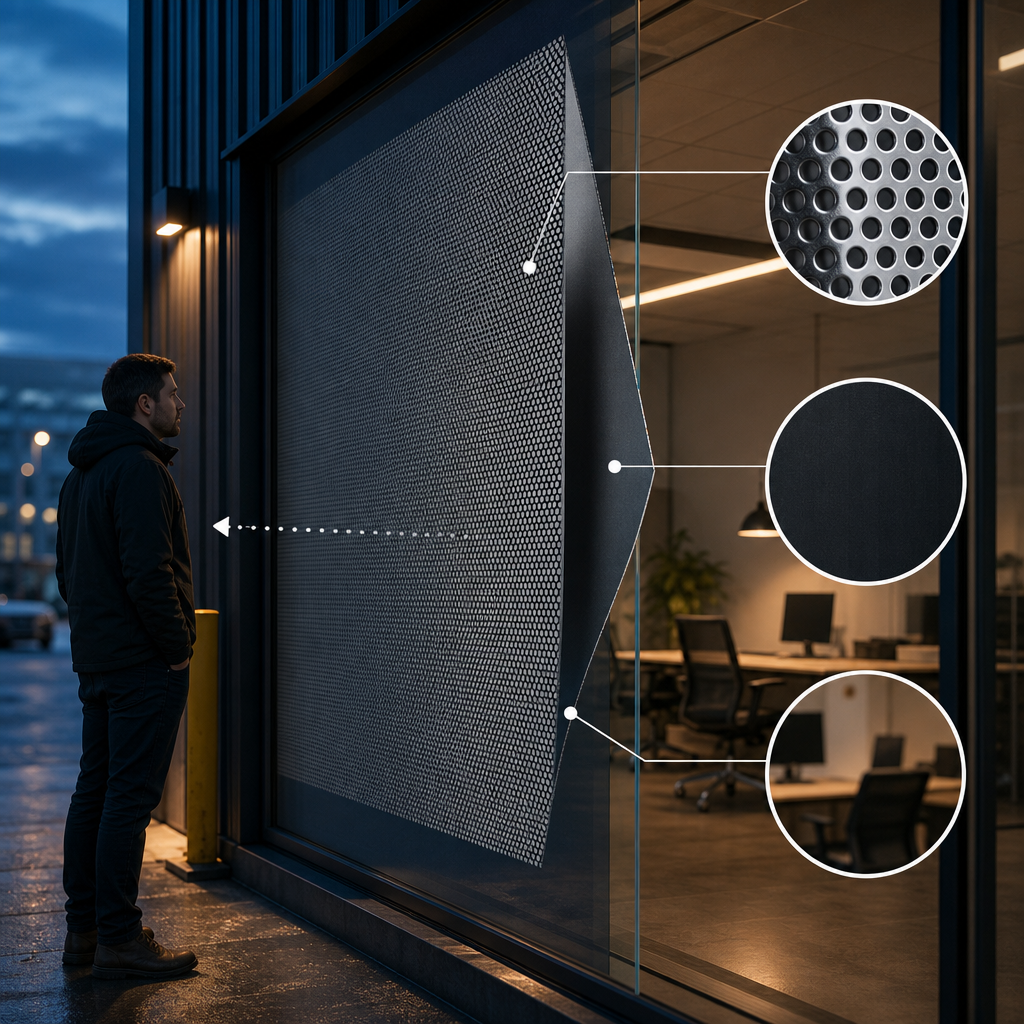
One-way vision graphics use perforated film containing printed areas and open holes. The outward-facing surface carries the image, while the reverse is usually dark. When the printed side is brighter than the viewing side, the eye reads the external graphic while a person inside can look through the perforations.
This is not absolute one-directional privacy. It is a visual effect produced by perforation, dark backing and lighting contrast. Contra Vision's explanation of the technology confirms that the effect relies on one side being more brightly illuminated than the other (Contra Vision).
Why the dark reverse matters
The dark surface facing the viewer inside reduces visual distraction. Instead of reading the printed artwork from behind, the viewer's attention passes through the open areas towards the brighter exterior.
If the reverse were visually busy or reflective, outward visibility would be less comfortable. This is why improvised perforated materials and incorrectly layered prints may not behave like purpose-made one-way vision film.
Why privacy can reverse after dark
During daylight, a bright exterior and darker shop interior usually support the intended effect. After dark, illuminated interiors and a dim exterior can reverse that relationship. People outside may then see through the perforations more easily.
Businesses requiring reliable privacy should not treat one-way vision film as a substitute for blinds, curtains, opaque film or controlled interior screening. The correct test is not "Can customers see in during the day?" It is "What happens under every lighting condition in which privacy matters?"
Visibility is reduced, not preserved unchanged
The open areas allow a view through the film, but they also interrupt it. Fine detail, low-contrast objects and poor weather can be harder to see through than bare glass. Dirt and water across perforations can further affect visibility.
That compromise may be acceptable on a shopfront. It requires more caution where the glass supports driving visibility, security observation or safety supervision.
Which product should you choose?
Choose standard decals when the priority is strong solid graphics, lettering or dependable screening across selected areas. Choose one-way vision film when external advertising must coexist with an outward view. Frosted film is usually better when consistent visual screening matters more than promotional colour or a clear view outside.
Start with the operational requirement, then select the film. Reversing that order often produces a visually attractive product that does not solve the underlying problem.
Choose standard decals for solid brand impact
Opaque decals suit windows where blocking the view is acceptable or intentional. Examples include a lower shopfront panel concealing storage, a campaign feature beside an entrance or a logo that must reproduce without perforations breaking up small details.
They also suit designs that rely on fine type, QR codes or subtle photographic detail. Any code still needs testing at the intended size and distance before production. Glass reflections, print finish and surrounding visual clutter can affect scanning even when the file itself is correct.
Choose one-way vision for advertising with an outward view
Perforated graphics make sense where a large shopfront needs visual coverage without making staff feel enclosed. They can also reduce the visual dominance of shelves, fixtures or internal activity when the exterior is brighter.
The trade-off is image density. The viewer outside does not see a continuous printed sheet. Small text and delicate details compete with the perforation pattern, reflections and whatever is visible behind the film.
Choose frosted film for dependable daytime screening
Frosted film is usually the stronger option for meeting spaces and consultation areas. It does not depend on an exterior image being brighter than the room. It diffuses the view in both directions, although silhouettes and movement may remain apparent depending on lighting and distance from the glass.
For sensitive rooms, assess what must be concealed. Hiding facial detail is different from concealing screens, documents or a person's presence.
Combine materials when one product cannot do everything
A shopfront does not need uniform coverage. A practical layout might use cut lettering near the entrance, solid graphics over an untidy internal zone and one-way vision across windows where staff need an outward view.
Combining films can improve function, but joins, gloss levels and colour reproduction must be planned together. Randomly mixing products panel by panel tends to make a facade look fragmented.
How should artwork be designed for glass?
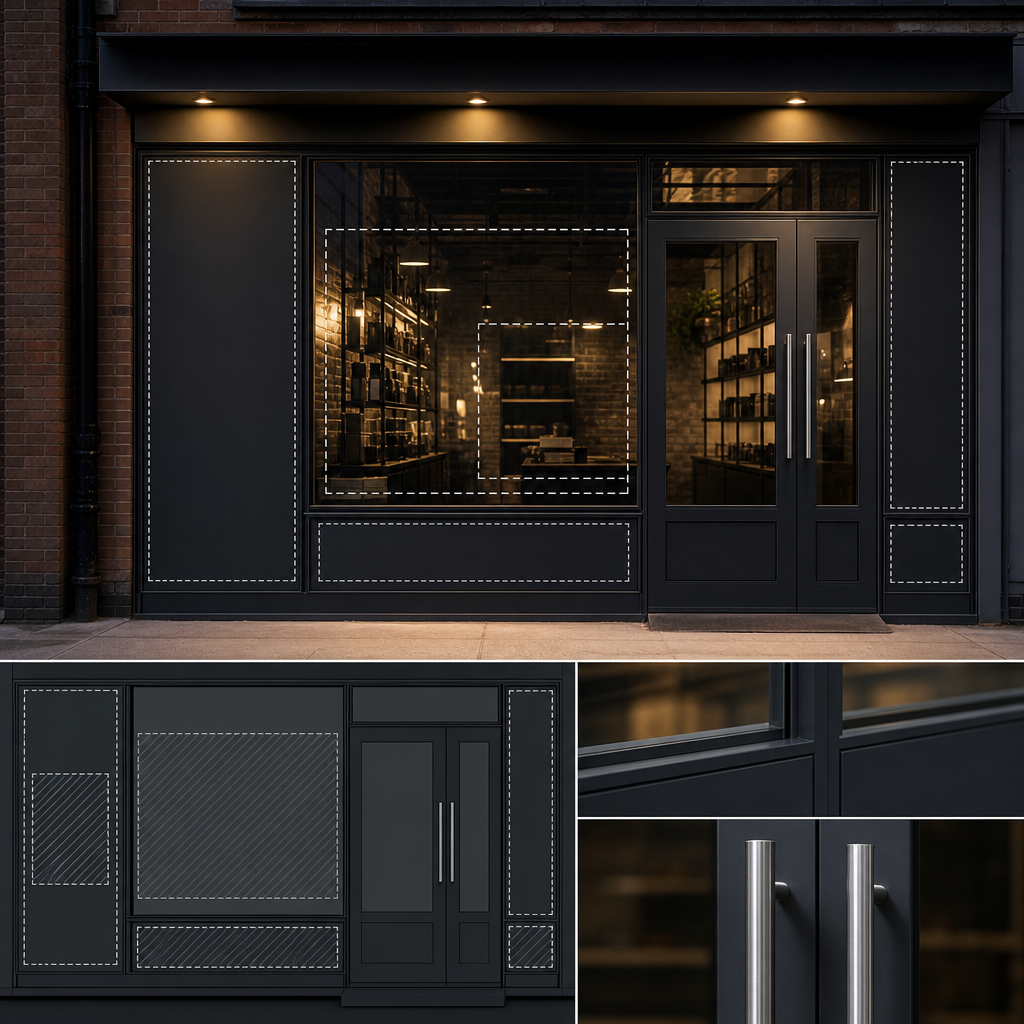
Artwork for glass should be designed around the complete elevation, not exported as separate window rectangles without context. Frames, mullions, door handles, sightlines, reflections and perforations all interrupt the design. Strong hierarchy and generous spacing usually outperform intricate layouts, especially for one-way vision viewed from passing traffic.
Design the facade before dividing the panels
Build the artwork across a scaled view of the complete glass area. Mark every frame, door, lock, handle, seal and non-glazed section before placing important content.
Only after the overall composition works should the artwork be separated into production panels. This prevents a logo from losing a letter behind a mullion or a face from being split awkwardly across a door frame.
Treat viewing distance as a content limit
A person walking past a shopfront has limited time to identify the organisation and understand the message. Adding more text rarely fixes an unclear hierarchy.
Prioritise the business name, principal offer and action. Secondary detail belongs where someone can stop safely and read it. Opening information near an entrance can use a different scale from a headline intended for passing traffic.
Simplify artwork for perforated film
One-way vision removes part of the printable visual surface through its perforations. Fine lines, small type and subtle tonal changes may lose clarity. Bold shapes, clear subject separation and strong contrast are more dependable.
Photographs can work, but the important subject should not rely on tiny facial details or a dark background that disappears into reflections. Proofing should consider the perforated output, not only the continuous image shown on a monitor.
Plan colour rather than promising a screen match
Displays emit light. Printed graphics reflect surrounding light. Glass also introduces reflections and background influence. These conditions make an exact visual match to an uncalibrated screen an unreliable expectation.
Where brand colour is critical, provide recognised colour references and discuss physical proofing. The substrate, ink system, surface finish and viewing light all influence perception. A small approved sample is more useful than debating screenshots between different displays.
Decide whether the graphic should read from inside or outside
Most promotional window graphics are designed for the street-facing viewer. Entry instructions, internal wayfinding and some safety messages may need to face people inside.
Confirm orientation before artwork approval. Reversing a design for inside-glass installation affects text direction, print order and material construction. It should never be left for the installer to interpret on site.
What affects installation quality and durability?
Installation quality depends on compatible glass, correct film, thorough cleaning, controlled handling and sound edge placement. Durability cannot be judged from the printed image alone. Heat exposure, existing coatings, sealants, window movement, cleaning practices and external access all influence how a finished graphic performs and removes.
Glass must be inspected before quoting final production
A clean-looking window may still carry silicone residue, grease, mineral deposits, old adhesive or cleaning products that interfere with adhesion. Scratches and chips can also become more noticeable once graphics are installed.
Existing tint, security film or surface treatments need identification. Applying a new product over an unknown layer may create adhesion, removal or thermal concerns. Where the glass history is uncertain, the supplier should seek further information rather than assume it is untreated.
Surface preparation is part of the sign
Film adheres to the surface presented to it. Dust trapped beneath a graphic creates visible points. Contaminated edges can lift. Residue around frames can prevent consistent finishing.
Cleaning must suit both the glass and the adhesive system. Household products that leave polish or surfactant residue may be unhelpful immediately before installation. The installer's preparation process should follow the selected film manufacturer's guidance.
Edge placement matters
Film pushed into unstable sealant or placed across moving joins is vulnerable. Leaving a controlled, consistent relationship to window edges often produces a neater and more reliable finish than forcing material into every corner.
Door graphics require particular care around handles, locks, weather strips and frequently touched edges. These are functional components, not visual inconveniences to cover without assessment.
Lamination is application-specific
A protective overlaminate can help printed graphics resist handling and make cleaning easier. On perforated film, however, the laminate changes how the holes behave. A clear layer may retain water across openings or alter through-vision under wet conditions.
This decision is especially important for vehicles. Do not assume a laminated shopfront specification should be transferred to vehicle glass.
Removal should be planned before installation
Ask whether the graphic is a short campaign, a seasonal display or an open-ended installation. Adhesive choice and exposure affect removal behaviour.
No responsible supplier should promise effortless removal under every future condition. Film age, heat, glass condition and previous coatings matter. A documented material specification and sensible replacement plan reduce uncertainty later.
Are one-way vision graphics suitable for vehicles?
One-way vision graphics may suit selected vehicle windows, but legality and driver visibility take priority over advertising coverage. Requirements vary by jurisdiction, vehicle type and window position. Windscreens and windows essential to the driver's field of view must not be treated like ordinary shopfront glass or covered by assumption.
Before production, confirm the vehicle's registration jurisdiction and the exact panes proposed for coverage. Queensland Government guidance states that vehicle modifications must continue to meet applicable vehicle standards (Queensland Government). Other states and territories administer their own requirements.
Vehicle applications also face curved glass, moving windows, demisters, wipers, seals, heat and regular washing. These conditions change product selection and installation method.
Rearward visibility must be assessed from the driver's position, not from a design mock-up. Perforated film still reduces visual information. Rain, dust, low light and headlights can make that reduction more noticeable.
If a proposed graphic creates doubt about legal compliance or safe visibility, reduce its coverage or move the advertising to the vehicle body. Marketing value does not justify compromised driving vision.
What compliance checks apply to building windows?
Building window graphics must preserve required safety markings, exits, accessibility cues and glazing performance. Film should not conceal mandatory manifestations or create confusion around doors. Existing safety glass, coatings and thermal conditions also need assessment before broad or dark coverage is approved for installation.
The National Construction Code establishes performance requirements for Australian buildings, including glazing and access considerations (Australian Building Codes Board). Standards Australia publishes AS 1288, the recognised standard concerning glass selection and installation in buildings (Standards Australia). Project-specific interpretation belongs with the relevant building professional or authority.
Do not obscure glass safety manifestations
Large transparent doors and panels may require visible markings so people can recognise that glass is present. Decorative branding may contribute visually, but that does not automatically mean it satisfies the applicable requirement.
The location, contrast and continuity of safety markings should be reviewed separately from marketing artwork. A beautiful graphic is not a compliance assessment.
Keep exits and entries understandable
Window advertising should not make an entrance look like a fixed panel or conceal essential instructions. Door seams, handles and access controls need clear visual recognition.
Consider the view from both directions. A graphic that looks obvious from outside may make the exit difficult to identify from within a brightly printed interior-facing surface.
Assess thermal risk rather than assuming all glass is equal
Dark or extensive film can change how solar energy is absorbed and distributed. Glass composition, coatings, shading, orientation and edge condition influence thermal behaviour.
For uncertain or specialised glazing, obtain the glass supplier's advice before applying film. Sign production expertise does not replace engineering information about a facade system.
How should window graphics be cleaned and maintained?
Clean window graphics gently with non-abrasive tools and products compatible with the film. Avoid aggressive scraping, high-pressure cleaning at exposed edges and harsh chemicals unless the manufacturer approves them. Regular inspection should focus on lifting edges, damaged perforations, fading, trapped contamination and changes affecting driver or pedestrian visibility.
Use a soft cloth or suitable squeegee with a mild cleaning solution. Work carefully around cut lettering and film edges. Dirt should be loosened rather than ground across the printed surface.
For perforated film, clean both the graphic and surrounding glass. Blocked holes, residue and water spotting can weaken outward visibility. Vehicle graphics require particular attention because road grime can accumulate quickly and affect the driver's view.
Do not use blades on or near applied film. A scraper that is safe on bare glass can cut graphics and damage underlying coatings.
Inspect the installation after severe weather, building works or changes to cleaning contractors. Early edge damage is easier to address before washing and handling enlarge the affected area.
What are the environmental considerations?
The most credible environmental approach is to specify only the coverage needed, choose a product suited to the intended service conditions and avoid premature replacement. Ask how offcuts, release liners and removed film are handled locally. Claims such as "eco-friendly" are not useful without a defined material, process or disposal pathway.
A film that fails early can create more waste than a carefully selected product kept in service for its intended campaign. Conversely, using a heavy-duty permanent system for a brief promotion can make removal unnecessarily difficult.
Separate the printed film, liner, laminate and packaging when discussing waste. They are different materials and may not share a recycling pathway. Local facilities also vary in what they accept.
Reusable artwork templates can reduce design waste across campaign changes. A business can retain stable brand elements and replace only the offer area rather than reproducing an entire shopfront without need.
Environmental decisions should be documented at quotation stage. Once mixed materials have been installed and removed together, disposal options may be more limited.
Privacy should be specified as a lighting condition
Our view at Sunquest Signs is that "one-way privacy" is the wrong starting specification. Privacy should be described by location, viewing direction and lighting condition. This exposes whether perforated film can genuinely meet the requirement or whether frosting, opaque coverage or a separate blind is needed.
Consider a street-facing office that wants daylight, outward visibility and privacy for evening meetings. One-way vision may work visually during bright daytime conditions. It cannot guarantee the same screening when internal lights dominate after sunset.
A better briefing process asks:
- Who must be prevented from seeing what?
- From which side and at what distance?
- During which operating conditions?
- Is outward visibility essential or merely preferred?
- Can lighting be controlled after dark?
- Does the glass support safety, security or driving visibility?
This approach changes the decision from a product request into a performance requirement. It also prevents a common mismatch: buying perforated film for privacy when the real need is consistent screening.
The same principle improves artwork. If the main requirement is advertising, design for external recognition and accept that privacy is conditional. If confidentiality is the priority, start with screening performance and add branding without weakening it.
How to brief a sign supplier
A useful brief identifies the glass, objective, audience, lighting, access and expected removal rather than sending artwork alone. Photographs help, but measured site information and an inspection may still be required. A complete brief allows the supplier to recommend film construction, print orientation and installation method with fewer assumptions.
Provide the site address, window photographs, approximate dimensions and intended message. Explain whether the graphic should be read from outside, inside or both directions.
Also disclose:
- Existing tint, film, frosting or unknown surface treatments
- Whether the glass is a door, fixed panel or vehicle window
- Privacy expectations during daylight and after dark
- Required outward visibility
- Campaign timing and likely removal expectations
- Building access restrictions or difficult external access
- Known glazing documentation or property management rules
- Brand colour references and approved artwork files
Request a proof showing panel divisions and obstructions. For colour-sensitive work, discuss a physical sample. For privacy-sensitive work, assess lighting conditions rather than relying on a daylight photograph.
Sunquest Signs can review your glass, artwork and practical requirements before production. To discuss a window signage project, use the Sunquest Signs contact page at /contact.
References
These sources support the core explanations concerning perforated vision technology, Australian building requirements, glazing standards and vehicle modification obligations. Product suitability still depends on the selected manufacturer's technical documentation and the conditions at the installation site. Regulatory questions should be confirmed with the relevant authority or qualified professional.
- Contra Vision, How It Works
- Australian Building Codes Board, National Construction Code
- Standards Australia, publisher of AS 1288 concerning glass selection and installation in buildings
- Queensland Government, Vehicle modifications
Talk to a signage expert
Tell us about your project and we'll come back with options and honest advice.
Get in TouchFrequently Asked Questions
Can people see through one-way vision graphics at night?
Yes, they may be able to. If the interior is brighter than the exterior, the daytime effect can weaken or reverse. One-way vision film should not be relied upon for confidential night-time privacy. Use blinds, opaque film, frosting or controlled lighting where dependable screening is required.
Can one-way vision film be installed inside the window?
Some systems can be specified for inside-glass viewing, but the construction and print sequence must be designed for that purpose. A standard external product cannot simply be turned around. Reflections, tinted glass and the loss of image strength through the glazing can also affect the result.
Are window decals easy to remove?
Removal depends on the adhesive, film age, exposure, glass surface and underlying coatings. Removable products can make planned campaign changes easier, but no film should be assumed to leave every surface clean under every condition. Tell the supplier the expected removal timing before material selection.
Will perforated graphics make the inside of a shop dark?
They reduce some incoming light because printed film covers part of the glass. The effect depends on the film construction, artwork, window area and existing interior lighting. If daylight is important, review a material sample and avoid treating a screen mock-up as a reliable light assessment.
Can window graphics cover cracks or damaged glass?
Graphics may hide damage visually, but they do not repair unsafe glazing. Cracked, chipped or unstable glass should be assessed and repaired by an appropriate glazing professional before film installation. Applying signage over damage can conceal a problem without resolving its cause.
Can I use one-way vision graphics on any vehicle window?
No. Suitability depends on the window position, driver visibility, vehicle type and the rules applying in the registration jurisdiction. Confirm compliance before printing. If coverage could affect the driver's field of view, use another window or place the advertising on the vehicle body.
Related Articles
Awning signs
Sunshine Coast Signage Project Gallery: Real Local Sign Installs by Suburb and Sign Type
Signage in Caboolture: Sign Options for CBD, Morayfield and Industrial Businesses, Council Rules and Costs
Signs that set you apart
Over 40 years on the Sunshine Coast. Design, compliance, manufacture and installation handled end to end.
Get a Free Quote