
Officeworks Printing vs. Professional Signage: Costs, Quality & What to Choose for Australian Businesses
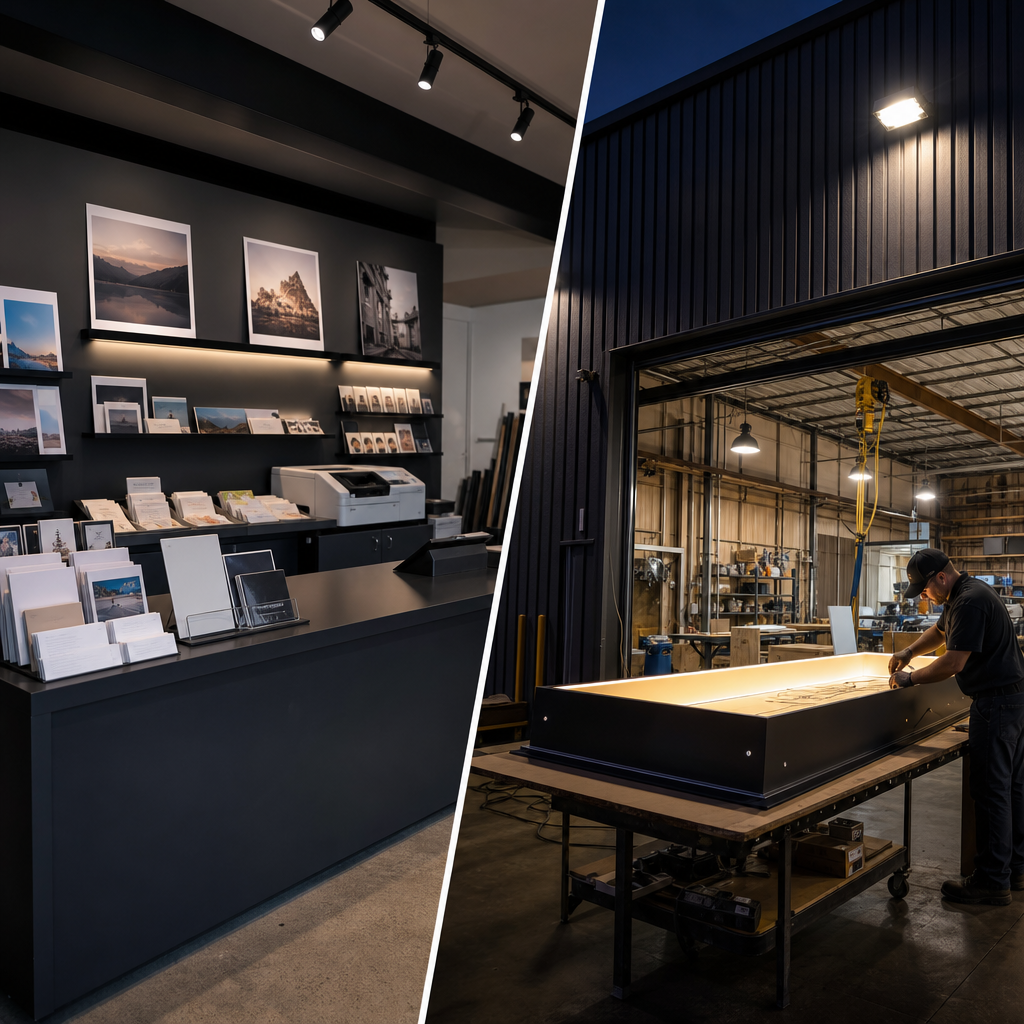
Officeworks printing prices can make sense for straightforward, low-volume print jobs with finished artwork. Professional signage is usually better for custom sizes, outdoor exposure, installation or brand-critical work. Compare the complete installed result, not just the printed item, because design, materials, finishing, compliance and replacement risk all affect the real cost.
Officeworks and a professional signage company solve different problems. Officeworks is built for accessible, standardised print ordering. A signage company scopes how visual communication will be designed, produced, installed and maintained in a specific environment.
That distinction matters when a low advertised price becomes an incomplete solution. This guide explains where each option fits, what drives custom signage cost in Australia, and how to compare quotes without paying for the wrong output.
Key takeaways
The right supplier depends on the job's complexity, exposure and business consequence. Officeworks is convenient for standard print products, while a professional sign company becomes more valuable when design judgement, specialised materials, fabrication or installation determine whether the finished work succeeds.
- Use Officeworks for simple, standard-format products when your artwork is ready and the consequences of an imperfect result are low.
- Use a professional signage company for custom dimensions, outdoor signs, wall graphics, vehicle graphics and fabricated structures.
- Compare materials, finishing, design, installation, removal and maintenance rather than relying on the headline print price.
- Confirm whether quotes include GST, artwork preparation, freight, access equipment and site work.
- Treat durability as a project requirement. A cheaper product is not better value if it fades, lifts or needs early replacement.
- Check landlord, council and building requirements before approving permanent or externally visible signage.
Ready to make your business impossible to miss?
Design, manufacture and installation, all under one roof in Warana.
Get a Free QuoteOfficeworks printing and professional signage at a glance
Officeworks generally offers standard products selected through a retail print process. Professional signage begins with the site, intended lifespan and communication objective. The comparison below is qualitative because Officeworks prices and professional quotes depend on product configuration, dimensions, quantity, finishing and delivery requirements.
| Comparison point | Officeworks printing | Professional signage company |
|---|---|---|
| Cost basis | Published or configured price for a standard product | Project quote based on scope, materials, production and site requirements |
| Cost per unit | Often attractive for basic, low-volume items | Can become more efficient when production, finishing and installation are planned together |
| Material choice | Options within a defined product catalogue | Materials selected for surface, exposure, lifespan and structural requirements |
| Design support | Best suited to supplied artwork or template-led files | Can include scoping, artwork, visualisation and production-ready design |
| Customisation | Limited by available formats and specifications | Custom sizes, shapes, finishes, fixings and fabricated elements |
| Installation | Usually separate from the print purchase | Can be scoped with access, fixings, site safety and final placement |
| Durability | Appropriate for the stated standard product use | Specified around indoor, outdoor, temporary or long-term conditions |
| Best fit | Documents, basic cards, flyers, posters and simple display products | Building signs, reception signs, wayfinding, wall graphics, shopfronts and branded environments |
Understanding your printing needs
A retail print service is enough when the product is standard, the artwork is genuinely production-ready and installation requires no specialist work. Move to a professional provider when the job involves unusual surfaces, exact colour requirements, outdoor exposure, multiple locations, fabrication, access constraints or a meaningful risk to your brand.
Start by defining the outcome rather than the product name. Asking for a poster assumes that a poster is the answer. Asking how to direct visitors from a car park to reception may reveal a need for several coordinated signs, suitable fixings and clear viewing angles.
When is DIY printing enough?
DIY or retail printing is a sensible choice when all of these conditions apply:
- The finished size appears in the supplier's standard catalogue.
- You have artwork with the correct dimensions, bleed, image resolution and fonts.
- The product will be used in a predictable indoor environment.
- Minor variation in colour or finishing will not create a serious problem.
- The item can be positioned safely without specialist fixings or equipment.
- Reordering or replacing it would not interrupt operations.
A short-run internal notice is fundamentally different from a shopfront sign. The notice communicates temporary information. The shopfront identifies the business, affects street visibility and must remain secure in changing weather.
Questions to answer before requesting prices
Write down where the item will go, how it will be viewed and how long it needs to last. Note the substrate or wall surface, exposure to sunlight and rain, required dimensions, viewing distance, installation height and any landlord conditions.
This preparation improves both retail ordering and professional quotations. It also prevents misleading comparisons between products that look similar on a screen but perform differently after installation.
The Officeworks advantage for basic print jobs
Officeworks is strongest when convenience and a familiar catalogue matter more than extensive customisation. Its Print & Copy service covers common business print products and provides a direct ordering path. That makes it practical for routine documents, standard marketing collateral and simple display items with completed artwork.
Businesses searching for "printing near me" or "print shops near me" often need something quickly, not a complete signage programme. A nearby retail print counter can be the most efficient answer for meeting papers, training documents, straightforward flyers or an interim poster.
Officeworks also gives buyers a visible starting point for product selection. Its Print & Copy service allows customers to review available categories and configure eligible products. Always check the current configuration and terms rather than relying on an old Officeworks printing prices article.
Where the retail model reaches its limits
A standard ordering system has to define what buyers can select. That simplicity becomes a constraint when a project needs site measurement, unusual profiles, custom fixings, fabricated lettering, illumination or coordination with builders and property managers.
Supplying artwork is another common dividing line. A file can look correct on a mobile or office monitor while still containing low-resolution images, missing bleed, substituted fonts or colours that will not reproduce as expected. File checking may identify technical faults, but it does not automatically solve weak hierarchy, poor legibility or unsuitable placement.
Retail print products are not inherently low quality. They are simply produced to a defined specification. The problem occurs when that specification does not match the job.
What professional signage adds beyond printing
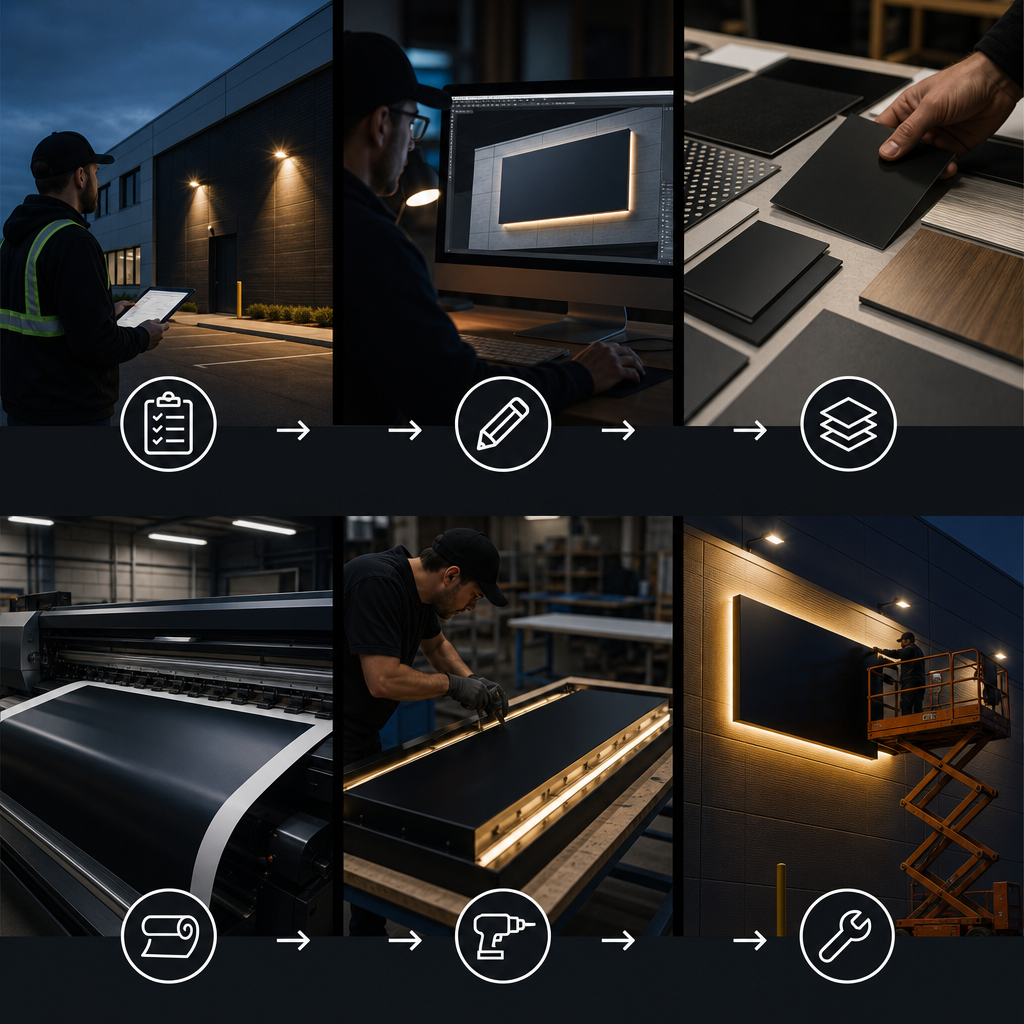
Professional signage combines design, material selection, production, fabrication and installation around a real site. The supplier is not merely transferring ink to a surface. It is deciding how the sign should communicate, withstand its environment, attach safely and integrate with the building or branded space.
This broader process is what separates commercial printing services from complete business printing solutions. A professional sign company can consider how each component works together, including substrates, laminates, adhesives, frames, fabricated elements and mounting systems.
Sunquest's signage services and custom sign capabilities are relevant when standard catalogue dimensions or finishes do not suit the project.
Custom and large-format production
Large-format printing is production intended for graphics beyond ordinary desktop or office printer formats. It can include wall graphics, window graphics, banners, display panels and other oversized applications. Size alone is not the main issue. The production method must also suit viewing distance, handling, finishing and installation.
A proper large-format printing comparison should examine:
- The intended substrate and compatible ink or print process.
- Image resolution at final output size.
- Colour expectations and proofing requirements.
- Lamination or surface protection.
- Edge finishing, joins, eyelets or mounting hardware.
- Panel alignment across large walls or windows.
- Installation method and surface preparation.
A cheap large print can become expensive if panels fail to align or adhesive damages the underlying surface. These are production and installation questions, not simply printing questions.
Fabrication and structural requirements
Some signs are manufactured objects rather than printed sheets. Reception lettering, dimensional logos, projecting signs and building-mounted panels can require cutting, folded returns, frames, welded components or custom fixing systems.
Sunquest lists fabrication services separately because this work involves different decisions from ordinary print ordering. Materials and fixings must suit the sign's weight, location, exposure and supporting structure.
Deconstructing the real cost of signage
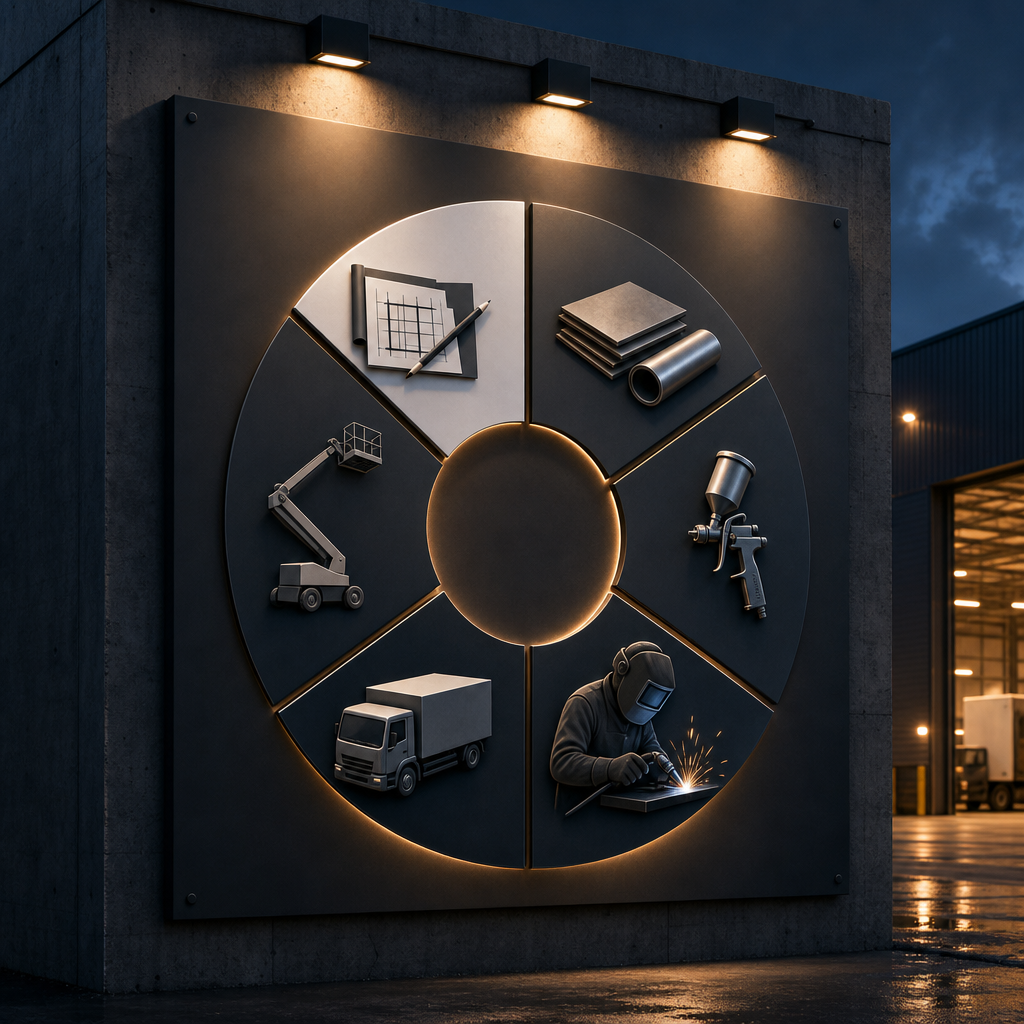
The real cost of a print or signage project includes everything required to achieve a usable result. That can include scoping, design, proofs, materials, finishing, fabrication, freight, access, installation and eventual removal. Comparing only the printed item's price can make an incomplete quote appear cheaper than a complete one.
Officeworks printing costs are generally configured around a selected product. Professional signage prices are usually project-specific because the provider must account for the site and production method. Neither approach is automatically cheaper. They are pricing different scopes.
Materials and finishing
Paper weight, vinyl type, rigid substrate, laminate, adhesive and protective coating all affect price and performance. Even products with similar descriptions can be designed for different uses.
For example, a temporary indoor graphic does not require the same specification as a west-facing exterior panel. Paying for outdoor durability on a short event display may be wasteful. Using a temporary material outdoors may create avoidable replacement and removal costs.
Ask each supplier to state the proposed material and intended application. A quote that says only "vinyl" or "panel" may not provide enough information for a fair comparison.
Design and artwork preparation
Design cost covers more than making a file attractive. Production design must account for final dimensions, viewing distance, legibility, brand consistency, safe margins, panel divisions and the limits of the chosen process.
Sunquest provides a scope and design service, which is relevant when the client has a business objective but not a production-ready file. Clarify whether a quote includes concept work, revisions, print-ready artwork and ownership or supply of final files.
If you already have approved artwork, say so. The supplier can then distinguish file checking from original design work.
Installation and site access
Installation costs depend on the surface, mounting method, height, access, working conditions and coordination required. A simple self-adhesive graphic on a prepared internal panel is different from exterior signage requiring specialised access and building penetrations.
A complete quote should clarify:
- Whether site measurement is included.
- Who prepares or repairs the mounting surface.
- Whether existing signs must be removed.
- What access equipment or site induction is required.
- Whether electrical or building work sits outside the sign company's scope.
- How waste and packaging will be handled.
Do not assume installation is included because a quote uses the word "signage". Ask for the inclusions in writing.
GST, delivery and other quote exclusions
Australian buyers should check whether a displayed or quoted price includes GST and mandatory charges. The ACCC's guidance on price displays explains component pricing and total-price obligations in consumer transactions. Business quotations may have different context, so the safest approach is to request a clear total and list of exclusions.
Also confirm delivery, packing, proof production, artwork corrections and urgent production requirements. An apparent saving can disappear when essential items are added after approval.
Durability and replacement risk
Purchase price is only one part of value. A sign that remains legible, securely fixed and appropriate for its environment avoids the disruption of premature replacement. It can also reduce the chance of inconsistent branding when one failed component is replaced in isolation.
The useful comparison is not "Which item is cheapest?" It is "Which specification delivers the required result for the intended lifespan with acceptable risk?"
Quality, durability and brand impact
Professional production matters most when the finished work represents the business publicly or must survive demanding conditions. Quality comes from matching design, materials, finishing and installation to the application. High-resolution printing cannot compensate for poor placement, unsuitable adhesive, weak contrast or an unstable fixing method.
UV exposure and weather
Australian exterior signage can face strong sunlight, heat, rain, wind and airborne contaminants. The correct response depends on location and orientation. A sheltered sign under an awning has different exposure from an elevated sign on an open facade.
Ask what part of the specification addresses exposure. This may involve the print process, protective laminate, substrate, edge treatment or mounting detail. Avoid accepting a vague promise that a product is "weatherproof" without understanding the conditions and exclusions.
Structural integrity and compliance
A freestanding, projecting or building-mounted sign can involve planning, structural and safety considerations. The National Construction Code provides Australia's primary technical framework for building work, while planning approval and advertising-device rules are commonly handled through state, territory and local government systems.
The Australian Building Codes Board publishes the National Construction Code. However, whether it applies to a particular sign, and what permits are required, depends on the structure, location and proposed work. Confirm requirements with the relevant council, certifier, landlord and qualified contractors before production.
Consistent brand presentation
Brand impact is not just colour accuracy. It includes proportion, spacing, visibility, placement and consistency across touchpoints. A reception sign, directional panel and exterior identifier should feel related even when made from different materials.
This is where professional oversight has value. The supplier can maintain a coherent system while adapting each item to its physical setting.
Stop comparing price per print
My view is direct: price per print is often the wrong metric for business signage. It measures production output, not whether customers can find the entrance, read the message or recognise the brand. Businesses should compare the cost of a complete, usable communication asset and the consequences if it fails.
Consider a hypothetical window graphic. The retail print price may look competitive, but the real project also requires accurate measurements, artwork divided around mullions, a film suitable for the glass, safe installation and clean alignment from outside. If those tasks remain with the buyer, they have not disappeared from the cost. They have become internal labour and risk.
A more useful decision model considers three layers:
- Output: What physical item will be supplied?
- Outcome: What must visitors, staff or customers understand or do?
- Risk: What happens if the item is late, unreadable, non-compliant or difficult to install?
For low-risk output, use the simplest suitable supplier. For a high-consequence outcome, pay for proper scoping. This approach avoids both over-specifying routine print work and under-specifying permanent signage.
How to assess real project evidence without invented case studies
Case studies should show the brief, constraints, chosen materials, installation method and completed result. No verified Sunquest cost savings or measured client outcomes were supplied for this article, so I will not invent them. Businesses can instead inspect documented project work and ask targeted questions about comparable applications.
Sunquest's project gallery provides a starting point for examining the types of work the company has delivered. Do not judge a supplier only by polished completion photos. Ask what problem was solved and what production decisions sat behind the result.
A hypothetical multi-site rollout
Imagine a business updating wayfinding across several premises. Sending isolated files to the nearest retail printer may produce individual signs, but it leaves the business responsible for site measurements, material consistency, placement and installation at each location.
A professional provider can scope the sign family as a system. That may include a location schedule, artwork controls, material specifications and installation instructions. The value comes from reducing variation and coordinating the work, not merely producing larger prints.
A hypothetical temporary campaign
Now consider an indoor promotion running briefly in a controlled environment. The artwork is complete, sizes are standard and staff can place the materials safely. A retail print service may be entirely appropriate. Specifying custom fabrication would add cost without improving the required outcome.
These examples show why supplier selection must follow the brief. Professional does not mean choosing the most elaborate option. It means choosing a specification appropriate to the job.
Making the right choice for your Australian business
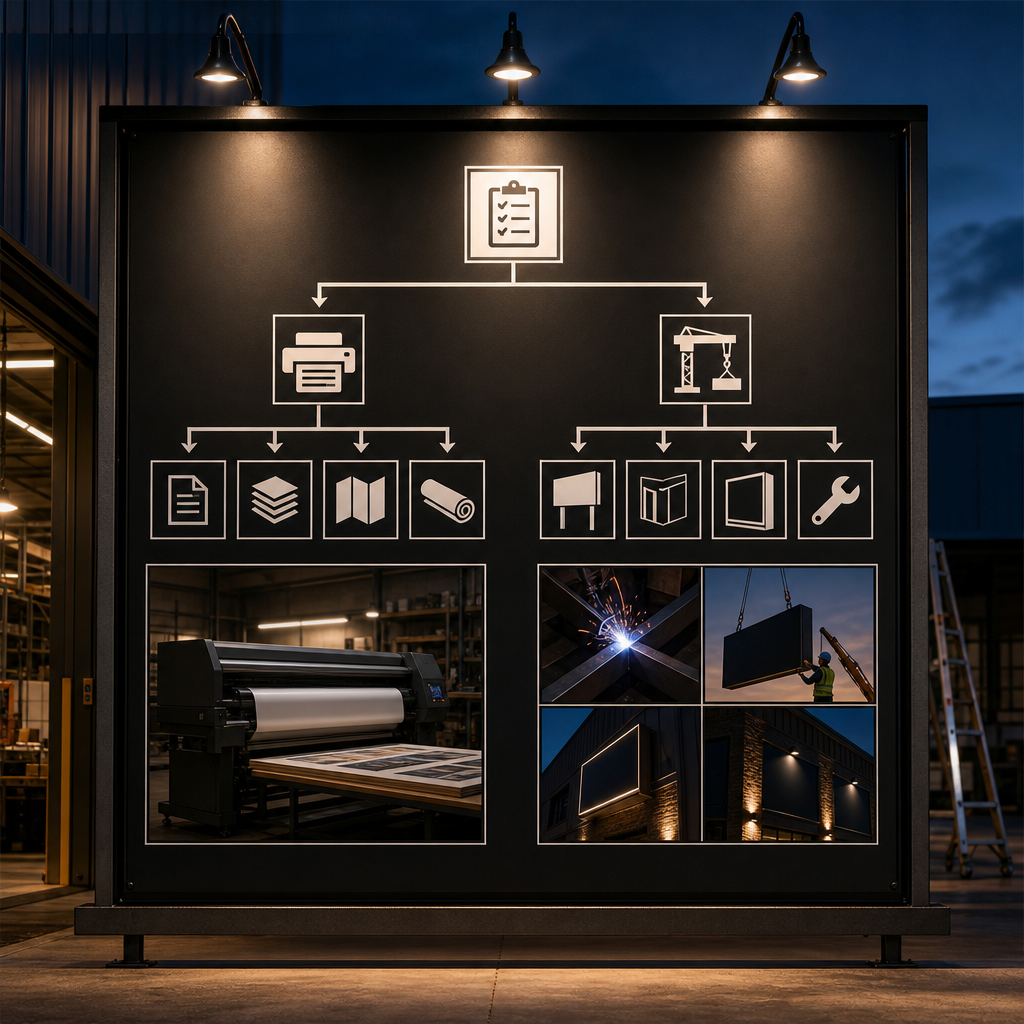
Choose Officeworks when the product is standard, artwork is ready and installation is simple. Choose a professional sign company when the project needs design input, custom materials, fabrication, site coordination or installation. If uncertain, document the site and outcome, then compare written scopes rather than product names.
Use the following decision sequence before requesting a quote:
Define the communication objective
State what the audience needs to notice, understand or do. "Reception sign" is a product label. "Help first-time visitors identify reception from the main entrance" is a useful objective.
Record the environment
Photograph the site and note dimensions, surfaces, viewing angles, light, weather exposure and access. Flag any landlord or centre-management requirements. Accurate context allows the supplier to propose appropriate materials and fixings.
Separate mandatory and optional requirements
Identify what cannot change, such as brand artwork, installation dates or landlord specifications. Keep preferences separate. This helps suppliers offer alternatives without weakening essential requirements.
Request comparable scopes
Ask each supplier to state materials, dimensions, quantities, finishing, design, freight, installation, GST, exclusions and expected approval steps. Quotes are only comparable when their scopes align.
Match the supplier to the risk
A low-risk internal handout does not need a site survey. A large exterior sign should not be purchased solely from a thumbnail and unit price. Match the purchasing process to the financial, operational and safety consequences of getting it wrong.
For a custom assessment, provide Sunquest with the intended location, approximate dimensions, photographs, artwork status and desired use through its contact page.
References
The following sources support the service, pricing and regulatory context discussed above. Product availability, configurations and prices can change, so buyers should verify current details directly with the provider before ordering.
- Officeworks Print & Copy
- ACCC guidance on price displays
- ACCC consumer rights and guarantees
- Australian Building Codes Board, National Construction Code
- Australian Sign & Graphics Association
FAQ_SCHEMA_JSON
Talk to a signage expert
Tell us about your project and we'll come back with options and honest advice.
Get in TouchFrequently Asked Questions
Is Officeworks cheaper for all types of printing?
No. Officeworks can be cost-effective for standard products and straightforward quantities, particularly when artwork is ready. Custom signs require a broader comparison that includes design, finishing, delivery, installation and expected lifespan.
What is large-format printing?
Large-format printing produces graphics larger than typical office printer formats. Common applications include wall graphics, window graphics, banners and display panels. Production must account for final-size resolution, materials, finishing and installation.
Can Sunquest help with signage design?
Sunquest lists scope and design among its services. Businesses should provide the objective, site photographs, measurements, brand files and intended lifespan, then confirm design inclusions in the written quotation.
How do professional signage materials differ from retail print materials?
Professional signage materials are selected for the surface, exposure, adhesion, rigidity, finishing and installation method. Retail print materials are limited to the options and specifications available for the selected catalogue product.
Do professional signage companies offer installation?
Many professional signage companies offer installation, but inclusions vary. Confirm site measurement, removal, surface preparation, access equipment, fixings, waste disposal and any excluded electrical or building work.
When should a business use professional printing for business cards?
Professional commercial printing is appropriate when business cards require unusual stocks, specialist finishes, precise colour management or coordination with other stationery. Retail printing can suit standard cards with completed artwork.
What signage regulations apply in Australia?
Requirements depend on location, size, structure, illumination and mounting. Council planning rules, landlord approvals and building requirements may apply, so confirm them before ordering permanent or externally visible signage.
Related Articles
Shop Front Signs in Caloundra: Precinct Styles, Coastal Materials, Council Rules and Costs
Pylon Signs in Noosa: Design, Coastal Materials, Council Approvals and Installation
Pylon Signs on the Sunshine Coast: Design, Materials, Approvals and Installation
Signs that set you apart
Over 40 years on the Sunshine Coast. Design, compliance, manufacture and installation handled end to end.
Get a Free Quote