
A Comprehensive Signage Design and Planning Guide for Australian Businesses
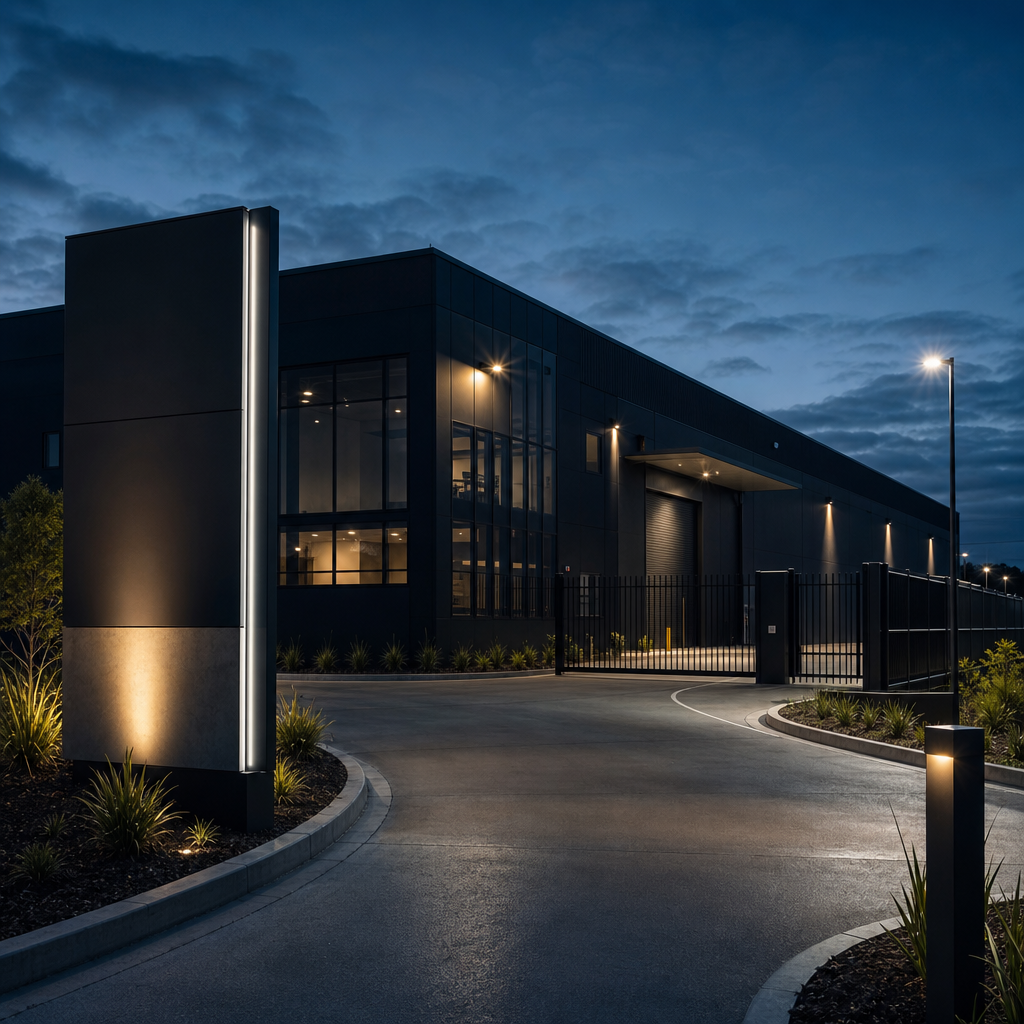
Effective signage design and planning starts with a clear communication goal, a verified site, an audience-focused design and materials suited to Australian conditions. Businesses must also address accessibility, council approvals, fabrication, installation and maintenance. Treating these requirements as one coordinated process produces signage that is readable, compliant, durable and commercially useful.
Signage is often treated as a graphic design purchase. That is too narrow. A sign has to communicate at the right moment, fit its physical environment and remain serviceable after installation.
This signage design and planning guide explains how to develop a practical brief, assess locations, choose materials, manage approvals and measure performance. It also shows why the strongest signage strategies are built around customer decisions rather than individual sign products.
Key takeaways
Successful business signage connects communication, location and construction. The message must be easy to understand, the placement must support how people approach the site, and the specification must survive local conditions. Approval, accessibility, installation and maintenance should be resolved before fabrication, not added after the design has been signed off.
- Give every sign one primary communication job.
- Audit the site from the customer's actual approach routes.
- Test legibility at the intended viewing distance and speed.
- Select materials based on exposure, maintenance and substrate conditions.
- Confirm council, building and accessibility requirements before fabrication.
- Measure signage through enquiries, visits, wayfinding performance and operational feedback.
Ready to make your business impossible to miss?
Design, manufacture and installation, all under one roof in Warana.
Get a Free QuoteSignage planning summary
A controlled signage project moves from business objectives to site evidence, design, approvals, fabrication and installation. Skipping a stage usually shifts risk downstream, where corrections become more disruptive. The following table shows the main purpose of each stage and the questions decision-makers should resolve before proceeding.
| Stage | Main purpose | Questions to resolve | Typical output |
|---|---|---|---|
| Define | Establish the commercial and communication goal | Who is the audience, and what action should follow? | Project brief |
| Audit | Understand physical and regulatory constraints | Where will the sign be seen, fixed and serviced? | Site survey and location schedule |
| Design | Create a readable visual hierarchy | What must viewers notice and understand first? | Scaled concepts and artwork |
| Specify | Match construction to location and lifespan | Which substrate, finish, fixing and illumination method suit the site? | Technical specification |
| Approve | Secure internal and external acceptance | Are landlord, council, building and accessibility reviews required? | Recorded approvals |
| Deliver | Fabricate and install safely | How will the site, access and existing services affect installation? | Installed signage and completion records |
| Maintain | Protect appearance and performance | Who will clean, inspect, update and repair the sign? | Maintenance plan and asset register |
Why signage design matters to a business
Good signage helps people identify a business, understand its offer and move through its premises without unnecessary effort. It also signals how carefully the organisation manages its physical environment. Poorly placed, crowded or damaged signs create hesitation because customers must work harder to confirm that they are in the right place.
Business signage performs several distinct functions:
- Identification: confirming the business name and location.
- Promotion: communicating an offer, product or point of difference.
- Wayfinding: directing visitors towards entrances, reception areas, facilities or departments.
- Information: explaining opening details, site rules or service processes.
- Safety and compliance: communicating required warnings, exits and accessible facilities.
A single sign should not be expected to perform every function equally. A roadside identification sign needs immediate recognition. A directory can carry more detail because people view it while standing nearby. A reception sign may support brand presentation, but it should not replace practical wayfinding.
A frequently cited FedEx Office survey reported that 76% of consumers had entered a store they had not visited before because of its signs. The research concerned American consumers, so it should not be treated as an Australian sales forecast. It still demonstrates a sound principle: physical signs can influence whether an unfamiliar business is noticed and considered. The survey is available through PR Newswire.
The commercial value of signage also depends on context. A visible fascia sign may matter greatly to a street-facing retailer. A medical centre in a shared complex may gain more from clear directories, parking instructions and accessible wayfinding. Design decisions should follow the customer's task, not a generic preference for larger signs.
How to plan and design effective signage
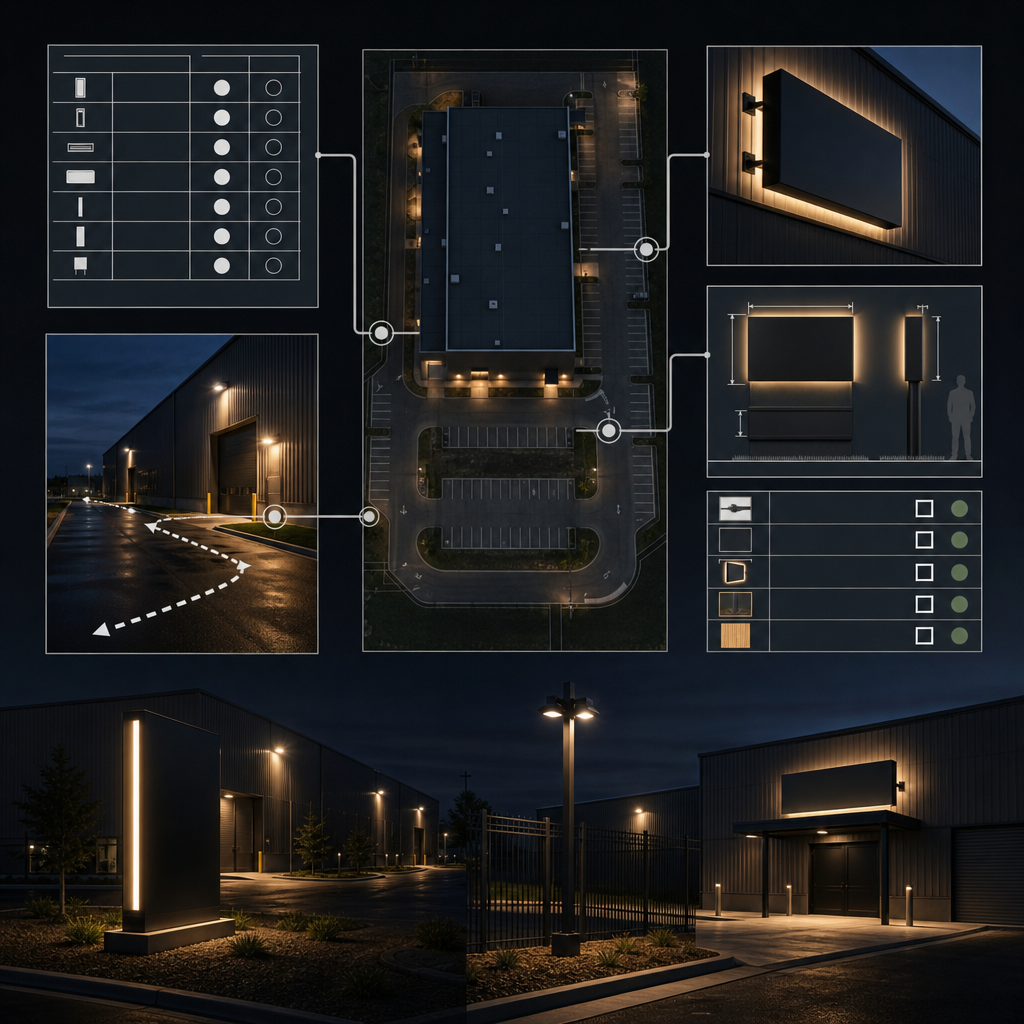
Effective signage planning begins before colours, fonts or sign shapes are selected. The business first needs a defined audience, communication objective, location schedule and verified site information. These inputs allow the designer to build a hierarchy that works from real viewing positions while accounting for approvals, access, services and installation constraints.
Write a functional brief
A useful brief describes what the signage must achieve, not merely how it should look. Include:
- the intended audience;
- the action or decision the sign should support;
- the viewing context;
- brand requirements;
- required wording;
- expected exposure and maintenance conditions;
- accessibility obligations;
- landlord, council or building constraints;
- installation access; and
- who has authority to approve the work.
Separate fixed information from information likely to change. Business names and permanent directions may suit fabricated lettering. Trading details, tenant names and temporary notices need an updateable system. Building change into the specification avoids replacing an entire sign whenever one line becomes outdated.
Build a location schedule
A location schedule turns a collection of signs into a manageable system. Give each proposed sign a unique identifier and record its purpose, location, dimensions, message, construction, finish, fixing method, illumination and approval status.
This schedule should remain connected to marked-up site plans and elevations. Without that connection, similarly named signs can be fabricated for the wrong wall, orientation or tenancy. A schedule also makes future maintenance easier because the business can identify an asset without relying on vague descriptions.
Verify the site
Do not design from architectural drawings alone. Completed sites often differ from early documentation, while existing buildings can hide services, uneven surfaces and access problems.
A site audit should examine:
- sightlines from roads, footpaths, car parks and entrances;
- competing signs and visual clutter;
- landscaping, awnings, columns and parked vehicles;
- wall construction and fixing suitability;
- electrical supply for illuminated signs;
- underground or concealed services;
- installation access and traffic control needs;
- exposure to sun, wind, rain and airborne salt;
- surrounding windows or residences affected by light spill; and
- existing signs that require removal or make-good work.
Photographs are useful, but they can distort distance and scale. Record dimensions and review the site from the same routes customers use. For vehicle-facing signage, observe the location from the direction of travel rather than only from directly in front.
Create a clear information hierarchy
Viewers do not give every element equal attention. The design must establish what they should notice first, what confirms the message and what can be read after they approach.
For a business identification sign, the name may be primary while a short service descriptor is secondary. For a wayfinding sign, the destination and arrow usually matter more than decorative brand elements. Contact details often belong on close-range signs, not on signs viewed briefly from moving vehicles.
Reduce wording until each sign can complete its job without explanation. Adding more messages rarely fixes uncertainty. It usually makes every message less prominent.
Test legibility in context
Legibility is affected by letterform, contrast, spacing, viewing distance, viewing angle, background complexity and movement. A sign that appears clear on a laptop can fail when installed above eye level or seen through traffic.
Test concepts at a representative scale and from the intended distance. Place a printed mock-up or temporary outline at the proposed location where practical. Check the design in daylight and after dark if illumination is planned. Also test common customer routes, including accessible paths and secondary entrances.
Avoid treating brand consistency as a reason to ignore readability. A thin typeface or low-contrast colour pairing may work in a brochure but perform poorly on an exposed external sign. The sign must remain recognisable as part of the brand while meeting its physical communication task.
Plan accessibility from the start
Accessible signage is not achieved by simply enlarging text. Relevant signs may require suitable location, luminance contrast, tactile characters, Braille and consistent placement. Requirements depend on the building and sign function.
The Disability (Access to Premises - Buildings) Standards 2010 and the National Construction Code provide the broader Australian compliance framework. Technical provisions may also involve applicable Australian Standards. Project teams should confirm the current requirements for the specific building rather than copying a detail from an unrelated project.
Choosing signage materials, finishes and illumination
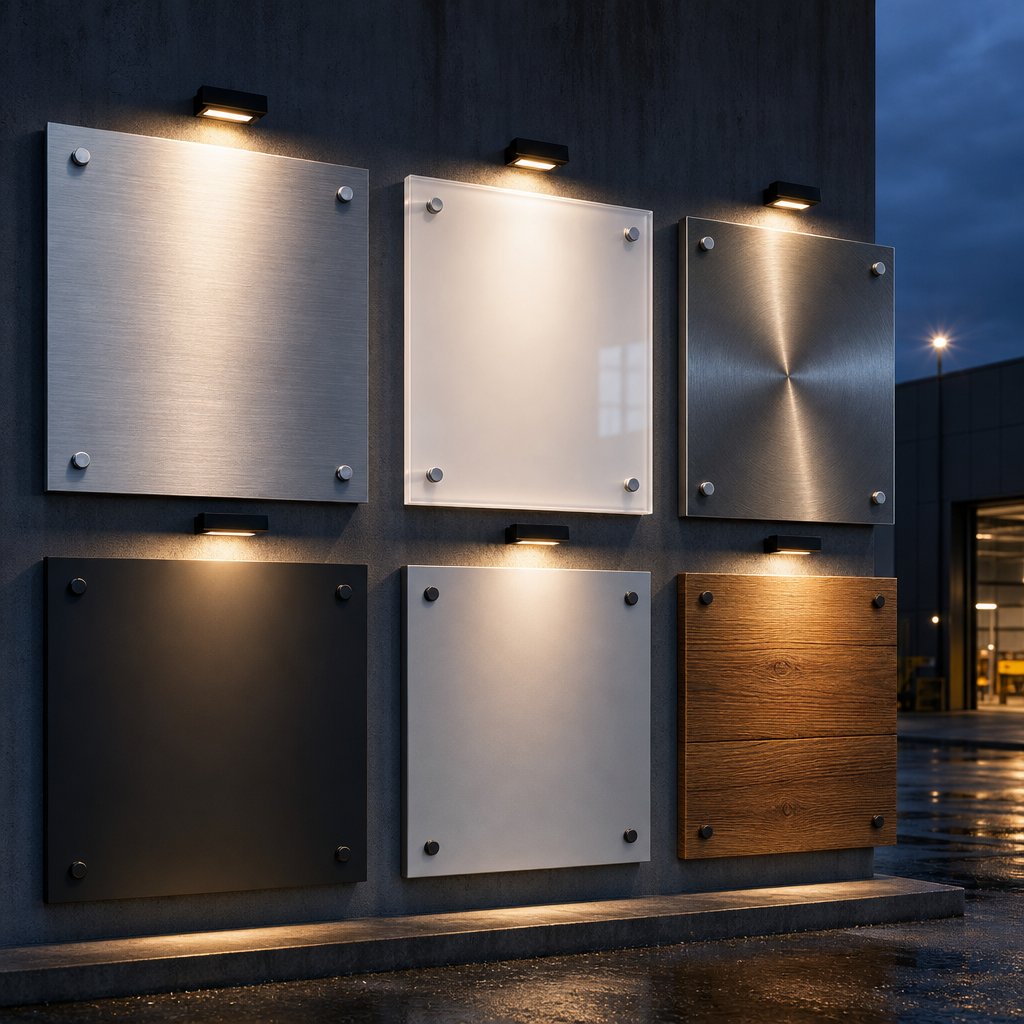
The right signage material is the one that suits the substrate, environment, intended appearance, maintenance plan and replacement needs. There is no universally superior option. Aluminium, acrylic, steel, vinyl and composite products all solve different problems, while coatings, fixings and edge details often determine how well the completed sign performs.
Common material options
Aluminium is widely used for external panels, fabricated lettering and sign structures because it is relatively light and can be coated in many finishes. The full assembly still needs appropriate framing, fixings and separation from incompatible metals.
Acrylic provides a clean face for lettering, panels and illuminated elements. Its suitability depends on thickness, support, fixing details and exposure. Large unsupported sheets or poorly positioned fixings can create avoidable stress.
Stainless steel is useful where a robust metallic finish is required. Grade selection, surface finish and local exposure matter, particularly near the coast or in environments where contaminants can settle on the surface.
Vinyl films suit window graphics, applied lettering, temporary promotions and some changes to existing panels. Performance depends on selecting the correct film for the substrate and exposure. Surface preparation is just as important as the film itself.
Aluminium composite material can provide a flat panel for wall signs and sign faces. Edge treatment, fixing design and the product's fire performance must be considered for the application and building context.
Timber and timber-look finishes can support a particular architectural character, but genuine timber requires realistic expectations about movement, weathering and maintenance. A finish should not be specified solely from a small sample viewed indoors.
Match finishes to the environment
Gloss, satin, matt, brushed and textured finishes behave differently under light. Highly reflective faces can create glare, while very dark finishes can show dust, salt or handling marks. Samples should be viewed at the intended angle and under comparable lighting.
Coastal exposure deserves particular attention in Australia. Airborne salt can settle on sign faces, frames and fixings even when the site is not directly on the beachfront. Material compatibility and a practical cleaning programme should be part of the specification.
Also consider what happens behind the visible face. Water paths, drainage, ventilation, access panels, electrical components and fixing points affect durability and servicing. A polished visual concept is incomplete if routine maintenance requires dismantling surrounding building elements.
Decide whether illumination is justified
Illumination should support visibility without creating glare, uneven brightness or unnecessary spill. Options include internally illuminated sign faces, halo-lit letters, face-lit letters and external lighting directed towards a non-illuminated sign.
The choice depends on viewing distance, operating hours, architectural context, nearby sensitive uses and maintenance access. Review how the sign will appear when illuminated components are switched off as well. Daytime presentation still matters.
Planning guidance for Victoria specifically addresses protection of sensitive uses from light spill. Other states, territories and councils apply their own controls. Confirm local planning requirements and avoid assuming that an approval for the sign structure automatically covers its lighting.
Approvals, fabrication and installation planning
Sign approval is rarely a single decision. A project may require consent from the business, property owner, centre manager, council, building consultant or other authority. The correct path depends on sign type and location. Establishing that path before fabrication prevents avoidable redesign, delays and disputes over responsibility.
Confirm the approval pathway
Australian council rules vary by municipality and planning scheme. Some signs may be exempt in specific circumstances, while others need planning or building approval. Heritage controls, road authority requirements, strata rules and shopping centre design criteria may also apply.
Prepare an approval package containing scaled elevations, dimensions, colours, materials, illumination details, fixing information and site photographs. Do not rely on informal verbal acceptance when a landlord or authority requires documented consent.
Sign content must also comply with the Australian Consumer Law. Claims about prices, savings, products or services must not mislead customers. The ACCC explains that the overall impression of advertising matters, including qualifications and fine print. A technically accurate disclaimer will not necessarily correct a prominent misleading message.
Design for fabrication
Concept artwork communicates appearance. Fabrication drawings explain how the sign will be built. Before production, confirm:
- final dimensions based on verified site measurements;
- artwork files and brand colours;
- material thicknesses and finishes;
- frames, returns, seams and joins;
- fixing points and engineering requirements;
- cable paths and electrical access;
- removable components for servicing; and
- interfaces with walls, glazing, roofs or landscape structures.
Colour proofs and material samples reduce ambiguity, but samples have limits. Printed colour, painted metal, translucent acrylic and illuminated vinyl can appear different even when based on the same brand reference. Approvals should identify the actual production process being assessed.
Treat installation as part of design
Installation constraints can change sign dimensions, panel joins, fixing locations and electrical design. Confirm access equipment, exclusion zones, pedestrian management, parking restrictions and operating-hour constraints while the sign is still being detailed.
The installer also needs reliable information about the substrate and concealed services. Fixing a sign to masonry is different from fixing through cladding into structural support. Where engineering or specialist certification is required, build it into the programme rather than requesting it after fabrication.
Complete the project with an installation inspection. Check alignment, finish, lighting, switching, make-good work and consistency with approved drawings. Record defects and responsibility for rectification.
Implementing a complete signage strategy
A signage strategy coordinates identification, promotion, wayfinding, information and compliance across the customer journey. It should set priorities, define design rules and assign ownership for updates. The aim is not to install more signs. It is to provide the minimum information customers need at each location and decision point.
Begin with an audit of existing signs. Identify duplication, outdated messages, inconsistent terminology, blocked sightlines and unofficial notices added by staff. Temporary paper signs often reveal a gap in the formal system. They show where customers or employees repeatedly need information.
Group signs into a hierarchy:
- site identification;
- arrival and parking;
- building entrance identification;
- internal directories;
- directional signs;
- room or facility identification;
- regulatory and safety information; and
- promotional messages.
Use consistent destination names. If one sign says "Customer Service", another says "Reception" and staff use "Front Desk", visitors must decide whether those terms refer to the same place. Consistent language reduces that friction.
Assign responsibility for every updateable sign. Marketing may own promotional content, while facilities manages directories and maintenance. Operational teams should review wayfinding because they hear recurring customer questions. Without ownership, obsolete signs stay in place and new notices accumulate around them.
Measurement should match the sign's function. Identification signage can be assessed through location-related enquiries, branded search behaviour or visits attributed to passing traffic. Wayfinding can be reviewed through customer questions, staff observations and repeated wrong turns. Promotional signage can use a dedicated offer, landing page or enquiry category where appropriate.
Do not treat correlation as proof. A rise in visits after installing a sign may also reflect seasonality, advertising or surrounding development. Record the installation date, establish a baseline where possible and review other changes occurring at the same time.
Why professional signage support reduces project risk
A professional signage company connects design intent with surveys, materials, fabrication, approvals and installation. That coordination matters because a visually strong concept can still fail through incorrect measurements, unsuitable fixings or overlooked access constraints. Professional support is most valuable when responsibility extends beyond artwork to the completed, maintainable sign system.
A capable provider should ask detailed questions before recommending a product. Expect discussion about audience, sightlines, substrate, exposure, electrical supply, landlord conditions, accessibility and maintenance. A quick price based only on an approximate size cannot resolve those factors.
When comparing proposals, check what each scope includes. Important differences may involve site surveys, structural advice, artwork preparation, permits, access equipment, traffic management, electrical work, removal of existing signs and surface repairs. A lower fabrication price may exclude work that remains essential to installation.
Request clear documentation, including drawings, material descriptions, finishes, warranties, exclusions and maintenance advice. Also review relevant case studies for evidence that the provider can manage projects with comparable site and approval constraints. Visual similarity alone is not enough.
Sunquest Signs can assist Australian businesses with signage design, planning, production and installation. To discuss a project, provide site details, photographs, brand files, target timing and the communication problem the signage needs to solve. That produces a more useful first conversation than requesting a generic sign price.
Plan around decisions, not sign products
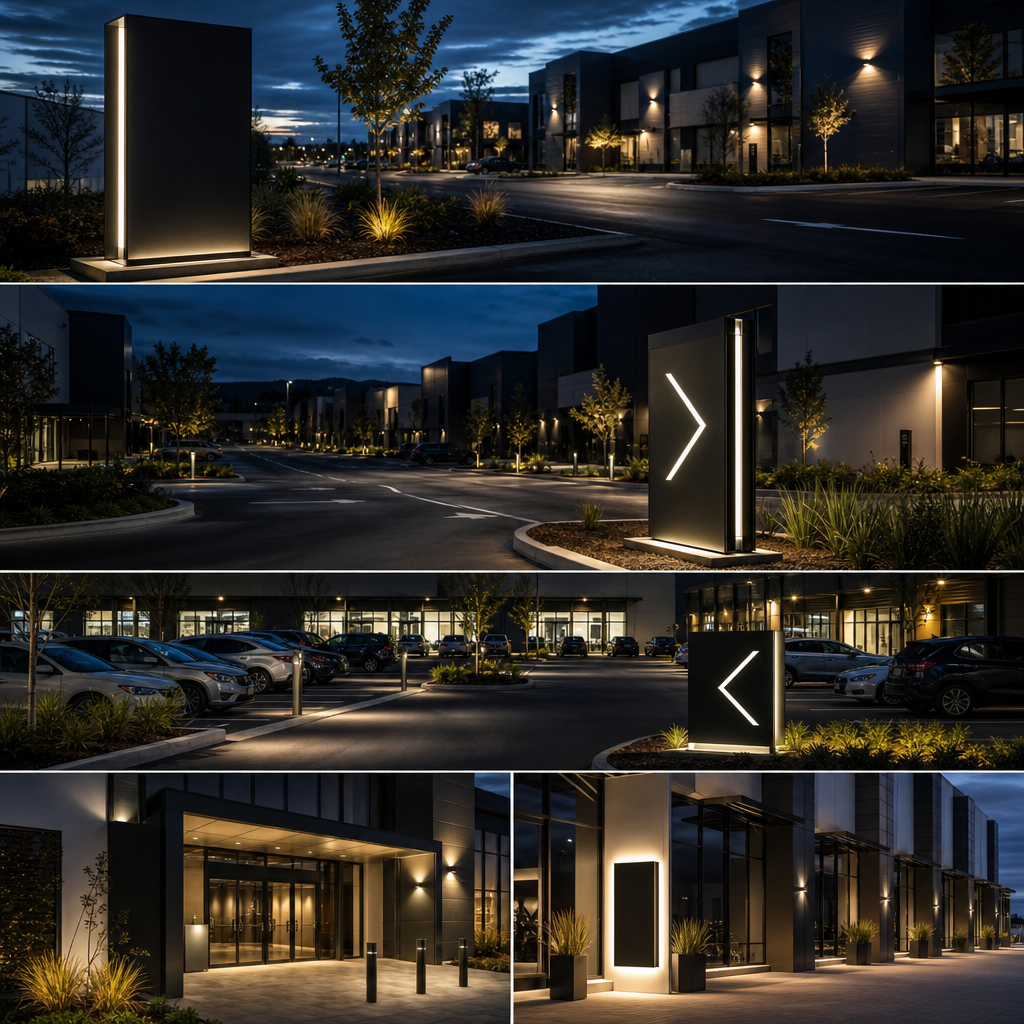
The strongest signage plans use customer decision points as their basic unit, rather than starting with a list of sign products. This changes the planning question from "Which signs should we buy?" to "What must a person understand here?" The result is usually a simpler, more coherent system with less duplication.
Consider a visitor arriving at a shared commercial site. The visitor must first recognise the property, find the correct vehicle entry, locate parking, identify the building entrance and then reach the intended tenancy. Each stage creates a separate information need.
A large building sign cannot compensate for a hidden driveway marker. A polished reception wall sign cannot help someone who entered through the wrong door. Product-first planning misses these gaps because it focuses on items rather than movement.
Map the journey from the visitor's perspective and mark every point where they must choose, confirm or change direction. At each point, ask:
- What does the visitor already know?
- What decision must be made here?
- Which destinations are visible without a sign?
- What is the minimum message needed?
- Can the next sign be seen from the current position?
- What happens if the visitor misses this cue?
This approach also controls visual clutter. If architecture, landscaping or an existing landmark already provides the necessary cue, another sign may add no value. Conversely, a modest directional sign at the right junction can outperform a larger sign installed after the decision has already been made.
References
These sources provide recognised guidance on advertising claims, accessible buildings, planning and public-realm signage. Requirements can change and may differ between jurisdictions. Businesses should check the latest legislation, National Construction Code provisions, Australian Standards, council controls and property conditions applying to their specific site before approving fabrication.
- Australian Building Codes Board, National Construction Code.
- Australian Competition and Consumer Commission, False or misleading claims.
- Australian Government, Disability (Access to Premises - Buildings) Standards 2010.
- Victorian Government, Signs and way-finding.
- PR Newswire, FedEx Office survey reveals most Americans judge businesses by their signs.
FAQ_SCHEMA_JSON
Talk to a signage expert
Tell us about your project and we'll come back with options and honest advice.
Get in TouchFrequently Asked Questions
What should a signage design brief include?
A signage brief should define the audience, objective, required message, proposed location, viewing conditions, brand requirements, materials, illumination, accessibility needs, approvals and installation constraints. It should also identify who can approve artwork and which information may need future updates.
Do Australian businesses need council approval for signage?
Approval requirements vary between councils, planning schemes, properties and sign types. A business may also need landlord, strata, heritage, road authority or building approval. Confirm the pathway with the relevant authority before fabrication, even when an existing sign is being replaced.
How do I choose the right signage material?
Choose materials by assessing location, substrate, weather exposure, desired appearance, maintenance access and expected update needs. External coastal signs require different consideration from internal directories or temporary window graphics. The complete assembly, including coatings, fixings and electrical components, matters more than the face material alone.
What makes business signage easy to read?
Readable signage uses a clear message hierarchy, suitable letterforms, strong contrast, controlled wording and placement matched to viewing distance and angle. Test the design from actual approach routes. Do not assume that artwork readable on a computer screen will remain clear when installed.
How can a business measure signage performance?
Match measurement to purpose. Track location-related enquiries, visits, offer responses, wayfinding questions, wrong turns, maintenance issues and staff feedback. Record when signage changes are installed and consider other marketing or operational changes before attributing an outcome solely to the sign.
When should a signage company become involved?
Involve a signage company during planning, before artwork and site decisions are fixed. Early input can identify substrate, access, approval, illumination and fabrication constraints while changes remain manageable. Waiting until installation often exposes problems that require redesign or additional site work.
Related Articles
Shop Front Signs in Caloundra: Precinct Styles, Coastal Materials, Council Rules and Costs
Pylon Signs in Noosa: Design, Coastal Materials, Council Approvals and Installation
Pylon Signs on the Sunshine Coast: Design, Materials, Approvals and Installation
Signs that set you apart
Over 40 years on the Sunshine Coast. Design, compliance, manufacture and installation handled end to end.
Get a Free Quote