
Transport and Infrastructure Signage Case Studies: How Australian Fleet, Logistics and Civil Operators Sign Their Sites
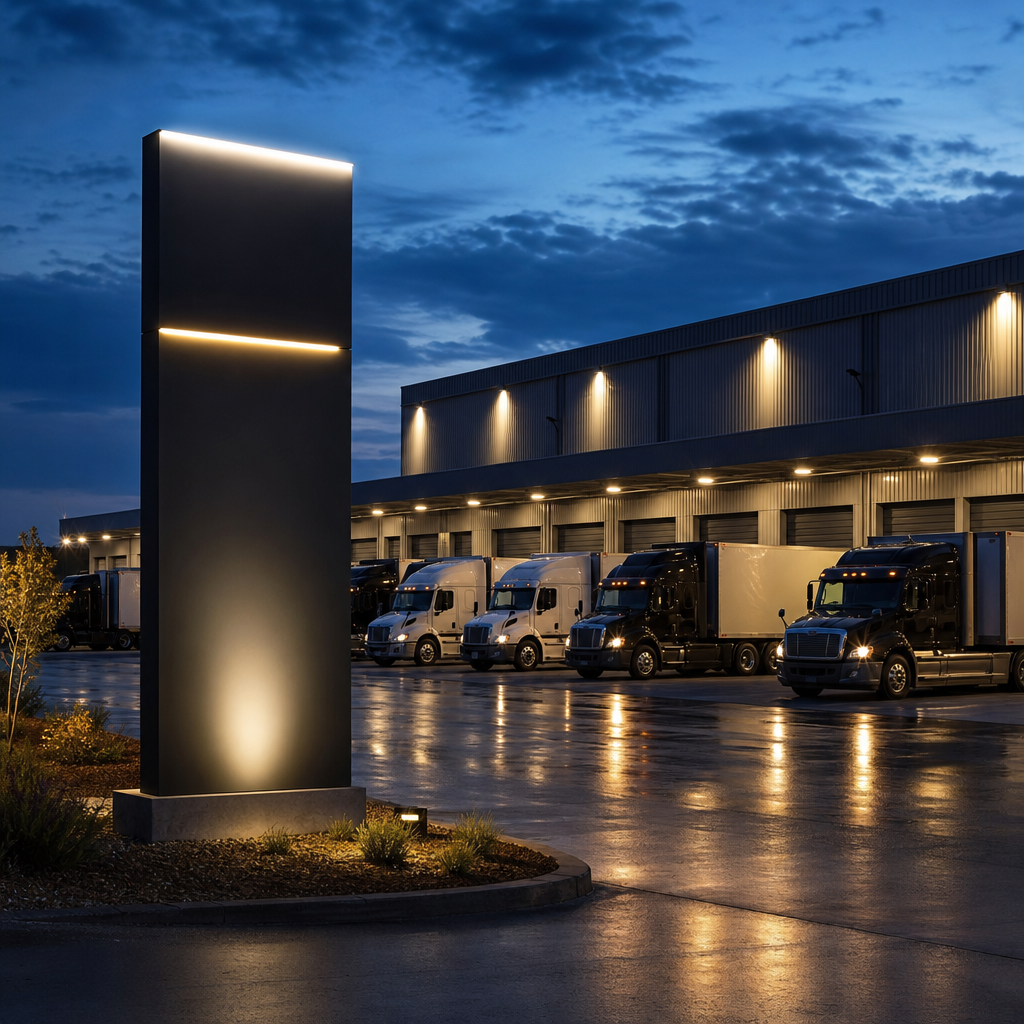
Transport and infrastructure signage case studies show how depots, warehouses, fleets and civil sites use pylon signs, illuminated fascia, wayfinding suites, vehicle wraps and project hoarding to identify sites, guide drivers and keep branding consistent. This covers commercial branding and wayfinding signage only, not statutory road or traffic control signs, which sit in a separate regulated category.
Operations managers, depot supervisors, fleet coordinators and civil project managers rarely think about signage until a new site opens, a driver gets lost in a yard at 4am, or a fleet rebrand stalls halfway through because trucks were wrapped ad hoc over eighteen months. Transport and infrastructure sites are some of the toughest environments in commercial signage: large lots, shift work, unfamiliar drivers, and vehicles that never stop moving.
This article walks through five representative project scenarios, drawing on how Sunquest Signs approaches depot identification, warehouse wayfinding, fleet rebrands and civil site hoarding across Australia. Every scenario is illustrative rather than a specific past client story, but it reflects the real constraints, sequencing and durability decisions that shape these jobs.
Key Takeaways
- Transport and infrastructure signage covers site identification, wayfinding, fleet graphics and hoarding, not statutory road or traffic signs.
- Freight and courier depots need road-visible entry signage plus reflective, high-contrast finishes for night deliveries.
- Warehouse and distribution centre wayfinding relies on dock numbering, laser cut panels and consistent aluminium or acrylic suites.
- Fleet rebrands are almost always staged, not done in one hit, because trucks cycle through servicing and new vehicles join over time.
- Civil and infrastructure sites need signage that moves through temporary, project and permanent stages as the build progresses.
- Installation on live sites has to work around truck movements, forklift traffic and shift patterns, which usually means early mornings or agreed site-cleared windows.
Ready to make your business impossible to miss?
Design, manufacture and installation, all under one roof in Warana.
Get a Free QuoteSummary Table: Signage Needs by Site Type
| Site Type | Core Signage Elements | Typical Project Timeline | Durability Priority |
|---|---|---|---|
| Freight and courier depot | Pylon or entry sign, illuminated fascia, reflective wayfinding | Concept to install: several weeks | Night visibility, weatherproof illumination |
| Warehouse or distribution centre | Dock numbering, aluminium and acrylic wayfinding suite, laser cut and CNC cut panels | Staged, depending on dock and building count | UV-stable materials, forklift-safe mounting heights |
| Fleet rebrand | Full and part vehicle wraps across trucks, vans and utes | Rolled out in batches as vehicles cycle through service | Wrap film durability outdoors, colour match consistency |
| Civil or infrastructure project site | Large-format hoarding, project boards, temporary-to-permanent signage | Matches build stages, from weeks to years | Wind load, site dust, mud and equipment exposure |
Why Transport and Infrastructure Sites Are a Signage Challenge
Transport and infrastructure sites are hard to sign because they combine large physical scale with drivers who are often visiting for the first time, in the dark, under time pressure. A depot yard or civil site has none of the walk-in foot traffic a retail shopfront relies on, so the signage has to do all the orientation work on its own.
Consider the difference between a suburban shopfront and a logistics depot. A shopfront customer walks a few metres from the footpath. A courier driver arriving at an unfamiliar depot at 5am has to find the right gate, the right dock, and the right check-in point, often while towing a trailer and reading a phone screen for the booking reference. Get the entry sign or the dock numbering wrong and that driver either blocks the yard or turns up at the wrong bay, which costs the depot real time on a tight schedule.
Civil and infrastructure project sites add another layer of difficulty: the site itself changes shape over the life of the build. A vacant lot becomes a hoarded construction zone, then a live works site with staged access points, then eventually a finished asset with permanent identification. Signage that only serves one of those stages is signage that has to be replaced two or three times instead of planned as a single evolving system.
Night operations compound all of this. Freight and courier networks run heavily outside daylight hours, and reflective or illuminated signage is not a nice-to-have on these sites, it is the difference between a driver finding the entrance and driving past it twice.
Case Study: Freight and Courier Depot Identification
A freight or courier depot needs signage that is visible from the road, legible at night and tough enough for constant truck movement. The core kit is a pylon or entry sign for road-side identification, illuminated fascia branding on the depot building, and reflective, high-contrast wayfinding for after-dark deliveries and driver check-in.
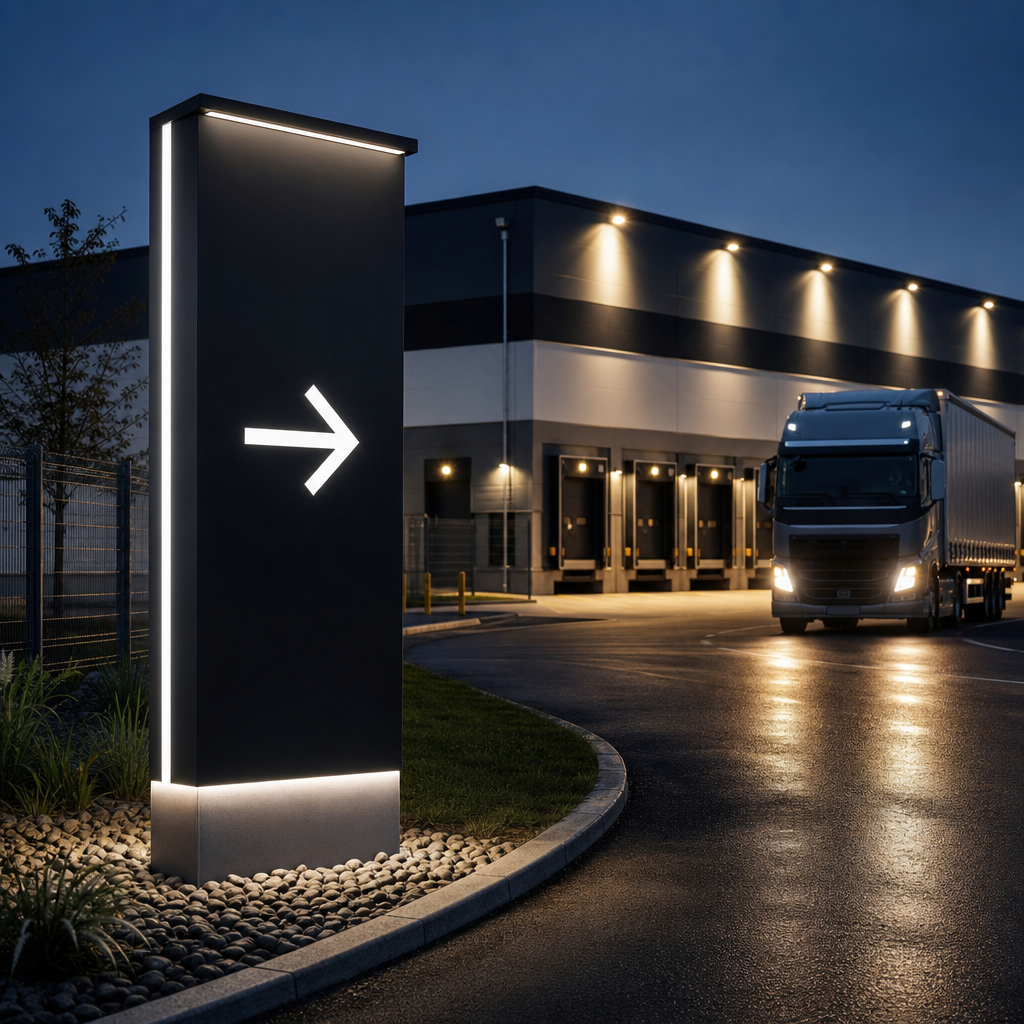
Imagine a regional courier depot on a busy arterial road, running a mixed fleet of vans and rigid trucks across two shifts. Drivers passing at highway speed need to identify the entrance well before the turn-off, which is why a pylon sign positioned close to the road boundary, with the depot logo and a clear "Deliveries" or "Driver Entry" callout, does more work than fascia signage on the building itself. Illuminated fascia signage on the depot frontage then carries brand recognition for daytime visibility and after-dark identification once the pylon has done its job of pointing the driver toward the right gate.
Inside the yard, reflective and high-contrast directional signage takes over. Numbered bay markers, one-way arrows and "Check In Here" signage in reflective vinyl or with integrated lighting keep drivers moving safely without needing yard staff to manually direct every arrival. For a depot running deliveries around the clock, this reflective finish is not cosmetic. It is the reason a driver in an unfamiliar truck can navigate a dark, wet yard at 11pm without guesswork.
Durability matters as much as visibility here. Depot signage sits in direct exposure to diesel exhaust, dust, UV and, in many parts of Australia, genuine heat extremes. Materials and finishes need to hold their colour and legibility for years, not months, which is why aluminium panels, powder-coated frames and commercial-grade vinyls are the default rather than the exception on these builds.
Case Study: Warehouse and Distribution Centre Wayfinding
Warehouse and distribution centre wayfinding depends on a consistent suite: dock numbering, directional signage for driver check-in, and internal wayfinding that guides forklifts, staff and visiting trucks to the right zone. Laser cut and CNC cut panels give sharp, durable dock numbers and logos that hold up under constant loading dock traffic.
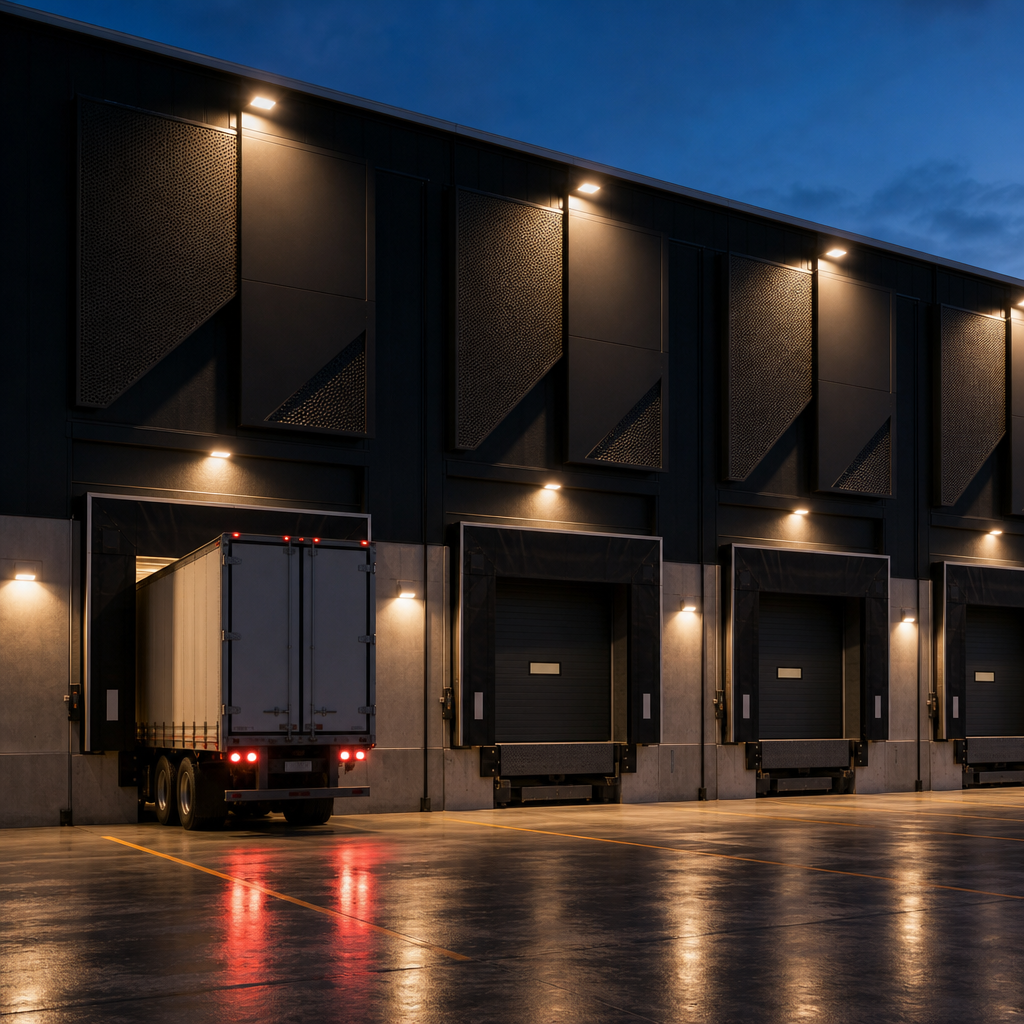
Picture a distribution centre with twenty loading docks spread across two buildings on one site. Every dock needs a large, legible number visible to a truck driver reversing in, plus a matching number at ground level for forklift operators working inside. Aluminium and acrylic wayfinding suites, cut with CNC or laser cutting equipment for crisp edges and consistent sizing, keep every dock marker looking identical whether it is dock 3 or dock 23. That consistency matters more than it sounds: a driver who has learned to trust the numbering system at one facility expects the same clarity at every dock, every time.
Driver check-in signage is the second half of the system. A clearly marked check-in point, ideally visible from the site entrance, reduces the number of trucks idling in the wrong lane while a driver works out where to report. Directional arrows, height clearance signage for canopy areas, and pedestrian crossing markers inside the yard round out a wayfinding suite that has to work for three very different audiences at once: truck drivers, forklift operators and site visitors.
For sites running multiple buildings or staged expansions, wayfinding suites are usually planned as a single specification applied in stages. New docks or buildings get signage that matches the existing suite exactly, rather than each addition becoming its own mismatched project.
Case Study: Staged Fleet Vehicle Wrap Rebrand
Fleet rebrands almost never happen in a single weekend. A staged rollout of vehicle wraps and part-wraps across trucks, vans and utes lets a transport company update its look without pulling every vehicle off the road at once, while colour matching keeps new arrivals visually consistent with the existing fleet.

Consider a transport company running a mixed fleet of forty vehicles, from rigid trucks down to service utes, with a new brand identity to roll out. Wrapping all forty vehicles simultaneously would take the entire fleet off the road, which is rarely workable for a business that needs trucks moving every day. The realistic approach is a staged rollout: vehicles are wrapped in batches as they come up for scheduled servicing or downtime, so the fleet transitions over weeks or months rather than stopping operations.
Part-wraps are common on this kind of job, particularly on service utes and smaller vans where a full wrap is not always the most cost-effective option. A well-specified part-wrap still carries the logo, contact details and brand colours clearly, and can be applied faster per vehicle, which matters when a fleet coordinator is juggling wrap scheduling against delivery rosters.
Colour matching is the detail that makes or breaks a staged rebrand. If a fleet is rolled out over six months and new trucks join the roster partway through, every wrap needs to reference the same colour specification and film batch characteristics as the first vehicles wrapped, otherwise the fleet ends up with visibly inconsistent shades sitting side by side in the yard. This is one area where a documented specification, agreed once at the start of the project, saves a transport operator from an inconsistent-looking fleet twelve months down the track.
Outdoor durability is the other constant question. Vehicle wraps on trucks running Australian conditions face UV exposure, highway speeds and regular washing, so film choice and lamination matter as much as the artwork itself.
Case Study: Civil and Infrastructure Project Site Signage
Civil and infrastructure project sites need signage that evolves through the life of the build: large-format printed hoarding and project boards during construction, followed by a transition to permanent site identification once the asset is complete. Planning for that transition from day one avoids paying for the same information twice.
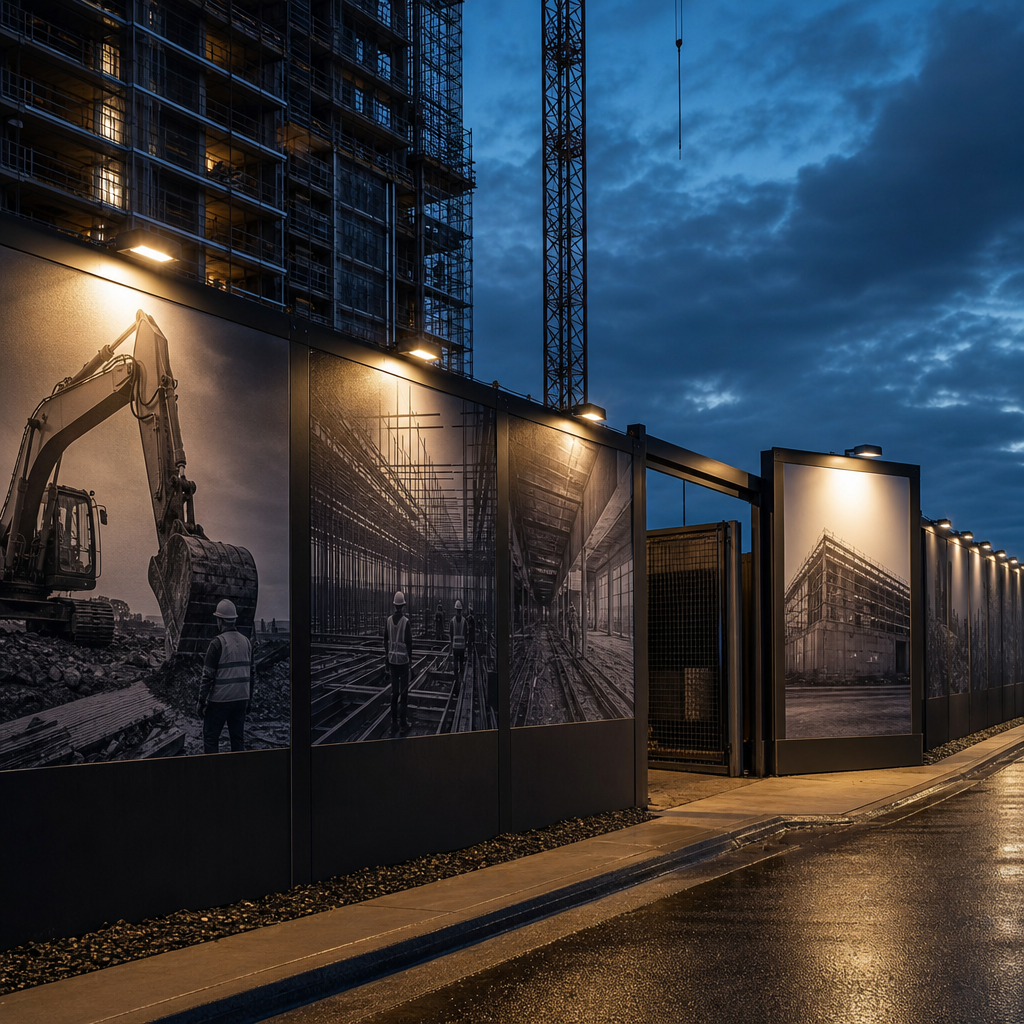
Imagine a civil contractor starting a multi-stage infrastructure project that will run for over a year. Early in the project, large-format printed hoarding wraps the site perimeter, carrying the contractor's branding, project name, safety messaging and any funding or partner logos required for the job. Project boards near the site entrance carry more detail: project timeline, contact information, and any community notices relevant to nearby residents or businesses.
As the build progresses through different phases, that hoarding often needs updating rather than replacing outright. A well-planned hoarding system uses a base structure that can carry new printed panels as milestones change, which is considerably more cost-effective than re-hoarding the entire perimeter every time the messaging updates.
Once the project nears completion, the temporary hoarding and project boards give way to permanent signage: site identification, wayfinding for the finished facility, and any statutory or safety signage required for ongoing operation. Planning that transition as part of the original signage brief, rather than as an afterthought once construction wraps up, avoids a gap where the finished site has no identification at all.
The Process Behind Every Transport and Infrastructure Signage Job
Every depot, warehouse, fleet or civil signage project runs through the same core process: a site survey and measurement visit, permit and approval management where councils or landlords are involved, installation scheduled around live site operations, and ongoing repair and maintenance once the signage is in place.
Site surveys and measurement come first, and on transport and infrastructure sites this step matters more than it does on a standard retail job. A depot yard, warehouse or civil site has obstacles a shopfront never does: overhead power lines, forklift traffic lanes, height clearance limits for trucks, and ground conditions that affect how a pylon sign footing is engineered. Getting accurate measurements and site conditions early avoids costly rework once fabrication is underway.
Permit and approval management follows, particularly for pylon signs, large-format hoarding and anything installed near a road boundary or on a site subject to council development conditions. Civil project sites in particular often carry specific conditions from the relevant planning approval that dictate hoarding size, placement and content, so this step is not optional paperwork, it directly shapes what can be built and where.
Installation is where the operational reality of a live transport site bites hardest. Consider a depot yard running continuous truck movements across two shifts, where an installation crew needs to mount an illuminated fascia sign above the loading area. Working around forklift traffic and reversing trucks safely usually means scheduling the lift and fixing work for an early morning window before the first trucks arrive, or negotiating a short site-cleared period with the depot manager. Out-of-hours and weekend installation is common on these jobs precisely because a yard rarely has a genuinely quiet daytime window. Height access, whether via elevated work platform or scaffold, adds another layer of planning where overhead services or truck clearance heights are involved.
Repair and maintenance is the step operators most often overlook when budgeting a project. Exposed industrial sites are hard on signage: UV fading, physical impact from forklifts or reversing vehicles, and weather exposure all take a toll over years of use. Building a maintenance check into the ongoing relationship, rather than waiting until a sign fails, keeps depot and warehouse signage looking and functioning as intended well beyond the first year.
Why Wayfinding Gets Skipped While the Front Gate Gets All the Budget
In my experience specifying signage for transport and logistics operators, the entry sign and the fascia branding almost always get funded first, while internal wayfinding gets treated as an optional extra. That is backwards, because the entry sign only has to convince one type of visitor once: it gets a driver through the gate. Everything after that, dock numbering, check-in points, internal directional signage, has to work for every driver, every shift, every day.
The pattern I see repeatedly is a depot or distribution centre that has invested heavily in a striking pylon sign and illuminated fascia, then relies on printed A4 laminated sheets taped to a wall for dock numbering. It looks inconsistent, it fades within months in direct sun, and it does nothing for the brand impression a driver forms once they are actually inside the yard. A driver's overall impression of a business is shaped as much by whether they found the right dock without confusion as by how sharp the entry sign looked from the road.
My view is that wayfinding budget should be treated as equal to frontage budget on any transport or logistics site, not as the leftover line item. A depot that gets this right spends proportionally more on aluminium and acrylic wayfinding suites relative to its pylon sign than most operators expect, and the payoff shows up in fewer driver phone calls to the site office asking where to go.
References
- Austroads, national transport and road agencies association, publisher of guidance relevant to signage and wayfinding on transport corridors.
- Safe Work Australia, national work health and safety body, relevant to signage requirements on active construction and depot sites.
- Standards Australia, publisher of Australian Standards including AS 1428 series covering accessible design, relevant to wayfinding signage specification.
- Australian Bureau of Statistics, national statistics agency covering the transport, postal and warehousing sector as part of Australian industry data.
Ready to sort your depot, wayfinding or fleet signage? Book a site survey with Sunquest Signs and request a staged quote covering entry signage, internal wayfinding, fleet wraps or project hoarding for your site.
Talk to a signage expert
Tell us about your project and we'll come back with options and honest advice.
Get in TouchFrequently Asked Questions
What is the difference between transport signage and statutory road signage?
Transport and infrastructure signage covers site identification, wayfinding, fleet graphics and project hoarding, all commercial branding elements. Statutory road and traffic control signs are a separate regulated category governed by road authorities and are not part of this scope.
How long does a depot signage project take from survey to installation?
Timelines vary with scope, but a typical depot project runs from an initial site survey and measurement visit through design, permit checks where required, fabrication and a scheduled installation, usually spanning several weeks depending on approvals and site access.
Can vehicle wraps be rolled out in stages as our fleet grows?
Yes, staged rollouts are the standard approach for fleets of any meaningful size. Vehicles are wrapped in batches around servicing schedules, with a documented colour and specification reference used throughout so new vehicles match the existing fleet exactly.
What signage do civil construction sites need before and after the build?
During construction, sites typically need large-format printed hoarding and project boards carrying branding, safety messaging and project details. As the build nears completion, this transitions to permanent site identification and wayfinding signage suited to the finished facility.
How durable is signage for exposed industrial and yard environments?
Materials matter more than in sheltered retail settings. Aluminium panels, powder-coated frames, UV-stable vinyls and commercial-grade wrap films are chosen specifically to handle sun exposure, dust, impact and weather over years of use, with a maintenance plan extending that lifespan further.
Do we need council approval for depot or site signage?
Often yes, particularly for pylon signs, large hoarding near road boundaries, or anything on a site subject to development conditions. Permit and approval management should be handled as part of the project rather than assumed to be unnecessary.
Related Articles
Sunshine Coast Signage Project Gallery: Real Local Sign Installs by Suburb and Sign Type
Signage in Caboolture: Sign Options for CBD, Morayfield and Industrial Businesses, Council Rules and Costs
Signage in Nambour: Sign Options for CBD, Heritage and Industrial Businesses, Council Rules and Costs
Signs that set you apart
Over 40 years on the Sunshine Coast. Design, compliance, manufacture and installation handled end to end.
Get a Free Quote